Nation Interview: Shawn Fain on Volkswagen and the UAW’s Southern Strategy
“Nation” Interview: Shawn Fain on Volkswagen and the UAW’s Southern Strategy
“These companies are more profitable than the Big Three ever dreamed of being, and the workers are paid even less.”
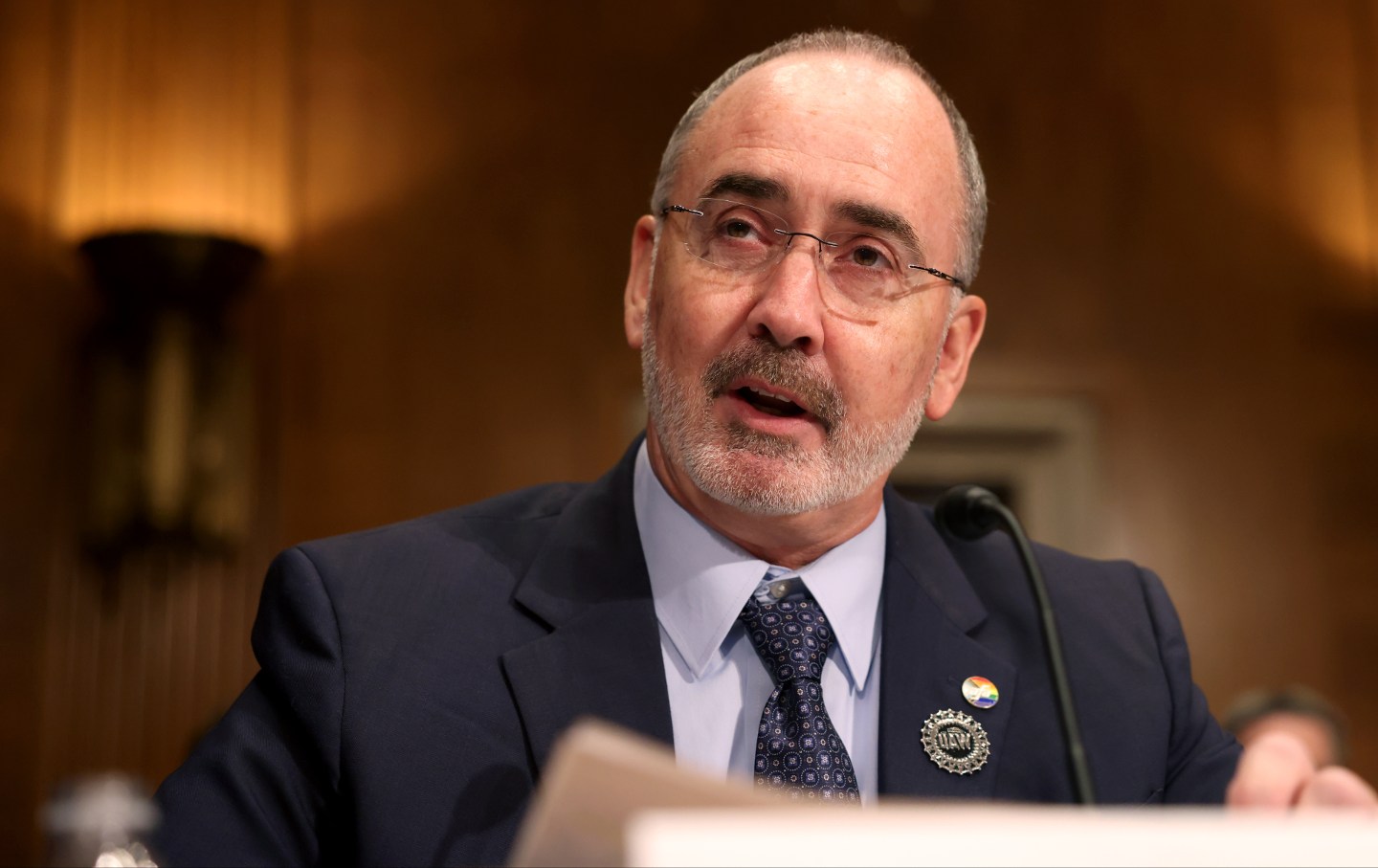
Shawn Fain testifying before Congress on March 14, 2024.
(Tierney L. Cross / Bloomberg via Getty Images)“Volkswagen family, welcome to the UAW family,” declared United Auto Workers union president Shawn Fain Friday night, after workers at the Volkswagen factory in Chattanooga, Tennessee, voted 2,628 to 985 for union representation. The overwhelming vote was a groundbreaking victory for the UAW at a foreign-owned plant in the historically hard-to-organize South.
In an interview conducted before the vote, Fain and I had an extended discussion about where the union is headed, including why winning at Volkswagen is crucial for organizing plants across the South and nationwide. We also discussed the broader struggle to organize non-union automakers in the US—such as Elon Musk’s Tesla plant in Fremont, California. This transcript has been lightly edited for length and clarity.
John Nichols: When the UAW strike against the Big Three succeeded, a lot of people were paying attention to what the union would do next. You signaled that the UAW was determined to organize the whole of the auto industry—to go after those Southern plants that are owned by foreign corporations, which has always been tough, and ultimately to take on Tesla.
Shawn Fain: People said we could never organize in the South. We hit 50 percent at Volkswagen [in early February] and then later in the month [reached 50 percent of workers] at Mercedes-Benz’s [Vance, Alabama, plant]. This goes back to something that’s not being talked about. Since [the Big Three victory] happened, since these workers have seen the difference a union makes, they want their share. These companies are more profitable than the Big Three ever dreamed of being, and the workers are paid even less. The exploitation of these workers is five times what it was in the Big Three. Workers are figuring that out now—they’re seeing the reality of that. And, already, because of this success, you’ve seen the state of Alabama, their Chamber of Commerce, their governor, coming out in opposition. They formed a new thing called “Alabama Strong,” where they’re trying to turn workers against the unions.
JN: There’s a long history of powerful political and economic interests in these Southern states seeking to block unions.
SF: You had Nikki Haley out there saying, as governor, “If you’re union, you’re not welcome in South Carolina.” They’re trying to pass [new anti-union] laws. They did it in Tennessee, they’re trying to do it in Georgia now, where if a company agrees to card-check authorization for unions, the company won’t get any funding from the state. They try to say that [getting workers to sign union cards] is the union strong-arming members. The union doesn’t strong-arm anybody into signing a union card. That’s a personal decision somebody makes. But what they don’t talk about is how the companies break the law every day with these employees. They hold captive-audience meetings. They threaten them. They threaten that they’re going to close their plant if they unionize. They threaten that they’ll send the jobs to Mexico. They break the law repeatedly and nothing happens.
JN: The companies create a circumstance where it’s often an act of courage to sign a union card. They have whole strategies to scare workers away from joining a union, yet they try to claim that the union is intimidating workers.
SF: That’s the arm-twisting. That’s the bullying that goes on. It comes from the company. The days when they put that [union bullying] narrative out there are going to be over. The bullying and the arm-twisting is a one-party thing—it’s on the side of the companies and the billionaire class. And that’s got to stop. We have to have laws in place that hold these companies accountable when they do break the damn law. When working-class people break the law, they go to jail. They have consequences. There aren’t consequences for these companies, and it’s got to stop.
JN: But you won’t get laws that stop it unless more supporters of unions are elected.
SF: That goes back, again, to the two candidates for president. Donald Trump was president, what did he do? He put an anti-union union buster as the head of the National Labor Relations Board, and we went backward. They killed the organizing drive at Volkswagen at that time.
With President Biden, labor’s going to have more favorable people in there. They’re going to work for working-class people. All these things come back to politics, and it comes back to the fact that working-class people need to look out for their interests. It all ties together.
JN: There are a lot more people to organize in the South. Then there’s Elon Musk and Tesla. When the UAW takes on Tesla, it’s really taking on the billionaire class, right? As regards setting the narrative for America, that’s a big deal.
SF: Look, Tesla’s in the same place on the radar as everybody in the South is. It’s not favoring one over the other. We’re prioritizing where momentum is at the current time and we’re focusing there and we’re going to keep building it. I firmly believe once the first domino falls, you’re going to see the floodgates open. Because people are going to realize the benefit of being in a union.
Update, 4/20/24: This piece was updated to reflect the UAW’s victory at the Volkswagen plant.