AIDS Denialism Is Back. We Can’t Let It Take Root.
Joe Rogan, RFK Jr., and others are pushing long-discredited conspiracy junk about HIV and AIDS. Here’s how we should deal with them.
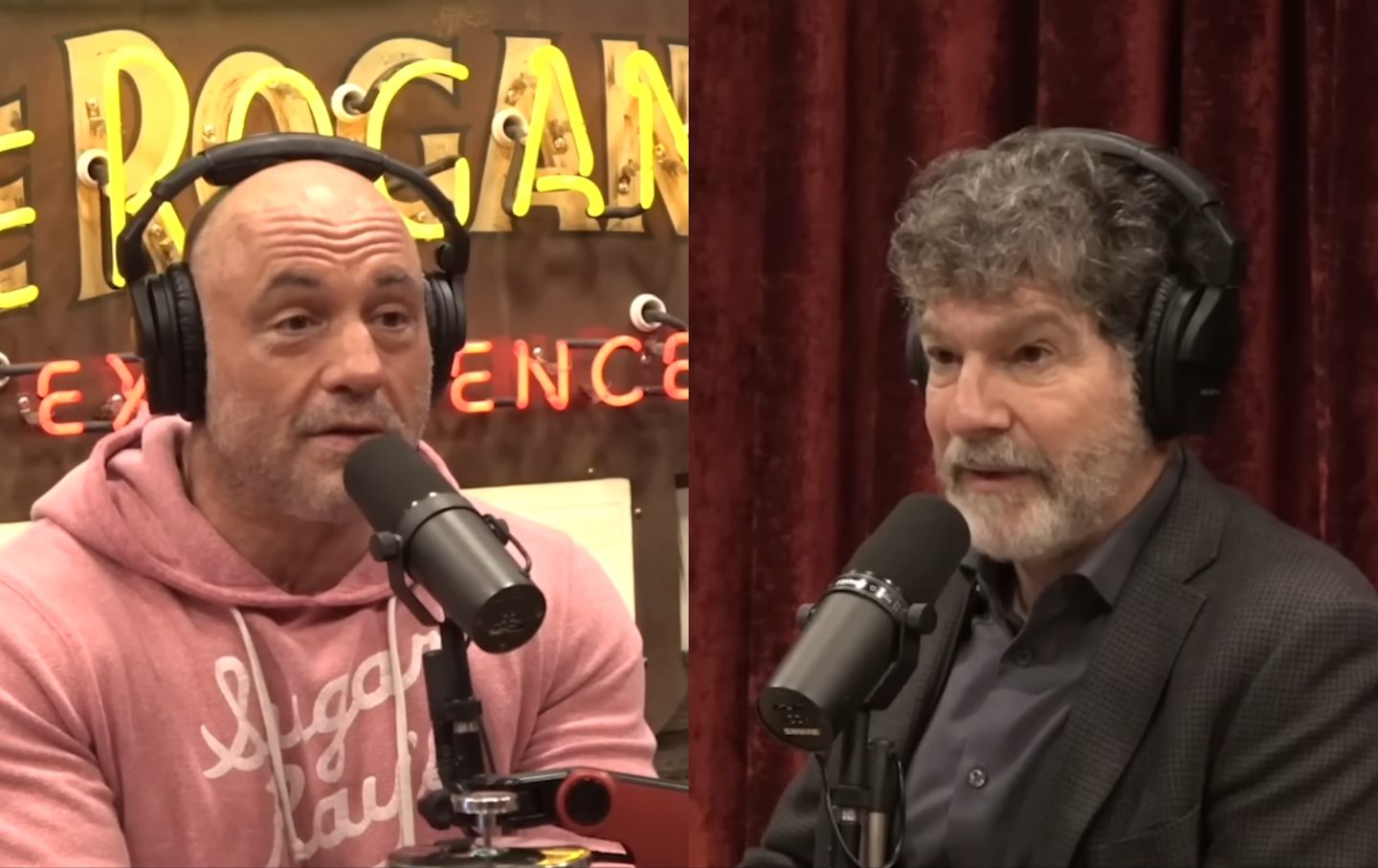
Joe Rogan and Bret Weinstein
(YouTube)Every epidemic spawns conspiracy theories. I grew up swatting away claims that HIV didn’t cause AIDS and that antiretroviral drugs were poison. Because, yes, there were people long ago, a small coterie including magazine writers, scientists from other fields, and Nobel laureates gone to seed who decided that the mass of scientific evidence was wrong and that everything from amyl nitrate to jizz to AIDS drugs themselves was responsible for a worldwide pandemic.
Conspiracies can kill. When South African President Thabo Mbeki, decided that these “alternative facts” were indeed true after too many late-night sessions surfing the Internet on Netscape in the late 1990s, he brought his country’s medical response to HIV/AIDS to a screeching halt. A Harvard study suggested that thanks to President Mbeki’s policies “more than 330,000 people died prematurely from HIV/AIDS between 2000 and 2005…and at least 35,000 babies were born with HIV infections that could have been prevented.” A group of us back then—people living with HIV, activists, and scientists—gathered to combat this nonsense under the banner of a website called AIDSTruth. After Mbeki lost the reins of power in 2008, South Africa’s policies shifted and the country now has the largest antiretroviral therapy program in the world. In 2015, AIDSTruth decided to mothball the website, as AIDS denialism was now history.
Plus ça change. It’s now 2024 and AIDS denialism is back, this time advanced by Joe Rogan, Bret Weinstein, and the least of the lesser Kennedys, RFK Jr. Not satisfied with their promotion of Covid conspiracies and anti-vax hysteria—which, judging by the continued spread of Covid and childhood infections like measles, has been a big success—this sad little trio has turned its attention to an even older set of myths. Weinstein, a professor-turned-crank with a depressingly large following, went on Rogan’s podcast recently and disseminated long-discredited junk about what causes HIV and AIDS. Where did he get these ideas? From RFK Jr., of course.
I don’t have time to delve into the psychology and politics of AIDS denialism—though it contains more than a little bit of racism, homophobia, and antisemitism—but I recommend Seth Kalichman’s Denying AIDS: Conspiracy Theories, Pseudoscience, and Human Tragedy and Nicoli Nattrass’s Mortal Combat: AIDS Denialism and the Struggle for Antiretrovirals in South Africa to those interested in understanding its domestic and global roots and impact.
All these years later, it’s questionable how much of an impact the new AIDS denialists will have. But there is also the question of how scientists and the rest of us should respond to denialism. Pascal Diethelm and Martin McKee have a wonderful article on this in the European Journal of Public Health from 2009, which discusses how to address denialism in all its manifestations from AIDS, to evolution, to climate change.
Diethelm and McKee suggest that it is natural for scientists to want to debate, to test the proposed hypotheses and weigh the evidence, but warn that denialists don’t play by the rules of scientific discourse and will move the goalposts in any debate and deploy other strategies to subvert any kind of sincere engagement. They recommend instead naming denialists for what they are and pointing out their well-worn tactics: introducing conspiracies, enlisting fake experts, selectively using the scientific literature, raising the burden of proof so high that no real scientific work could offer answers on the topic at hand, by invoking logical fallacies and outright misrepresenting the facts.
Denialism—like the Great Barrington Declaration and its offspring spawned during our most recent pandemic—isn’t healthy iconoclasm, and it’s not going to wilt in the face of scientific peer review. If it did, creationists would have stopped trying to get universities to “teach the controversy” about evolution a long time ago (and just to be clear, there is absolutely no controversy at all where evolution is concerned). Denialists and conspiracists simply get stronger by being indulged. As scientists, we cannot fall into that trap and raise up pseudoscience in an exercise of false equivalence, as tempting as it may be for some.
But my greatest fear right now is that we are about to get our own taste of Thabo. Donald Trump has come out blazing against routine childhood vaccinations with remarks in Virginia a few days ago that suggest he would defund schools that require vaccines for children, which include mumps, measles and rubella, polio, and chickenpox.
Given we have a measles outbreak in Florida brought to us by the denialism of Ron DeSantis and his surgeon general, Joe Ladapo, the prospect of this kind of deadly quackery going national is not theoretical speculation: As goes Florida, so goes the nation under a new Trump presidency. Trump already dabbled in his own unhinged theories in 2020—remember injecting bleach as a Covid treatment? What would be on offer in 2025? I shudder to think about it.
If scientists should push back on denialism and call it out in our disciplines, we have a different responsibility in the public arena. Thabo Mbeki and his cabal of AIDS denialists, including his health minister Manto Tshabalala-Msimang (who recommended beetroot, garlic, and ginger to treat HIV!), were defeated by the brave activists of the Treatment Action Campaign, in alliance with a broad spectrum of South African civil society, from scientists to the clergy. This election year, we need to learn from their example.
Those of us in public health and clinical medicine need to lead a campaign to ensure that Donald Trump does not get elected and that the Weinsteins, Rogans, and RFK Jr.s of the world do not gain an even bigger foothold. This isn’t partisan—it’s about the politics of public health Trump and his allies hold, which are hazardous to our health. What’s at stake is the health of the nation. There’s no more time for sitting on the sidelines.