How DEI Programs and Liberal Politics Are Failing Gaza
Diversity, equity, and inclusion programs, as they exist in education, are failing, because they emphasize personal feelings over the need to collectively organize.
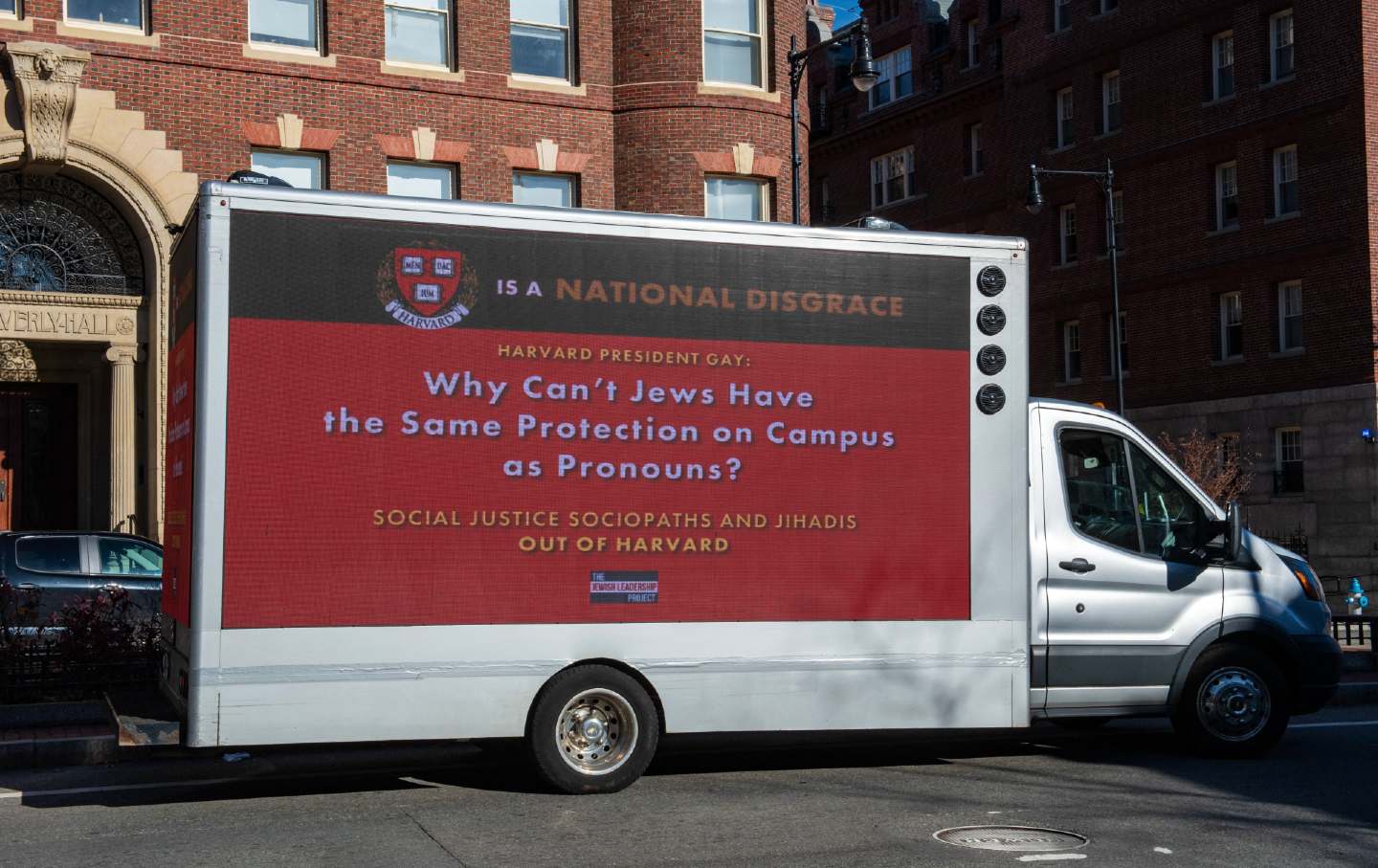
A truck carrying a sign calling the president of Harvard a disgrace drives around Harvard University in Cambridge, Mass., on December 12, 2023.
(Joseph Prezioso / AFP)The operative word in high school and college faculty meetings is fear. If you say anything about Gaza, if you criticize the Israeli military or display any anguish about an ongoing genocide, you risk retribution. For many teachers, there is an even greater fear of raising the issue of Gaza in class, where a student armed with a cell phone camera could brand you as an antisemite to the administration and beyond. So the default choice is usually silence.
Students are then too often left to figure it all out on their own. One veteran high school teacher told me, “This is like something I’ve never experienced. You are scared to breathe. After 9/11 and then after the start of the Iraq War, we were leading conversations about war and its history across the school. As teachers, we weren’t perfect but we never thought that if we said a wrong word or if a discussion went off the rails, we could pay for it with our careers. So our kids are left without guidance.”
This fear has stifled conversations about why a chief ally of the United States is using US-made weapons to bomb an already deeply impoverished civilian population. The question is where this fear comes from and how can we stand up to it?
The first part that must be acknowledged is that this fear is based in the reality of a new McCarthyism. There is a middle school teacher in my liberal community that was suspended for using the Palestinian independence slogan “From the River to the Sea” as a tagline on an e-mail. The redefining of that popular phrase as something antisemitic and even exterminationist has been a propaganda coup for those who defend the shelling of Gaza.
There is also a 14-year-old Muslim student in my city who was doxxed with her photo pasted on walls across her high school campus with the words “antisemite” under her face because she posted a cartoon on Instagram. (I’m not describing the details of the frankly tame cartoon, to protect her anonymity.) Her picture and that of her family were then pasted up on the surrounding streets. The school’s response? To suspend her until she takes a special course called “social media ethics.” (The civil liberties attacks on high schoolers since October 7 has gone underreported.)
College students also feel under a microscope with administrators banning clubs, canceling rallies, and trying to enforce campus placidity rather than inquiry. A few college presidents are now on the unemployment line because they—quite clumsily, one must say—refused to bend the knee before rabid Trumpists in Congress. The resignation of Claudine Gay as president of Harvard has both AIPAC and anti-Black racists crowing. It feels like any statement, any question, any protest of Israel’s military incursion will be met with a fusillade of poisonous accusations. Across all levels of education, heads are down, and mouths are understandably shut.
But fears of heavy-handed punishment are not the only factor stifling discussion. Diversity, equity, and inclusion (DEI) programs that train faculty in both secondary school and higher ed must be also held to account. DEI is proving to be woefully inadequate as a project to challenge a brutal and, yes, racist war
The right wing is trying—and often succeeding—to ban DEI departments and other programs that discuss the realities of oppression in the workplace and beyond. The first act of Governor Ron DeSantis and his baldly racist apparatchik Christopher Rufo in their hostile takeover of the New College of Florida was to abolish the school’s DEI department. These programs should be defended because they strive to create space to discuss societal inequity and are in the crosshairs of the radical right. But defending these liberal DEI programs from statehouse goons should never be the same as endorsing them as a method to fight racism.
DEI, as it exists in most institutions, holds sacred, in the words of one teacher, “the idea that all experiences are valid and your personal pain or trauma must be centered and validated.” This fails Gaza on multiple fronts. First, it provides a false equivalency that allows supporters of Israel to speak about feeling attacked whenever so much as a Palestinian flag is displayed on a Trapper Keeper. The DEI process provides space for people to claim that any critique of the Israeli state rises to the level of antisemitism. In many DEI circles, the weaponization of the charge of antisemitism has proven to be effective. An individual’s feelings that a criticism of Israel is antisemitic is often weighed as a view just as valid as those of people distressed by the IDF’s shelling of Palestinian civilians. But it’s not just about process. DEI arises from mainstream liberal politics, a cornerstone of which for decades has been to be progressive except for Palestine. In the face of this, when the choice is silence or being branded an antisemite, it’s understandable why fear would rule the day.
DEI also fails this moment because its emphasis on the personal steers people away from the political discussions that schools need to be having. We need students and teachers talking about why this story does not begin on October 7, why Palestinian lives are so devalued in this country, and why the United States relentlessly supports this war over global objections. And yet a combination of ruthless donors, anxious (to be kind) parents, and nervous administrators are thwarting these critical discussions right when we need them most. Clearly we should demand diversity, equity, and inclusion, but we also need a deeper kind of anti-racist education and practice. DEI programs may look at structures of power, but, because DEI is rooted in the politics of mainstream liberalism, they rarely analyze how to challenge or transform them. Without that, DEI programs mostly become just conversation.
The solution lies in something far easier said than done: collectively organized courage. During McCarthyism, it was the small acts of a brave few in education that first punctured its power. Today we don’t just need similar heroes willing to break the silence. We need networks of support and solidarity. The moment demands organization, open speech, and love for the Palestinian people. The alternative is we go about our lives as if everything is normal: haunted with the knowledge that future generations will ask why we did nothing.