
How a Leading Definition of Antisemitism Has Been Weaponized Against Israel’s Critics
Pro-Israel groups have used the examples attached to the IHRA definition of antisemitism to silence dissent about Israel’s attacks.
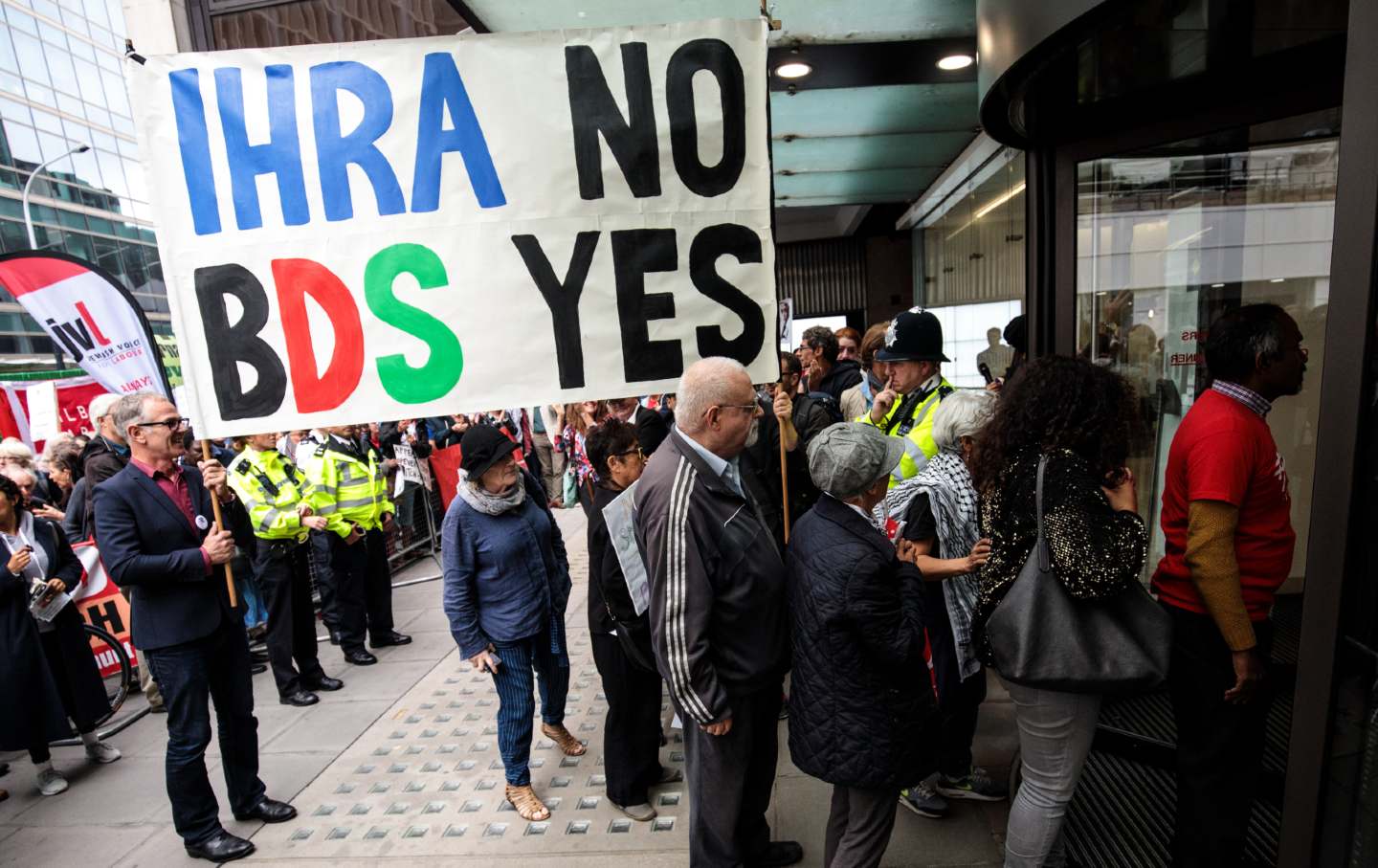
Protesters demonstrate outside a meeting of the National Executive of Britain’s Labour Party on September 4, 2018, in London, England. Labour’s NEC meets today to vote on whether to adopt the full International Holocaust Remembrance Alliance definition of antisemitism.
(Jack Taylor / Getty Images)Americans across the country have joined mass protests demanding a cease-fire to Israel’s siege of Gaza following Hamas’s October 7 assault on Israel. College students are conducting sit-ins, protests, and teach-ins reminiscent of the Vietnam anti-war movement. The chorus of criticism of Israel’s indiscriminate bombings and denial of food, water, and other humanitarian aid to 2 million Palestinians trapped in Gaza has only grown louder as the Palestinian death toll has skyrocketed beyond an estimated 22,000, nearly half of whom are children.
Too often, however, supporters of continued military action by Israel respond not by debating the merits of a cease-fire but through McCarthyistic campaigns to silence human rights advocacy in public and on college campuses.
Among the most effective strategies of censorship is a politically motivated expansion of what constitutes antisemitism to conflate it with criticism of Israel’s policies and practices.
In 2016, member states of the International Holocaust Remembrance Alliance (IHRA) adopted a working definition of antisemitism, defined as a “certain perception of Jews, which may be expressed as hatred of Jews” through both words and actions.
IHRA developed the definition to help guide and evaluate research and law enforcement data before being used to educate the public about the Holocaust and antisemitism. Governments and institutions, in turn, have adopted the definition to help combat antisemitism.
Some pro-Israel groups, however, increasingly use the IHRA definition not to address antisemitism but to silence critics of Israel. While attempting to define antisemitism is a laudable goal, the IHRA’s version includes two examples, out of 11, that have been exploited to censor speech. Specifically, the first example is “denying the Jewish people their right to self-determination; e.g., by claiming that the existence of a State of Israel is a racist endeavor”; and the second is “applying double standards by requiring of [Israel] a behavior not expected or demanded of any other democratic nation.” These examples are often interpreted, including by government and university officials, as allowing the penalization of speakers, including Jewish groups, critical of Israel’s anti-Palestinian policies, laws, and practices.
As Human Rights Watch noted, the first example opens the door to reflexively labeling as antisemitic human rights organizations and lawyers who argue that current Israeli government policies constitute apartheid against Palestinians or that Israel’s founding involved ethnically cleansing “the Land” (Ha’Aretz) of hundreds of thousands of Palestinians in the Nakba. The second example permits labeling as antisemitic anyone who points to abuses by Israel when worse abuses are being committed elsewhere. Extending this logic would make a person who criticizes China for committing crimes against humanity against the Uyghurs an anti-Chinese racist.
Although the IHRA explicitly recognizes that these examples could be forms of antisemitism, noting that the interpreter should take “into account the overall context,” it fails to draw a clear—and necessary—distinction between antisemitism and criticism of the state of Israel.
Students, professors, rights organizations, and politicians who have either criticized Israeli policies or spoken out against human rights violations against Palestinians are often smeared by some pro-Israel groups and pundits as antisemites based on the IHRA definition.
In November 2018, Jewish students at the University of California–Berkeley organized a joint vigil to mourn deaths of Palestinian children killed in Gaza and those Jews killed at the shooting at the Tree of Life Synagogue in Pittsburgh. Critics of the vigil complained to the Department of Education Office for Civil Rights that the vigil’s purpose was to classify “Israel as a barbarian and racist nation.”
In April 2019, a group of pro-Israel students filed a lawsuit against the University of Massachusetts–Amherst to force the cancellation of a panel that planned to discuss the censorship of speech supporting Palestinian human rights. The lawsuit used the IHRA definition to show that the panel’s criticism of Israel amounted to antisemitism.
In May 2023, a City University of New York (CUNY) law student’s commencement speech that criticized Israel as a settler colonial state was labeled antisemitic hate speech, igniting a political firestorm. The attacks on the Muslim student perpetuated Islamophobic tropes that she was presumptively antisemitic on account of her religious identity—a troubling phenomenon examined in a new report, “Presumptively Antisemitic: Islamophobic Tropes in the Palestine Israel Discourse,” by the Rutgers Center for Security, Race, and Rights. Critics of the graduation speech cited the IHRA definition, and some even demanded the federal government cut funding to CUNY.
The weaponization of the IHRA definition has not gone uncontested. In April, more than 100 organizations asked the United Nations to reject the definition because it “has often been used to wrongly label criticism of Israel as antisemitic, and thus [to] chill and sometimes suppress, non-violent protest, activism and speech critical of Israel and/or Zionism.” As an expert for the American Jewish Committee wrote, the contemporary examples attached to the IHRA definition may be used as “a blunt instrument to label anyone an antisemite.” Similarly, Kenneth Stern, the lead drafter of the IHRA definition, warns that “right-wing Jews are weaponizing it” to effectively impose speech codes on college campuses, as we have recently witnessed at Harvard, MIT, and the University of Pennsylvania.
Some criticism of Israel is motivated by antisemitism, and the number of antisemitic incidents has surged since October 7. But the overwhelming majority of criticism remains directed at the Israeli government for its decades-long occupation and oppression of the Palestinian people.
Popular
“swipe left below to view more authors”Swipe →Meanwhile, the IHRA definition perversely labels progressive Jews as self-hating. Jewish Voice for Peace, a prominent Jewish and anti-Zionist group that promotes Palestinian liberation, vehemently opposes the IHRA definition, noting that it is deployed by right-wing Zionists not to secure the safety for Jews but to vilify Israel’s critics. This ultimately harms not only those critics but also Jews as a whole by incorrectly suggesting that all Jews, regardless of their political beliefs, are necessarily supportive of the Israeli state and complicit in its occupation of Palestine and other human rights violations, just by virtue of identifying as Jewish.
Two alternative definitions—the Jerusalem Declaration on Antisemitism, proposed by a broad collation of scholars, and the Nexus Document, advanced by a task force associated with Barnard College and the University of Southern California—more clearly define what constitutes antisemitism and provide guidance on the contours of legitimate speech about Israel and Palestine.
For instance, the Jerusalem Declaration defines antisemitism as “discrimination, prejudice, hostility or violence against Jews as Jews (or Jewish institutions as Jewish),” rather than the IHRA’s vague notion of “perceptions of Jews.” Similarly, the Nexus Document clearly targets “negative beliefs and feelings about Jews, hostile behavior directed against Jews (because they are Jews), and conditions that discriminate against Jews and significantly impede their ability to participate as equals in political, religious, cultural, economic, or social life.”
These definitions allow for robust political debate, because, as the Nexus Document states, “even contentious, strident, or harsh criticism of Israel for its policies and actions, including those that led to the creation of Israel, is not per se illegitimate or antisemitic.”
The ability to criticize states and their policies—whether at home or abroad—is central to democratic governance. Weaponizing criticism of Israel as necessarily antisemitic not only devalues the term’s meaning, to the detriment of all Jews, but also threatens Americans’ free speech rights. By replacing the IHRA definition with the more accurate Nexus Document or Jerusalem Declaration, our society address antisemitism without insulating Israel from criticism for its actions or censoring its critics.
Become a Sustaining Donor This September
Between the reemergence of right-wing red-baiting and Donald Trump’s use of the chilling National Security Presidential Memorandum–7 to criminalize left political organizing, we’re seeing McCarthyism reborn before our eyes.
This assault on democracy cannot be ignored or wished away. Resisting it requires bravery in the face of threats and repression, a steadfast commitment to the truth, and the unwavering belief that we can—and will—overcome this darkness.
We must have an independent media that sets the record straight, unearths corruption and abuses of power, and advances a politics of justice and dignity for all if we’re to win this fight.
That’s why I’m writing to you today. This September, The Nation needs to add 100 monthly donors to sustain our progressive journalism. Your contribution makes the next investigative report, the next truth-speaking column, and the next pathbreaking essay all possible.
I hope you’ll support our work with a recurring donation today. If you donate $10 or more a month, we’ll send you a brand new “Hands Off the Free Press!” sticker to recognise your commitment to our cause. Please, donate today.
Onward,
Katrina vanden Heuvel
Editor and Publisher, The Nation
More from The Nation
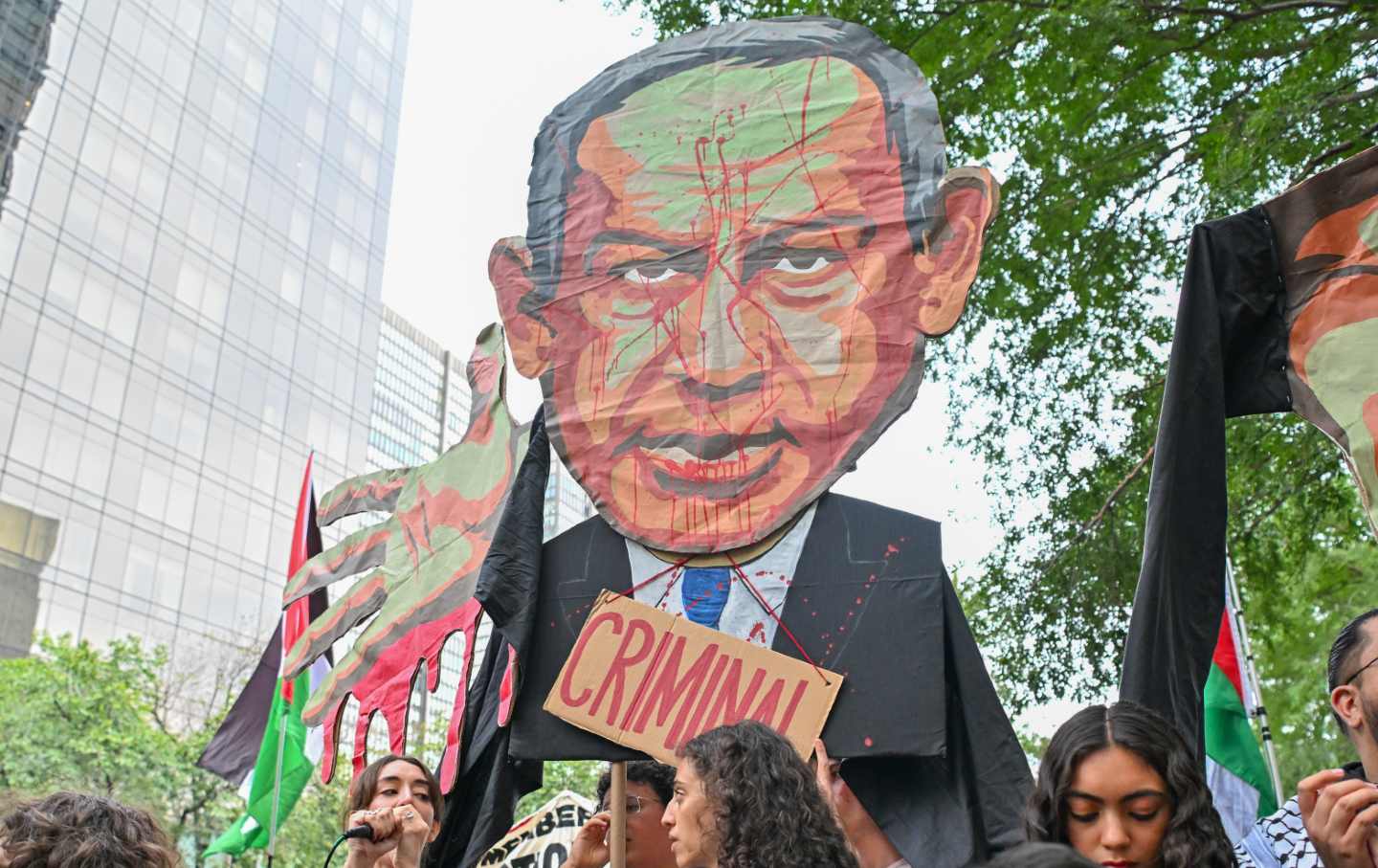
Netanyahu Came to New York. New Yorkers Were Ready for Him. Netanyahu Came to New York. New Yorkers Were Ready for Him.
Scenes from the defiant protest against the genocidal leader’s UN speech.

How Joe Biden Helped Cause a Genocide in Gaza How Joe Biden Helped Cause a Genocide in Gaza
An interview with reporter Akbar Shahid Ahmed about his new book, “Crossing the Red Line.”

Israel’s Election Can’t Fix What Netanyahu Broke Israel’s Election Can’t Fix What Netanyahu Broke
The fundamental problem is not the name of the prime minister, but rather the actions of the Israeli government and the urgent issues that need to be addressed.

Cities as Climate Labs: Inside the U20 Summit Cities as Climate Labs: Inside the U20 Summit
Mayors at the Urban 20 Summit worked across borders to confront the climate crisis at the local level.

How to Arrest Benjamin Netanyahu How to Arrest Benjamin Netanyahu
Make no mistake: The United States can seize Netanyahu for crimes under US law and prosecute him in US courts when he is in New York City this week.

The Ed Sheeran Controversy The Ed Sheeran Controversy
In a society that claims to promote free speech, what crosses the line from controversial to unacceptable? Who gets to define where the line begins and ends?

