Robert Downey Jr.’s Portrayal of Lewis Strauss May Finally Land Him an Oscar
There is more to know about Strauss’s role in the devastating aftermath of the Castle Bravo test in 1954.
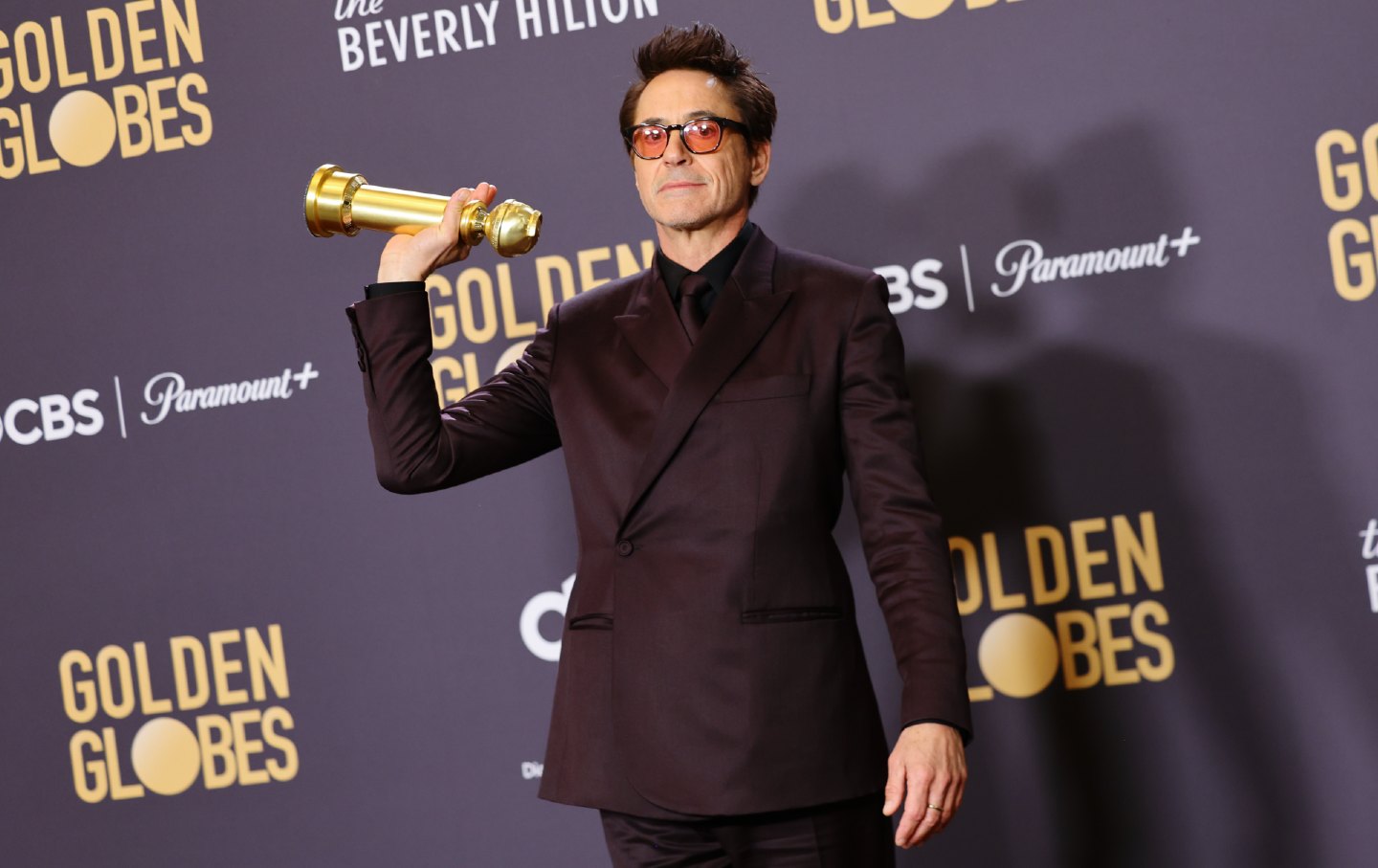
Tomorrow, the film Oppenheimer is likely to become the big winner at the Academy Awards and take home several Oscars. Among the favorites to win is surely Robert Downey Jr. as best supporting actor for his brilliant portrayal of the narrative’s antihero, Lewis Strauss. Strauss is the ideal malfeasant—petty, self-absorbed, nauseatingly ambitious—and Downey brings him to life with his characteristic intensity. It is hard to overestimate just how important a perfect villain is to a good story.
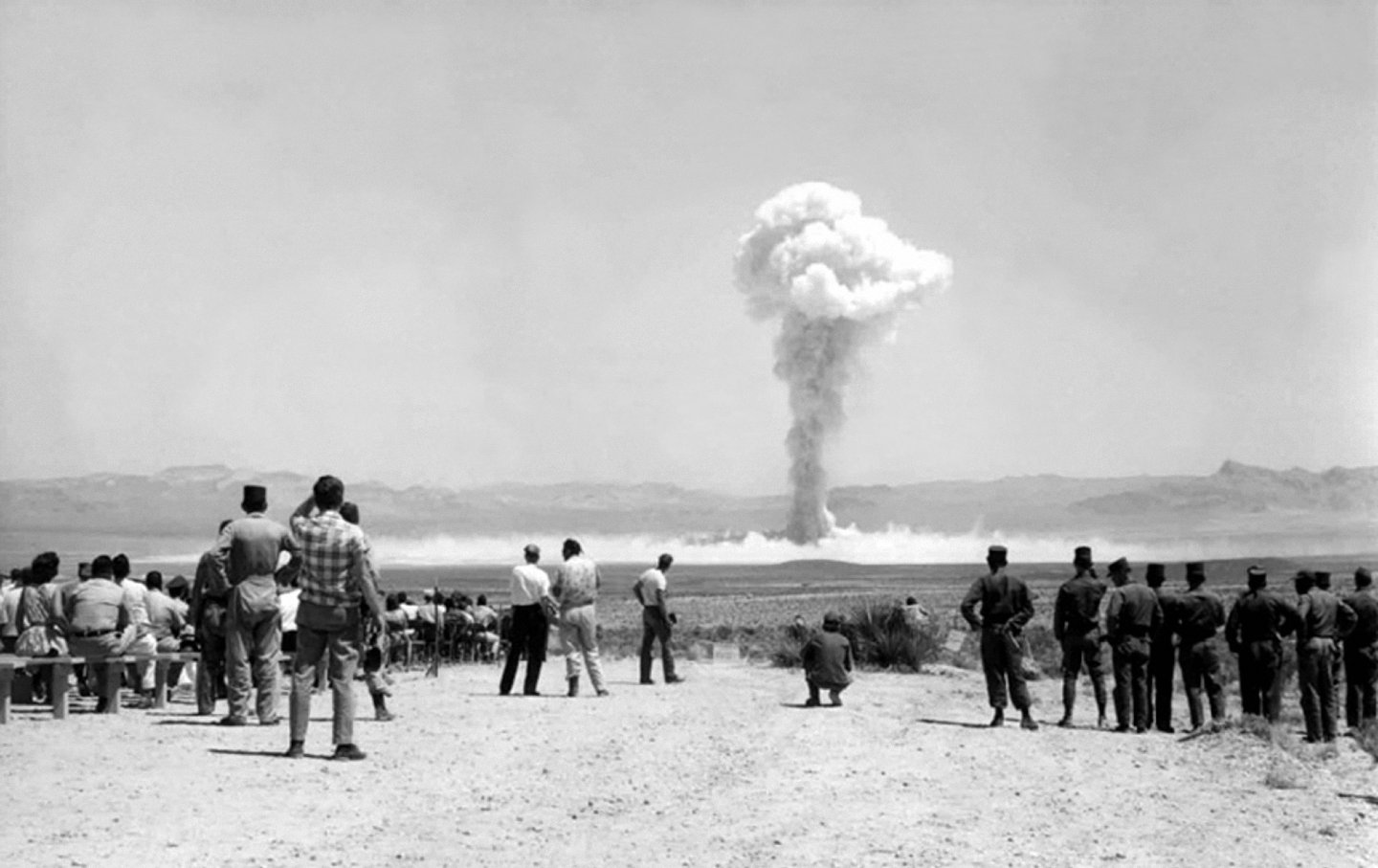
And yet, the film provides an incomplete picture of Strauss’s wickedness. Yes, included is Strauss’s relentless pursuit of stripping J. Robert Oppenheimer, the father of the atomic bomb, of his security clearance and his dignity. Same goes for Strauss’s passion and commitment to hydrogen bombs, referred to as “the supers” throughout the film. But the part that we don’t learn from Nolan is just how ruthless Strauss was when our largest hydrogen bomb—the equivalent of 1,000 Hiroshima bombs—exploded on March 1, 1954, in the Marshall Islands, 70 years ago.
That fateful morning, Alvin Graves gave permission to fire the Bravo test in the northwest corner of the Bikini Atoll, despite knowing that the winds were going to carry the fallout towards populated atolls of Rongelap, Utirik, and beyond. For decades, the United States maintained that the yield of Bravo was miscalculated. A document produced just five days before the test, and declassified in recent years, suggests otherwise. Using the claim that the winds had changed and that the yield had been higher than anticipated, the US government maintained for decades that the entire episode had been an accident.
“The whole sky turned red,” is how the late Marshallese leader Tony de Brum described Bravo when speaking about the terrible legacy of the US nuclear testing in the Marshall Islands, conducted from 1946 to 1958. De Brum was fishing with his grandfather on Likiep Atoll, some 280 miles away from Bikini, when the bomb explosion seemed to set the world on fire and the monstrous mushroom cloud rose 25 miles high and 60 miles in diameter.
The people of Rongelap, only 100 miles away from Bikini, also saw the explosion, but what they next experienced was far worse—radioactive fallout arriving on their islands like snow, with children playing in the pulverized coral thinking that it was in fact snow. The Bravo blast instantly vaporized the entire reef next to Namu Island in the Bikini Atoll, which then mixed in with the bomb’s radioactive isotope products, like iodine-131, before raining back down on Earth as poisonous coral flakes. The winds carried this toxic cloud of dust and debris, reaching Rongelap about four hours after the explosion, and bringing with it immediate and acute radiation sickness. “I vomited, itchy all over my body.… my skin came off, my hair came off so easily,” Senator Jeban Riklon remembered some 60 years later. Long-term illnesses soon followed.
The US military became quickly aware of what had happened to people on Rongelap, and in fact visited them that same day, although only to make radiological measurements. It returned two days later to take them to the airbase on Kwajelein Atoll, where they were, in the words of Rokko Langinbelik, “used as human experiments.” And that’s where our favorite villain enters the story. Once the news of the exposure broke out in the United States, Lewis Strauss, as head of the Atomic Energy Commission, flew out to Kwajalein to visit the affected population, stating afterward that they “appear to me to be well and happy.” Nothing could have been further from the truth. Moreover, Strauss also attacked the Japanese fishermen from the Lucky Dragon, who were fishing “outside of the danger zone” on the day of Bravo. Strauss not only denied US responsibility for their illness and suffering (one of them died six months later) but called them a “red spy outfit.”
In the Marshalls, Bravo didn’t affect only the people of Rongelap. There were also the people of Utirik and many of the other 29 atolls. For instance, the rate of miscarriages and birth defects on 10 different atolls in the decades following Bravo was found to be dramatically elevated and inversely proportional to the distance from Bravo.
As for the people of Bikini, who were moved from their home islands in 1946, they still cannot return to Bikini as the radiological contamination, in large part thanks to Bravo, remains unacceptably high.
Christopher Nolan’s Oppenheimer has shone a light on a dark time and Robert Downing Jr.’s portrayal of Strauss has exposed the depth of moral depravity of a leading character in this pivotal moment in history. Seventy years after Bravo, the full extent of Strauss’s evil and its consequences must also be laid bare.
Support The Nation’s June Fundraising Campaign
With the midterm elections now firmly upon us, the question is whether Democratic candidates will do more than merely occupy ballot lines as mild alternatives to the red-hot crisis that is Donald Trump.
As Trump spends over $1 billion a day on a globally destabilizing war on Iran and admits that he doesn’t “think about Americans’ financial situation,” millions across the country are struggling with the surging costs of essentials. Democrats must seize this moment and advance bold, small-“d” populist ideas—not settle for cynical caution that once again snatches defeat from the jaws of victory.
The Nation elevates progressive ideas, movements, and elected officials achieving real change across the country into the national conversation. At the same time, our journalists are exposing how crypto and AI-funded super PACs are spending hundreds of millions of dollars to knock out candidates they oppose, reporting on the devastating impact of the Supreme Court’s evisceration of the Voting Rights Act, and sounding the alarm on attempts by red states to quickly redraw electoral maps, disenfranchising Southern Black voters.
We can play this critical role because of support from readers like you. This June, we’re raising $20,000 to power The Nation’s independent journalism in the run-up to November’s immensely consequential elections.
It’s in our power to build a more just society, and your support at this critical moment brings us closer to that bold vision. I hope you’ll donate today.
Onward,
Katrina vanden Huevel
Editor and Publisher, The Nation