Print Magazine
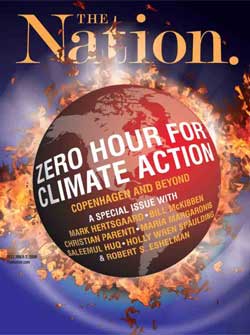
December 7, 2009 Issue
Patricia J. Williams on life sentences for juveniles, Jochen Hellebeck on Stephen F. Cohen, a timeline of the road to Copenhagen…
Cover art by: Cover design by Gene Case & Stephen Kling/Avenging Angels
Purchase Current Issue
or
Login to Download the PDF of this Issue Download the PDF of this Issue
Editorial
Deficit spending is a cure for our troubles, not the cause. If Obama reduces the red ink, the Great Recession could be born again
William Greider
The birthers, the anticommunist crazies, the "Obama as Witch Doctor" caricatures: they're all of a piece, welded to sex.
JoAnn Wypijewski
The Chinese own so much of us that they're stuck with us.
Chris Hayes
In Washington, big ideas for financial reform are suddenly gaining momentum.
William Greider
You don't have to go to Copenhagen to join the activists racing against the ticking environmental bomb.
The Editors
To try alleged 9/11 perpetrators without handing Al Qaeda a propaganda victory, the trial must be fair beyond question.
David Cole
Many obstacles stand in the path of a successful global agreement. But Obama can still take the lead on fighting climate change.
The Editors
Column
NFL Commissioner Roger Goodell seems to understand that when athletes play with a concussion, it is bad for their health--and for business. But do his reforms go far enough?
Dave Zirin
It is manifestly barbarous that children should be tossed into jail for life.
Patricia J. Williams
TNR's more significant sin is to weaken the bond between Israel and liberal American Jews--which is to say, most of them.
Eric Alterman
Letters
Congratulations on the excellent coverage of Afghanistan and Pakistan in your November 9 special issue...
Our Readers and Corey Robin
Feature
In the latest push to privatize public education, regents at the University of California have raised tuition by 32 percent.
Ben Ehrenreich
Inside sources reveal that the firm works with the US military in
Karachi to plan targeted assassinations and drone bombings, among other sensitive counterterrorism operations.
Jeremy Scahill
In response to Lizzy Ratner's "Generation Recession," young readers from across the country wrote to The Nation to share how the recession has impacted them.
Our Readers
The prochoice movement stops playing nice in the fight for healthcare reform.
Sharon Lerner
At major US banks, shareholders actually want their executives to be rewarded for taking on excessive risk.
Zach Carter
Will carbon capture and sequestration help us avoid runaway climate change?
Holly Wren Spaulding
Our crumbling atomic power stations and the government agency that loves them.
Christian Parenti
Promising local initiatives are pointing the way forward for national policy.
Robert S. Eshelman
Some of the best activism is happening in Britain—but in policy terms, payoff has been slight.
Maria Margaronis
Poor countries can make big gains in climate talks if they stick together, argues Saleemul Huq.
Mark Hertsgaard
In Our Choice, Al Gore explains what must be done. But is there the political will to do it?
Bill McKibben
In the dry Sahel, farmers are already adapting to climate change.
Mark Hertsgaard
Books & the Arts
Against the background of the surge, David Finkel twists the concept of wartime good into a cosmic joke.
Akiva Gottlieb
Stephen F. Cohen's Soviet Fates and Lost Alternatives surveys a political landscape of reform, struggle and reconciliation.
Jochen Hellbeck
In their discussions of justice, Michael Sandel and Amartya Sen endorse communal good but slight collective endeavor.
Samuel Moyn
Recent Issues
See All
"swipe left below to view more recent issues"Swipe →
See All