The War Was Won Before Hiroshima—and the Generals Who Dropped the Bomb Knew It
Seventy years after the bombing, will Americans face the brutal truth?
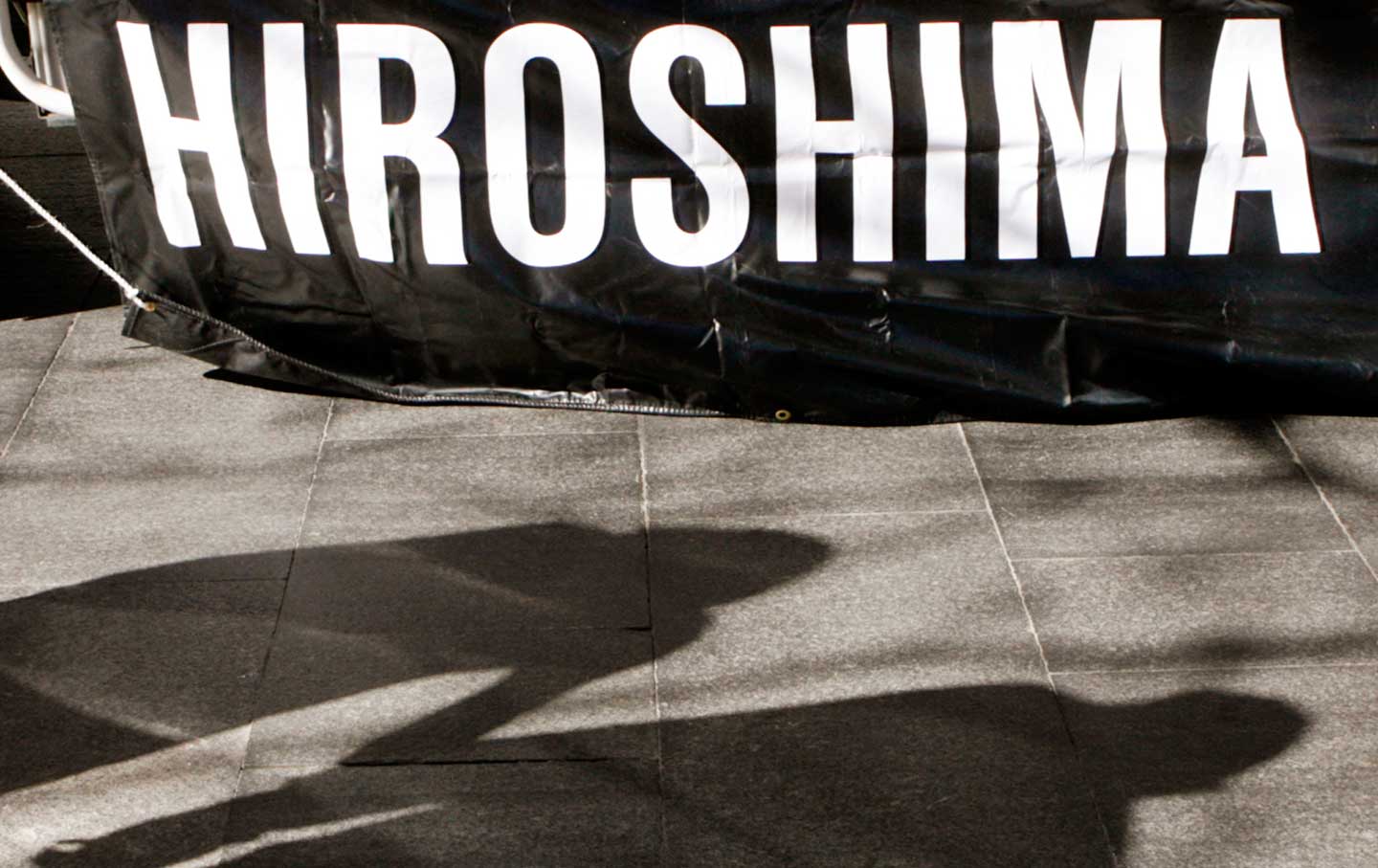
A couple walks past a placard during an anti-nuclear demonstration in central Sydney, August 2, 2008.
(Daniel Munoz / Reuters)Visitors to the National Air and Space Museum—America’s shrine to the technological leading edge of the military-industrial complex—hear a familiar narrative from the tour guides in front of the Enola Gay, the plane that dropped an atomic weapon on the civilians of Hiroshima 70 years ago today. The bomb was dropped, they say, to save the lives of thousands of Americans who would otherwise have been killed in an invasion of Japan’s home islands. Hiroshima and Nagasaki were largely destroyed, and the lives of 135,000 to 300,000 mostly Japanese women, children, and old people were sacrificed—most young men were away at war—as the result of a terrible but morally just calculus aimed at bringing an intractable war to a close.
This story may assuage the conscience of the air museum visitor, but it is largely myth, fashioned to buttress our memories of the “good” war. By and large, the top generals and admirals who managed World War II knew better. Consider the small and little-noticed plaque hanging in the National Museum of the US Navy that accompanies the replica of “Little Boy,” the weapon used against the people of Hiroshima: In its one paragraph, it makes clear that Truman’s political advisers overruled the military in determining how the end of the war with Japan would be approached. Furthermore, contrary to the popular myths around the atomic bomb’s nearly magical power to end the war, the Navy Museum’s explication of the history clearly indicates that “the vast destruction wreaked by the bombings of Hiroshima and Nagasaki and the loss of 135,000 people made little impact on the Japanese military.”
Indeed, it would have been surprising if they had: Despite the terrible concentrated power of atomic weapons, the firebombing of Tokyo earlier in 1945 and the destruction of numerous Japanese cities by conventional bombing killed far more people. The Navy Museum acknowledges what many historians have long known: It was only with the entry of the Soviet Union’s Red Army into the war two days after the bombing of Hiroshima that the Japanese moved to finally surrender. Japan was used to losing cities to American bombing; what their military leaders feared more was the destruction of the country’s military by an all-out Red Army assault.
The top American military leaders who fought World War II, much to the surprise of many who are not aware of the record, were quite clear that the atomic bomb was unnecessary, that Japan was on the verge of surrender, and—for many—that the destruction of large numbers of civilians was immoral. Most were also conservatives, not liberals. Adm. William Leahy, Truman’s chief of staff, wrote in his 1950 memoir, I Was There, that “the use of this barbarous weapon at Hiroshima and Nagasaki was of no material assistance in our war against Japan. The Japanese were already defeated and ready to surrender.… In being the first to use it, we…adopted an ethical standard common to the barbarians of the Dark Ages. I was not taught to make war in that fashion, and wars cannot be won by destroying women and children.”
The commanding general of the US Army Air Forces, Henry “Hap” Arnold, gave a strong indication of his views in a public statement 11 days after Hiroshima was attacked. Asked on August 17 by a New York Times reporter whether the atomic bomb caused Japan to surrender, Arnold said that “the Japanese position was hopeless even before the first atomic bomb fell, because the Japanese had lost control of their own air.”
Fleet Adm. Chester Nimitz, the commander in chief of the Pacific Fleet, stated in a public address at the Washington Monument two months after the bombings that “the atomic bomb played no decisive part, from a purely military standpoint, in the defeat of Japan.” Adm. William “Bull” Halsey Jr., the commander of the US Third Fleet, stated publicly in 1946 that “the first atomic bomb was an unnecessary experiment…. It was a mistake to ever drop it…. [The scientists] had this toy, and they wanted to try it out, so they dropped it.”
Gen. Dwight Eisenhower stated in his memoirs that when notified by Secretary of War Henry Stimson of the decision to use atomic weapons, he “voiced to him my grave misgivings, first on the basis of my belief that Japan was already defeated and that dropping the bomb was completely unnecessary, and secondly because I thought that our country should avoid shocking world opinion by the use of a weapon whose employment was, I thought, no longer mandatory as a measure to save American lives.” He later publicly declared, “It wasn’t necessary to hit them with that awful thing.” Even the famous hawk Maj. Gen. Curtis LeMay, the head of the Twenty-First Bomber Command, went public the month after the bombing, telling the press that “the atomic bomb had nothing to do with the end of the war at all.”
The record is quite clear: From the perspective of an overwhelming number of key contemporary leaders in the US military, the dropping of atomic bombs on Hiroshima and Nagasaki was not a matter of military necessity. American intelligence had broken the Japanese codes, knew the Japanese government was trying to negotiate surrender through Moscow, and had long advised that the expected early August Russian declaration of war, along with assurances that Japan’s emperor would be allowed to stay as a figurehead, would bring surrender long before the first step in a November US invasion could begin.
Historians still do not have a definitive answer to why the bombs were used. Given that US intelligence advised that the war would likely end if Japan were given assurances regarding the emperor—and given that the US military knew it would have to keep the emperor to help control occupied Japan in any event—something else clearly seems to have been important. We know that some of Truman’s closest advisers viewed the bomb as a diplomatic and not simply a military weapon. Secretary of State James Byrnes, for instance, believed that the use of atomic weapons would help the United States more strongly dominate the postwar era. According to Manhattan Project scientist Leo Szilard, who met with Byrnes on May 28, 1945, “[Byrnes] was concerned about Russia’s postwar behavior…[and thought] that Russia might be more manageable if impressed by American military might, and that a demonstration of the bomb might impress Russia.”
History is rarely simple, and confronting it head-on, with critical honesty, is often quite painful. Myths, no matter how oversimplified or blatantly false, are too often far more likely to be embraced than inconvenient and unsettling truths. Even now, for instance, we see how difficult it is for the average US citizen to come to terms with the brutal record of slavery and white supremacy that underlies so much of our national story. Remaking our popular understanding of the “good” war’s climactic act is likely to be just as hard. But if the Confederate battle flag can come down in South Carolina, we can perhaps one day begin to ask ourselves more challenging questions about the nature of America’s global power and what is true and what is false about why we really dropped the atomic bomb on Japan.