
Ukraine’s Dangerous Illusion of New Nuclear Energy
Nuclear plants are prime targets in wartime Ukraine. Renewables are safer, cheaper—and already on the rise.
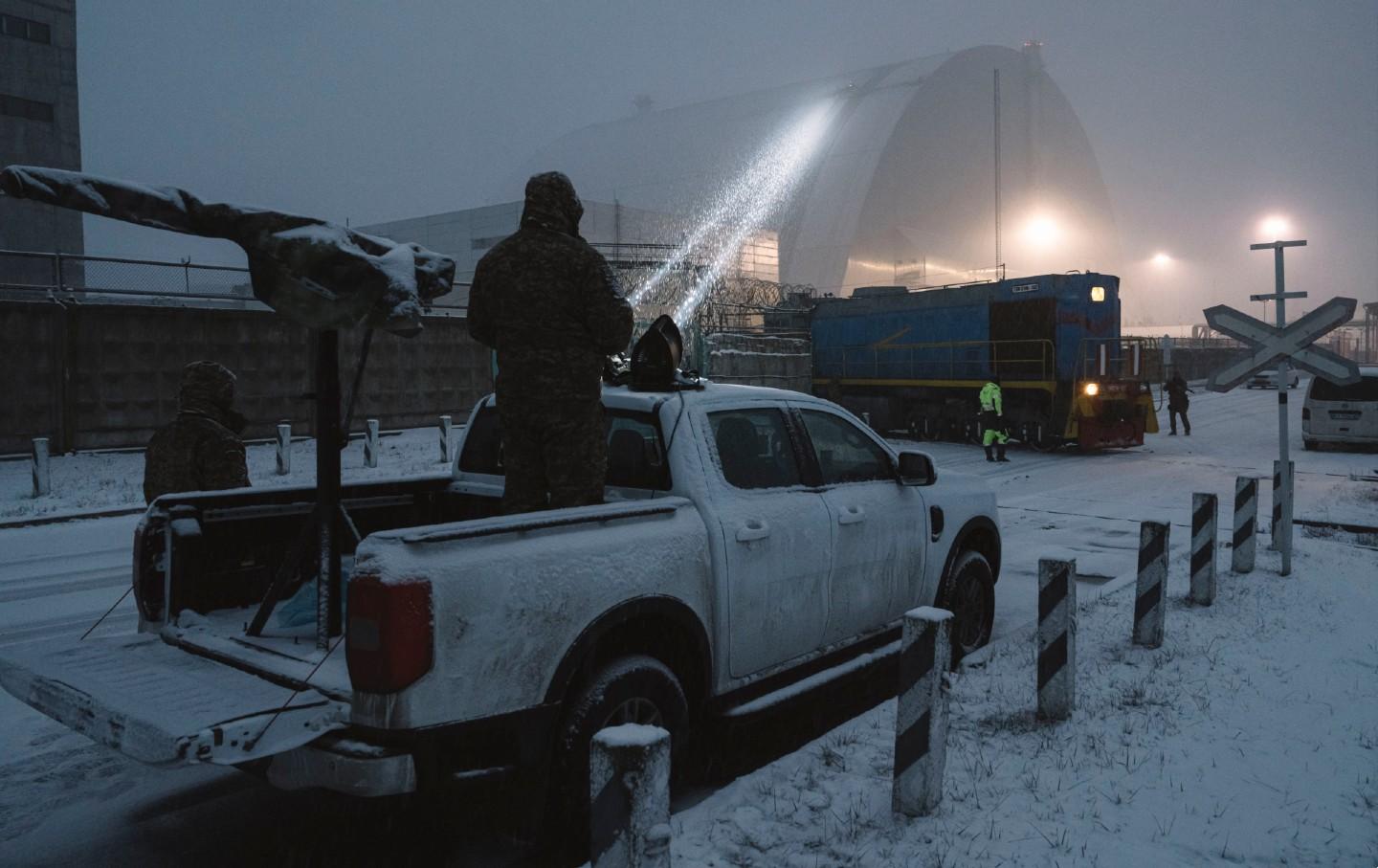
Tragically, Ukraine is falling for the red herring of new nuclear power—an option that undermines its security at the worst possible moment. Nuclear energy today is not only sky-high costly and notoriously slow to rollout, but it presents an egregious security risk that Ukraine, of all countries, understands well. The pursuit of more nuclear power—over half of the country’s total electricity already hails from its nuclear fleet—will drain valuable finances and make Ukraine more rather than less vulnerable to the Russian assault.
Since the full invasion three years ago, Ukraine’s 15 nuclear reactors—six currently under Russian military control but operated by Ukrainian staff—have been targets of relentless Russian shelling and drone attacks. On February 14, a Russian drone with a high-explosive warhead punched a hole in the protective outer shell of Ukraine’s shuttered Chernobyl nuclear plant and started a fire that burned for two weeks.
Ukraine’s leadership and the International Atomic Energy Agency, an agency promoting nuclear energy, have screamed about the gravity of the threat posed to existing reactors, yet these plants remain operational to provide the country a bare minimum of energy. A 2024 UN mission was so concerned about the Russian bombardments that it warned of “a nuclear disaster potentially exceeding both the 2011 Fukushima Daiichi accident in Japan and the 1986 Chernobyl disaster in Ukraine.“ One expert recently claimed that a nuclear disaster in Ukraine is only a “matter of time” if Russian forces continue to hit reactor systems.
Of course, Ukraine is a country that understands nuclear power (and its dangers). It owns the largest nuclear power plant in Europe, and only France and Slovakia rely more on the splitting of atoms for electricity. And thus, it might be understandable that Ukraine’s old-school energy elite—products of Soviet-era thinking—believe that only more will compensate Ukraine’s damaged fossil fuel and hydroelectric plants, which left people freezing in mid-winter. Ukrainian president Volodymyr Zelensky calls nuclear energy expansion a “key to energy independence.”
This is why Ukraine’s state-owned nuclear utility sought out the US company Westinghouse to negotiate building nine pressurized water reactors at established plant sites. There are no public estimates for the cost of the entire deal, but by the measure of the two 2023-completed AP1000 reactors in Vogtle, Georgia, nine similar, brand-new units at this price would run up a bill of over one hundred billion dollars. (With two reactors already under construction at the Khmelnytskyi nuclear power plant in western Ukraine and some of the other technology in Ukraine’s sights partly constructed. Thus far, the highest figure Ukraine has made public is an unrealistic $30 billion for the completion of five reactors.) Just this year, Ukraine expressed interest in purchasing two unfinished Russian-made reactors from Bulgaria for $600 million, despite experts’ warnings and the fact that Ukraine has yet to inspect them.
New Nuclear Power Is a Dead End for Ukraine
Even if Ukraine’s existing reactors must remain on, the country’s pursuit of more nuclear energy is fundamentally wrongheaded and its desperate attempt to do so on the cheap is doomed to fail. This is not the same fool’s errand that other countries are pursuing—a global “nuclear energy renaissance” is supposedly in progress—but a self-inflicted wound that will compromise the country’s defense and therefore its very existence.
Security experts from the European Commission argue that solar and wind are better bet to improve the country’s energy security and geosecurity. The buildout of decentralized renewables and integration into the EU energy system, the Commission claims, is the quickest way to stabilize Ukraine’s decimated energy system and the best foil to repel Russian efforts to incapacitate it further.
Also, security experts have begun to take note of renewables’ value. Unlike conventional energy generation, renewable energy is by its nature decentralized and distributed: that is, its production local and close to the point of consumption, while performed by a variety of small, usually grid-connected hardware.
Distributed renewables are more resilient and robust because they are modular: they can be brought back online more quickly, and they are distributed, which means that no single node on the network destroys (or incapacitates) the rest.
Clean-energy “technologies should be spread throughout the country to deprive Russia of the ability to knock out large amounts of power capacity with one strike,” argues Volodymyr Kudrytskyi, former head of Ukrainians transmission grid and now think tank analyst. He estimates that at the cost of $10 billion Ukraine can roll out hundreds of new sustainable energy parks that generate up to 10 megawatts each. For example, a solar park of this magnitude, which is about the size of 40 football fields (15 hectares), would generate enough electricity to power approximately 2,000 average-sized homes. They would “deprive Russia of the ability to knock out large amounts of power capacity with one strike,” he claims.
Why not nuclear? Also, the cost of new nuclear energy is prohibitive. Not a single reactor of any kind is currently being built in all South and North America. Neither states nor private financiers are willing to front the billions required to build them. And compared to onshore wind and solar parks, nuclear power per kilowatt is at least three times as pricey.
Moreover, the developers’ rosy projections of nuclear plant construction schedules usually range from five to eight years—but always take longer, often two or three times longer. The Vogtle reactors in the US, estimated to be built in five years, took ten and were $17 billion over cost. The UK’s Hinkley Point C reactors were pledged to take eight years and are now at 17. Construction costs for Hinkley have ballooned from £18 billion to £46 billion. Clearly, new nuclear power—or even second-hand atomic technology—is not the quick-as-possible fix that Ukraine desperately needs, even given the most sanguine projections.
Second-Hand Scrap Metal
Behind Ukraine’s gambit to cut costs and buildout time is the purchase of partially constructed reactors that Westinghouse and the Bulgarian state mothballed years ago. The two Westinghouse AP1000s have idled in a warehouse since 2017 when South Carolina utilities bailed on the project which, due to manufacturing errors and incompetence, had more than doubled in projected cost; they forfeited the $9 billion spent, which constituted the largest business failure in South Carolina history.
Popular
“swipe left below to view more authors”Swipe →In fact, Russia is just about the only country building nuclear stations abroad these days, but this is obviously not an option for Ukraine.
Decentralized Renewable Energy
Ukraine’s interests are far better served investing in solar and wind parks, smart grid, and storage systems: the zero-carbon technology that investors worldwide sunk over $2 trillion into last year, compared to just $80 billion in nuclear technology. Energy investors obviously know a deal when they see it, and renewables’ farms can be up and running within months after their approval.
In order to replace the 10 gigawatts of conventional generation that the war with Russia has knocked out, Ukraine would need 1,000 such parks! That’s a lot and, of course, not doable in a year or two, even if Ukraine has already begun the task. But every newly constructed park is a step in the right direction.
Support independent journalism that does not fall in line
Even before February 28, the reasons for Donald Trump’s imploding approval rating were abundantly clear: untrammeled corruption and personal enrichment to the tune of billions of dollars during an affordability crisis, a foreign policy guided only by his own derelict sense of morality, and the deployment of a murderous campaign of occupation, detention, and deportation on American streets.
Now an undeclared, unauthorized, unpopular, and unconstitutional war of aggression against Iran has spread like wildfire through the region and into Europe. A new “forever war”—with an ever-increasing likelihood of American troops on the ground—may very well be upon us.
As we’ve seen over and over, this administration uses lies, misdirection, and attempts to flood the zone to justify its abuses of power at home and abroad. Just as Trump, Marco Rubio, and Pete Hegseth offer erratic and contradictory rationales for the attacks on Iran, the administration is also spreading the lie that the upcoming midterm elections are under threat from noncitizens on voter rolls. When these lies go unchecked, they become the basis for further authoritarian encroachment and war.
In these dark times, independent journalism is uniquely able to uncover the falsehoods that threaten our republic—and civilians around the world—and shine a bright light on the truth.
The Nation’s experienced team of writers, editors, and fact-checkers understands the scale of what we’re up against and the urgency with which we have to act. That’s why we’re publishing critical reporting and analysis of the war on Iran, ICE violence at home, new forms of voter suppression emerging in the courts, and much more.
But this journalism is possible only with your support.
This March, The Nation needs to raise $50,000 to ensure that we have the resources for reporting and analysis that sets the record straight and empowers people of conscience to organize. Will you donate today?
More from The Nation

Trump and His Soulless Cronies Have Managed to Suck the Joy Out of the World Cup Trump and His Soulless Cronies Have Managed to Suck the Joy Out of the World Cup
Not even soccer is immune from Trump’s reverse Midas touch.
Garbage In, Carnage Out Garbage In, Carnage Out
The harrowing lessons of the Pentagon’s recently dissolved partnership with Anthropic.

The Iran War Could Be Catastrophic for the US-Israel Alliance. Good. The Iran War Could Be Catastrophic for the US-Israel Alliance. Good.
As Israel’s role in pushing the war with Iran comes into ever sharper focus, it’s up to us to turn outrage into change.

An Unlawful War An Unlawful War
The precedent being set by the US in launching this war of aggression against Iran will long live in infamy.

Trump and Netanyahu Want to Turn Iran Into a Failed State Trump and Netanyahu Want to Turn Iran Into a Failed State
This war looks designed to cause maximum chaos and instability. The world will pay a high price.

The War on Terror Paved the Way for Trump’s Rise—Now He’s Making It His Own The War on Terror Paved the Way for Trump’s Rise—Now He’s Making It His Own
Only the total abolition of the DHS can restore freedom.

