The Mpox Outbreak Is a Damning Indictment of the Global Health System
The inequalities and injustices in our medical infrastructure have made the outbreak so much worse than it could have been.
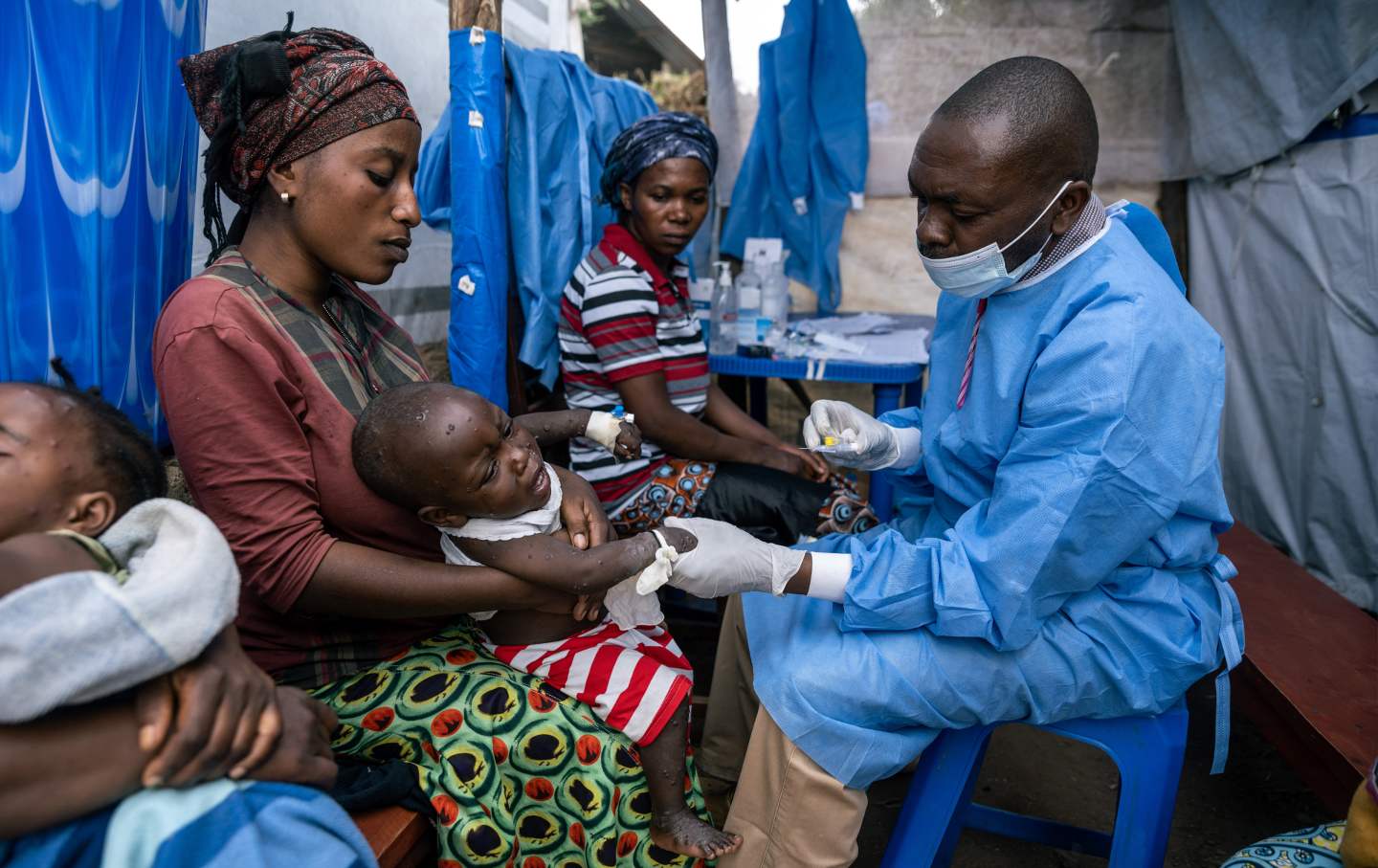
A mother holds her son as he receives his daily injection while being treated for mpox at the Kavumu health center in Kabare territory, South Kivu region, Democratic Republic of Congo, on Tuesday, September 3, 2024.
(Arlette Bashizi / Bloomberg via Getty Images)It has been over 50 years since the first cases of mpox, the disease formerly known as monkeypox, were discovered in the Democratic Republic of Congo. Mpox is related to smallpox, and causes symptoms similar to but milder than its once-feared relative, which was eradicated in 1980.
For decades, mpox outbreaks were self-limiting, resulting in a few hundred, perhaps a few thousand cases in regions that are endemic for the disease in West and Central Africa. However, in 2022, a global outbreak led to close to 100,000 cases worldwide, transmitted primarily among men who have sex with men, and through sexual contact. This was a departure for the virus, which until then was known to be largely transmitted from small mammals to humans in forested locales, with limited human-to-human spread by close physical contact.
A disease ignored by much of the world until then shot up the charts in the attention of public health officials everywhere, gaining notoriety among politicians and the general public, particularly the LGBTQ community. A vaccine for smallpox made by a small company in Denmark, Bavarian Nordic, was deployed rapidly in the United States and in other rich countries affected by the outbreak. Within a few months, shifts in behavior by gay men, and perhaps a little help from the vaccine, brought the outbreak under control, though cases erupt from time to time still in the United States and elsewhere.
But in September 2023, less than six months after the World Health Organization called the acute phase of that outbreak over, a new outbreak was starting in DRC. And it continued throughout the rest of the year into 2024, with now close to 20,000 cases reported and close to 1,000 deaths—all likely to be grossly underreported due to the weak health infrastructure in DRC and surrounding countries. The global outbreak in 2022–23, by contrast, caused only about 200 deaths, with the clade—or strain of virus—responsible for this new outbreak historically being thought of as more lethal than the 2022 variant. As of mid-August, two cases of this new strain have been reported globally, one in Sweden and another in Thailand.
The relative rapidity with which the international community responded to the 2022–23 outbreak stands in stark contrast to what has happened now with a severe outbreak roiling through Africa. It’s hard not to think that this has everything to do with who has been hit hardest; white people in high-income countries in 2022, black people in low-income countries in 2024. But in addition to the continuing colonial and racist forces at work in global health, it’s also important to realize that whether it’s Covid, H5N1, or mpox, there isn’t a lot of appetite for confronting public health problems until they are impossible to ignore—whether at home or abroad.
The expansion of the current mpox outbreak could have been stopped in its tracks, or at least blunted, if we took the requisite steps to protect the people of the DRC, such as a commitment to supplying vaccines and subsidizing the necessary infrastructure to get them to even remote corners of the country. This would not have been easy—but the alternative is what is before us today, another outbreak spreading regionally, with the potential for seeding a new global outbreak as well. Even now, as the outbreak is in full swing, vaccines, tests, treatment, and care are lacking on the ground.
We can’t keep making the same mistakes over and over again and calling it progress. We are stuck in a failure loop, making screw-up after screw-up on infectious diseases, from Covid to bird flu and now with mpox, all in the span of a few years. But what we do abroad is a special kind of fuckery. Global health has moved from an explicit colonial project at its inception, to a Cold War realpolitik project in the mid-to-late 20th century, to a philanthrocapitalism project in our era, but it has never been about justice.
Over the past decade or so, there has been a movement to “decolonize” global health. What that means depends on whom you talk to, but it’s clear that relying on rich nations to “do the right thing” is a losing game. Low- and middle-income countries need the ability to chart their own future, which means having the resources to do so. In Africa, including the regions in which the current mpox outbreak is spreading, large chunks of health funding come from external sources, which are shrinking by the day.
How do you create a funding stream in these countries without a reliance on rich countries to foot the bill? One way is through taxation. According to a 2017 article, “up to $189 billion per year of tax revenues was lost—more than twice the $86 billion that OECD countries as a whole spend on overseas development assistance,” from tax evasion and avoidance by individuals and transnational corporations. We’ve got to radically reenvision how global health works and put all ideas on the table.
Depending on the kindness of strangers is not a sustainable global health strategy, and with Covid and now mpox, we know it’s a deadly one.
Support independent journalism that does not fall in line
Even before February 28, the reasons for Donald Trump’s imploding approval rating were abundantly clear: untrammeled corruption and personal enrichment to the tune of billions of dollars during an affordability crisis, a foreign policy guided only by his own derelict sense of morality, and the deployment of a murderous campaign of occupation, detention, and deportation on American streets.
Now an undeclared, unauthorized, unpopular, and unconstitutional war of aggression against Iran has spread like wildfire through the region and into Europe. A new “forever war”—with an ever-increasing likelihood of American troops on the ground—may very well be upon us.
As we’ve seen over and over, this administration uses lies, misdirection, and attempts to flood the zone to justify its abuses of power at home and abroad. Just as Trump, Marco Rubio, and Pete Hegseth offer erratic and contradictory rationales for the attacks on Iran, the administration is also spreading the lie that the upcoming midterm elections are under threat from noncitizens on voter rolls. When these lies go unchecked, they become the basis for further authoritarian encroachment and war.
In these dark times, independent journalism is uniquely able to uncover the falsehoods that threaten our republic—and civilians around the world—and shine a bright light on the truth.
The Nation’s experienced team of writers, editors, and fact-checkers understands the scale of what we’re up against and the urgency with which we have to act. That’s why we’re publishing critical reporting and analysis of the war on Iran, ICE violence at home, new forms of voter suppression emerging in the courts, and much more.
But this journalism is possible only with your support.
This March, The Nation needs to raise $50,000 to ensure that we have the resources for reporting and analysis that sets the record straight and empowers people of conscience to organize. Will you donate today?