November 2, 2023

Michael Bennett: “We Cannot in Good Conscience Fund the Bombing of Palestinian Civilians”

The NFL champion calls upon Joe Biden to demand a cease-fire in Gaza
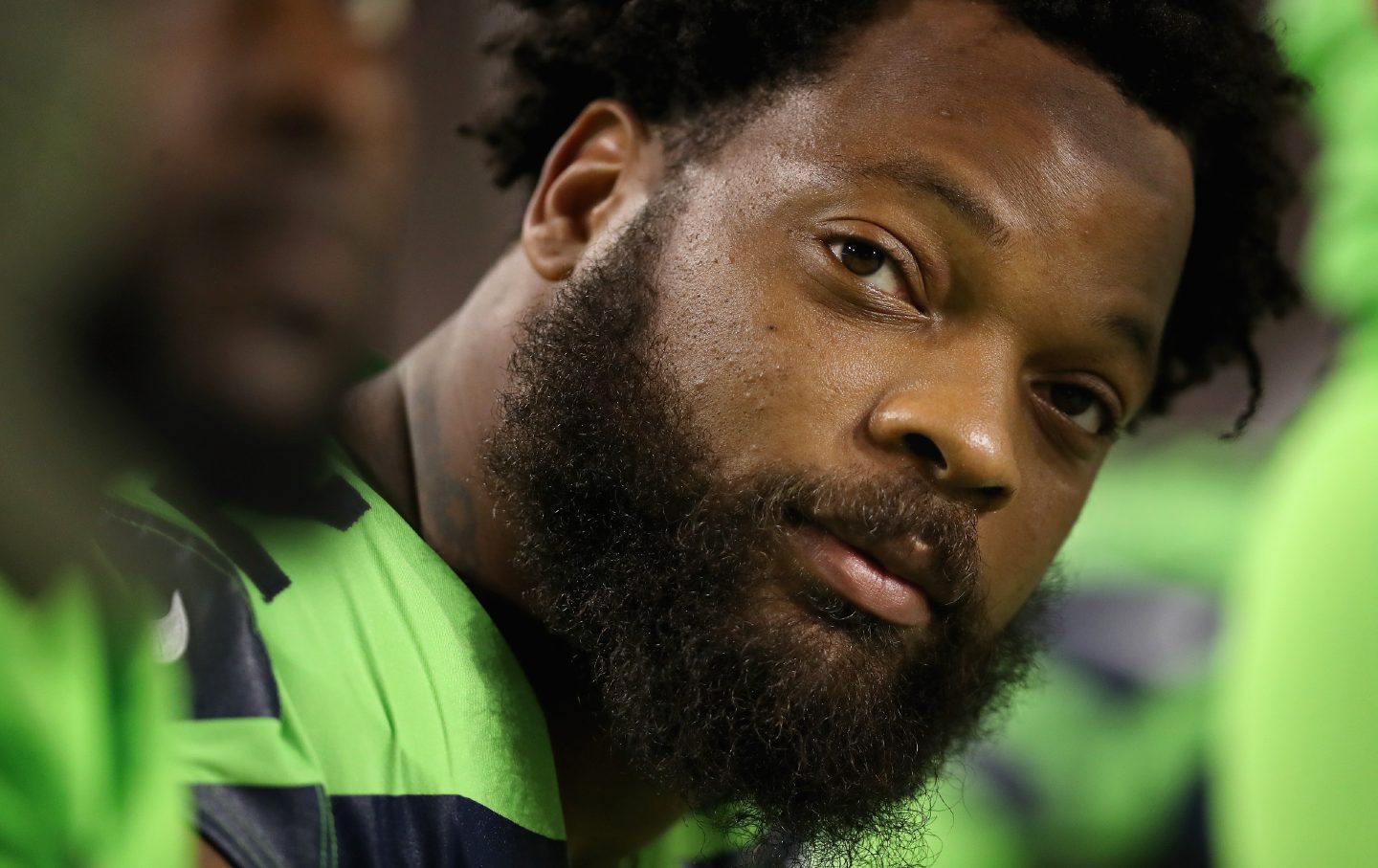
Michael Bennett

Defensive end Michael Bennett of the Seattle Seahawks at the University of Phoenix Stadium on November 9, 2017, in Glendale, Ariz.

(Christian Petersen / Getty Images)

Michael Bennett played in the National Football League for 11 seasons, was a pro bowler three times, and a Super Bowl champion with the Seattle Seahawks. He is also known for taking up a variety of social causes from malnutrition in impoverished communities to expanding STEM in underserved schools to police violence. He also made serious waves in 2017 when publicly turning down an NFL-sponsored trip to Israel in solidarity with Palestinians living under a state of occupation. Here he returns to that subject and makes clear why he supports a cease-fire now.—Dave Zirin, sports editor

The ongoing conflict in Israel and Palestine is a deeply introspective challenge, one that forces us to grapple with profound philosophical and spiritual questions. As I bear witness to the tragic loss of innocent lives—both Israeli and Palestinian—it weighs heavily on my heart and soul, compelling me to stand in solidarity with those who suffer daily. In this conflict, I don’t just see Palestinians or Israelis; I see humans, and for that reason it’s crucial for the United States to demand a cease-fire for Israel and prevent the further loss of innocent children.

We cannot in good conscience fund the bombing of Palestinian civilians, including children, for they are all people, all humans. When we watch the news and see children suffering, we should feel the anguish of a father, the sorrow of a mother, the pain of a brother, a sister, an uncle losing a niece. We must find empathy for the suffering of those who have lost their lives and livelihoods. Because I don’t want to see any more loss of life, I call upon President Joe Biden to demand a cease-fire and ensure that American tax dollars are not used for weapons, or the ongoing occupation of Palestine—especially since there are urgent needs at home, like properly funding Black schools and infrastructure.

I stand with people across the globe who demand that we acknowledge the rights of the Palestinian people to exist on their land and live their lives in peace. This is not about taking sides; it’s about upholding morality, civility, and humanity. I have always stood against antisemitism and this statement is not antisemitic; it’s anti-death, and it speaks to a moral issue that we must address. Innocence should never be sacrificed. A policy that leads to bombing hospitals will not create safety in the world; we must choose humanity.

In the face of this ongoing conflict, we must ask ourselves, what is the definition of humanity? My condolences go out to the families who have lost their loved ones, and I believe that we must seek a path that ensures the dignity and rights of all, regardless of their background. This is not about taking sides; it’s about choosing a path that respects the sanctity of life.
Disobey authoritarians, support The Nation

Over the past year you’ve read Nation writers like Elie Mystal, Kaveh Akbar, John Nichols, Joan Walsh, Bryce Covert, Dave Zirin, Jeet Heer, Michael T. Klare, Katha Pollitt, Amy Littlefield, Gregg Gonsalves, and Sasha Abramsky take on the Trump family’s corruption, set the record straight about Robert F. Kennedy Jr.’s catastrophic Make America Healthy Again movement, survey the fallout and human cost of the DOGE wrecking ball, anticipate the Supreme Court’s dangerous antidemocratic rulings, and amplify successful tactics of resistance on the streets and in Congress.

We publish these stories because when members of our communities are being abducted, household debt is climbing, and AI data centers are causing water and electricity shortages, we have a duty as journalists to do all we can to inform the public.

In 2026, our aim is to do more than ever before—but we need your support to make that happen. 

Through December 31, a generous donor will match all donations up to $75,000. That means that your contribution will be doubled, dollar for dollar. If we hit the full match, we’ll be starting 2026 with $150,000 to invest in the stories that impact real people’s lives—the kinds of stories that billionaire-owned, corporate-backed outlets aren’t covering. 

With your support, our team will publish major stories that the president and his allies won’t want you to read. We’ll cover the emerging military-tech industrial complex and matters of war, peace, and surveillance, as well as the affordability crisis, hunger, housing, healthcare, the environment, attacks on reproductive rights, and much more. At the same time, we’ll imagine alternatives to Trumpian rule and uplift efforts to create a better world, here and now. 

While your gift has twice the impact, I’m asking you to support The Nation with a donation today. You’ll empower the journalists, editors, and fact-checkers best equipped to hold this authoritarian administration to account. 

I hope you won’t miss this moment—donate to The Nation today.

Onward,

Katrina vanden Heuvel 

Editor and publisher, The Nation

Michael Bennett

Michael Bennett is a three-time Pro Bowler, Pro Bowl MVP, Super Bowl Champion, two-time NFC Champion, cofounder with Pele Bennett of the Bennett Foundation, and coauthor of Things That Make White People Uncomfortable.

More from The Nation

Hend’s family during their olive harvest season in 2024. Photo courtesy of Hend Salama Abo Helow

Israel Tried to Destroy Our Olive Trees. But They Resisted—and So Did We. Israel Tried to Destroy Our Olive Trees. But They Resisted—and So Did We.

These trees have endured drought, pollution, toxic mines, uprooting, bulldozing, and burning—much like the people of Gaza. But they fought to survive.

Hend Salama Abo Helow

Trump Foreign Policy

Trump’s National Security Strategy and the Big Con Trump’s National Security Strategy and the Big Con

Sense, nonsense, and lunacy.

Robert L. Borosage

Sunset over Christ the Saviour cathedral in Moscow

Does Russian Feminism Have a Future? Does Russian Feminism Have a Future?

A Russian feminist reflects on Julia Ioffe’s history of modern Russia.

Nadezhda Azhgikhina

Oleksandr Ibrahimov, 56, a security guard working for 35 years at the House of Trade Unions, finds a sunflower growing amidst wreckage.

Ukraine’s War on Its Unions Ukraine’s War on Its Unions

Since the start of the war, the Ukrainian government has been cracking down harder on unions and workers’ rights. But slowly, the public mood is shifting.

David Zauner

Young learners listen to an educator during the start of classes at Latin Patriarchate School inside the Holy Family Catholic Church compound sheltering displaced Palestinians in Gaza City, on December 3, 2025.

I’m a Teacher in Gaza. My Students Are Barely Hanging On. I’m a Teacher in Gaza. My Students Are Barely Hanging On.

Between grief, trauma, and years spent away from school, the children I teach are facing enormous challenges.

Ghada Eyad

Pinochet pointing upward

Operation Condor: A Network of Transnational Repression 50 Years Later Operation Condor: A Network of Transnational Repression 50 Years Later

How Condor launched a wave of cross-border assassinations and disappearances in Latin America.

Peter Kornbluh