
How Italy’s Workers Shut Their Country Down for Gaza
Hundreds of thousands blocked ports and roadways to demand an end to military collaboration with Israel.
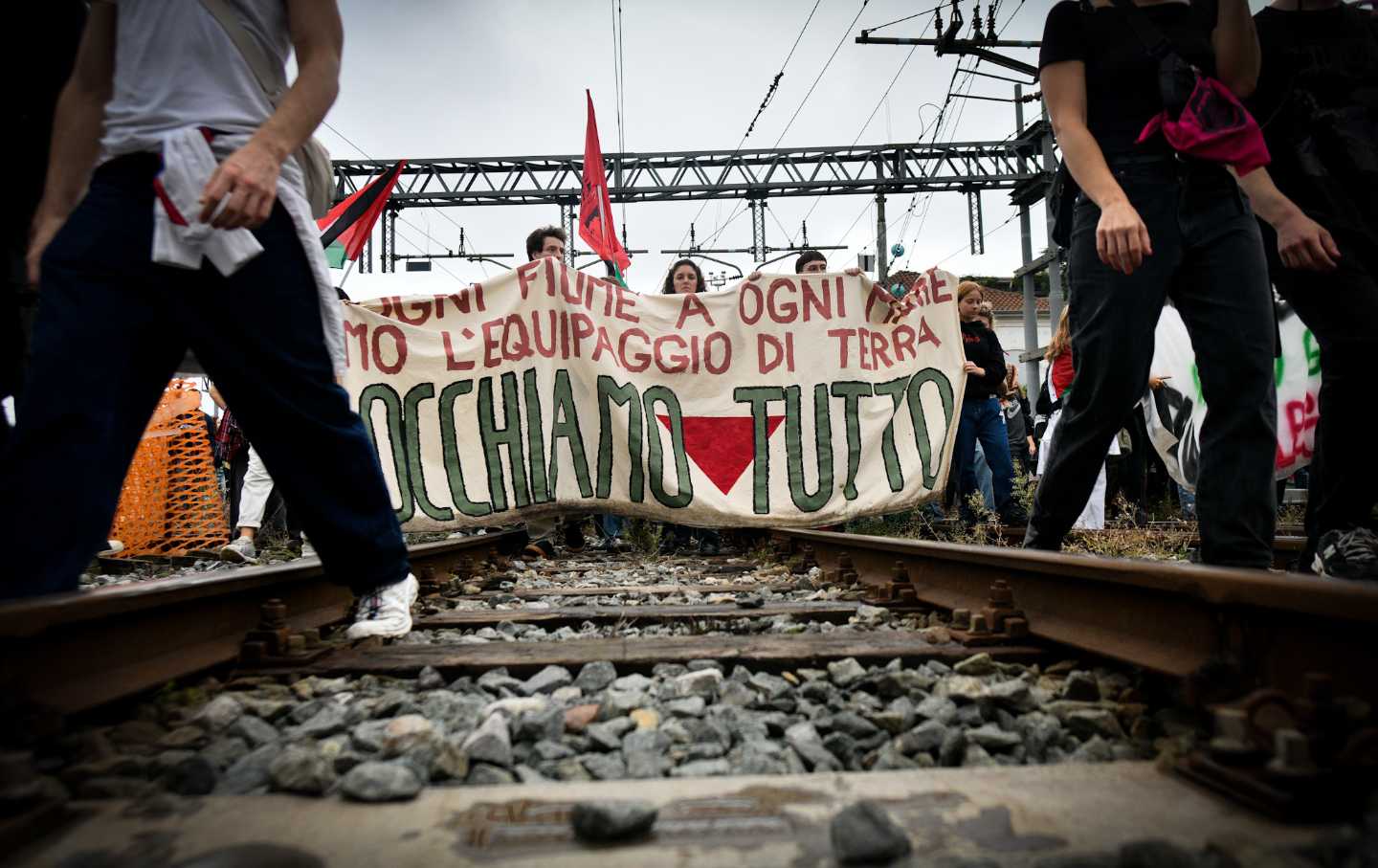
Protesters occupy the tracks of Turin’s train station during the General Strike for Palestine on September 22, 2025.
(Stefano Guidi / Getty)
Last week, as the Israeli military continued to annihilate the Gaza Strip, a 24-hour general strike rocked the Italian peninsula. Demanding an end to Italy’s complicity in the genocide, half a million people abandoned their workplaces, schools, and universities in over 80 cities across the country, inspired by a single slogan: “Blocchiamo tutto.” (“Let’s block everything.”)
The precise number of participants will remain a matter of contention, but the scale and efficacy of the September 22 strike exceeded all expectations. As the protesters swelled in number, it became easier to manage a blockade of strategic points across the country. In addition to the dozens of cities where urban traffic was severely disrupted, highways were obstructed in Turin, Florence, Bologna, and Rome, train tracks invaded in Turin, Naples, and Milan, and subways halted in Brescia and Milan.
Finally, ports were blocked in Genova, Trieste, Venice, Livorno, and Salerno. Dockworkers’ pro-Palestinian activism was absolutely crucial to the strike, not just because of their support of the Global Sumud Flotilla, which is sailing toward Gaza with supplies. Dockworkers are uniquely capable of disrupting production across Italy and impeding the continued flow of weapons and other military technologies from European ports to Israel.
Following the United States and Germany, Italy has become the third-largest supplier of weapons to Israel in the world. The country also supplies vast amounts of dual-use materials (that is, goods with both civilian and military applications) such as ammonium nitrate, a key component in the production of explosives, and radioactive isotopes that are generally used in thermonuclear weapons.
Italy’s continued military collaboration with Israel is not the only issue that motivated the general strike. In the past months, this government’s behavior on the international stage has also been the subject of fierce criticism. In general, the country’s diplomatic posture since October 7 has been aimed at preserving a delicate equilibrium: protecting its commercial ties with Israel and diligently following Trump’s lead while making sure not to upset well-established diplomatic relationships with the Arab nations. Since the start of the war on Gaza, Italy has abstained on several important UN resolutions regarding Palestine. Two days after the general strike, Prime Minister Giorgia Meloni declared herself open to the recognition of a Palestinian state (pending the release of all hostages and the denial of any official role for Hamas).
This empty posturing has a second purpose in domestic politics. Like many other governments across the West, Meloni’s coalition has found it increasingly hard to defend Netanyahu’s actions. Though the two leaders share many political affinities, a May 2025 poll showed that only 28 percent of Meloni’s electorate holds positive views on the Israeli prime minister. Her administration has responded by directing occasional tepid criticism at Netanyahu, while framing popular opposition to the genocide as an expression of far-left ideologies and antisemitic movements united by a hatred of Western values.
As a consequence, a protest hundreds of thousands strong across the entire country was buried under headlines and proclamations focused solely on the skirmishes between police and protesters in Milan. Italy’s most widely read newspaper, Il Corriere della Sera, opened its front page with the headline “Guerrilla warfare in Milan over Gaza.” Meloni, on the other hand, summarized the enormous mass demonstrations by tweeting that the events in Milan were “shameful.”
Yet the mainstream media’s failure to frame these protests is only matched by its failure to control the narrative on Israel. According to a British YouGov poll, in June 2025, only 9 percent of Italians still believed Israel’s attacks on Gaza were justified, the lowest number among dwindling figures across Europe. The videos of drivers honking in approval or displaying improvised Palestinian flags while stuck on Italy’s roads during the strikes have gone viral across the country, effectively creating a grassroots counternarrative that corrects the record on public sentiment.
What remains to be seen is whether these protests can successfully pressure Meloni’s government into changing its stance toward Israel. The general strike, made possible thanks to the efforts of a number of different unions and activist groups, exceeded any one organizational identity. In fact, Italy’s most important national trade union, the Confederazione Generale Italiana del Lavoro (CGIL), was conspicuous for its absence from the strike. The CGIL decided to call its own, nonaligned strike on Friday, September 19, which proved to be a serious strategic mistake. This blunder is a telling example of the legitimacy crisis gripping the country’s governing classes.
At present, however, there seems to be little space for the resolution of such a crisis, especially on the left. In fact, the events of the last few months seem to have accelerated it: Not a rally goes by without the flags of Italy’s main center-left party (Partito Democratico) being heckled by other protesters. Unable to control the framing of the discourse, unwilling to take a radical stance on one of the defining issues of the moment, the institutional Italian left has lost much of its political credibility, especially among younger generations.
What will happen to the political capital that was mobilized from the bottom up so effectively for this general strike? There are reasons to be optimistic. Firstly, because hundreds of thousands found a collective voice that had long been lost, reclaiming an idea of the general strike as a form of political action that can go beyond sectoral interests. Second, because it is clear that protesters do not regard Gaza as an isolated humanitarian issue confined to a distant place. Instead, they see it as a symbol of Western double standards and moral bankruptcy, and understand how it’s tied to a wider mobilization against Europe’s rearmament and the austerity that will inevitably be imposed in its name.
Of course, movements like these have dissipated before, especially when lacking strong organizational identities. After Israel’s nighttime drone attack on the Sumud Flotilla on September 23, this vast, sprawling movement will need to prove it can keep up the momentum and ratchet up the stakes. Genoese dockworkers are rising to the occasion by threatening a total block on trade to Israel. As these words were being written, Italian Defense Minister Guido Crosetto decided to send a military frigate to assist Italian citizens present in the flotilla, expressing “the strongest condemnation” for the attack they endured. If the protesters needed a reason to believe that their actions can have an effect, he just gave them one.
Become a Sustaining Donor This September
Between the reemergence of right-wing red-baiting and Donald Trump’s use of the chilling National Security Presidential Memorandum–7 to criminalize left political organizing, we’re seeing McCarthyism reborn before our eyes.
This assault on democracy cannot be ignored or wished away. Resisting it requires bravery in the face of threats and repression, a steadfast commitment to the truth, and the unwavering belief that we can—and will—overcome this darkness.
We must have an independent media that sets the record straight, unearths corruption and abuses of power, and advances a politics of justice and dignity for all if we’re to win this fight.
That’s why I’m writing to you today. This September, The Nation needs to add 100 monthly donors to sustain our progressive journalism. Your contribution makes the next investigative report, the next truth-speaking column, and the next pathbreaking essay all possible.
I hope you’ll support our work with a recurring donation today. If you donate $10 or more a month, we’ll send you a brand new “Hands Off the Free Press!” sticker to recognise your commitment to our cause. Please, donate today.
Onward,
Katrina vanden Heuvel
Editor and Publisher, The Nation
More from The Nation
The AfD’s Rise Isn’t Just About East Germany The AfD’s Rise Isn’t Just About East Germany
The Alternative für Deutschland has a stable national poll lead, including in the former West Germany. Its rise owes to much more than Eastern grievances.
Chinese Development Is the Betrayal Washington Cannot Forgive Chinese Development Is the Betrayal Washington Cannot Forgive
The prospects for Xi Jinping’s visit are dim because American leaders are blaming China for the failures of globalization.
Pinochet: The Verdict of History in the Letelier-Moffitt Case Pinochet: The Verdict of History in the Letelier-Moffitt Case
An act of international terrorism on the streets of Washington, DC, still reverberates 50 years later.
How to Arrest Benjamin Netanyahu How to Arrest Benjamin Netanyahu
Make no mistake: The United States can seize Netanyahu for crimes under US law and prosecute him in US courts when he is in New York City this week.
In the Age of AI, Nuclear Weapons Abolition Is a Renewed Imperative In the Age of AI, Nuclear Weapons Abolition Is a Renewed Imperative
As long as we have nuclear weapons, the job of ending humanity will continue to be as easy as the push of a button—or an AI agent hacking into a nuclear command-and-control system...
These Students Are Shaping UN Human Rights Policy These Students Are Shaping UN Human Rights Policy
Princeton undergraduates are helping the organization develop standards for post-mortem digital privacy and death in custody.

