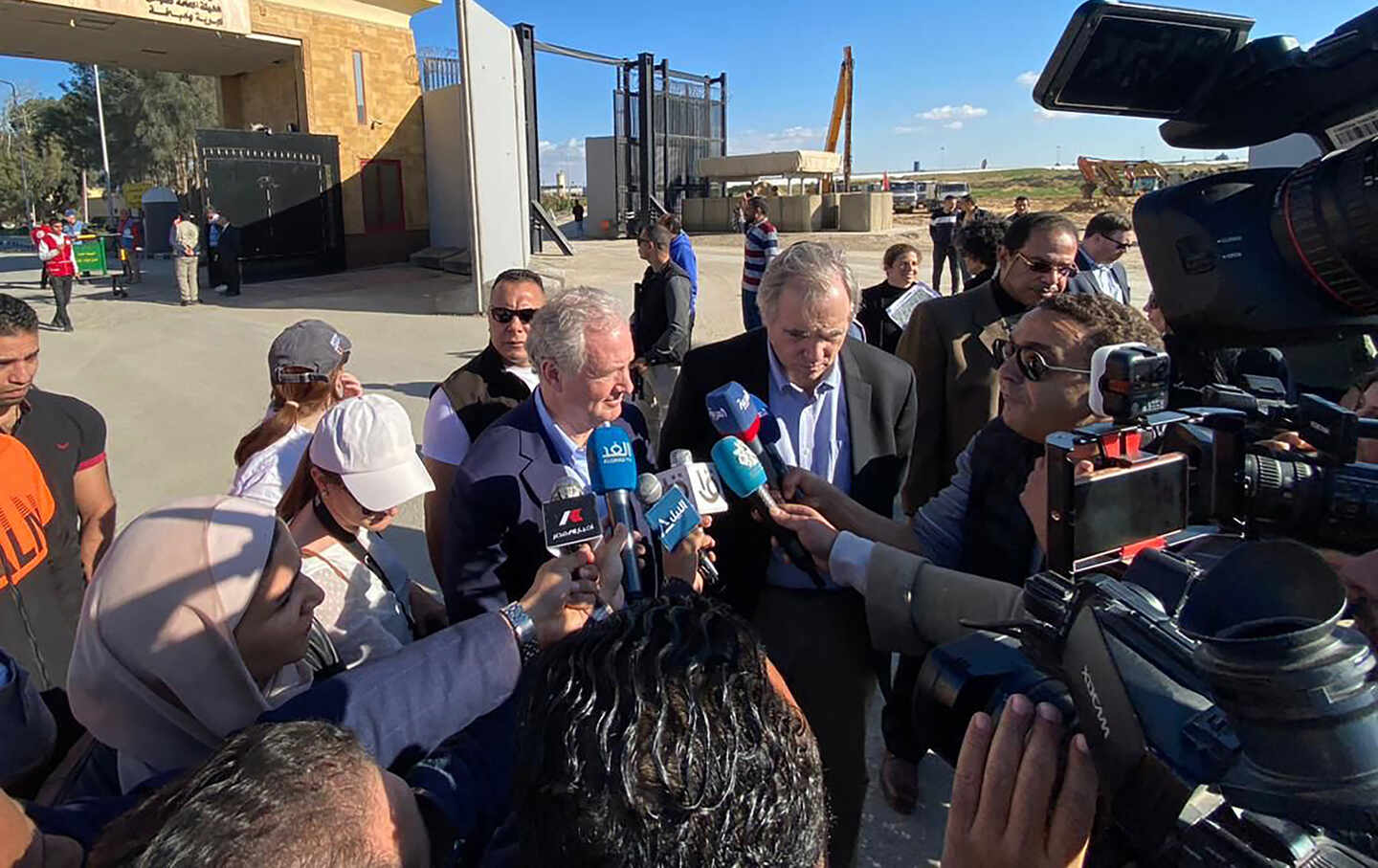
US Senators Chris Van Hollen (C-L) and Jeff Merkley (C-R) talk to the press as they visit the Egyptian side of the Rafah border crossing with the southern Gaza Strip along with a US delegation on January 5, 2024.
(AFP via Getty Images)Jeff Merkley is a progressive Democrat who has represented Oregon in the Senate since 2009.
This interview has been edited and condensed. The full audio and transcript can be found at the Start Making Sense podcast.
Jon Wiener: Recently you went to the Rafah border crossing, between Gaza and Egypt—it’s one of the very few ways for anyone to get into or out of Gaza, and is the principal route for delivery of humanitarian aid. Why did you go, and what did you see?
Jeff Merkley: Senator Chris Van Hollen and I felt like we should try to understand the humanitarian issues, and the best way to do that was to go to Gaza. We tried to get into Gaza. We tried every possible strategy. But quite frankly, none of the governments wanted to risk letting two senators in. We were the only two members of Congress, I believe, who have made it to Rafah Gate.
At Rafah, you can talk to the people who are coming out of Gaza through the gate. You can talk to the truck drivers waiting to get in. You can talk to all the humanitarian aid workers who are seasoned professionals about what’s going on inside. We came back with powerful insight into, an understanding of, the many, many barriers that Israel has set up to efficient delivery of aid: truck drivers who have to stay with their trucks for a week, from the time they pick up a load, get it inspected, and get permission to enter into Gaza. And then the great difficulty they have transferring aid to Palestinian trucks. They don’t want their own trucks damaged. Palestinian trucks, Palestinian drivers who know the area, those drivers are having enormous difficulty figuring out how they can safely deliver aid. The result is that even though there have been some modest improvements, like opening Kerem Shalom, the number of trucks stayed way too low to provide the basic necessities.
So that is the big message: Israel has a clear strategy, a convoluted inspection process, and a failure of deconfliction. By deconfliction, I mean coordinating with the suspension of military activities along the path to warehouses so that supplies can be safely delivered to hospitals and warehouses. You combine all this together, and the humanitarian workers who have been in the worst-conflicted zones in the world told Senator Van Hollen and me that this was far worse than anything they’d ever seen anywhere.
JW: You called for a cease-fire back in mid-November. You were only the second senator to do that. Dick Durbin of Illinois was the first. Even now, in February, only five senators have called for a cease-fire. The five include Elizabeth Warren, but do not include Bernie Sanders. Are there any prospects for more support in the Senate for a cease-fire?
JM: This call has come with many different words. Some have used the term “humanitarian pause.” Some have called for a “cessation of hostilities.” Some have called for “a cease-fire with conditions.” Indeed, no cease-fire would be sustainable if there’s not a release of hostages, if there’s not a transition in terms of Hamas controlling Gaza.
The reason I wanted to use the term “cease-fire” was because of the horrific damage to civilians. The US, time and time again, called on the Netanyahu government to use a much more targeted approach. The US went through this in Fallujah. We used an untargeted approach and then stopped and said, “No, this is not OK,” the amount of damage that’s being done to civilians, and then spent months working out a much more targeted strategy in that war.
But despite the president weighing in, and Secretary of State Blinken, and Secretary of Defense Austin, and many other members of the Biden team, Israel has said, “No, we’re going to continue this strategy with its massive civilian casualties, massive hunger, massive potential for disease—because that’s what we want to do.” They’ve given the stiff arm to the Biden administration.
JW: So what is to be done right now?
JM: I’m now calling on the Biden administration to launch Operation Gaza Rescue: the direct provision of aid to the 14 remaining hospitals, direct provision of food and water at various points along the 40-mile coastline—because we are tied into this catastrophic humanitarian collapse in Gaza, and we all have a responsibility. We tried to solve it through encouraging and urging Israel to change its strategy. That has failed. So we should intervene directly now and supply massive quantities of aid using our military assets offshore for delivery by sea.
Support independent journalism that does not fall in line
Even before February 28, the reasons for Donald Trump’s imploding approval rating were abundantly clear: untrammeled corruption and personal enrichment to the tune of billions of dollars during an affordability crisis, a foreign policy guided only by his own derelict sense of morality, and the deployment of a murderous campaign of occupation, detention, and deportation on American streets.
Now an undeclared, unauthorized, unpopular, and unconstitutional war of aggression against Iran has spread like wildfire through the region and into Europe. A new “forever war”—with an ever-increasing likelihood of American troops on the ground—may very well be upon us.
As we’ve seen over and over, this administration uses lies, misdirection, and attempts to flood the zone to justify its abuses of power at home and abroad. Just as Trump, Marco Rubio, and Pete Hegseth offer erratic and contradictory rationales for the attacks on Iran, the administration is also spreading the lie that the upcoming midterm elections are under threat from noncitizens on voter rolls. When these lies go unchecked, they become the basis for further authoritarian encroachment and war.
In these dark times, independent journalism is uniquely able to uncover the falsehoods that threaten our republic—and civilians around the world—and shine a bright light on the truth.
The Nation’s experienced team of writers, editors, and fact-checkers understands the scale of what we’re up against and the urgency with which we have to act. That’s why we’re publishing critical reporting and analysis of the war on Iran, ICE violence at home, new forms of voter suppression emerging in the courts, and much more.
But this journalism is possible only with your support.
This March, The Nation needs to raise $50,000 to ensure that we have the resources for reporting and analysis that sets the record straight and empowers people of conscience to organize. Will you donate today?