
These Kids in Gaza Are Starving. So Are Their Mothers.
“There’s not enough food for me, so how can I have enough milk for her?” one woman says.
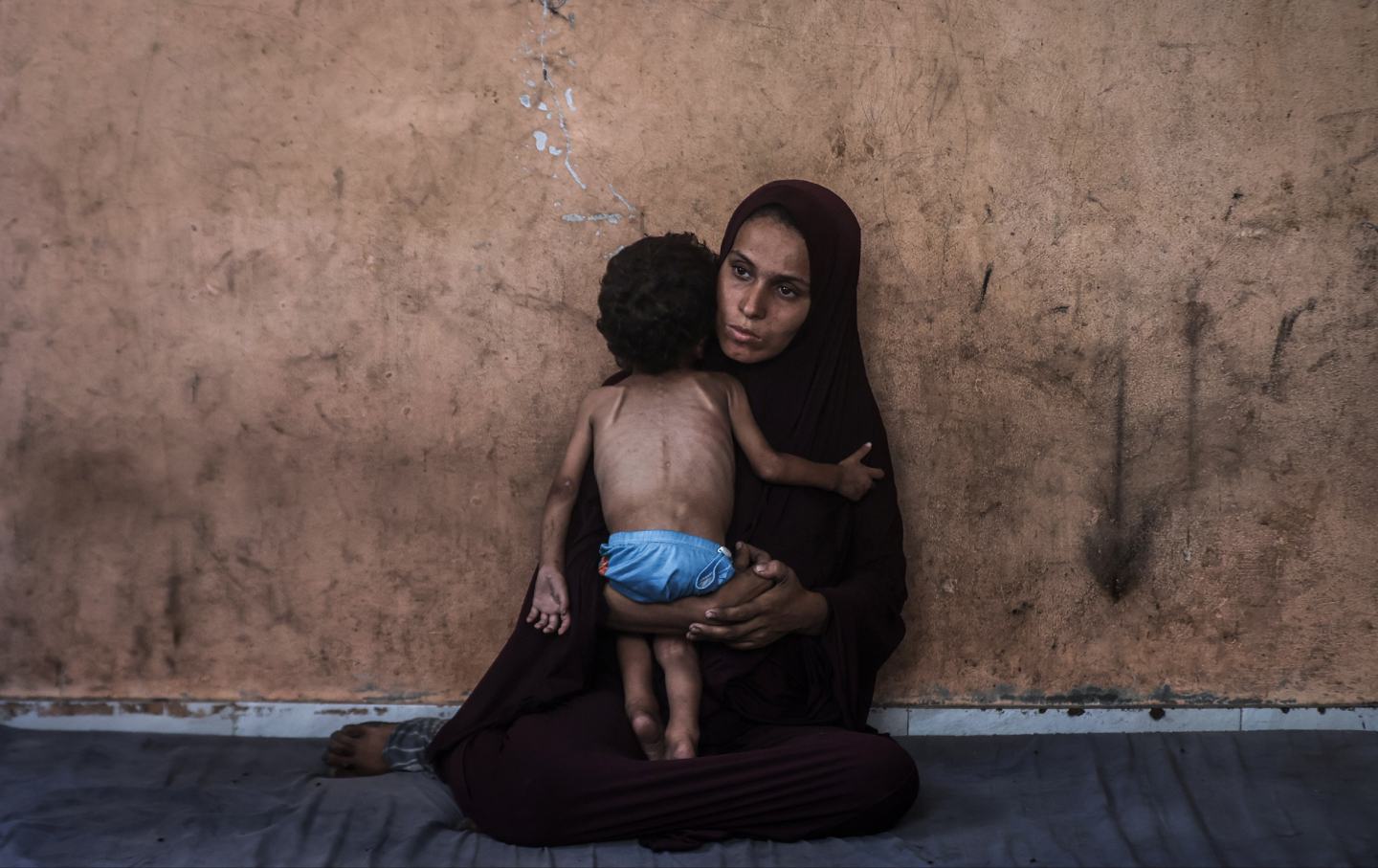
2-year-old Palestinian Yezen Abu Ful, whose health has deteriorated due to lack of access to food and nutritional supplements, is seen with his mother in the Al-Shati Refugee Camp in the Gaza Strip on July 24, 2025.
(Ali Jadallah / Anadolu via Getty Images)For the last year, I’ve been in constant correspondence with my friend Riham, a 24-year-old mother of a 1-year-old girl in Gaza. Riham, who lives in Gaza City, gave birth during the war. She had to make her way to the hospital in Nuseirat while she was displaced in Deir Al Balah, nearly five miles away. She got into an ambulance and rode across the city, unsure whether she’d make it to the hospital alive or whether her baby would be born into a world that was still standing. The delivery, which took place through constant bombing, was terrifying and traumatizing.
Now, as mass starvation grips Gaza, Riham is struggling to find enough to feed herself and her girl. She crushes up rice if it’s available. She waters down lentils. She does what she can with whatever scraps are left.
At the moment in Gaza, baby formula is nowhere to be found. And when it is, it’s too expensive for most people to afford. “I breastfeed when I can, but I’m barely eating. There’s not enough food for me, so how can I have enough milk for her?” she says. “[My daughter] should weigh more. She needs real food, eggs, fruits, and vegetables, but we can’t find any of it.” She’s tried giving her daughter supplements, but even those are hard to find, and the ones that do exist are much too expensive for a young mother with no home, no income, and a baby depending on her.
Riham’s heartbreak resonates with my own experiences in Gaza. I used to go hungry to feed my son, who was only two and a half when the war began. It’s devastating to watch any child grow up without the most basic of needs, like clean water, food, medicine, and safety, let alone having to endure the trauma and terror of waking up to the sound of explosions.
My family and I have now left Gaza, and I have had another baby. But I still hear from mothers who have not been able to flee. Their lives are only getting worse.
Another friend of mine, Sundus, has two children—Maria, 5, and Hamza, 3. She is sheltering in Gaza City. Every time she tells me stories about how her day went, I hear my own pain echo back. “My children’s health has definitely worsened. Their immunity became very weak, and they kept getting sick, so I took them to the clinic often. Any virus or bacteria around us really affects their health,” she says.
Sundus stopped eating bread when Gaza’s famine began, so that she could give the children the food instead. “If I don’t, they start crying, and I can’t stand seeing them cry,” she says. Her kids are now tiny, with fragile bodies that haven’t been given a chance to grow healthy. “Their immunity is so weak,” Sundus says. “Any virus or bacteria gets to them immediately. They’ve lost weight. I took them to the clinic again and again.”
But there are only so many times you can visit a clinic when medicines have run out and the doctors are overwhelmed. So, like many mothers now, Sundus began to improvise. She would cradle her children in her arms each time a strike rattled the house. She would lie with them until they stopped shaking. When food was scarce, she’d hide away whatever small portion she had so they would never go to bed hungry.
She managed to keep diapers for her son Hamza as long as she could, even as their prices skyrocketed. “I had no choice,” she says. “Now he’s older and doesn’t need them, thank God.” But there’s no relief in that kind of independence. It didn’t come naturally or slowly. It came all at once—war forcing toddlers to grow up fast, to stop needing things their mothers could no longer provide.
Riham says something I’ve heard from almost every mother in Gaza—that they have to pretend they’re okay: “We try not to show fear so our children can feel some safety, even when nothing is safe.” I used to do that with my child as well.
The strength in these women is enormous, but it’s not the kind of strength anyone should be forced to carry. They aren’t warriors or saints. They’re just mothers who are tired. “I hope God compensates my daughter,” Riham says, “for every day she spent hungry, afraid, without a real childhood.”
Mothers in Gaza are pretending not to be scared. Their children flinch at the sound of doors slamming. Their infants look out on the world with sunken eyes. Their toddlers aren’t crying anymore when there’s no dinner. Everyone has learned to go quiet.
What’s horrifying is how normal these conditions have become. Running out of baby formula isn’t a headline anymore. Aid trucks that are counted in press releases but don’t arrive in neighborhoods pass without notice. Mothers cradling their kids through a missile strike doesn’t even feel exceptional now.
Sometimes, when the kids are finally asleep, mothers allow themselves a moment. “I want to give her a real life,” Riham says, her voice trembling. “A life with toys. A life with light.” Sundus, too, dreams of a future. She doesn’t have the luxury of grand hopes, but she holds on to small ones, like clean water, a fresh apple, quiet nights. “I just want to keep them safe,” she says. “And I want them to feel happy again.”
Sundus says there was one morning when her children asked for the simplest things: a pacifier, a toy, a piece of candy. But there was absolutely nothing in the markets. “That was the moment I broke,” she tells me. “I couldn’t give them anything. Not even that.”
Riham’s home was bombed early in the war. She now lives with her in-laws in the remains of their damaged building. “My mother-in-law helps me with my daughter sometimes,” she says. “But it’s hard. Everything is hard.”
When her daughter caught a chest infection and the flu a few weeks ago, Riham was prescribed to give her nebulizer treatments five times a day. But she didn’t have a nebulizer. The electricity was out, and the bombing outside made it impossible to go to a clinic at night. “She was wheezing, and I couldn’t help her,” Riham says. “I just held her and prayed. I’ve never felt so helpless in my life.” Sundus tells me she often feels like her body is collapsing. She lives on vitamins when she can find them. “I’m always tired, always dizzy,” she says. “There’s nothing left in me, but I still have to get up and do everything. I have no other choice.”
“We’re moody all the time,” Sundus says. “One minute angry, the next crying, the next trying to act normal for the kids. Some days, I feel like I want to die. Some days I just hold my children and hope the next bomb misses us.” She says she sometimes wishes she could hide her children inside her eyes and keep them there, safe, where nothing could ever touch them. There is nothing poetic about that image when it comes from a place like Gaza. It’s the logic of war. “You start wishing your children were part of your body again, back inside the womb, or behind your ribs, or in your eyes, just so you can shield them from a world that wants to break them,” Sundus says.
Popular
“swipe left below to view more authors”Swipe →Even the most basic acts of care have become impossibly complicated. Diapers now cost over $100, if found at all. Riham tells me she has to use makeshift alternatives, but they cause rashes, which need creams that don’t exist. “If I go to the clinic,” she says, “they don’t even have the right medicine. Everything is missing.” The longer the war drags on, the more this becomes a slow, grinding form of collapse.
Flour is now a rare and expensive commodity. Bread—plain, unseasoned bread—has become a symbol of privilege. Mothers in Gaza are asking for enough food to nourish their babies, for medicine to bring down a fever, shelter that doesn’t shake every night, and for the war to stop before their children stop growing, before their own bodies give out.
Sundus says something that stays with me: that her life has become “bombings, massacres, martyrs,” punctuated by the desperate scramble for bread. “We just want the war to end,” she says. “After that, everything else can fall into place.”
When I speak to these women, I understand that the war will not simply end even if there’s a ceasefire tomorrow. Their minds, bodies, memories, and even children are too damaged to heal anytime soon. The war has already rewritten their bodies, stolen years of growth from their kids, and left behind mothers who feel emptied out. Every day is another impossible decision. Which need is more urgent: food, medicine, safety, or rest? Every day is another inch deeper into exhaustion.
When I ask Riham what scares her the most, she says, “Losing my daughter. Losing my family. We could die at any moment.” The war has crept into every corner of their lives. “I’m always afraid,” she says. “Always imagining what might happen next. Always thinking, will this be the night we don’t survive?” There’s no future to look forward to either, or structure to hold on to. “You feel stuck,” she says. “Like the days just pass. You don’t know what to do anymore.”
What Riham wants most is not grand. She’s not asking for revenge, or even justice. She’s asking that her daughter be allowed to have a normal life. “I want her to grow up with food to eat,” she says. “To play outside, to be safe, nothing more.”
But even that feels impossible. “We can’t take our children out to walk, and definitely not to have a fresh breath of air,” she says. “There’s bombing everywhere. It can strike anywhere, at any time.” In Gaza now, danger doesn’t follow a pattern. There are no zones of safety, or any guaranteed hours of calm. People are being killed in markets, in mosques, in their sleep. Children die while coloring, while eating, while hiding under the stairs.
The last time Riham received food aid was five months ago. A shipment from the World Food Programme. Since then, nothing. “The crossings closed, prices rose, and we’re left with nothing.” And still, she clings to the wish that someday her daughter will have a life that looks nothing like this one, one where children laugh out loud without being shushed, no mother counts calories to stretch her breast milk, where medicine isn’t locked behind a border crossing, and diapers aren’t more expensive than gold.
Both Riham and Sundus, like many other mothers in Gaza, know wishes are fragile in Gaza. “This life we are living is not right. We deserve life,” Riham says. Gaza’s mothers deserve to be something much more than symbols of heroism and extraordinary strength. We want only, and simply, to be mothers raising our children, in a place designed to break both.
Become a Sustaining Donor This September
Between the reemergence of right-wing red-baiting and Donald Trump’s use of the chilling National Security Presidential Memorandum–7 to criminalize left political organizing, we’re seeing McCarthyism reborn before our eyes.
This assault on democracy cannot be ignored or wished away. Resisting it requires bravery in the face of threats and repression, a steadfast commitment to the truth, and the unwavering belief that we can—and will—overcome this darkness.
We must have an independent media that sets the record straight, unearths corruption and abuses of power, and advances a politics of justice and dignity for all if we’re to win this fight.
That’s why I’m writing to you today. This September, The Nation needs to add 100 monthly donors to sustain our progressive journalism. Your contribution makes the next investigative report, the next truth-speaking column, and the next pathbreaking essay all possible.
I hope you’ll support our work with a recurring donation today. If you donate $10 or more a month, we’ll send you a brand new “Hands Off the Free Press!” sticker to recognise your commitment to our cause. Please, donate today.
Onward,
Katrina vanden Heuvel
Editor and Publisher, The Nation
More from The Nation
Pinochet: The Verdict of History in the Letelier-Moffitt Case Pinochet: The Verdict of History in the Letelier-Moffitt Case
An act of international terrorism on the streets of Washington, DC, still reverberates 50 years later.
How to Arrest Benjamin Netanyahu How to Arrest Benjamin Netanyahu
Make no mistake: The United States can seize Netanyahu for crimes under US law and prosecute him in US courts when he is in New York City this week.
In the Age of AI, Nuclear Weapons Abolition Is a Renewed Imperative In the Age of AI, Nuclear Weapons Abolition Is a Renewed Imperative
As long as we have nuclear weapons, the job of ending humanity will continue to be as easy as the push of a button—or an AI agent hacking into a nuclear command-and-control system...
These Students Are Shaping UN Human Rights Policy These Students Are Shaping UN Human Rights Policy
Princeton undergraduates are helping the organization develop standards for post-mortem digital privacy and death in custody.
The Peril of Trump’s Final Act: Would He Use a Tactical Nuclear Weapon in Iran? The Peril of Trump’s Final Act: Would He Use a Tactical Nuclear Weapon in Iran?
Trump is trapped in a war that has already been lost, a reality that he will never allow himself to admit.
A Spreading War Rattles Global Energy Markets A Spreading War Rattles Global Energy Markets
Analysts say the consequences for energy prices and the world economy may be more serious in this later phase of a war that many had expected to be largely over by now.

