
I’ve Endured Two Years of Genocide. But I’m Still Here.
The world before October 7, 2023, is a distant memory. But we carry on, fueled by the determination that this land will become a place of life once more.
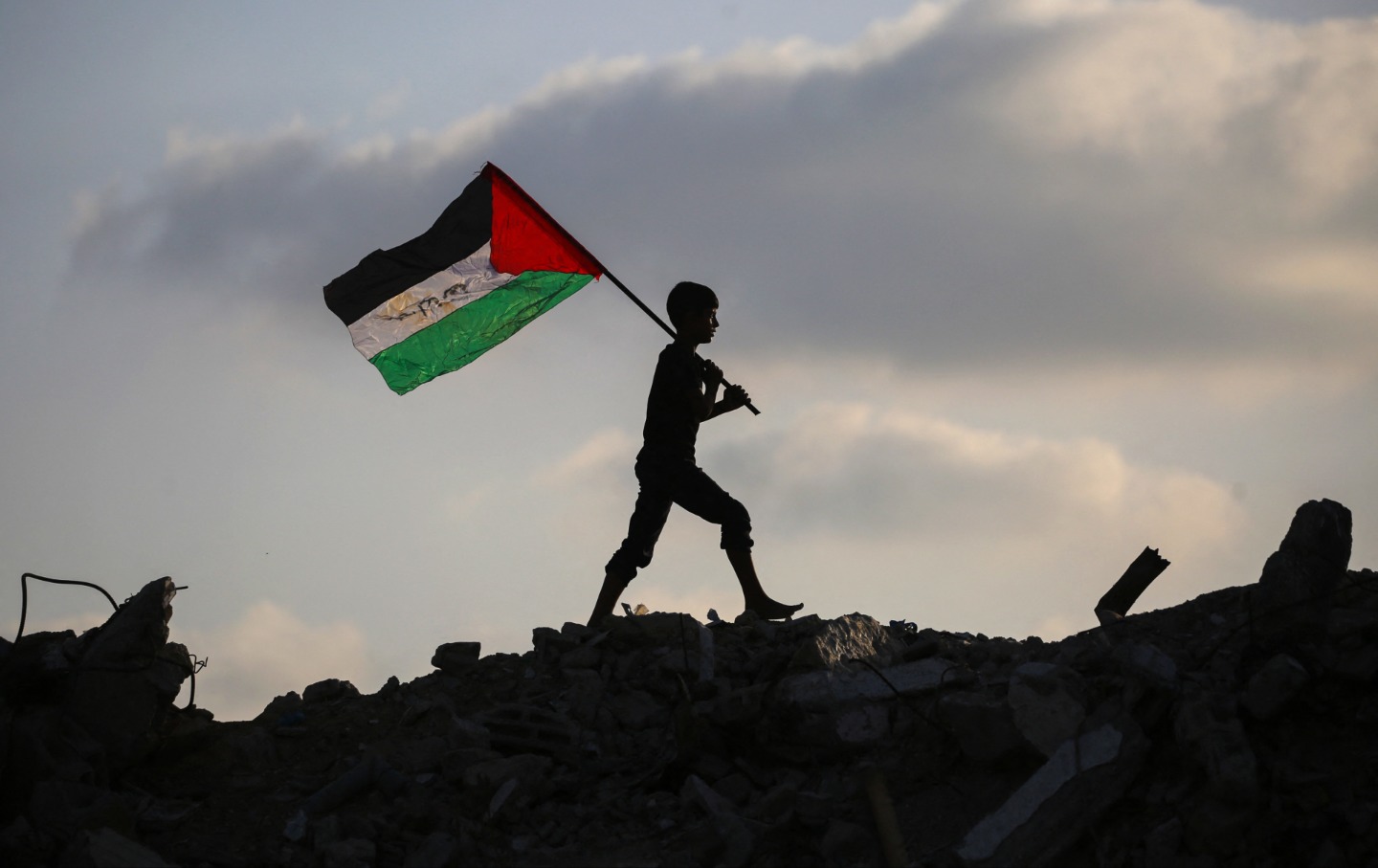
A displaced Palestinian child waves a Palestinian national flag as he walks on the rubble of a destroyed building at the Bureij camp for refugees in the central Gaza Strip on September 22, 2025.
(Eyad Baba / AFP via Getty Images)For two years, Gaza has lived through an unrelenting genocide. Life has been reduced to an endless cycle of loss and suffering in a system that spares nothing—neither human, stone, nor tree. Death is a constant presence. Day after day, we suffer from siege, hunger, bombardment, and destruction; from displacement and disorientation; from homes collapsing into rubble atop the bodies and dreams of those who once lived inside them. Loved ones vanish, leaving only photographs in place of their faces. The city itself throbs with chaos, beating as wildly as my own heart.
The world of two years ago is a distant memory. Before October 7, and despite 18 years of blockade imposed by the Israeli occupation, life still felt almost luxurious to us—ordinary, simple, and threaded with a sense of safety and freedom that survived inside our hearts. The siege narrowed our horizons, but it never robbed us of the feeling of being alive. It did not stop us from imagining a future we could build with our own hands.
On July 20, 2023, I graduated from high school. Those days were full of joy—celebrations with my friends, ceremonies that seemed endless. Soon after, I enrolled at the Islamic University of Gaza, where my father is a professor, and where he had taken me countless times as a child. The memories of walking beside him through those corridors remain vivid. I chose to major in English literature, a subject I had always loved. The world of books and new languages fascinated me, and I was eager to begin the university life I had imagined for years.
For one month, my father drove me to the university each morning, and we returned together in the afternoons. I met my friends in lectures or just after. Then the genocide came, and everything I had built collapsed. Classes stopped for nine months. On June 28, 2024, the university announced that classes would resume, but only online.
I continued with determination. Only 42 credit hours now separate me from graduation. I would say to myself over and over: This is not the university life I imagined. But I persevered, because education is a form of resistance to the occupation.
I built an inner world within my studies to escape the one outside. In my Introduction to Literature course, we were asked to follow the lectures of Dr. Refaat Alareer, the writer and poet assassinated by the Israeli military. I was never his student in a classroom, but I watched all his lectures and read everything he wrote, everything he inspired his students to write. In one video he spoke of the importance of telling stories, quoting two passages that stayed with me.
The first was about a First Nations Canadian who approached colonizers dividing up the land. When they told him, “We own this land; we are dividing it among ourselves,” he replied, “If this is your land, tell me your stories. If this is indeed your land, tell me your stories.” There was only silence in response, because they had no stories about that land—they did not truly belong.
The second was from Nigerian writer Chinua Achebe: “If the lions do not have their own historians, the history of the hunt will always glorify the hunters.” So if we don’t write our stories, as Dr. Alareer put it, ”history will always glorify the occupier and the colonizer, rather than the colonized, the oppressed, the indigenous, the rightful people of the land.“
These words pushed me to take my own step into writing. Eight months ago, I began publishing because I felt it was my duty to tell the stories of my people. Reading and writing have been my talents since childhood, but under the ongoing Israeli genocide they became both my therapy and my weapon.
For the past eight months, I have written about the daily experience of this genocide and about those I have lost. The occupation did not only kill our dreams; it killed my loved ones one after another. Each name marks an emptiness that cannot be filled, each memory lives in my texts and my heart: my dearest friends Shimaa Saidam (19), Raghad Al-Naami (19), Lina Al-Hour (19), Mayar Jouda (18), Asmaa Jouda (21), along with members of my family: my aunt Asmaa, my uncle’s wife Neveen, my cousin Fatima, my uncle Abd al-Salam and his children Huthaifa (13) and Hala (8). When I look at their photos I do not see mere images—I see faces full of affection, warmth, and life.
Then, I turned to writing about the destruction of schools and universities by the Israeli occupation, including the Islamic University itself, and about the teachers and professors who were killed, leaving behind an academic and spiritual void. I wrote about displacement, which has become part of our daily existence—I personally was displaced five times: one month in Khan Younis and five months in Rafah. I recounted all the homes we have lost: my uncle’s home, my grandfather’s four-story house, my sister’s six-story building—even Gaza City itself. A home is part of your identity. Every corner, every street, every room holds a story.
I also wrote about the famine caused by deliberate siege, the chronically ill denied even the medicines they needed for survival, and the children growing up amid hunger and lack of basic necessities—children who silently ask, Will we eat today? All this, while the world stands paralyzed.
Popular
“swipe left below to view more authors”Swipe →Despite the digital blockade imposed by the occupation to erase us from memory, I refused to surrender. I engaged in international programs and workshops—from Gaza to the UK, Malta, Germany, and Sweden—continuing my education and creative work through online programs that were windows to a still-living world.
All the writing I have done cannot convey the depth and breadth of our suffering. No words can adequately describe the horrors we have survived.
I am exhausted. We are exhausted. If fatigue can be worn, we are all wearing threadbare shirts. We long for the Gaza we once knew, for the lives we once lived, and for the selves we once were. All we ask is for this relentless nightmare of genocide to end, for the land to become a land again, and for us to once again embrace life, not death.
Become a Sustaining Donor This September
Between the reemergence of right-wing red-baiting and Donald Trump’s use of the chilling National Security Presidential Memorandum–7 to criminalize left political organizing, we’re seeing McCarthyism reborn before our eyes.
This assault on democracy cannot be ignored or wished away. Resisting it requires bravery in the face of threats and repression, a steadfast commitment to the truth, and the unwavering belief that we can—and will—overcome this darkness.
We must have an independent media that sets the record straight, unearths corruption and abuses of power, and advances a politics of justice and dignity for all if we’re to win this fight.
That’s why I’m writing to you today. This September, The Nation needs to add 100 monthly donors to sustain our progressive journalism. Your contribution makes the next investigative report, the next truth-speaking column, and the next pathbreaking essay all possible.
I hope you’ll support our work with a recurring donation today. If you donate $10 or more a month, we’ll send you a brand new “Hands Off the Free Press!” sticker to recognise your commitment to our cause. Please, donate today.
Onward,
Katrina vanden Heuvel
Editor and Publisher, The Nation
More from The Nation
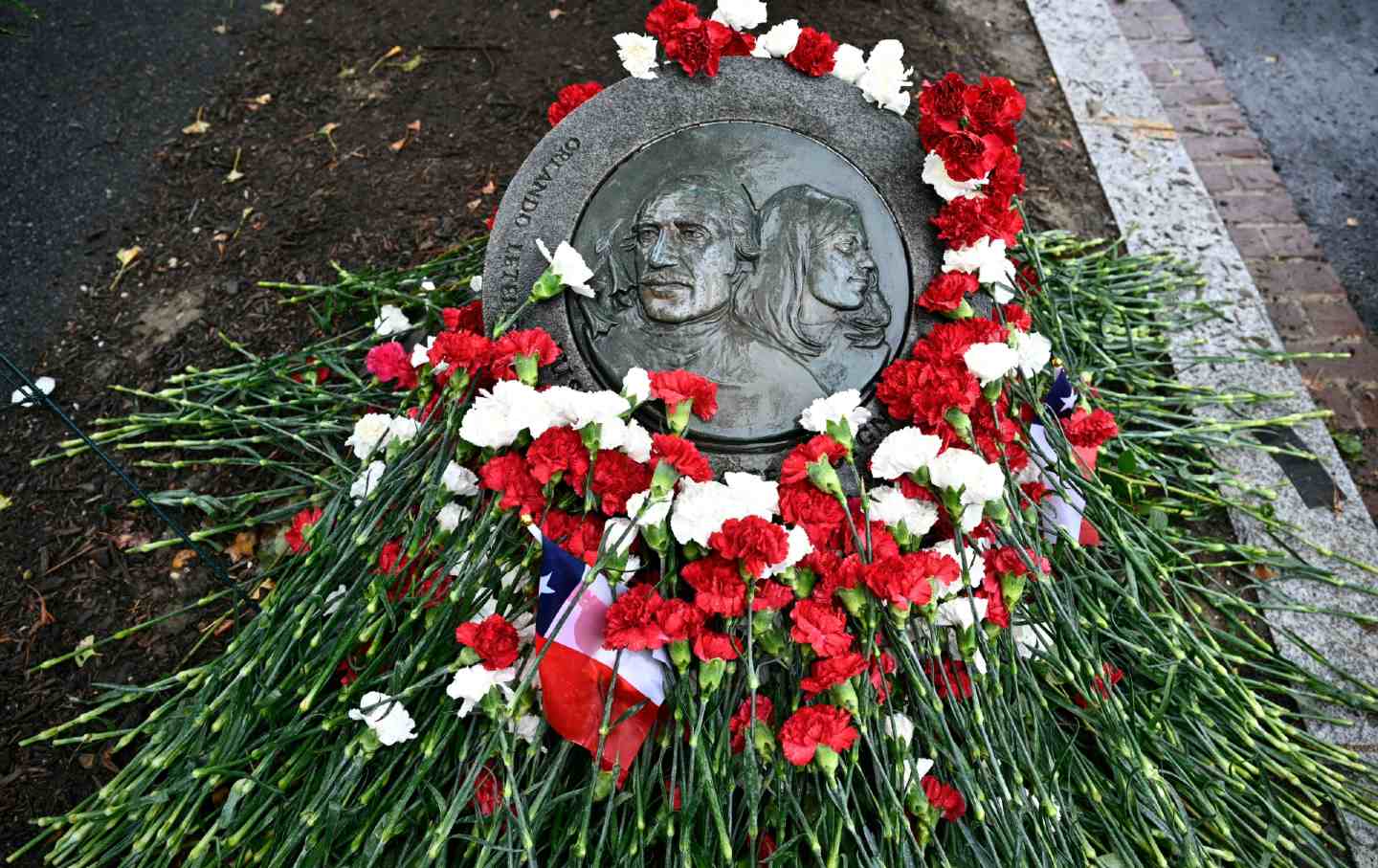
Pinochet: The Verdict of History in the Letelier-Moffitt Case Pinochet: The Verdict of History in the Letelier-Moffitt Case
An act of international terrorism on the streets of Washington, DC, still reverberates 50 years later.
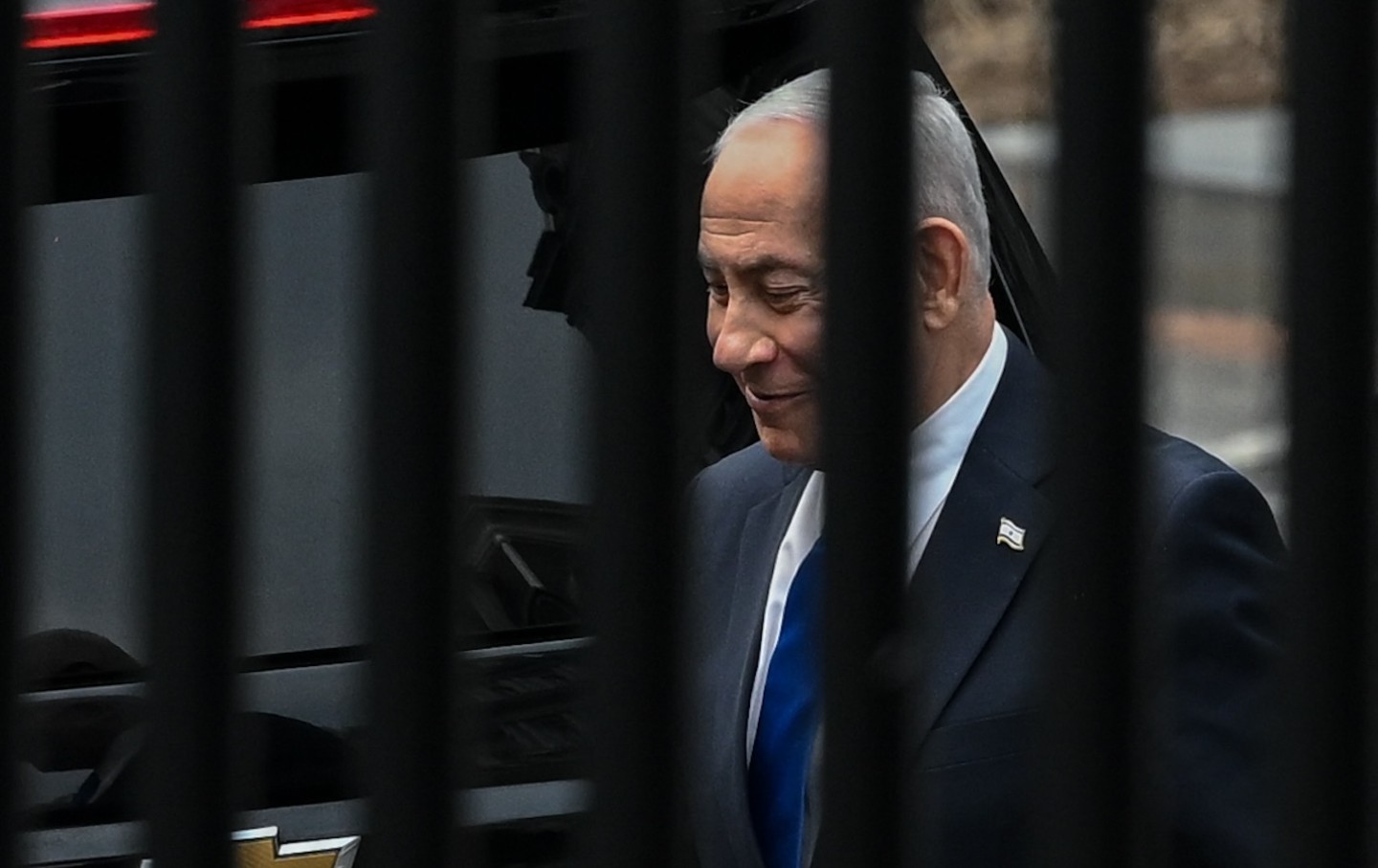
How to Arrest Benjamin Netanyahu How to Arrest Benjamin Netanyahu
Make no mistake: The United States can seize Netanyahu for crimes under US law and prosecute him in US courts when he is in New York City this week.
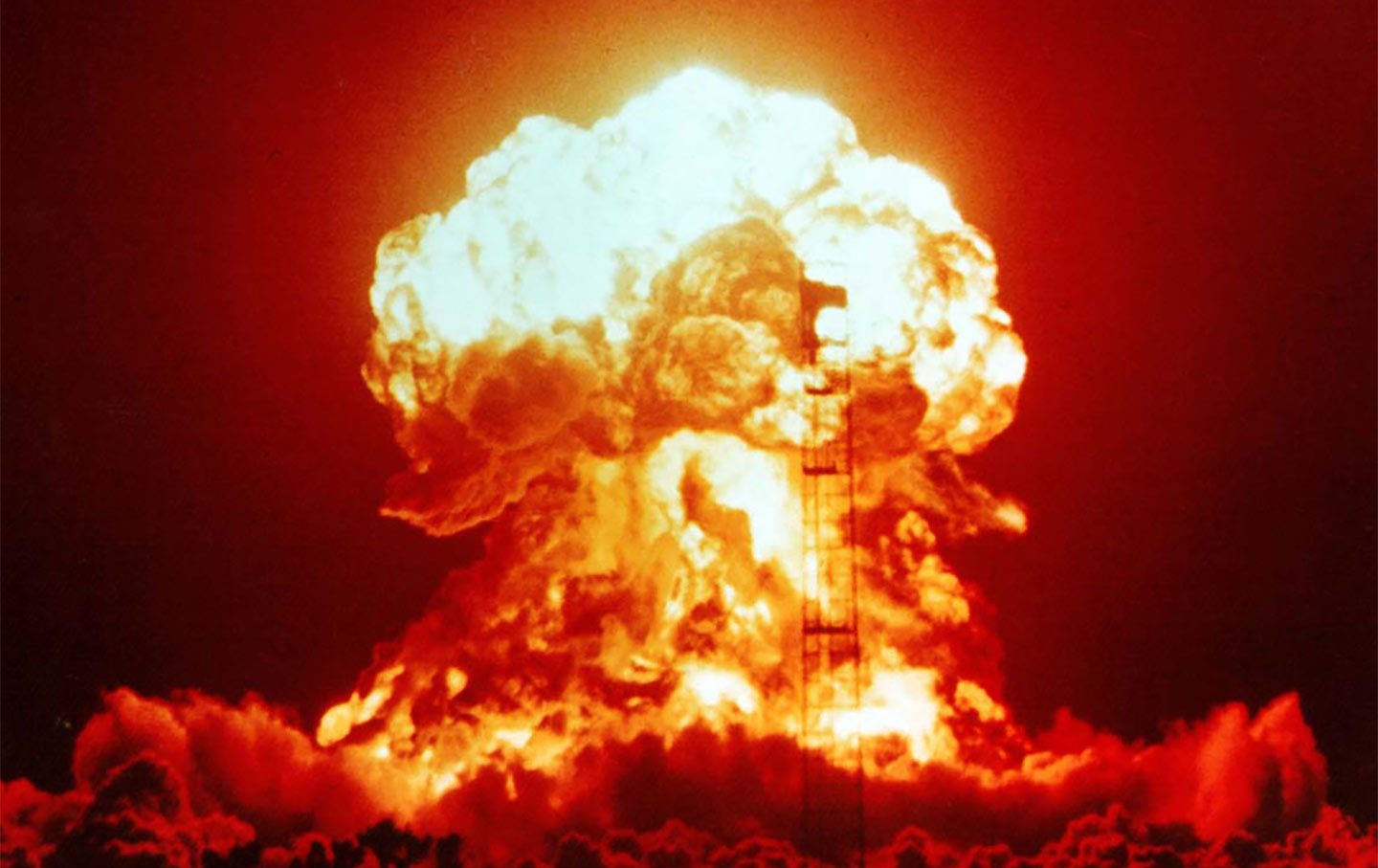
In the Age of AI, Nuclear Weapons Abolition Is a Renewed Imperative In the Age of AI, Nuclear Weapons Abolition Is a Renewed Imperative
As long as we have nuclear weapons, the job of ending humanity will continue to be as easy as the push of a button—or an AI agent hacking into a nuclear command-and-control system...
These Students Are Shaping UN Human Rights Policy These Students Are Shaping UN Human Rights Policy
Princeton undergraduates are helping the organization develop standards for post-mortem digital privacy and death in custody.
The Peril of Trump’s Final Act: Would He Use a Tactical Nuclear Weapon in Iran? The Peril of Trump’s Final Act: Would He Use a Tactical Nuclear Weapon in Iran?
Trump is trapped in a war that has already been lost, a reality that he will never allow himself to admit.
A Spreading War Rattles Global Energy Markets A Spreading War Rattles Global Energy Markets
Analysts say the consequences for energy prices and the world economy may be more serious in this later phase of a war that many had expected to be largely over by now.

