Gaza — Where Is the Law?
For decades, justice has been absent from the conflict. Will that change now?
As Israel mounted its air campaign in Gaza last month, bombs destroyed the home of my dear friend Raji Sourani, director of the Palestinian Center for Human Rights. Three days earlier, Sourani had told Democracy Now!, “I am here like an olive tree. We will never leave our homeland.” But when the bombs rained down, he wondered if he had made a mistake by refusing to leave. He hadn’t wanted “be part of new Nakba,” as he wrote to his friends after surviving.
What makes the attack on Sourani’s home particularly disturbing among all the wanton killings of the past month is that Raji, winner of the Robert F. Kennedy Human Rights Award, has for 40 years symbolized the attempt to use the law to redress Israeli crimes against Palestinian civilians, including war crimes, collective punishments, illegal settlements, and apartheid.
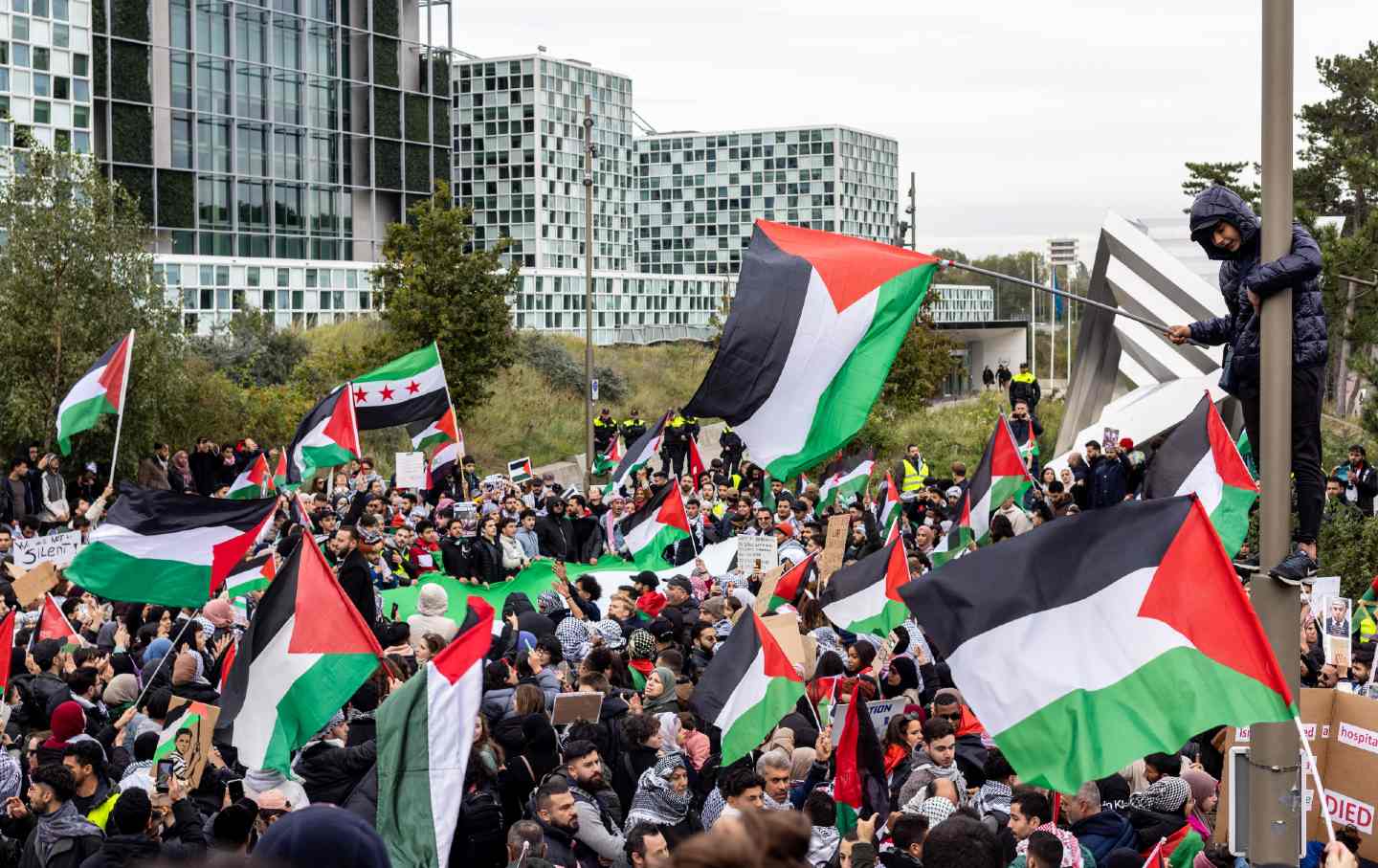
I remember sitting next to Sourani in The Hague in December 2020 when he looked the International Criminal Court prosecutor Fatou Bensouda in the eye and pleaded with her to tell Palestinians that they could trust in the ICC to heed their plight, that the court could assure them international law still had meaning for them and violence was not the only weapon they had at their disposal.
The fact is, however, that every attempt to use the ICC and other institutions to hold Israeli officials legally accountable has been sidelined or delegitimized as “lawfare.” Complaints filed in Europe against Israeli leaders on the basis of “universal jurisdiction”—the so-called “Pinochet principle” of pursuing justice in courts abroad—were not only thrown out; in some instances, the laws in question were curtailed so that such cases could not be brought again in the future.
Palestinian efforts to invoke the ICC have gotten the slow walk for the almost 15 years since the Palestinian Authority (PA) submitted a declaration accepting the court’s jurisdiction in January 2009, following Israel’s “Cast Lead” operation, which left more than 1,400 Gazans dead. Prosecutor Luis Moreno Ocampo, under strong pressure from the United States (not itself even a party to the ICC), spent three years considering whether he had jurisdiction before punting the issue to other UN bodies. After the UN General Assembly recognized Palestine as an observer state, and Palestine in 2015 ratified the ICC’s governing Rome Statute, prosecutor Bensouda conducted, in her own words, “a painstaking preliminary examination…that lasted close to five years” before opening a formal investigation in March 2021 just as her nine-year term was about to expire. By then, the Trump administration had imposed sanctions on Bensouda for her probe into alleged US crimes in Afghanistan and to deter further ICC action on Palestine. Even in 2021, when the Biden administration lifted those sanctions, Secretary of State Anthony Blinken maintained the United States’ “longstanding objection to the Court’s efforts to assert jurisdiction over personnel of non-States Parties such as the United States and Israel.”
By contrast, when Russia invaded Ukraine in February 2022, the new ICC prosecutor, the astute Briton Karim Khan, elected with strong UK and American support, made multiple visits to a country he called a “crime scene,” opened the largest investigation in the ICC’s history, and raised unprecedented amounts of extrabudgetary money and temporary staff from Western countries. Even the United States expressed its support, although the ICC was exerting jurisdiction over nationals of a country—Russia—that, like Israel and the United States, was not a party to the ICC. By March 2023, Khan had issued an arrest warrant for Vladimir Putin over the deportation of thousands of children from Ukraine.
Sourani supported the Ukraine probe but lamented at the time that the prosecutor had made no similar attempt to raise outside money to fund the Palestine investigation, never spoke about a “crime scene,” and had not apparently sought to visit Palestine. Khan announced at the ICC Assembly in December 2022 that he hoped to go to Palestine in 2023, but Israel is known to have rejected his request. The fact is that, as of today, no Israeli official has had to face international charges for crimes committed over several decades of conflict, creating a sense of impunity. After surviving the bombing of his house, Sourani told Democracy Now! he considered Khan “complicit” through his inactivity in the crimes now unfolding in Gaza. (As I write, Sourani is still in Gaza City, very close to Israeli bombs, and unable now to get out.)
In the face of the mounting atrocities and growing criticism of the ICC’s failure to comment, Khan broke his silence, however, visiting the Rafah crossing between Egypt and Gaza on October 29 and following that up with an unusually strong, emotive speech in Cairo that harked back to his soaring rhetoric following Russia’s invasion of Ukraine. He spoke in detail about Hamas’s cruel attacks and hostage-takings on October 7, which he labeled as crimes, and about the Israeli response. He made a point of warning the Israeli government that any attack liable to kill civilians must comply with principles under international law of “distinction, precaution and of proportionality.” In other words, any time the Israelis hit a house, a school, a hospital, a church, or a mosque, they needed to remember that such places enjoyed protected status—“unless the protective status has been lost…[and] the burden of proving that the protective status is lost rests with those who fire the gun, the missile, or the rocket in question.”
No prosecutor has ever spoken to Israel so bluntly. The question now is whether Khan will take action to follow up on his strong words. Will he move on the charges of apartheid and war crimes, including illegal settlements, which have been on his desk for years? Will Israel allow him to investigate on the ground? Will the United States drop its long-standing objection to the ICC’s role? Will there, finally, be room for accountability in the Israel-Palestine conflict?
Support independent journalism that does not fall in line
Even before February 28, the reasons for Donald Trump’s imploding approval rating were abundantly clear: untrammeled corruption and personal enrichment to the tune of billions of dollars during an affordability crisis, a foreign policy guided only by his own derelict sense of morality, and the deployment of a murderous campaign of occupation, detention, and deportation on American streets.
Now an undeclared, unauthorized, unpopular, and unconstitutional war of aggression against Iran has spread like wildfire through the region and into Europe. A new “forever war”—with an ever-increasing likelihood of American troops on the ground—may very well be upon us.
As we’ve seen over and over, this administration uses lies, misdirection, and attempts to flood the zone to justify its abuses of power at home and abroad. Just as Trump, Marco Rubio, and Pete Hegseth offer erratic and contradictory rationales for the attacks on Iran, the administration is also spreading the lie that the upcoming midterm elections are under threat from noncitizens on voter rolls. When these lies go unchecked, they become the basis for further authoritarian encroachment and war.
In these dark times, independent journalism is uniquely able to uncover the falsehoods that threaten our republic—and civilians around the world—and shine a bright light on the truth.
The Nation’s experienced team of writers, editors, and fact-checkers understands the scale of what we’re up against and the urgency with which we have to act. That’s why we’re publishing critical reporting and analysis of the war on Iran, ICE violence at home, new forms of voter suppression emerging in the courts, and much more.
But this journalism is possible only with your support.
This March, The Nation needs to raise $50,000 to ensure that we have the resources for reporting and analysis that sets the record straight and empowers people of conscience to organize. Will you donate today?