
Biden’s Zombie Foreign Policy Lurches Blindly Along
As global instability spreads, the president remains committed to failed strategies.
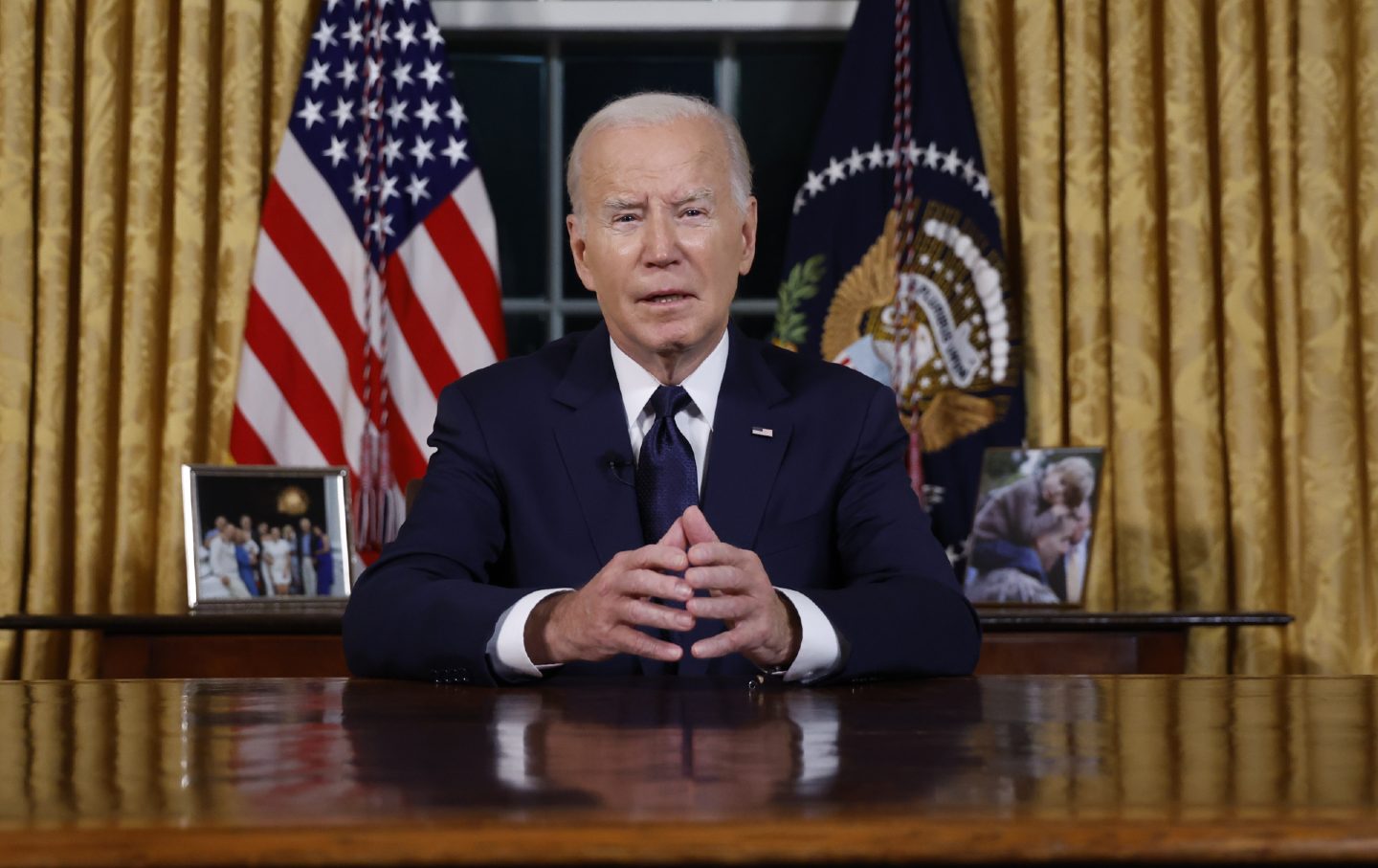
On Friday, Joe Biden delivered a lengthy foreign policy address calling on Congress to support more military funding for Ukraine and Israel. Biden linked the two conflicts, claiming that “Hamas and Putin represent different threats, but they share this in common: They both want to completely annihilate a neighboring democracy.” In making this comparison, Biden inadvertently highlighted the incoherence of his foreign policy.
It hasn’t escaped the attention of the wider world that the Biden administration is winking at Israel’s violations of international law—while simultaneously trying to build an international coalition against Russian violation of the same norms. Further, the Israeli bombing of Gaza has once again brought to the fore the problem of Palestinian statelessness, an issue Biden has tried to sideline by pushing the Abraham Accords, a policy seeking to formalize the alliance between Israel and the Arab autocracies.
With intractable and bloody conflicts continuing in Europe and the Middle East, Biden’s vaunted skill as a trusted foreign policy strategist has shown itself to be a fantasy. As his speech makes clear, Biden has nothing left but a zombie foreign policy, one that totters and stumbles forward in pure unthinking reflex, without any signs of cognition or awareness that actual unfolding events are giving the lie to the worldview underlying all its actions.
The nearly unequivocal support the United States and the European Union are offering the Israeli government in its current bombing campaign in Gaza is deepening the rift between the West and the Global South, the developing countries that are home to most of the world’s population. Under the leadership of Joe Biden, the policy of the West has been full-throttle backing of Israel, tempered only by the mildest of rhetorical cautions about the dangers of over-reaction.
On Wednesday, the Financial Times reported that officials and diplomats in European and Middle Eastern countries believe that the West’s support for the Gaza campaign “has undone months of work to paint Moscow as a global pariah for breaching international law,” thereby “exposing the US, EU and their allies to charges of hypocrisy.” One G7 diplomat told the newspaper, “All the work we have done with the Global South [over Ukraine] has been lost…. Forget about rules, forget about world order. They won’t ever listen to us again.” The diplomat added, “What we said about Ukraine has to apply to Gaza. Otherwise we lose all our credibility. The Brazilians, the South Africans, the Indonesians: why should they ever believe what we say about human rights?” An Arab official said, “If you describe cutting off water, food and electricity in Ukraine as a war crime, then you should say the same thing about Gaza.”
The contradiction between supporting international law in Ukraine and ignoring it in Gaza should have been obvious, yet doesn’t seem to have occurred to Biden or his speechwriters. This oversight is more than a matter of parochialism or shortsightedness. Rather, it’s an example of zombie-like brainlessness, an inability to understand elementary points that are obvious to any observer with a minimum of cognition.
In his Friday speech, Biden at least had the decency to avoid his favorite pablum phrase, “the rules-based international order.” And he was self-aware enough not to tout the Abraham Accords. Yet both ideas still permeated the speech as implicit goals. For example, Biden boasted: “The United States and our partners across the region are working to build a better future for the Middle East, one where the Middle East is more stable, better connected to its neighbors, and—through innovative projects like the India-Middle East-Europe rail corridor that I announced this year at the summit of the world’s biggest economies. More predictable markets, more employment, less rage, less grievances, less war when connected.”
What Biden is outlining here, in idealized and euphemistic terms, is the shared foreign policy goal of the Trump and Biden administrations: an alliance system headed by the United States that would bring together Arab autocracies like Saudi Arabia with Israel. This pact would depend on pushing to the margin any promise of democracy or human rights for Arabs who live under dictatorships, as well as selling out the Palestinians in Israel. Instead, these rights-deprived groups would be rendered quiescent through the offer of economic improvement. Saudi Arabia would get a promise of military security from the United States, including its being allowed to get to the threshold of producing nuclear weapons. Israel would get to integrate with its regional neighbors without making concessions to the Palestinians. The United States itself would maintain its hegemonic power in the Middle East, allowing it to fend off rivals like Iran and China.
Writing in Foreign Policy, Matt Duss, vice president of the Center for International Policy, noted:
Even if it worked, the policy would lock in a future of repression in the region, in the hope that imprisoning its people would deliver security and stability for the United States. Among those most harshly imprisoned, of course, are the Palestinians, for whom the Biden doctrine offers little beyond vague promises of trying to keep open the possibility of maybe someday, sort of, kind of creating a Palestinian state.
Sold as hard-headed pragmaticism, Biden’s policy turned out to be a classic case of “crackpot realism” (to revive a useful phrase from the late sociologist C. Wright Mills): a Machiavellian ploy based on illusion. Duss again:
The Biden doctrine presumed that the Palestinians could be shunted aside and offered some crumbs to keep them quiet. No attempt would be made to address a key source of violence: the Israeli occupation of the West Bank, Gaza, and East Jerusalem, now more than half a century old. Many, if not most, who engage with this region and its peoples have understood that is a fantasy. And over the past week, we’ve all seen quite graphically how dangerous and tragic a fantasy that is. This conflict has a way of reasserting itself on the global agenda.
Biden, like Trump before him, hoped the Abraham Accords would build a lasting security bulwark that would allow the United States to pivot away from the Middle East and pursue a new global competition with China. Now, Biden finds himself shuttling to the Middle East and sending two Navy carrier strike groups to the region, while warning Iran of the dangers of intervening. Rarely has crackpot realism cracked up so thoroughly.
The most alarming aspect of Biden’s speech is that it shows no awareness of the failed policies that have led to this current plight—or of how hollow his rhetoric about Russia’s violating international norms sounds to anyone who believes that all peoples, not just those allied with the United States, deserve protection from war crimes. Nor does Biden realize that the framework of the Abraham Accords has decisively failed. Instead, Biden with his zombie ideas, plans to continue shuffling along even as the world is engulfed in carnage.
More from
Jeet Heer 
Trump and Netanyahu Want to Turn Iran Into a Failed State Trump and Netanyahu Want to Turn Iran Into a Failed State
This war looks designed to cause maximum chaos and instability. The world will pay a high price.
The State of the Union Will Be Even Worse Than Trump’s Polling Numbers The State of the Union Will Be Even Worse Than Trump’s Polling Numbers
What’s a flopping demagogue to do? Lash out at his enemies, pretend he’s doing great, and bore us all into submission.
Trump’s Iran War Could Be an Even Bigger Catastrophe Than Iraq Trump’s Iran War Could Be an Even Bigger Catastrophe Than Iraq
Remarkably, Trump seems on the verge of outdoing George W. Bush in reckless, stupid militarism.
Why Trump Is Trying to Steal Jesse Jackson’s Glory Why Trump Is Trying to Steal Jesse Jackson’s Glory
The president wants you to know he had a Black friend, sort of.
From Epstein to Bezos, the Ruling Class Is Rotten to the Core From Epstein to Bezos, the Ruling Class Is Rotten to the Core
Let this week be yet another reminder that plutocrats are a threat to democracy, not its saviors.
How Trump Became the Biggest Crook in the History of Democracy How Trump Became the Biggest Crook in the History of Democracy
The penny-ante bribes of his first term have given way to billions in graft.

