On Anti-Zionism and Antisemitism
A “non-Jewish” Jewish perspective.
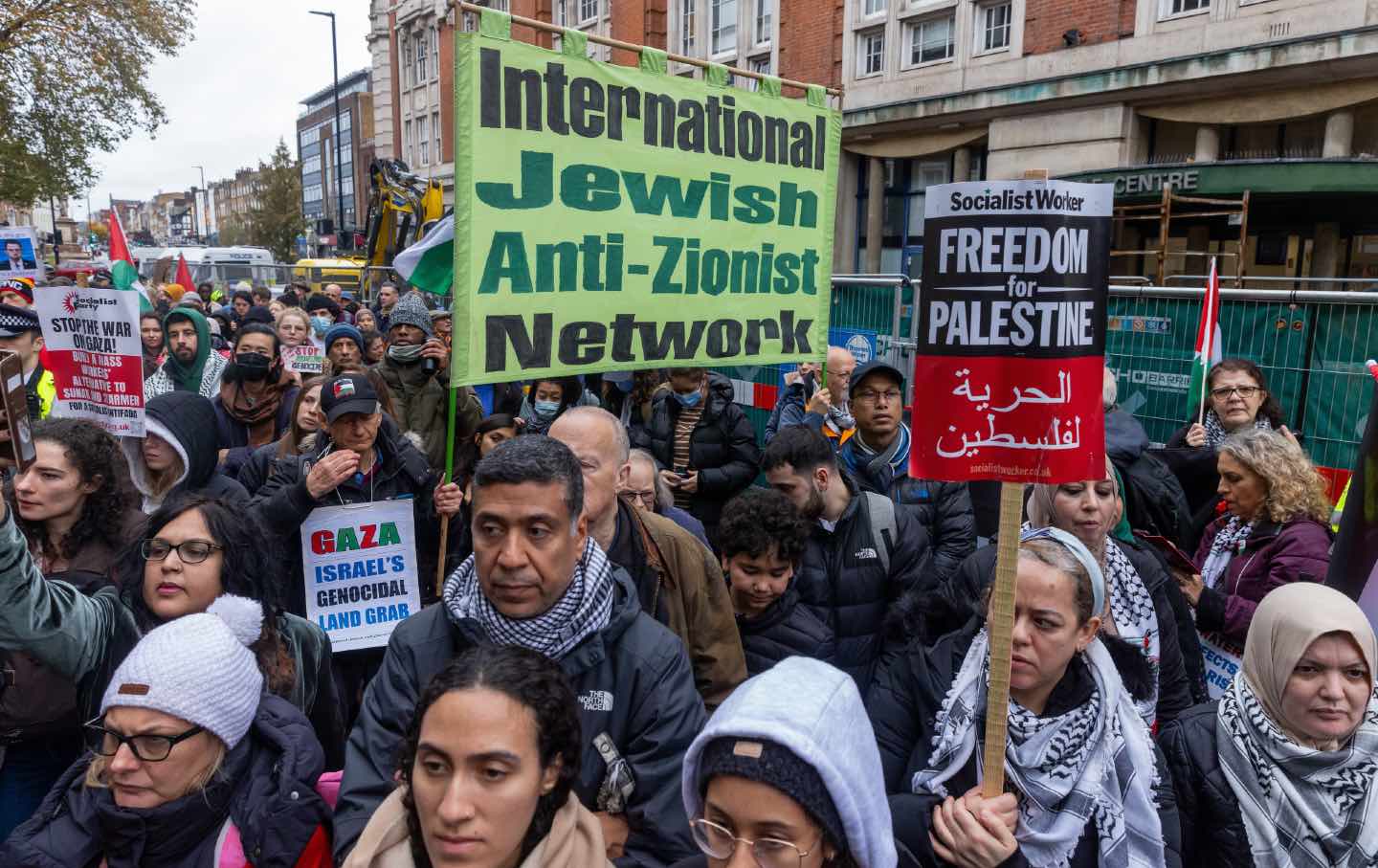
Seeking some “common understanding” about the relationship of anti-Zionism to antisemitism, New York Times columnist Charles Blow consulted Jonathan Greenblatt, the chief executive of the Anti-Defamation League. Greenblatt, fresh from the March for Israel held on November 14 at the National Mall in Washington, D.C., told Blow that he regarded anti-Zionism as, by definition, antisemitism, because “Zionism is fundamental to Judaism.” Someone claiming to be anti-Zionist but not antisemitic, according to Greenblatt, would be “like someone saying in 1963 that ‘I’m against the civil rights movement, but I’m also against racism.’”
Really? Leaving aside the analogy for the moment, the claim that anti-Zionism is “by definition” antisemitism strikes me—a self-professed anti-Zionist Jew—as incredibly intolerant and exhibiting a colossal ignorance of history. Let’s start with the history. Judaism, according to experts’ consensus, originated about 3,700 years ago in the related kingdoms of Israel and Judah. The Babylonian captivity of the Judahites and other untoward events during the Hellenistic and Roman periods led to the dispersal of Jewish groups throughout the Mediterranean, and the eventual formation of three distinct diasporic communities (Ashkenazim, Sephardim, Mizrahim). In succeeding centuries, these communities interacted with their polytheistic, Christian, and Muslim neighbors in distinct ways, experienced repeated religious-cultural schisms, and also spawned revivalist movements—of which Hasidic Judaism is probably the best known. Two developments in post-Enlightenment Europe are worthy of note: the emancipation of Jews from various legal restrictions thanks to the French Revolution and the Napoleonic conquests; and the concurrent Jewish Enlightenment (Haskalah) that stressed secular culture and a turn away from Yiddish.
The late 19th and early 20th centuries saw two further developments: the emigration of large numbers of Jews from Europe to the Americas; and the emergence of Jewish nationalism, or modern Zionism, that sought a Jewish national homeland. Both were responses to the persistence of antisemitism in Europe and the failure of assimilationist strategies to cope with it. From its first congress in 1897, the Zionist Organization led by Theodore Herzl proclaimed that Jews, no less than any other national group, deserved their own homeland—that is, their own nation-state. Although Zionists had some early success in recruiting European Jews to settle in Ottoman-held Palestine, their numbers remained small up to 1914 in comparison to the indigenous Muslim and Christian populations as well the transatlantic wave of emigrants. Within Europe, Zionism faced significant pushback from Jews who threw in their lot with internationalist movements, especially of Marxist inspiration.
Before the Nazis came to power in Germany, therefore, the vast majority of Jews would have laughed at the notion that Zionism was “fundamental to Judaism.” It took a lot more to realize the Zionist project of creating a state of Israel that would assume the burden of protecting all Jews who made aliya (immigration to that state). It took British colonial machinations, insistent fundraising among Jews wealthy and otherwise, and paramilitary Jewish “self-defense” organizations with names like Haganah, Irgun, and Lehi (“the Stern Gang”) that carried out terrorist missions against both the British and Palestinians. But the decisive factor was undoubtedly the Holocaust and the persistent unwillingness of the United States to take more than a small fraction of Jewish refugees before, during and even after the war.
In the course of realizing the Zionist project, a lot of other people got displaced, lost, or had severely constrained, their homeland. Palestinians also had their civil and political rights restricted even under relatively liberal Israeli governments. Little wonder that the 75 years of Israeli independence have been punctuated so often by war: the 1948 War of Independence/Palestinian Nakba; the 1956 Suez Crisis when Israel joined neocolonialist Britain and France to attack upstart Egypt; the Six-Day War of 1967 when Israel took the West Bank from Jordan, the Golan Heights from Syria, and the Sinai Peninsula from Egypt; the Yom Kippur War of 1973 (initiated by Egypt to regain the Sinai); the war Israel launched in 1982 to expel the Palestinian Liberation Organization from southern Lebanon; the two Intifadas of 1987–93 and 2000–05; and the Israel-Hamas War of 2023. This dolorous list does not include the far more frequent skirmishes, instances of rock-throwing, slingshot hurling, kidnapping, imprisonment, shootings of Palestinian civilians by Israeli soldiers, beating by settlers, attacks on Israeli civilians, so-called “targeted killings” and other forms of violence indicative of endemic ill-will.
Notwithstanding, most Israelis probably do not think of themselves as racists. But they don’t necessarily favor equal rights for all Israel’s inhabitants, either. There are, however, millions of Jews scattered throughout the world who do. Their rejection of Zionists’ insistence on the requirement to support Israel come what may makes them neither antisemites nor “self-hating Jews.” They may be simply non-nationalistic or even anti-nationalist, which is to say, internationalist.In this sense, they are the legatees of a long Jewish tradition going back to the 17th-century Portuguese-Jewish philosopher Baruch Spinoza and carried forward by the German-Jewish poet Heinrich Heine, by Karl Marx, Rosa Luxemburg, and Leon Trotsky. Isaac Deutscher, the Polish-Jewish Marxist, called them “non-Jewish Jews.” They each transcended their own ethnic or religious particularities to struggle for the emancipation of all.
In an interview he gave in 1967 in the wake of the Six Day War (and shortly before his death), Deutscher referred to Israel, victorious in three successive wars, as the “Prussia of the Middle East.” But this Middle Eastern Prussia was, Deutscher observed, a “feeble parody of the original” in the sense that “the Prussians were at least able to use their victories for uniting in their Reich all German-speaking peoples living outside the Austro- Hungarian Empire.” The Israelis were stuck with the problem of what to do with the conquered Arabs. Should they, as Ben Gurion, “the evil spirit of Israeli chauvinism,” urged, create an Israeli Protectorate on the West Bank of the Jordan? He went on:
None of the Israeli parties is prepared even to contemplate a bi-national Arab-Israeli state. Meanwhile great numbers of Arabs have been “induced” to leave their homes on the Jordan, and the treatment of those who have stayed behind is far worse than that of the Arab minority in Israel that was kept under martial law for 19 years. Yes, this victory is worse for Israel than a defeat. Far from giving Israel a higher degree of security, it has rendered it much more insecure. If Arab revenge and extermination is what the Israelis feared, they have behaved as if they were bent on turning a bogey into an actual menace.
So how fundamental is Zionism to Judaism? In the aftermath of the massacre of October 7 and the plethora of antisemitic acts committed in the United States and elsewhere in the world in response to the Israeli army’s retaliatory violence inflicted on Palestinians in Gaza, we might consider another question: How fundamental is anti-Zionism to Judaism?
Support independent journalism that does not fall in line
Even before February 28, the reasons for Donald Trump’s imploding approval rating were abundantly clear: untrammeled corruption and personal enrichment to the tune of billions of dollars during an affordability crisis, a foreign policy guided only by his own derelict sense of morality, and the deployment of a murderous campaign of occupation, detention, and deportation on American streets.
Now an undeclared, unauthorized, unpopular, and unconstitutional war of aggression against Iran has spread like wildfire through the region and into Europe. A new “forever war”—with an ever-increasing likelihood of American troops on the ground—may very well be upon us.
As we’ve seen over and over, this administration uses lies, misdirection, and attempts to flood the zone to justify its abuses of power at home and abroad. Just as Trump, Marco Rubio, and Pete Hegseth offer erratic and contradictory rationales for the attacks on Iran, the administration is also spreading the lie that the upcoming midterm elections are under threat from noncitizens on voter rolls. When these lies go unchecked, they become the basis for further authoritarian encroachment and war.
In these dark times, independent journalism is uniquely able to uncover the falsehoods that threaten our republic—and civilians around the world—and shine a bright light on the truth.
The Nation’s experienced team of writers, editors, and fact-checkers understands the scale of what we’re up against and the urgency with which we have to act. That’s why we’re publishing critical reporting and analysis of the war on Iran, ICE violence at home, new forms of voter suppression emerging in the courts, and much more.
But this journalism is possible only with your support.
This March, The Nation needs to raise $50,000 to ensure that we have the resources for reporting and analysis that sets the record straight and empowers people of conscience to organize. Will you donate today?