How Black Moms in Temecula Are Fighting the School Board’s Right-Wing Takeover
The board banned “critical race theory” and decried ethnic studies, but a local group of Black mothers has a plan. “We’re going to use what’s available to us—the right we have as citizens to recall.”
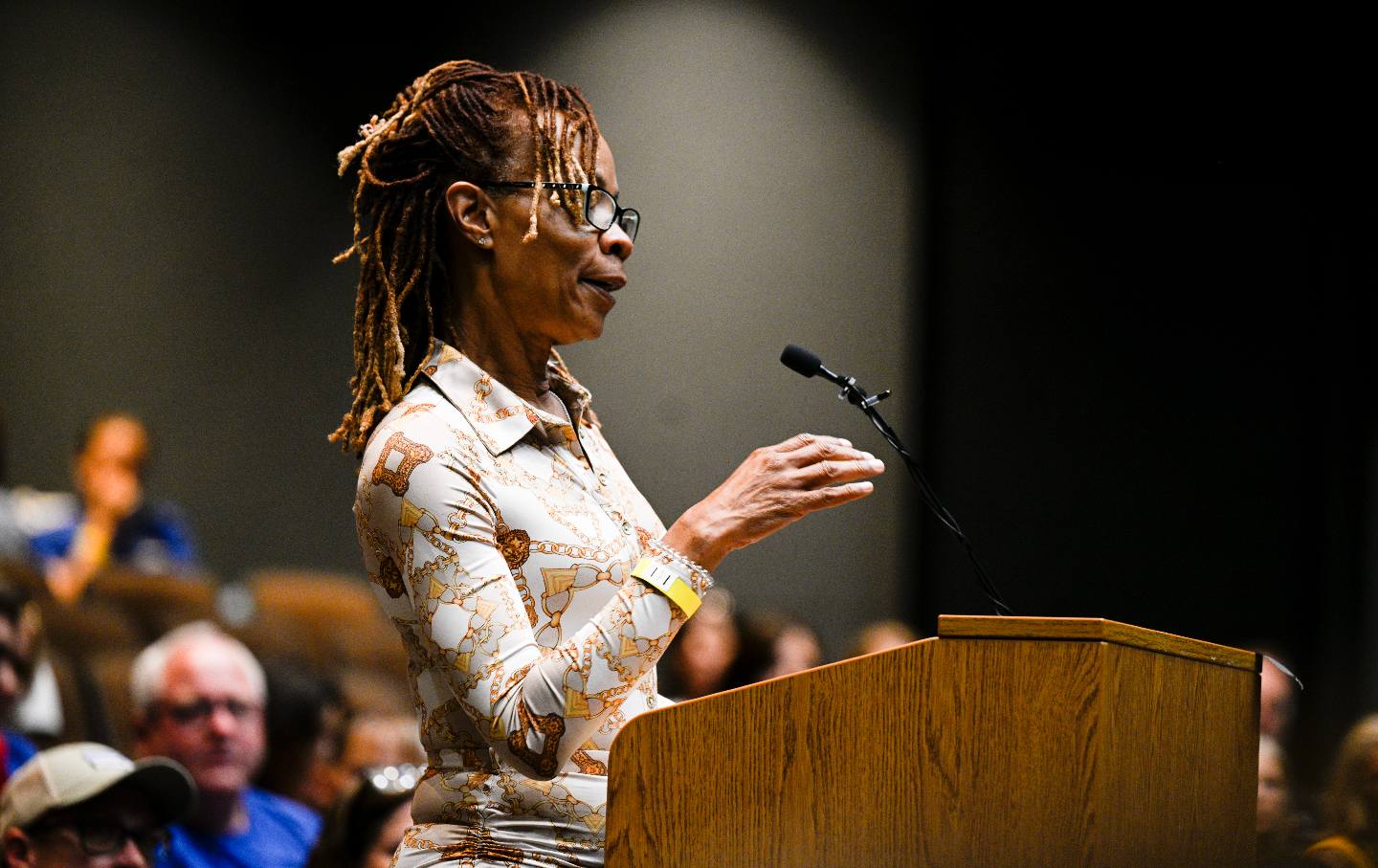
Monica La Combe, a parent within the district, speaks to the Temecula Valley Unified School District School Board.
(Anjali Sharif-Paul / Getty)Last December, in Temecula, Calif., a small city in a blue county known for its wineries and idyllic weather, three school board members voted to ban critical race theory on the day they were sworn into office. At their first meeting, on the stage of Temecula Valley High School’s auditorium, new board president Joseph Komrosky recited the Pledge of Allegiance; Jen Wiersma declared that “every skin color has both been a slave and owned a slave” as she decried Ethnic Studies’ “overemphasis on white supremacy”; and Danny Gonzalez saw nothing in the proposed policy—which effectively banned teaching about structural, quotidian, racism—that “undermine[d] the teaching of true American history.”
During public comment, more than twenty students, parents, and educators testified against the measure on the docket that would ban critical race theory (CRT). Others—like the March for Our Lives Club at Chaparral High School—had been organizing for days, collecting nearly 300 signatures opposing the proposal prior to the board vote.
But minutes after midnight, following hours of discussion and threats to remove the audience, Gonzalez, Komrosky, and Wiersma passed the Temecula Valley Unified School District’s CRT ban—outvoting, by 3-2, the board’s two veteran members. Students booed, and left the room. “Critical race theory is a buzzword…distorted to serve political purposes,” one junior insisted. “You are ridding…discussion of race and the history of race and racism [from the classroom].”
If this all sounds familiar, it’s because Temecula is far from alone in its struggle—even in California, where Ethnic Studies will soon be a graduation requirement for public high schools. Faux-grassroots groups like Moms for Liberty have strategically taken control of school boards, attacked curricula, banned books, and harassed educators across the country for teaching about race and gender.
Last spring, in the Bay Area, a Palestinian-American director of Ethnic Studies got so much hate mail that administration had to filter her e-mails and voicemails. This summer, in Marietta, Ga., a teacher was fired for reading a book about gender identity. And in Temecula, months after its jarring ban on critical race theory, the school board vetoed a K-5 curriculum because it referenced Harvey Milk, the first openly gay man to hold public office in the state. A few months after that, they passed a policy requiring school staff to notify parents if their kids used pronouns that did not match their birth certificates.
“They’re following a playbook,” says Jeff Pack, cofounder of the nonpartisan One Temecula Valley PAC and father of five TVUSD alumni. “[They’re] not doing anything unique.” The CRT ban Komrosky introduced and passed in December matches verbatim that of Paso Robles (another California district) whose anti-CRT legislation language was taken in part from former president Trump. Wiersma, who proudly links to an article on Temecula’s ban in her Instagram bio, campaigned on the same “parental rights” platform touted by Governor Ron DeSantis and Moms for Liberty. All three far-right candidates were backed by the Inland Empire Family PAC, which advances “Christian and Conservative values” and denounces “forced LGBTQ+ acceptance” and “transgenderism.”
What is unique about Temecula is that it just might pull off a grassroots, electoral defense of education. This April, after being forced out of a school board meeting, a group of Black mothers approached Pack and his PAC with a plan to recall Jen Wiersma.
“We’re going to use what’s available to us—the right we have as citizens to recall,” Monica La Combe, one of the moms, told The Nation. “I’m not a Democrat, I’m not a Republican…I’m a Black mom. [I’m going to make] sure that Black voices and marginalized voices are heard and our issues are addressed.”
By early October, the joint effort expanded into a local campaign to “Recall All 3,” with teachers door knocking and protesting outside of schools and amassing more than 2,000 total signatures. If, by December 8, canvassers collect approximately 4,000 signatures from registered voters in each board member’s district, recall measures for all three will be on the March 5, 2024, primary ballot.
At stake is not just textbook choice but student safety—and future generations’ collective understandings of both history and contemporary movements. As historian Robin D.G. Kelley writes, “It would be a mistake to think of the current wave of attacks on ‘critical race theory’ as a culture war. This is a political battle.” It is “part and parcel of the right-wing war on democracy, reproductive rights, labor, the environment, land defenders and water protectors, the rights and safety of transgender and nonbinary people, asylum seekers, the undocumented, the unhoused, the poor, and the perpetual war on Black communities.”
Temecula, then, reminds us of this—and of a few tasks we may have overlooked this election season: Read about the school board candidates (and who’s endorsing them) in your district. If you can, vote. And if all else fails, organize.
Read the rest of StudentNation’s dispatches on the 2023 election here.