
State Farm Is Embroiled in Scandal—and Things Just Got Worse
The insurance giant has been in a legal battle in Oklahoma over allegedly systematic attempts to bilk policyholders. Newly released court documents show the depth of the problem.
In 2021, a State Farm “captive agent” told a company sales leader that attempting to get information about claims out of company reps and adjusters was like talking to members of a “secret society.” The agent was not a member of the club—State Farm captive agents technically work for themselves under contract to the company—and the difficulty of getting straight answers made it look to the agent like the claims department wasn’t doing its job.
Or, perhaps, it was doing its job just fine.
The agent’s concerns are contained in court documents recently unsealed in Comanche County, Oklahoma. They are part of a long-running legal battle between State Farm and thousands of Oklahoma homeowners who say that the company has deliberately worked to reduce payouts on claims of roof damage following severe wind-and-hail events in the state. The fight has drawn the interest of Oklahoma’s government and become an issue in the state’s gubernatorial race.
The documents, which were released late last week, show that the agent was not alone; numerous other State Farm contractors were sounding internal alarms over what appeared to be a company-wide scheme to lowball distressed claimants.
The story starts in June 2020—June 26, to be precise, according to the new documents. That’s when a plan to systematically reduce indemnity costs, which I will refer to as the Wind/Hail Initiative, was launched in Texas. Within six months, the plan was rolled out to other states, including Oklahoma. (State Farm has defended its tactics as ordinary business operations.)
Roofers across Oklahoma quickly noticed that State Farm had stopped paying out fully on roof replacement claims. In doing so, the company seemed to be following in the footsteps of Allstate, which decades earlier had implemented a similar “process” to arbitrarily reduce payouts on roof damage. Many policyholders lawyered up, and soon, there were dozens of bad-faith roof-claim cases quietly moving through Oklahoma courts. From 2020 to 2024, plaintiffs fought to gain access to secret documents that remained under protective orders even as they were said to prove the existence of a scheme to defraud Oklahoma policyholders of hundreds of millions of dollars.
Today, there are more than 1,000 legal cases against State Farm in Oklahoma, and the effort to hold insurance conglomerates responsible has turned political. Republican Oklahoma Attorney General Gentner Drummond, as he vies for the governorship of the state in a primary runoff to be held Tuesday, has intervened in ongoing litigation and filed lawsuits against both State Farm and Allstate.
Drummond may be said to have staked his candidacy on his defense of Oklahoma homeowners, who, despite paying twice the national average for homeowners insurance, have for years found their claims of hail damage to be denied at a mysteriously elevated rate. Drummond’s runoff opponent, a Trump-endorsed former state senator named Mike Mazzei, has come to the defense of insurance carriers, even as Oklahoma polls show bipartisan distaste for insurance companies and as President Trump has publicly upbraided State Farm.
Now, at the final hour before the runoff, an initial tranche of the so-called State Farm Documents is finally coming to light.
My own insurance odyssey launched in early 2025, when the editor of a small Oklahoma nonprofit journalism outlet asked me to look into homeowners insurance in the state.
In May 2025, I published the first article of what would prove to be approximately 50,000 words’ worth of insurance stories. The maiden effort focused on Oklahoma Insurance Commissioner Glen Mulready’s sneaky ploy to spread a false claim—via The Wall Street Journal — that hail alone, and not insurance companies’ policies, explained Oklahoma’s outsize homeowners rates.
A couple of months later, I received an anonymous text from someone familiar with my coverage, advising me to attend an upcoming hearing in a case known as Nida v. State Farm.
Nida was a consolidation of nine cases, which in turn were representative of 125 bad-faith cases against State Farm. The cases were remarkably similar: A home would suffer approximately $30,000 in damage, and State Farm would produce a lowball offer of 10 percent of that amount in compensation.
The hearing was held in a cavernous old courtroom in Oklahoma City, with great murals on the walls, ancient nicotine stains on the ceiling, and enough hard wooden pews to accommodate the indicted congregation of a megachurch. But apart from the attorneys, I was only one in the echoey room.
The Nida cases, I learned, had been settled more or less immediately after plaintiffs’ attorneys won access to the secret documents and began deposing State Farm executives. The documents remained under a protective order because the cases were settled. But then State Farm briefly—and accidentally, the company later claimed—made the terms of the settlements public. A new lawsuit was filed, and in court, I witnessed one of the plaintiffs’ attorneys reveal the settlement amount of just one of the 125 cases.
Not $30,000. Not $50,000 or $100,000. Just one case settled for $3 million.
Multiply that by 125. Round down to be safe (not everyone would have necessarily been in line for such an eye-popping payout). That’s how much State Farm appeared willing to pay to protect the secret documents.
The Nida case is ongoing, but that was not State Farm’s biggest problem. Their problem was that it never stopped hailing in Oklahoma.
In early December, I wrote about a denied claim from a Tulsa police lieutenant named Billy Hursh, a kind and clean-cut man who, alongside his wife and son, exhibited the nostalgic charm of a Hummel figurine. With that, the trickle of cases turned into a deluge. A fellow journalist later told me that she noticed 10 new roof claim cases being filed every day in courts across the state.
A few days after my Hursh piece ran, Attorney General Gentner Drummond filed to assist in the cases. Drummond charged that State Farm had committed racketeering offenses. (It wasn’t the first time that State Farm had been threatened with RICO laws. In 2018, the company paid $250 million to wriggle out of a lawsuit that alleged it had purchased a seat on the Illinois Supreme Court.)
It was about then that the Oklahoma Supreme Court got involved, with both the secret documents and the AG’s intervention. State Farm was producing writs of prohibition like they were gobbling aspirin, and I wrote about another bad-faith case: The insurance company was fighting tooth and nail to deny the roof claim of none other than a retired chief justice of the Oklahoma Supreme Court.
I wrote stories about secret documents from the past. A State Farm whistleblower from the 1990s—a woman who has since gone missing—left behind a sheaf of documents that were leaked to her after she appeared on an episode of 60 Minutes. Other pleadings in Oklahoma sneaked in details of the “process” that Allstate had first tried out on residents of Albuquerque, New Mexico, in 1997.
All the while, both plaintiffs’ attorneys and lawyers for State Farm refused interview requests about the rapidly accumulating cases in Oklahoma. (State Farm’s corporate media center has also consistently refused requests for interviews with State Farm executives.)
Then word came: A judge in Comanche County had ordered State Farm to produce 800,000 documents. State Farm did so, but designated all 800,000 documents confidential. The plaintiffs argued that this was in violation of Oklahoma law, and the judge agreed. He ordered the release of 31 documents out of the 44 requested by attorneys, totaling 159 pages. It was the first time any of the State Farm Documents had become public. I drove three hours to Comanche County to grab them before State Farm could file a stay.
One figure at the heart of the Great Oklahoma State Farm Roof Claim Saga is a woman named Nicole Manduca, a 27-year State Farm veteran who rose through the ranks from claim representative to senior leader and director of property and casualty operations, among other titles.
In previous stories, I had reported that Manduca had bragged about setting an arbitrary goal of a 50 percent reduction in payouts in the Wind/Hail Initiative, representing billions of dollars of denied claims. The new documents reveal that early in 2020 Manduca identified full roof replacements on wind and hail claims as the company’s “biggest bucket of opportunity” for reducing claim payouts.
In newly released e-mail and text exchanges, Manduca frequently referred to what she called “the hypothesis”: Before 2020, she said, State Farm was awarding full roof replacements on 85 percent of small hail-damage claims and 65 percent of wind claims. Citing data from the consulting giant Accenture, Manduca claimed that nationwide “averages” on hail and wind roof replacements were 8–10 percent and 5 percent, respectively.
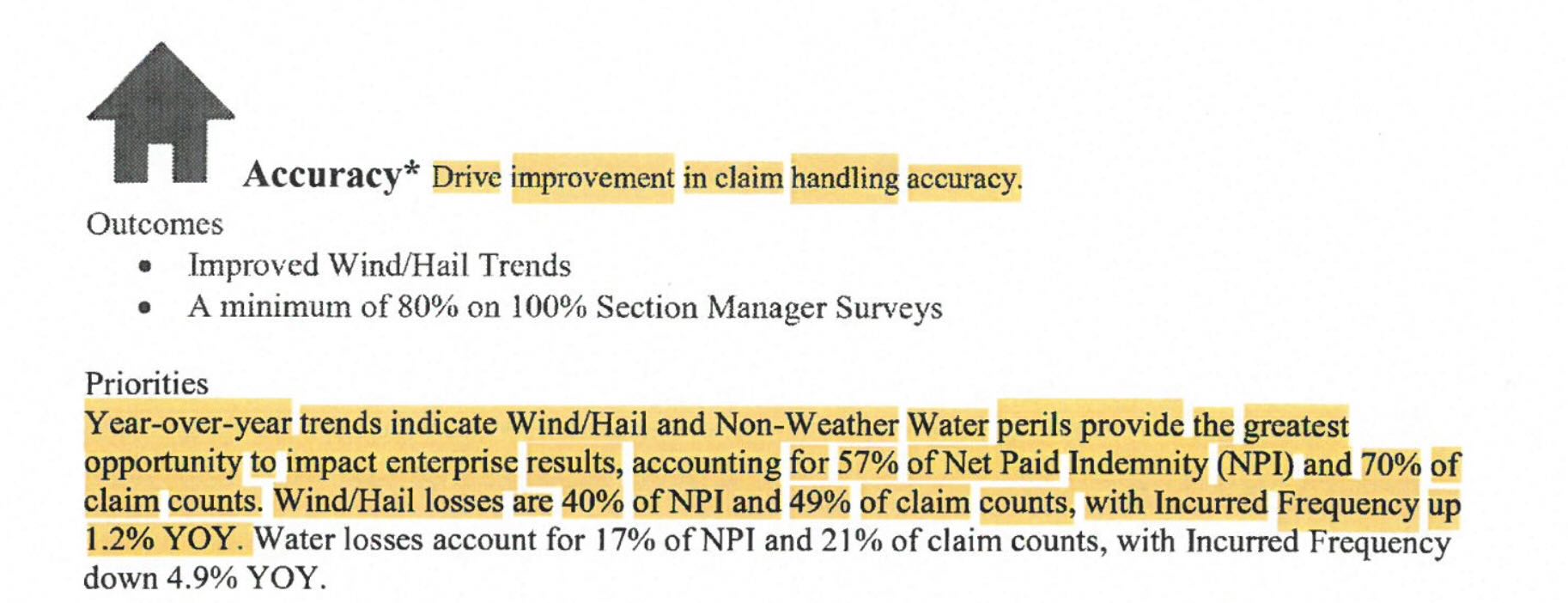
Presumably, “the hypothesis” was that State Farm could save a load of money if full roof replacement rates were in line with the nationwide “average.”
To understand that bit of sophistry, you have to step into the past.
Insurance companies have always sought to finesse extra profits. The lunge toward greed, however, took a quantum leap forward in the 1990s, when Allstate called on corporate supervillain McKinsey and Company to help the insurance industry scrappily claw its way from highly profitable to too big to fail.
That’s where the story starts repeating. After receiving a McKinsey “fact-gathering” report totaling more than 12,000 pages, Allstate identified the best area in which to pursue “opportunity dollars”: roof damage in wind and hail claims. In the years to come, Allstate would secure Accenture data suggesting that nationwide roof replacement rates were significantly lower than what certain companies were then paying out.
There was a problem, however. The Accenture data that first Allstate, and then State Farm, claimed to rely on has proven impossible to verify. When asked to provide evidence of the data in court, State Farm’s lawyers were forced to say that they couldn’t.
In devising and championing the Wind/Hail Initiative in Dallas in 2020, Manduca and several other State Farm executives repeated what Allstate did in Albuquerque in 1997. Both got caught with their hand in the cookie jar and paid a price (Allstate has lost multiple court cases over the past two decades), but not enough of a price to change their behavior—at least so far.
The insurance giants also got help from the courts. In a landmark 2003 decision in Campbell v. State Farm, the Supreme Court shot down a $146 million punitive judgment against the company, effectively inoculating it against the kind of massive award that might actually compel a corporate bad actor to change its reprehensible ways.
Apart from the decision, the oral argument in Campbell v. State Farm is notable for a quote from Justice Antonin Scalia. Rather than the sort of flippant quip that has solidified Scalia’s legacy as a conservative icon, his comments in Campbell were a plaintive call, a winsome acknowledgement that there were few ways left to hold insurance companies accountable.
“No amount of money will suffice; maybe we have to send them to jail,” Scalia said. “Whatever it takes to stop them. I mean, what if nothing will stop them but sending them to jail?”
They don’t just come out and say it.
The internal State Farm documents read like the faux-sacred texts of a Ponzi scheme cult. Neutered acronyms abound. The documents speak of “quality” when they mean “arbitrarily reducing payouts.” An increased “error rate” means an employee is not being sufficiently ruthless in denying claims. The “Art of the Conversation,” a training module offered to claims handlers tasked with delivering news of claim denials to insureds, is the whitewashed process of teaching a human being to be cruel to another human being.
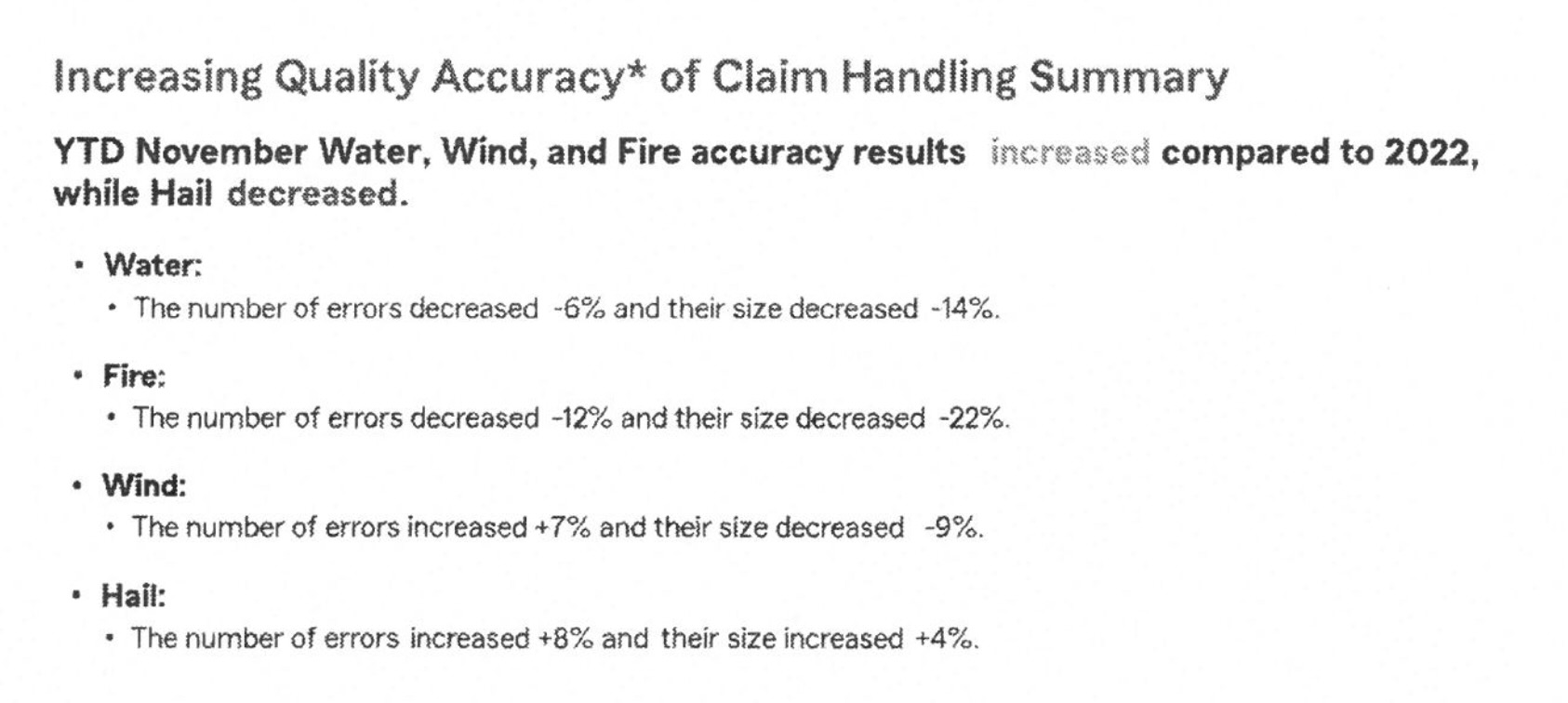
What becomes palpable in the documents is that the biggest problem the insurance companies had in implementing craven profit initiatives was the reluctance of managers and agents and claim handlers to get fully on board. Internal communications often read like the goofy rhetoric of a cult leader scheming the best way to turn desperate initiates into brainwashed acolytes.
Hence, Nicole Manduca, in the early months of the 2020 rollout in Dallas, wrote in newly released text exchanges to colleagues that “expanding/broadening management review on higher hail/wind severity threshold nets us the most gain.” In other words, get your managers in line, or it doesn’t work.
Manduca’s nervousness is apparent as she sweats data from the early months (“Concerned to see the larger % for Wind and Hail is flat”), as is her excitement when tools become available to track data on the Wind/Hail Initiative (“I’m drooling. :o3:o3:o3”).
![kathy.ress. nicole. manduca. Would love to kathy.ress. kathy.ress. Will that work for you? nicole.manduca i'm drooling :03:03:03 kathy.ress lol! [2021-03-03 20:21:27 (UTC)]: WIll you have W/Hdashboard ready for next month quality check in we could highlight in this call? |2021-03-03 20:21:44 (UTC)|: 12021-03-03 20:22:19 (UTC)]: Very good. We're going to focus on Wind/Hail TX, IL and GA. and the FME dashboard [2021-03-03 20:22:23 (UTC)]: |2021-03-03 20:23:04 (UTC)|: [2021-03-03 20:23:34 (UTC)]: nicole.manduca • [2021-03-03 20:24:19 (UTC)] Passion project. am so excited and optimistic (and I believe steeped in reality) that we WILL realize improvements in Wind/Hail trends in '21](https://www.thenation.com/wp-content/uploads/2026/08/im-drooling.jpeg)
By 2023, the jury was in: The Hail/Wind Initiative was wildly profitable, with $1.4 billion in reduced indemnity from 2020 to 2021. Before the initiative, Manduca reported internally, State Farm replaced 5.6 roofs for every roof they repaired. Since then, the number of total roofs replaced had fallen to 2.1. The Wind/Hail Initiative was reaping billions.
![From: Sent: To: BCC: Subject: Nicole Manduca [/0=STATEFARM/OU=HOME/CN=RECIPIENTS/CN=LOK2] 1/16/2023 10:20:46 PM FW: Wind/Hail Peril Trends Attachments: Total Homeowners Wind Hal - December 2022.pdf; Wind Hail 5 year trends.pdf We can talk through this in a touch point but thought you may find the information interesting to see the ycar-over-year comparisons. We started the Wind/Hail FME work the summer of 2020 (pilot in one count in DFW) then scaled December 2020. Volume down while severity up quite a bit. About a $1.4B decrease in indemnity from 2020 to 2021 (Wind Hail 5 year trends attachment). I also received additional data this morning on our Total Roof to Partial Roof Replacement ratio. When we started this work, we were replacing roofs at a rate of 5.6 to every 1 we repaired. In 2021 we landed at 2.0 for every 1 and 2022 increased to 2.2 to every 1.](https://www.thenation.com/wp-content/uploads/2026/08/decrease-in-indemnity.jpeg)
In August 2023, even as bad-faith roof cases had begun to pile up in Oklahoma, the newly released documents show that the Wind/Hail Initiative had become a subject of discussion at weekly meetings of a group known as the Fix Profit Task Force. In short, State Farm wasn’t concerned by the roof claims in Oklahoma or the tens of millions of dollars they would pay to make those cases go away. Instead, they doubled down, and now the very highest reaches of State Farm were getting involved. The morning meetings of the Fix Profit Task Force were called by State Farm CFO Jon Farney, who would soon be promoted to become just the sixth CEO in State Farm’s 104-year history.
Letters from three State Farm captive agents embedded in the documents released last week—each written as the Hail/Wind Initiative took hold, and each expressing an alienation from the company that was identical to the agent who said it operated like a secret society—tell the story of what has become of an iconic American brand.
An August 2021 letter from Dublin, Ohio–based State Farm agent Chad Harris described his experience of getting pulled into a claim dispute but being unable to communicate with anyone from State Farm’s claims department. Harris complained that claims were now being handled by outside contractors, and that no one at State Farm was empowered to resolve a conflict.
Popular
“swipe left below to view more authors”Swipe →“This is terribly embarrassing for State Farm…and me, as the local agent,” Harris wrote. “This claim highlights all the current dysfunction within our SF claims operations and processes.”
Two months later, Louisville, Kentucky–based State Farm agent Tracy Haus wrote to leadership to say that although she “bleeds State Farm logos” she was now worried for State Farm’s reputation: reputable companies, she said, were now saying that State Farm was no different from Allstate.
“The old slogan of ‘we pay what we owe, not a penny less, not a penny more,’ is not the case right now,” Haus wrote. “We now pay really low and customers fight to get what we owe them in more and more cases…. We need a drastic change before it’s too late.”
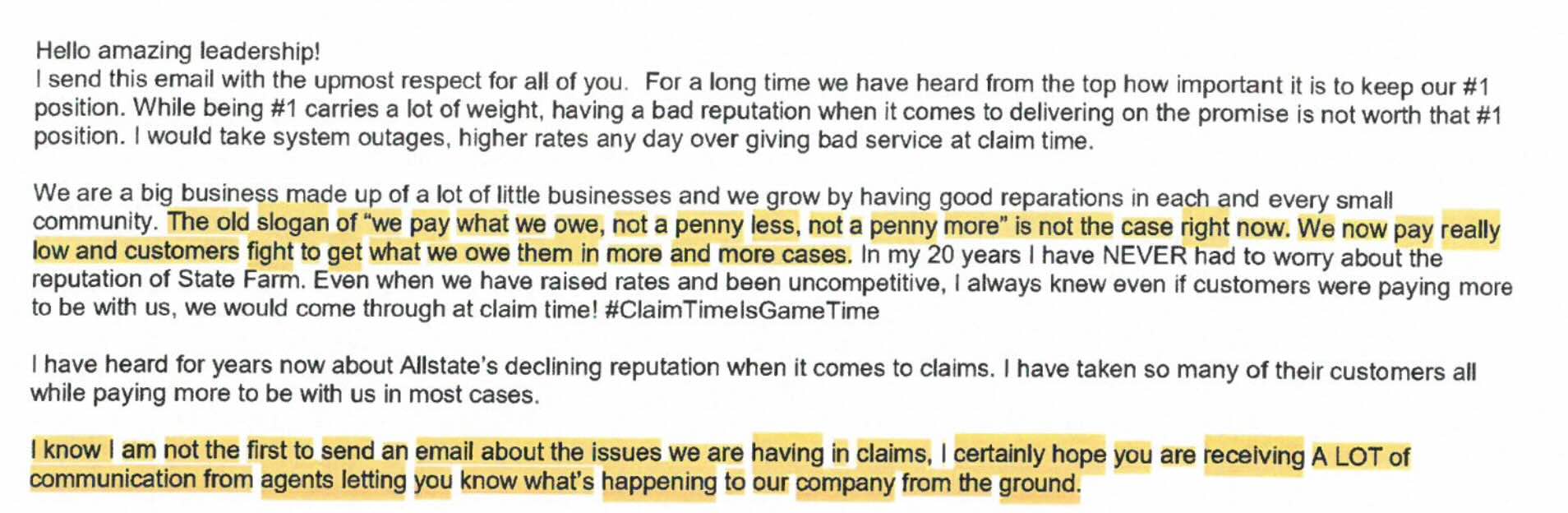
Two weeks after Haus’s letter, Massillon, Ohio–based State Farm agent Robert Garner wrote to leadership to describe the impact of a denied roof claim on his business. He was losing multiple clients over a single claim, Garner said, and, like Harris, he was struggling to communicate with the claims department.
“This is just one example of many other clients that feel the same way,” Garner wrote. “This is the first time in my 15 years I have had any issue with claims.”
What the agents failed to perceive in 2021—that being sidelined in the claim process was all part of the Wind/Hail Initiative—must have become apparent in May of this year, when State Farm announced pay cuts of 35–40 percent for 19,000 captive agents across the country.
The Great Oklahoma Roof Claim Saga has reached a fever pitch.
Today, when I attend a State Farm hearing in Oklahoma, there are generally three or four reporters in the courtroom, and cameras waiting in the hallway representing most of the media outlets in the state. Plaintiffs’ attorneys have begun giving interviews. Morose State Farm lawyers continue to refuse comment.
Tuesday’s runoff election may signal whether Oklahomans are tired of feeble excuses for skyrocketing homeowners rates and the arbitrary denial of valid claims from wildly wealthy insurance companies.
Regardless of the outcome of the election, the litigation will continue. Trial dates that took months to secure are rapidly approaching, and in the same case that forced State Farm to hand over 800,000 documents, plaintiffs’ attorneys were granted a deposition of State Farm CEO Jon Farney. In a separate case, Nicole Manduca will be deposed as well—for the third time.
Two questions remain. First, will State Farm once again settle out of court, not for tens of millions of dollars for 125 cases this time, but for whatever it will take to quash 1,000 outstanding Oklahoma cases? And second, will plaintiffs’ attorneys and attorneys general across the country follow the lead of Oklahoma and further compound State Farm’s woes?
More from The Nation

Seeing My Mother in Prison: A Conversation With Author Harriet Clark Seeing My Mother in Prison: A Conversation With Author Harriet Clark
An interview with the author of The Hill about her debut novel and the artist’s role in documenting atrocities.
Recovering From a “Gut Punch”: Black Women Fired by Trump and Musk Work to Overcome Shame and Self-Blame Recovering From a “Gut Punch”: Black Women Fired by Trump and Musk Work to Overcome Shame and Self-Blame
Black women working for the federal government did what they were supposed to do. Yet their achievements could not protect them from the political winds.

How the Skydance Merger Will Remake Hollywood and the News Business How the Skydance Merger Will Remake Hollywood and the News Business
The Ellison family’s $110 billion deal to acquire Warner Bros. Discovery means more top-down control, and less room for dissent.

The Conservative Organization Building a New Young Elite The Conservative Organization Building a New Young Elite
From pro-life summits to Palantir résumé drops, the David Network is discreetly building a pipeline for conservative college students.
The Unseen Toll: Depression, Anxiety Plague Black Women a Year After Being Fired by DOGE The Unseen Toll: Depression, Anxiety Plague Black Women a Year After Being Fired by DOGE
Trump’s federal workforce cuts dismantled a job pipeline for Washington, DC’s Black community and gutted the well-being of the women who hold up that community.
Yale’s Protest Tradition Is Back Yale’s Protest Tradition Is Back
For the first time in more than 50 years, Yale students gathered around an iconic sculpture to protest their university and their government.

