
The Hunger Era
In Gaza, we watch people being starved by Israel. In rich countries, we watch people starving themselves. The situations are completely different—but they are also connected.
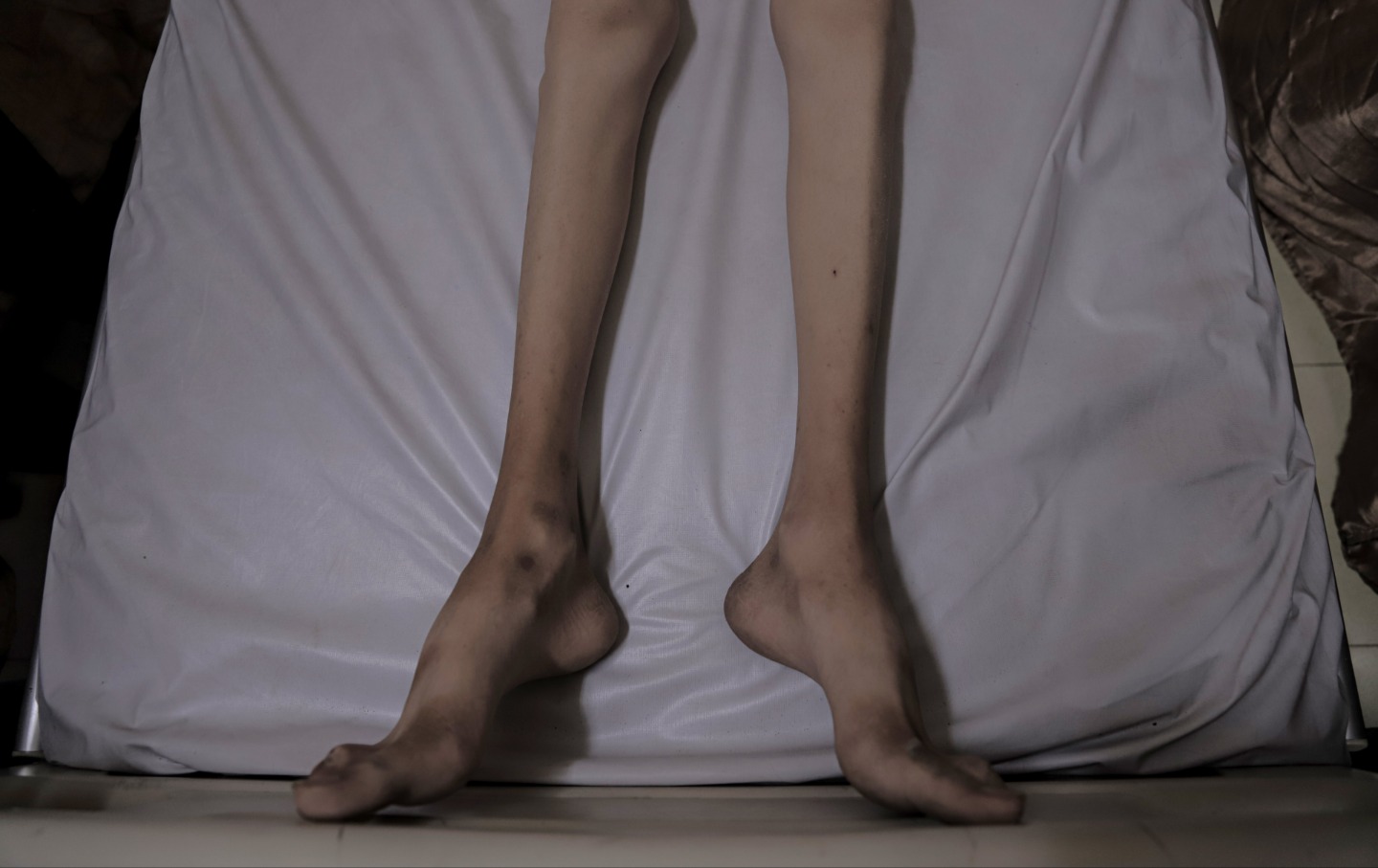
Seventeen-year-old Ayman Nasir al-Nunu, who suffered from malnutrition, receives treatment at the Patient Friends Association Hospital in Gaza City, Gaza, on October 29, 2025.
(Abdalrahman T. A. Abusalama / Anadolu via Getty Images)Last summer, I noticed that no one on my Instagram feed was eating.
Half of what I saw was related to fashion and beauty—ads featuring angular models and graphics discussing the reemergence of “pro-ana” content, or news reports on the insatiable demand for appetite-suppressant jabs. (Some of those ads were later banned by the Advertising Standards Authority in the UK, where I’m from.) The trend for severe skinniness is now ubiquitous enough among celebrities and influencers for The Cut to dub this “The Era of Emaciation.” Mothers, in that article, described worrying about taking their daughters to the cinema or letting them use TikTok, and I can attest to an amplification of the voice in my own head that tells me I should lose weight. That voice is negligible, normally, but ever-present; I’m of a demographic that doesn’t have to google what “pro-ana” means.
The other posts concerned the deliberately-induced famine in the Gaza Strip. Israel had placed a near-total ban on goods entering Gaza in March 2025, and then turned the limited aid distribution sites that were established into killing centers. By August, the price of flour was reported to have risen by a factor of 30. Cases of severe malnutrition ensued. One baby, Siwar Ashour, was so underfed at five months old that she “struggled to cry.” Photos of children like her, along with their desperate parents, proliferated on my screen.
Over and over again, I would be served these posts within seconds of each other: hungry kids followed by skeletal models. The developments they represented were and remain incomparable in terms of urgency and violence; eliminationist impulses have nothing to do with fashion or health, despite their advocates’ claims. But they came to seem related, to me, by dint of their proximity—by the bizarre experience of feeling encouraged to starve myself on aesthetic grounds while the horror of real starvation was also being beamed into my brain. Both, for one thing, were forms of conspicuous hunger, inflicted to communicate or achieve something rather than because of a simple lack of food. Both made the human body into a tool for ends beyond its own survival.
In Gaza’s case, the end was clear. Israel had laid the basis for instrumentalizing hunger by characterizing all able Palestinian bodies as threats to Israeli society, if not to Jews at large, regardless of the dominance evident in its ability to withhold what those bodies required. The most efficient way to utilize a body like this, its leaders seemed to have decided, one designated both strong and weak, both threatening and vulnerable, was to turn it on itself, to let its own demands drain its capabilities. Images of the resulting desperation also served as a statement of ruthlessness and intractability. That effect might have been an accident, but in circles where force is currency, those qualities have power.
Fashion-based thinness, on the other hand, makes a statement about the individual who displays it. (I’m talking specifically about thinness as a trend, here, rather than about the more ambient and existential forms eating disorders can take.) The body becomes a status symbol, proving its ability to withstand discomfort in the name of what is, for now, called “beautiful.” Even as a preteen during the last “thin is in” round, I understood that this beauty came from self-conscious denial, not genuine need. This time, no one was sharing pictures of Gazans as “thinspiration.” The fact that “skinny” exists in an environment of abundance is exactly what, for its adherents, makes it special.
Any story about food is also a story about control. This, maybe, was what I felt most at watching these stories bleed into each other: conscious of an atmosphere of growing control worldwide, bluntly military but also soft and implicit (and often gendered), enacted in a top-down direction by elites whose access to certain resources—high-tech weaponry, money, media attention—enables them to dictate others’ lives. Everyone else is kept in a state of wanting and dissatisfaction, which renders them vulnerable: to death in one case, to the predations of marketing in another. (Beauty is a useful choice of ideal, in this case. You can’t buy it—only the things that promise, however unreliably, to give it to you.)
The result of this process is that the concentration of resources deepens. The occupying army gains more land with fewer “enemy” bodies to impede its progress across it. The global beauty and fitness industries, worth about $500 billion each, shift more money from your pockets into their own. Worldwide, these developments contribute to a scale of inequality that means there are not only haves and have-nots; there are also the choose-not-to-haves, circles in which food is so available that the ability to avoid it becomes the mark of distinction.
Again, these experiences are miles apart—but part of me wonders whether the self-obsession the beauty industry fosters isn’t a death itself, of a kind. Every moment I spend focused on my body’s supposed aesthetic faults is a moment in which I’m distracted from the world around me, an axing away of the large and precious part of existence that depends on seeing other human beings as more than comparators. The political consequences are self-evident: that distraction is also a distraction from the natural horror I experience watching other human beings suffering, and from the thought that I could help make it stop.
I don’t believe there’s anything this actively conspiratorial about the renewed skinniness trend. Trends simply operate in a cycle, a fact that, like the recent introduction of AI models, strikes me as oddly exposing—clear evidence that the unattainability is the point, that the real goal is to keep you striving into the sunset. Still, the effect is there. It also works the other way. The violence of the scenes in Gaza is a reminder of the kind of force other governments could use if the inequality at play were objected to in a way they considered too vociferous. Suppressing an urge as natural as hunger requires constant effort and attention, but the inversion of your gaze can still be comforting. It remains easier to change yourself than it is to change the world.
Thinness, in fact, has the added appeal in these conditions of appearing as a form of control one can enact rather than just endure. Adherence to trends in general, I think, is more than Stockholm Syndrome. Fashion is predicated on an understanding that looking a certain way helps you get ahead in life—that it improves your chances of love, for example, or professional success. That promise becomes only more enticing against a backdrop of images demonstrating the spectacular pain to which your body is, at base, as vulnerable as any other, and the fact that some of the people with whom we share this world are ready and willing to inflict it.
In November, a group of eight individuals in British prisons, each of them charged with involvement in incidents claimed by Palestine Action (PA), began an action that put those truths to better use. All eight had already been held in pretrial detention for over a year, under conditions tied to PA’s July proscription as a “terrorist organization,” despite their nonviolent alleged activity predating that status, and despite the anger that had followed the government’s decision to proscribe in the first place. (The bulk of Palestine Action’s activity had involved vandalizing property tied to the Israeli weapons firm Elbit and its subsidiaries. This February, the High Court decided that the proscription was unlawful, but the group remains banned.)
Specifically, the eight stopped eating. This coordinated refusal—the aims of which included the closure of Israeli arms firm Elbit’s operations in Britain, as well as deproscription and bail—went on for more than two months, well past the point at which hunger can kill; the longest strike, that of Heba Muraisi, lasted for 73 days. For a while, it looked like some of the strikers would die. Concessions were won, but when the action was called off, I expect most onlookers, like me, saw it as a reasonable decision to save the lives of individuals who had already given up their health and liberty for their cause.
In its context of conspicuous hunger, that sacrifice had particular symbolism. By inflicting on themselves the same kind of suffering that continues to take place in Gaza, the strikers proved the transience of the distinctions that make it possible for some to eat while others can’t, and the commonality of forms of bodily repression—occupation, imprisonment—in seemingly disparate settings. This was a commitment to the idea that an attack on one is an attack on all made with actual flesh.
The strike still shared something with aesthetic hunger, in its recognition of the power of putting willful self-restriction on display. A hunger strike as a mechanism depends on the fact that entering into physical weakness intentionally, knowingly, can communicate an abstract kind of strength. But it also claims the body-as-tool back from the forces that generally wield it. It doesn’t exert itself in the service of handed-down paradigms: it insisted, in this case, on the body’s natural right to be treated with dignity, and laid blame for any death or disablement resulting from failure on that front firmly on the groups that almost always avoid it.
Popular
“swipe left below to view more authors”Swipe →This, of course, is the necessary backdrop to any discussion of hunger’s prevalence in specific regions and social niches: the fact that those deaths and disablements happen all the time. Most hunger, the hunger caused by poverty, is kept inconspicuous, considered only occasionally newsworthy, despite its now shaping daily life for 14 million people in Britain alone. Most people starving there aren’t doing so on their own terms. The impression created by effacing that fact, the idea that enforced hunger happens “over there,” only backs up the myths of predestined disaster that have always made famines such effective colonial tools. And it blurs the more routine relationships of control and subjection, the ways those forces continue to produce a constant, quiet distress in between the extreme conditions of high glamour and genocidal war.
Anxiety is a nauseous sensation, and everyone feels it now. Maybe that’s another factor in the renewed desire for thinness. Looking at the world, it’s very possible to imagine an emotional level on which one is trying not to eat, trying not to even want to eat, despite the precious availability of food, isn’t really about looking a certain way to produce a certain outcome, but about escaping the human body completely. I don’t mean death—although for some there will be that drive—but an Icarian bid for freedom from biological limits. If I learned anything from all that scrolling, it was that being human is a risk. In the absence of mutual care and fair distribution, it would feel better to be something hardier, like an AI model, or a sniper drone.
Support independent journalism that does not fall in line
Even before February 28, the reasons for Donald Trump’s imploding approval rating were abundantly clear: untrammeled corruption and personal enrichment to the tune of billions of dollars during an affordability crisis, a foreign policy guided only by his own derelict sense of morality, and the deployment of a murderous campaign of occupation, detention, and deportation on American streets.
Now an undeclared, unauthorized, unpopular, and unconstitutional war of aggression against Iran has spread like wildfire through the region and into Europe. A new “forever war”—with an ever-increasing likelihood of American troops on the ground—may very well be upon us.
As we’ve seen over and over, this administration uses lies, misdirection, and attempts to flood the zone to justify its abuses of power at home and abroad. Just as Trump, Marco Rubio, and Pete Hegseth offer erratic and contradictory rationales for the attacks on Iran, the administration is also spreading the lie that the upcoming midterm elections are under threat from noncitizens on voter rolls. When these lies go unchecked, they become the basis for further authoritarian encroachment and war.
In these dark times, independent journalism is uniquely able to uncover the falsehoods that threaten our republic—and civilians around the world—and shine a bright light on the truth.
The Nation’s experienced team of writers, editors, and fact-checkers understands the scale of what we’re up against and the urgency with which we have to act. That’s why we’re publishing critical reporting and analysis of the war on Iran, ICE violence at home, new forms of voter suppression emerging in the courts, and much more.
But this journalism is possible only with your support.
This March, The Nation needs to raise $50,000 to ensure that we have the resources for reporting and analysis that sets the record straight and empowers people of conscience to organize. Will you donate today?
More from The Nation

Bridging the Red-Blue Divide, One Concrete Deed at a Time Bridging the Red-Blue Divide, One Concrete Deed at a Time
The evidence is in: working together to solve local problems reduces polarization.

Gisèle Pelicot Shows Us Why “Shame Must Change Sides” Gisèle Pelicot Shows Us Why “Shame Must Change Sides”
Fifty-one ordinary men raped an unconscious woman. Her case reveals the limits of anti-carceral feminism.

In Defense of Being Performative In Defense of Being Performative
The critics of “performative politics” misunderstand something fundamental: Democracy survives only when citizens perform it.

Iftar With the Knick and the Mayor Iftar With the Knick and the Mayor
In a union of religion, culture, sports, and politics, a rookie for the New York Knicks broke bread with the youngest mayor in the city’s modern history.
Why Does the Supreme Court Treat Trump Like a “Regular” President? Why Does the Supreme Court Treat Trump Like a “Regular” President?
The emperor is stark naked, but thanks to a misguided legal doctrine, the Republican justices keep insisting he’s fully clothed.

Mary K. Simkhovitch and the Dream of an Affordable New York Mary K. Simkhovitch and the Dream of an Affordable New York
A new book revisits the public housing programs of the 1930s.

