
How a Reactionary Peruvian Movement Went Multinational
Parents’-rights crusaders seeking to impose their Christian nationalist vision on the United States took their playbook from South America.
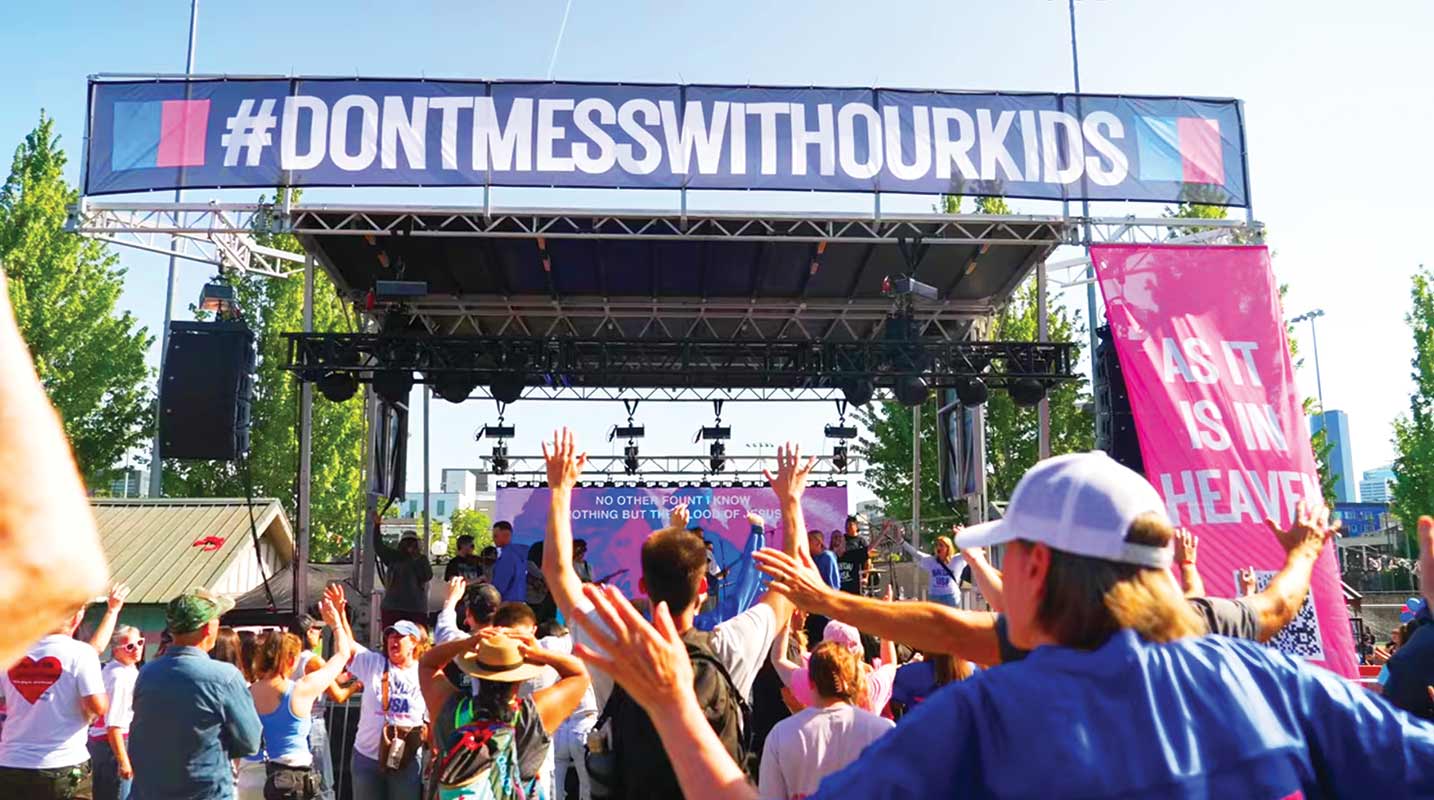
Last spring, the Mayday USA tour—a traveling road show of Christian parents’-rights activists campaigning against gender and sexual expression in children—brought its message to five American cities. Each of its appearances, in highly visible public arenas such as Times Square in New York City and Discovery Green in Houston, was something between a political rally, a Christian tent revival, and a college-football tailgate party. Music pulsated from the sound system, hands were held aloft in praise, and speakers assured the crowd that they were a righteous silent majority, fed up and ready to roar. Invoking Jesus’s love, activist influencers and charismatic pastors unleashed a barrage of alarmist rhetoric aiming to channel parental anxiety into a broader Christian-supremacist project.
The choreography was amped-up and melodramatic, following a conventional arc: collective prayers, tearful testimonies, calls to protect children from unseen cultural forces. The point wasn’t just to feel good, but to feel chosen—a persecuted vanguard with divine backing. By the end of each event, the crowd was buzzing, swapping Instagram handles and embraces, convinced that they weren’t simply attending a rally but standing on the front lines of a holy war.
That is, until the fourth of the five rallies brought Mayday USA to Seattle’s Cal Anderson Park. The choice of venue was not accidental: The park, named for Washington’s first openly gay legislator, sits in the heart of the city’s historic LGBTQ+ district. By nightfall, the streets of Seattle were a battlefield, with fists flying and police dragging away 23 protesters. With the eruption came the prize every movement covets: national attention. Seattle’s Democratic mayor, Bruce Harrell, condemned the violence, blaming anarchists for “infiltrating” the counterprotest. But his sharpest words were reserved for the Mayday USA rally itself, accusing its organizers of trying to “provoke a reaction” in a city whose values they reject. “Seattle is proud of our reputation as a welcoming, inclusive city for LGBTQ+ communities,” Harrell said. “We stand with our trans neighbors when they face bigotry and injustice.”
That was the spark that turned the clash into a cause célèbre on the right. Deputy FBI Director Dan Bongino posted on X that his office would “fully investigate allegations of targeted violence” against what he termed “the Seattle concert.” Freedom of religion, he added, “isn’t a suggestion.” The White House Faith Office weighed in, condemning the “violent disruption” of the event and declaring it an issue of upholding the attendees’ constitutional rights.
For Mayday USA’s organizers, the national uproar was a gift from heaven. Three days later, they staged a follow-up protest in front of Harrell’s office. Dubbed the “Rattle in Seattle,” it drew 500 Christian and conservative demonstrators, protected by a heavy police presence and a fence around City Hall. One pastor in a MAGA hat led chants for the police and sneered, “If that makes me a fascist, sign me up.”
The Rattle’s organizers were there to issue the Seattle Proclamation, a defiant missive to the city and to their detractors. “His Kingdom is coming,” they vowed, proclaiming Christ’s dominion over the earth. “And we, His people, will stand brave in this hour.” For a movement hungry for oxygen, a seemingly grassroots gathering of concerned parents made for the perfect launching pad. But that image masks the movement’s real origin story—one far murkier, and far more revealing, than the spectacle on display.
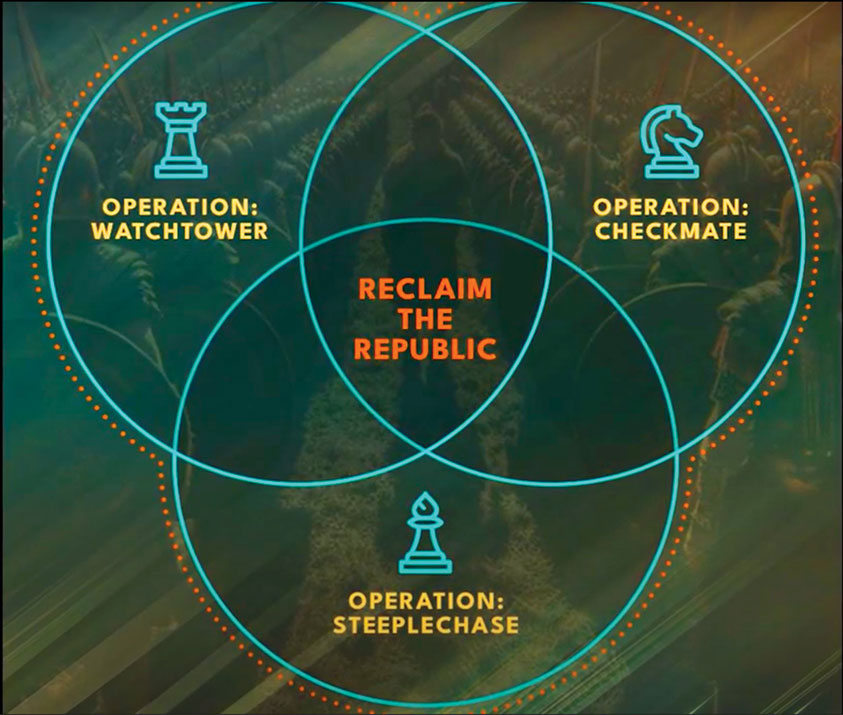
In 2023, a secretive network of ultra-wealthy Christian donors known as Ziklag produced a strategy to return Donald Trump to the White House. In a leaked nine-minute video for members that comes across like the trailer for an apocalyptic film, a graphic is repeatedly flashed with the central message: “Reclaim the Republic.”
Ziklag is named for the Old Testament town that was given to David by a Philistine king before the hated Amalekites burned it and seized its people. David’s daring defeat of the raiders and his rescue of the women and children was the victory that paved his way to Israel’s throne. Today’s Ziklag is an invitation-only club for ultra-wealthy Christian donors, including Hobby Lobby’s Green family, office-supply titans the Uihleins, and Jockey apparel’s Waller family, among a membership that reportedly requires a net worth in the tens of millions. It exists to pool money into projects aimed at reshaping American culture and politics along explicitly conservative Christian lines, even claiming credit for Amy Coney Barrett’s appointment to the Supreme Court.
Ziklag was founded after Trump’s 2016 election by the Silicon Valley entrepreneur Ken Eldred, who, in the lead-up to Trump’s first electoral victory, backed an important meeting between American evangelical leaders and Trump through a faith-based nonprofit called United in Purpose. Eldred had amassed his substantial personal wealth through a mail-order computer-accessories business in the 1970s and ’80s and then merged it into a software giant in the 1990s before becoming deeply entrenched in conservative politics, including serving on the finance committee for George W. Bush’s 2000 presidential campaign. In the private sphere, he promotes what he calls “kingdom entrepreneurship,” encouraging Christian businesspeople to bring Christ into the workplace and spread the Gospel by starting for-profit businesses. He believes that Christians must operate on a “triple bottom line,” where economic, social, and spiritual capital are pursued in tandem.
But after Trump’s election in 2016, Eldred’s political passions were reignited. He wanted “wealthy Christian people to come together,” according to a longtime collaborator. The Covid pandemic, he said, was a “gift from God,” bringing about His advancing kingdom through “a series of glorious victories, cleverly disguised as disasters,” and ensuring that people returned to the Christian faith.
The mission of Ziklag is no less ambitious: to remake American politics in the service of an oligarch class convinced of its divine right to rule. The secret video from its December 2023 “Trailblazers” cultural-engagement summit opens with a booming declaration: “We are boldly pursuing the reclamation of America’s founding as a Christian nation.” The presentation lays out a plan to target “battleground states, where we need to refocus on values-based voting,” distilled into three strategic pillars. The first, “Checkmate,” would bankroll “election integrity” groups; the second, “Steeplechase,” would mobilize faith leaders and congregations; and the final one, “Watchtower,” would prosecute a culture war around “parental rights” and opposition to sexual and gender expression.
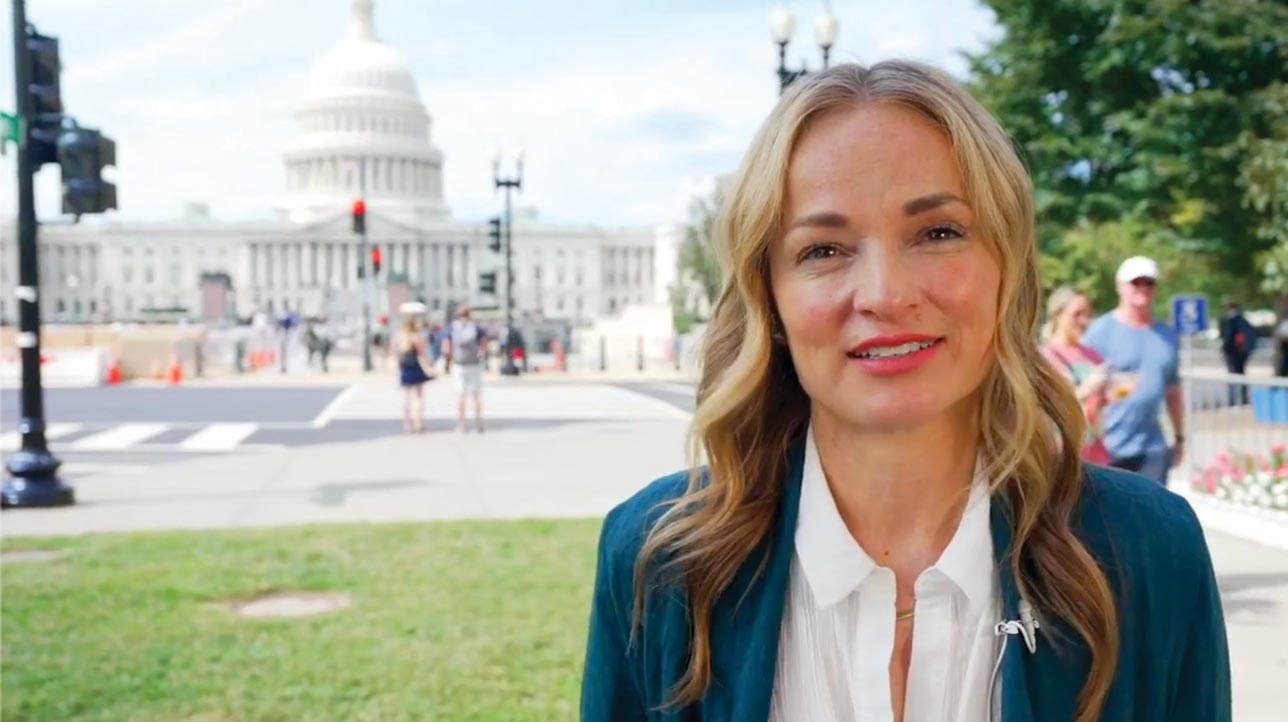
For Watchtower and Steeplechase, Ziklag’s power brokers handpicked Jenny Donnelly—the wife of a telegenic preacher in Portland, Oregon, a mother of five, and a former multilevel marketer—as its public face. We know little about how she emerged from relative obscurity to become a leading figure in evangelical circles, other than that she and her husband, Robert, launched the Collective Church and Tetelestai Ministries, which oversees Her Voice MVMT as its political arm. A cut-and-paste Christian mom, Donnelly had initially tried to make a name for herself with at-home workout videos. Her sudden elevation as the leader of this Christian social movement followed a script that’s familiar in right-wing circles: The pandemic lockdowns—especially church closures—galvanized Donnelly and many around her, while the Black Lives Matter protests in Portland’s 2020 “Summer of Rage” pushed them fully into action.
Initially, Her Voice MVMT had no significant following. It was another slick, one-click-checkout site pushing faith-based courses on living a righteous life—a dime a dozen in the evangelical charismatic world. Ziklag’s intervention changed that.
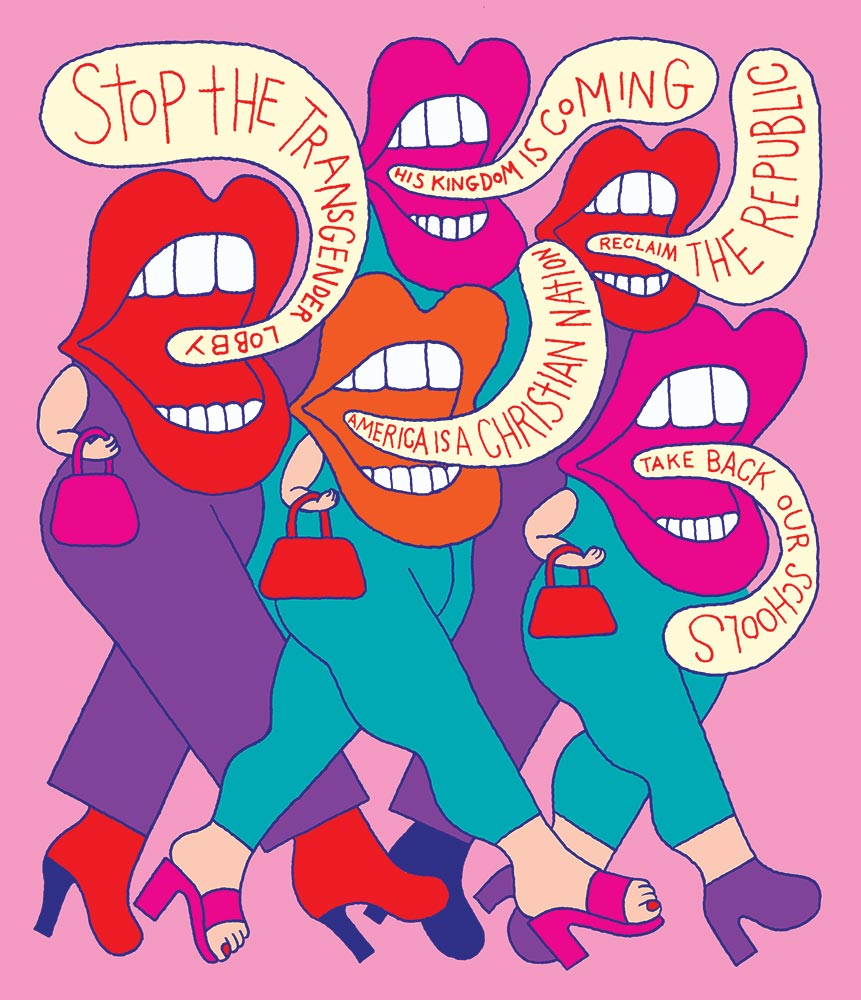
In the “Trailblazers” video, Ziklag outlined its blueprint to turn the parents’-rights crusade into a full-blown political machine, promising to “create a coalition” of like-minded groups, “amplify their efforts,” and bankroll them to wage a culture war more effectively. The wedge issue, it insisted, was government “control over our kids,” with parents supposedly forced “to remain silent while the transgender lobby attempts to take over.” At the center of this crusade would be Her Voice MVMT, which Ziklag promised would build “300,000 prayer hubs nationwide” by the end of 2024. The prayer groups were designed to be weaponized as frontline organizers, drilled with training materials from Charlie Kirk’s Turning Point USA, fire-and-brimstone pastors, and the America First policy stores. The plan was to rebrand conspiracy-theory-soaked paranoia as grassroots moral revival—and to hardwire it directly into electoral politics.
As promised, Donnelly exploded onto the national stage at the end of 2023 with a call for simultaneous prayer rallies in every state capital in April 2024, followed by a million-woman Christian-nationalist march on the National Mall that October, weeks before the general election.
The Mayday USA tour emerged from a partnership between Her Voice and Ross Johnston Ministries. Johnston, affiliated with conservative organizations, is a millennial preacher with the energy of a Twitch streamer and a conversion story tailor-made for his audience. Born via artificial insemination and raised in Los Angeles by two lesbian mothers, Johnston says he grew up with an “orphan spirit”—loved but unmoored, “floating through life and searching for a destiny.” In his telling, the Covid lockdowns and the loss of in-person contact drew him to the church—and, in the process, helped him overcome a nine-year porn addiction.
Like Donnelly, Johnston experienced the pandemic as a turning point for a revival of religious liberty. Yet Donnelly offers something more. As a relatable face for a prized political demographic, she embodies both tradition and renewal: political sermons that blend kitchen-table wisdom with the apocalyptic urgency of the charismatic revival, a guardian of family and faith fronting an uncompromising political campaign.
Many in Ziklag’s inner circle—including the pastors who elevated her—hail from the neo-charismatic Pentecostal movement and its more extreme edge, the New Apostolic Reformation. With an emphasis on the Holy Spirit and its role as the conduit for a personal relationship with God, it’s a strain of evangelicalism that has surged through global Christianity in recent decades. It’s the religious current running beneath MAGA, led by figures like Trump’s spiritual adviser, Paula White-Cain, and defined by the physical intensity of faith: the laying-on of hands for healing, ecstatic worship, and daily battles with demonic forces.
The shutdowns struck at the core of the neo-charismatics’ spiritual and economic models. Without the exuberant intimacy of their worship, they couldn’t practice their faith as they understood it; nor could they sustain the ministry circuits and event-based revenues that underpin their institutions. For those like the Donnelly family, pastors with real skin in the game, the threat was spiritual, theological, financial—and existential.
But while Donnelly’s movement may look as all-American as a sawdust tent revival, its playbook comes not from the likes of Phyllis Schlafly or Sarah Palin. It comes from Peru.
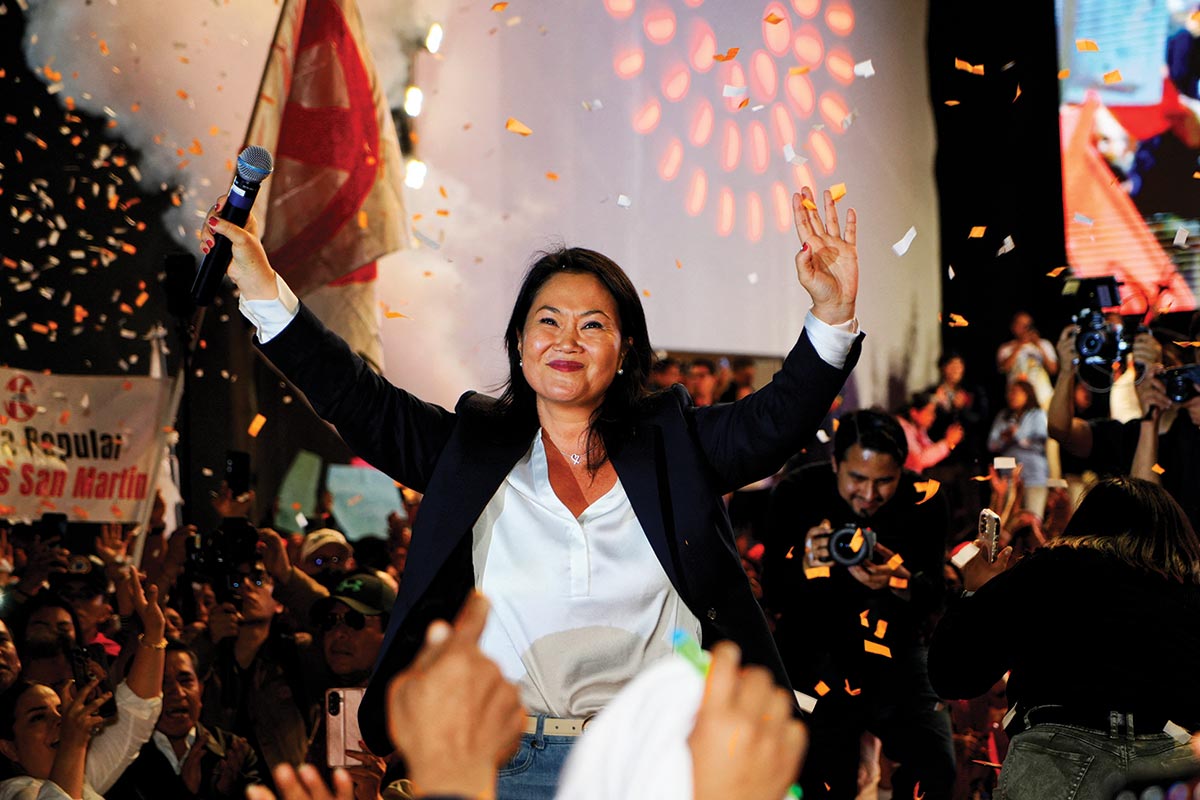
In 2016, Christian Rosas—the son of a prominent Peruvian evangelical congressman, a graduate of Jerry Falwell’s Liberty University, and an adviser to perennial hard-right presidential candidate Keiko Fujimori—emerged as the face of Con Mis Hijos No Te Metas (“Don’t Mess With My Kids”), a slick, media-savvy campaign claiming that gender education in schools was “homosexualizing” children.
Several years of poor performance by Peruvian schoolchildren in international tests had pushed education to the forefront of national debate at just the time that liberal sexual and gender reforms to the national curriculum were taking effect. For conservatives, the two issues fused into a single flash point, bringing together a coalition of faith-based groups that were mobilizing against a succession of socially progressive presidents elected between 2011 and 2020.
Under the banner of Con Mis Hijos No Te Metas (CMHNTM), the coalition framed educational reforms as a threat to children and forged powerful alliances between evangelical and Catholic churches and sympathetic politicians. Though it initially lost key court battles, the movement succeeded in mainstreaming a rigid definition of gender in policy debates, galvanizing popular opposition to women’s and LGBTQ+ rights.
Education Minister Jaime Saavedra, who had spearheaded the liberal reforms, championed social tolerance and said he wanted “our boys to internalize gender equality.” But in late 2016, Peru’s Congress, then controlled by Fujimori’s right-wing Fuerza Popular party, ousted him on dubious corruption charges—a move widely seen as punishment for imperiling Fujimori-aligned business interests through his reforms of higher education. Donnelly frequently points to this moment as an example of the political power her movement could wield in the United States.
In March 2017, CMHNTM staged its first national rally, which, according to Rosas, took place simultaneously in all 25 of Peru’s regions. “It was a vivid example that the church could unite despite their doctrinal differences,” Rosas says, proud of the movement’s ability to bring evangelicals and Catholics together at a time when they are in strong competition for followers. “By doing so, we were able to bluntly break the law.”
Rosas claimed that 2 million people turned out; opponents put the figure at 68,000. The reasons for what followed are contested, but soon after, the Education Ministry made concessions on the curriculum. A year later, President Pedro Pablo Kuczynski was ousted on corruption charges. Unlike Saavedra’s removal, his fall had broader causes, but the conservative panic over his administration’s “gender agenda” left him politically weakened and more vulnerable to attacks from the right.
Rallies continued as Kuczynski’s former vice president, Martín Vizcarra, took office, with the archconservative Fujimori and Fuerza Popular intensifying their fight against gender- and sexual-education reforms in Congress. After losing both a Supreme Court challenge and the 2019 congressional elections, the protest movement returned to the streets during the pandemic, seizing on discord and chaos and ultimately helping to unseat Vizcarra on corruption charges.
Peruvian politics rarely captures global attention—but then George Soros, an Antichrist figure to many on the populist right, took a personal interest in the bitterly contested battle. Last year, Soros’s Open Society Foundations announced the completion of a global restructuring that, according to Rosas, would curtail its philanthropy in Peru. The decision, which The Nation could not independently confirm, was credited in right-wing circles to the influence of CMHNTM, with many hailing Rosas as the man who “drove Soros out of Peru.” The claim supercharged Rosas’s profile among hard-right Christian networks abroad, where activists saw Peru as a model worth exporting. His movement quickly caught the attention of people with the money, conviction, and ability to make its concerns a central issue in American life.
Rosas instructed his new admirers in the United States that there are particular “tricks to the success of the movement.” The first is structural: It has no hierarchy and “does not exist formally,” making it immune to tax audits and NGO regulations. (“We are a ghost,” he says.) The second is strategic: There are no formal rules beyond working within the branding and guidelines, which include focusing on ideology rather than individuals and using “secular wording” so that nonconservatives and non-Christians—especially athletes and celebrities—feel comfortable aligning with the cause.
Harking back to his American education, Rosas leveraged transnational networks like a televangelist, exporting his formula across the region. His slogan and strategy traveled well: In Brazil, it fed into Jair Bolsonaro’s culture-war politics; in Argentina, it dovetailed with the rhetoric that would help propel Javier Milei to power. In the United States, it appealed to Ziklag’s architects, who saw the potential for a sequel on a bigger and more moneyed stage. Experts believe they brokered the alliance between Rosas and Donnelly, who describes “copy-pasting” his playbook. “What he said to us on the Zoom,” she explained to her followers: “‘This is where you’re headed, America, and you have an opportunity right now to stop it before it gets worse.’”
Calling her new movement Don’t Mess With Our Kids (DMWOK) and even using the same stark blue and pink colors that Rosas believed were fundamental to his campaign’s everyday appeal, Donnelly hit the road, holding rallies for suburban “mama bears” in swing-state America. With her active role in the Christian right’s campaign for Trump’s reelection, Donnelly’s transformation was complete. The woman who had spent years trying to spearhead Christian movements with little success was now pictured front and center in a group of prominent evangelical leaders laying hands on Trump two weeks before his reelection.
For Americans used to exporting ideas abroad, a movement imported from a small southern neighbor may sound unusual—but it speaks to a much deeper trend underway. For centuries, missionaries from Europe and North America fanned out across Latin America, Asia, and Africa to spread the Gospel and “civilize” the locals. Today, the traffic is going the other way. In a phenomenon called “reverse evangelism,” preachers and political operatives from the developing world are coming to the US and Europe, determined to rekindle the faith of a “post-Christian” West they believe has lost its way. The legalization of same-sex marriage, along with broader gains for LGBTQ+ rights, is often held up as the clearest symptom of Western spiritual decline and moral depravity.
The Peruvian movement is a prime example of how it all works. The country’s gender politics have been shaped by a protracted and bitter history going back to the presidency of Alberto Fujimori, Keiko’s father, in the 1990s. The conservative strongman, who was later imprisoned for human-rights abuses and corruption, oversaw forced-sterilization campaigns that targeted poor, rural, and Indigenous women. Those abuses turned sexual and reproductive rights into a lasting political fault line—fought over in battles about contraception, abortion, and, more recently, civil unions for same-sex couples.
Fujimorismo, as his brand of populist authoritarianism came to be known, was revived by Keiko, who mounted failed presidential bids in 2011, 2016, and 2021. After her last defeat, her party captured control of Congress, making her the leader of the opposition. Among her most reliable constituencies were conservatives and an ascendant evangelical movement that has supplied the energy to push back against advances in progressive social rights.
Although the neo-charismatic Pentecostal movement has been less popular in Peru than in other Latin American nations such as Guatemala and Brazil, where it now rivals Catholicism for followers, charismaticism is gaining ground fast, politically as much as spiritually. Approximately one in five Peruvians now identify as Protestant, by and large evangelical Protestant, and the country’s neo-Pentecostal leaders are increasingly plugged into a continental network that pushes the same populist, punitive politics as MAGA in the United States or Bolsonaro’s movement in Brazil.
Before Rosas could try his reverse evangelism in the US, CMHNTM had learned to flip the script, casting “gender ideology” as foreign wokeness foisted on unsuspecting nations. “Their enemy is framed in the language of neo-imperialism, since they claim that gender ideology was conceived abroad,” says Stéphanie Rousseau, a political scientist at the Pontifical Catholic University of Peru. “National sovereignty is in question.” The movement portrayed itself not simply as protecting children but as defending the people and the country. That inversion of the usual missionary narrative has made it easy to transplant the campaign across borders, highlighting a broader civilizational battle that is being waged.
As Rousseau notes, while sexuality and gender remain the movement’s sharpest rallying points, it has proved adept at folding other issues into the mix. Nowhere was that clearer than in Colombia in 2016, when voters narrowly rejected a peace agreement between the government and the leftist FARC insurgency. One of the factors that tipped the balance: a coordinated push by conservative activists who claimed that the deal’s provisions on equality smuggled “gender ideology” into national law.
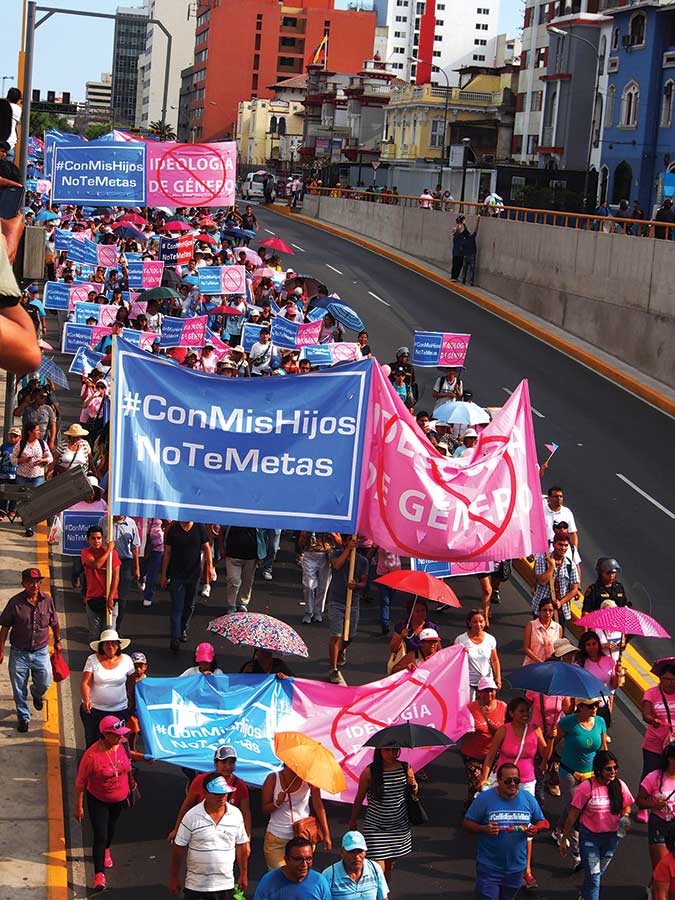
The regional spread of Con Mis Hijos No Te Metas was no accident. While the movement bills itself as a grassroots uprising, there have long been suspicions that a web of dark money and influence has helped to spread the movement across the Americas. And the political dividends have been substantial: This now-multinational movement is an engine of coordinated political—and spiritual—warfare. The goal is not just to counter progressive policy but to target elected officials for defeat, erode faith in democratic institutions, and replace ousted bureaucrats with loyalists. From Rosas’s playbook, Donnelly borrowed the idea of simultaneous rallies in every state, a tactic designed to project ubiquity and inevitability. She overhauled her personal brand to match: sleek Instagram-friendly visuals, stripped of overt religious imagery, with a message broad enough to pull in people who aren’t particularly interested in politics or religion, while dog-whistling to those who are already engaged.
Donnelly initially partnered with controversial groups like Moms for Liberty, whose explicitly right-wing image, combative gatherings, and flair for controversy ended up clashing with DMWOK’s preferred style as a softer, pastel-hued community of concerned mothers. DMWOK churns out shareable memes and infographics for social media that bypass traditional gatekeepers. Complex debates are distilled into emotionally charged slogans about protecting children.
Another important part of the movement—one that Rosas proudly boasts about—is that it sidesteps pastors and traditional church hierarchies, cultivating the feel of a popular uprising against church leaders. This “army,” as Rosas calls them, are “just leaving their military base, meaning they’re just leaving the church to express themselves publicly after many decades.” Elected and appointed officials might be cast as the enemy, but they can just as often become key allies: CMHNTM posted a message on X crediting Casey DeSantis, the wife of Florida Governor Ron DeSantis, with launching the #ConMisHijosNoTeMetas (#DontMessWithMyKids) movement in the United States as a part of her mobilization of conservative mothers. Rosas’s sister Dorcas Hernandez, who cofounded CMHNTM, runs a company that connects Latin American business leaders and officials with US tycoons and politicians.
For André Gagné, a professor of theological studies at Concordia University, the Christian right’s long-term aim of merging the political and the spiritual is evident in DMWOK, which sees itself as fighting back against “an attack on what they view as the normal family,” he says. “Since the days of Jerry Falwell and the Moral Majority, the Christian right has framed everything as a defense of the family.” Challenging traditional sex and gender norms “disrupts what they view as the divine order of things—if you attack the family, that leads to a breakdown of society.”
In Rosas and Donnelly’s message, Gagné hears an unmistakable biblical register. “It’s rooted in Old Testament warfare narratives,” he says: “‘We got the land—but now we’ve got to take on the giants.’” It’s a battle cry that collapses the distinction between politics and prophecy, turning the defense of the family into a holy war. Meanwhile, it also ignores allegations that have called Rosas’s own family values into question. In 2021, his wife accused him of physical and psychological abuse—charges that he waved off as merely “subjective” and “interpretive.”
Where the evangelical old guard was defined by gray-suited patriarchs like Falwell, this new wave taps into a different current on the religious right—a celebration of sisterhood, without the feminism. With slogans like “If you silence a woman, her children become vulnerable to the enemy,” Donnelly’s rise epitomizes a new kind of militant maternalism, in which a growing cadre of ultraconservative women marry soft-focus personal branding with hard-line reactionary politics.
It was this uncontainable momentum that vaulted Jenny Donnelly past veteran female prophets who had spent years grinding on the charismatic circuit. She emerged fully formed: polished, camera-ready, and perfectly suited to fill a vacancy—the religious right’s answer to Glennon Doyle or Cheryl Strayed, reframing hard-right politics through the approachable lens of a suburban mom with good hair and an easy warmth. While traditional social media influencers sell aspirational wealth, Donnelly sells something more attainable: the fantasy that you, too, can be a culture warrior in yoga pants.
That’s how a reactionary movement born in Peru helped shape the terms of the 2024 US presidential election. The politics of protecting children cuts cleanly across party lines. Women with little prior political engagement are drawn in by Donnelly’s PTA-mom framing, only to find themselves in MAGA’s slipstream—suburban swing voters nudged rightward by the soft power of relatability. Think of it as a moral Tupperware party: deliberately decentralized, built on loose online networks that can harden into communities without ever looking like a formal political machine.
By last November, gender and education were no longer just talking points—they had become defining wedge issues in American politics, driving a manufactured moral panic over children that the religious right has expertly deployed. Now it’s spread far beyond the hard-liners protesting outside city halls to become a staple issue in the mainstream media. In turn, it has helped to refocus a growing number of American Christians, shifting support for Trump from political calculation to spiritual conviction. In his first term, Trump was King Cyrus, a flawed ruler who was not one of God’s people but who served God’s plans—a biblical analogue that could be used for political ends. In the second Trump administration, he is cast as a divinely appointed leader in a cosmic battle. After all, only people driven by demonic forces could object to protecting children.
More from The Nation
The American Universities Programming Israel’s Killer Drones The American Universities Programming Israel’s Killer Drones
Industry partnerships in higher education are pushing STEM graduates into the business of weapons manufacturing and genocide profiteering.

The Red State–Blue State Healthcare Divide Is Dangerous for Everyone The Red State–Blue State Healthcare Divide Is Dangerous for Everyone
Whether or not you have access to independent, scientifically sound public health guidance may depend on how your state voted for governor.
In the Trump Era, Celebrating Black History Month Feels Radical Again In the Trump Era, Celebrating Black History Month Feels Radical Again
After putting on their very best performances of solidarity every Black History Month, this year corporate marketers have seemed at a loss for words.
ICE’s Detention of Pregnant People Continues a Disgraceful American Tradition ICE’s Detention of Pregnant People Continues a Disgraceful American Tradition
We are seeing yet another example of state-sanctioned violence against the reproductive futures of those deemed outside the national body.
The Price of Being Black and Proud in European Soccer The Price of Being Black and Proud in European Soccer
The Brazilian star Vinicius Jr. has repeatedly been a victim of racist abuse from soccer fans. Now, it seems such vitriol can even come from players without much consequence.
Why the Supreme Court’s Tariff Decision May Be Short-Lived Why the Supreme Court’s Tariff Decision May Be Short-Lived
Within hours of losing the case, President Trump declared a new global tariff under a different statute.

