We Need a Project 2025 for the Left
The right has a blueprint for the future. Where’s ours?
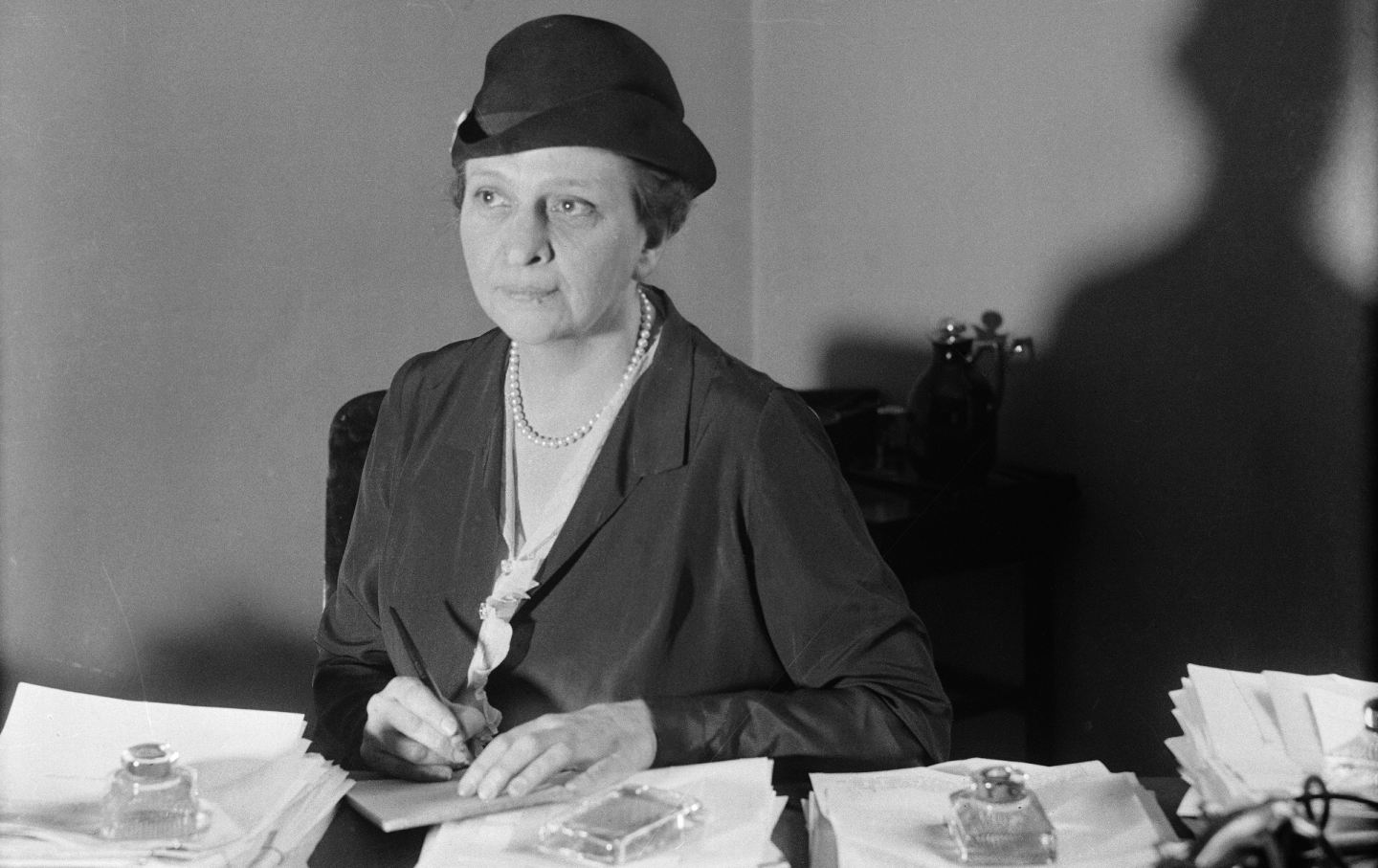
Frances Perkins in 1933, just before becoming secretary of labor for Franklin D. Roosevelt.
(Bettmann via Getty Images)In March 2020, at the onset of the Covid-19 pandemic, Stanford political scientist Margaret Levi wrote a short post on Social Science Space called “ “Frances Perkins Was Ready.”The gist of the piece was that in the wake of the Triangle Shirtwaist Factory fire in 1911, which Perkins witnessed, the labor movement of which she was a part sprang into action to pass groundbreaking workplace health and safety regulations.
Perkins would do the same as labor secretary in the 1930s when the Depression hit, championing a set of social and economic reforms that are still with us today. Perkins was ready, as Levi says, because she and those she worked with had already dreamed up and plotted out the architecture of what needed to be done. What they needed was an opening, an opportunity for action. Levi’s piece goes on to talk about Covid-19 as a contemporary opportunity for building what she calls a “new moral political economy”—in other words, “how better to structure our politics and economics based on commonly shared values.”
I was thinking about Perkins and Levi’s piece as I read the June issue of this magazine, which includes a special section on Project 2025, the American right’s plan for the next Trump administration, or whenever they grasp control of power again in the United States. Despite Levi’s and others’ important intellectual work (for example, the Law and Political Economy Project) on crafting a new vision for our future, it is the right that has a comprehensive blueprint for action, for taking power, for embodying their ideas in policies, practice, and law. It has the endorsement of almost all right-wing groups across the country and a political apparatus to electrify this Frankenstein monster of a vision into life. In other words, the right is ready. So we need to be ready too.
I’ll just say it outright: We need our own Project 2025 and all the fixin’s that go with it. While I think it is vital as a political imperative, it also has everything to do with public health. Even if you don’t think we need such a detailed plan for our teetering democracy, we definitely need one to ensure that we physically survive and thrive into the rest of this new century. I’ve written about the life-expectancy crisis in America before, our terrible response to Covid, our seemingly endless ability to keep doing the wrong thing with H5N1, but at the base of it all is what I would call the political determinants of health—how the policies, practices, and law we make create sickness and death.
The social determinants of health are responsible for the vast bulk of health outcomes in this world—not medical treatment. The structure of healthcare matters, but education, housing, social protections— all “the conditions in the environments where people are born, live, learn, work, play, worship, and age”—matter even more. And all of these things are shaped by our politics. So when I say we need a Project 2025 for public health, I am being quite serious—if we want to turn around the terrible life expectancy in the US, be prepared for the next pandemic, and confront the existential crisis of climate change—we need a working vision for our future, yes, an intellectual one, but frankly, we have a lot of that; what we need is to institutionalize that vision. As Robert L. Borosage says:
Now these MAGA operatives are, in the words of Heritage president Kevin D. Roberts, intent on “institutionalizing Trumpism.” The foundation’s Project 2025 includes a 900-page book, Mandate for Leadership, that lays out a Trumpist agenda for every corner of the government; a still-secret 180-day Transition Playbook for the first six months in office; a right-wing version of LinkedIn to recruit and vet candidates for political appointment; and a Presidential Academy to train them.
I’ll have what they’re having, please. If Covid-19 has taught me anything it is how our collective public health—no matter how much technical, scientific work I and others do day to day—is wholly held hostage by our political leaders. So we have to organize—it’s probably the most important thing to do right now to ensure our health and well-being. A long-term grassroots movement takes time to build, stitching together what exists now will help, but we simply don’t have a unified base in this moment to protect us from the political determinants of health that are driving us to be a sicker nation.
We need something in the interim—and this is the Project 2025 model—an operational plan to recraft our “politics and economy around commonly shared values.” In this case, the values are to survive, thrive, and flourish. Health, according to the WHO, is more just the absence of disease, it is “complete physical, mental, and social well-being.” You may say this is starry-eyed fantasy, but is it any more fantastical than the fever dream that is the Heritage Foundation’s 900-page tome? Is it not a goal more worthy than what the right has to offer? I am not quite sure why we’re unable on the left to think like this, work like this, organize like this. All I know is that our failures to rise to this challenge are killing us—and that, if we don’t get ready like Frances Perkins did, we are endangering ourselves more than any virus could.