
The Billionaires Are Abandoning Humanity
Peter Thiel and his friends feel they no longer belong to our species.
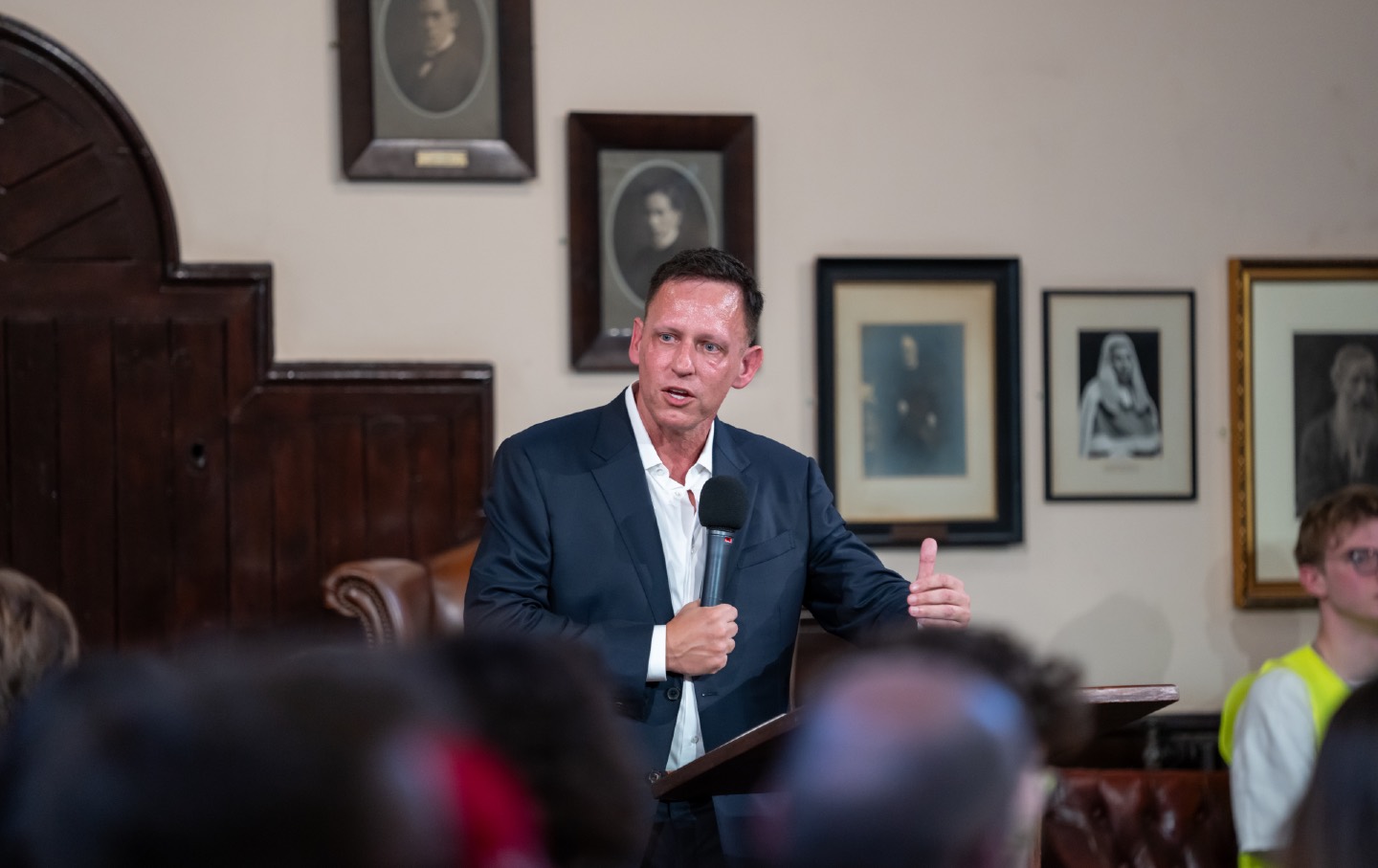
Among plutocratic reactionaries, Peter Thiel, who made his fortune as a cofounder of PayPal, is a trendsetter. In 2016, even billionaires who were hostile to liberalism and shared Thiel’s views on the necessity of radically reducing government to empower big business were hesitant to support Donald Trump, seeing the candidate’s populism as a threat to the established order. Thiel himself knew that betting on Trump was a gamble—but it was a bet he thought was not just wise but necessary. For many years, as he makes clear in a lengthy interview with Ross Douthat in The New York Times published last Thursday, Thiel has worried that Western civilization had entered a period of long-term stagnation in the 1970s which will continue unless there is a radical shake-up. This stagnation has many dimensions: lower economic growth, fewer world-changing scientific discoveries, and a general cultural malaise.
Trump, Thiel hoped, would at least open up a conversation about why progress was stalled. This was, he admits, “a preposterous fantasy.” Although his political investments haven’t quite paid off in overcoming stagnation as he’d hoped, Thiel continued to invest in politicians—some of whom have been elevated to the national stage thanks to his largesse (he was a notable patron of Vice President JD Vance).
Thiel’s analysis of stagnation as requiring a radical right-wing political turn has also had a profound influence on his peers in Silicon Valley, who to greater and lesser degrees now share his worldview. They might be more circumspect than Thiel about how closely they are willing to align with figures like Trump and Vance, but they seem to have been won over to his broader analysis.
According to Thiel, he’s had debates about his stagnation thesis with Eric Schmidt (CEO of Google) in 2012, venture capitalist Marc Andreessen in 2013, and Amazon founder Jeff Bezos in 2014. All three first rejected the idea that stagnation is a problem, but, Thiel claims, “have, to varying degrees, updated and adjusted.” This shift, he asserts, is “deeply linked” to the turn of Silicon Valley elite away from supporting mainstream Democrats such as Barack Obama and toward embracing in varying degrees the Trump agenda.
The idea of stagnation is itself not an absurd one—nor inherently reactionary. Many left-wing historians and economists (notably the late Eric Hobsbawm in his magisterial 1994 study The Age of Extremes and the economic historian Robert Brenner in his crucial 2006 book The Economics of Global Turbulence) have analyzed a “long downturn” that began in the early 1970s when the major capitalist nations entered a period of slower technological innovation and lower economic growth. In order to roll back the labor victories of the postwar era (which had become harder to justify in the wake of falling profits), American elites both empowered finance capital (leading to a series of bubbles) and embraced deindustrialization, with many industries shifting to the Global South (notably China).
Even if one doesn’t accept every point made by Hobsbawm, Brenner, or similar Marxist thinkers, their analysis at least has a sturdy basis in political economy and material reality. By contrast, Thiel has a bizarrely cultural analysis of stagnation that doesn’t even pass the laugh test. The Western world, he claims, entered into five decades of anemic growth because of the counterculture of the 1960s. According to Thiel, “in my telling of the history of the 1970s…the hippies did win. We landed on the moon in July of 1969, Woodstock started three weeks later and, with the benefit of hindsight, that’s when progress stopped and the hippies won.” Thiel adds that “everyone became as deranged as Charles Manson.”
Because of the hippies, says Thiel, Western powers embraced an ideology of peace and safety that stalled technological growth.
More recently, the environmental movement has taken hold, which blocks progress even more. Thiel refers to climate change activist Greta Thunberg as the Antichrist. He is not being metaphorical in this description, since he makes clear that he believes the biblical account of the Antichrist is to be taken as a literal depiction of the dangers facing humanity. Thiel says that “in the 17th century, I can imagine a Dr. Strangelove, Edward Teller-type person taking over the world. In our world, it’s far more likely to be Greta Thunberg.”
This is all too much for even so conservative a figure as Ross Douthat, who not unreasonably objects, “Greta Thunberg is on a boat in the Mediterranean, protesting Israel.”
One could add that the hippies did not win in the 1960s; Richard Nixon did. After Nixon, Reagan and Thatcher won and were the dominant figures of our age. Their solution to the problem of stagnation is in fact the same as Thiel’s: deregulation and lower taxes for the rich. This is also the formula Donald Trump has followed with his “Big Beautiful Bill” now making its way through the Senate.
Reagan and Thatcher were politically successful, remaking even their center-left opponents such as Bill Clinton and Tony Blair into celebrants of streamlined government. But this political success has not in fact solved the problem of stagnation, which remains as severe, by Thiel’s account, as it has ever been. Thiel and his cohorts have gotten everything they want politically, but that has still failed to solve the key problem of our time. The fact that he still advocates a failed economic program suggests the deeper stagnation is in his own mind.
Popular
“swipe left below to view more authors”Swipe →Since politics has failed, Thiel and the other plutocrats are also toying with another solution: secession from society and the human species. Thiel has long been an advocate of various post-human technological solutions that will allow him and his fellow plutocrats to free themselves from the stagnant mass of humanity: cryonics (to overcome death), sea-steading (to create sea-board libertarian utopias), colonizing Mars, and artificial intelligence.
In a telling moment in the interview, Douthat asks Thiel what he feels about the future of the species:
Douthat: It seems very clear to me that a number of people deeply involved in artificial intelligence see it as a mechanism for transhumanism—for transcendence of our mortal flesh—and either some kind of creation of a successor species or some kind of merger of mind and machine.
Do you think that’s all irrelevant fantasy? Or do you think it’s just hype? Do you think people are raising money by pretending that we’re going to build a machine god? Is it hype? Is it delusion? Is it something you worry about?
Thiel: Um, yeah.
Douthat: I think you would prefer the human race to endure, right?
Thiel: Uh——
Douthat: You’re hesitating.
Thiel: Well, I don’t know. I would—I would——
Douthat: This is a long hesitation!
Thiel: There’s so many questions implicit in this.
Douthat: Should the human race survive?
Thiel: Yes.
Douthat: OK.
Thiel: But I also would like us to radically solve these problems.
Thiel goes on to talk about his hopes that technology will allow humanity to solve the problem of death and achieve the long-held promise of Christianity of eternal life and transcendence.
In the interview, Thiel also alludes to Robert Heinlein’s science fiction classic The Moon Is a Harsh Mistress (1966). In that novel, the colonists of the moon, disgusted by the corruption of earth folk, launch a libertarian revolution under the slogan “There’s No Such Thing as a Free Lunch” with the aid of AI.
Listening to Peter Thiel, it is hard to escape the conclusion that he and his fellow billionaires are sick of the human species. They want to escape the inferior beings that surround them. Recently, Mark Zuckerberg has radically cut back his philanthropy, preferring to give his money to STEM research rather than helping poor people. Meanwhile, Jeff Bezos has basically rented the city of Venice to throw a multimillion-dollar wedding attended by his fellow plutocrats, an oligarchical orgy.
If the billionaires are so determined on quitting humanity, perhaps it would be best to give them what they want and sponsor a mission to Mars so humanity can rid itself of them.
More from
Jeet Heer 

Where Is the Outrage Over Trump’s Racist Targeting of Ilhan Omar? Where Is the Outrage Over Trump’s Racist Targeting of Ilhan Omar?
The establishment press and some Democrats are strangely mute over the president’s flagrant abuse of the legal system.
The Real AI Threat Is Already Here The Real AI Threat Is Already Here
Never mind some future apocalypse—AI is being used right now to cause enormous suffering.
Elon Musk’s James Talarico Smear Blew Up In His Face Elon Musk’s James Talarico Smear Blew Up In His Face
But that doesn’t mean the danger from Musk’s lies is over.
Does America First Really Mean Israel First? Does America First Really Mean Israel First?
Mike Huckabee’s aide shows how an extremist agenda dominates Trump’s Middle East policy.

The Death Penalty Has Become a Torture Machine The Death Penalty Has Become a Torture Machine
Christa Pike's botched lethal injection proves there is no humane form of execution.

Kimberly Guilfoyle Is a Master of Mafia Diplomacy Kimberly Guilfoyle Is a Master of Mafia Diplomacy
The US Ambassador to Greece is making suspicious deals for her buddies.

