Will Moderna’s Cancer Vaccine Be Good for People, or Profits?
The drug giant restricted access to its Covid vaccine to protect its bottom line. Will history repeat itself now?
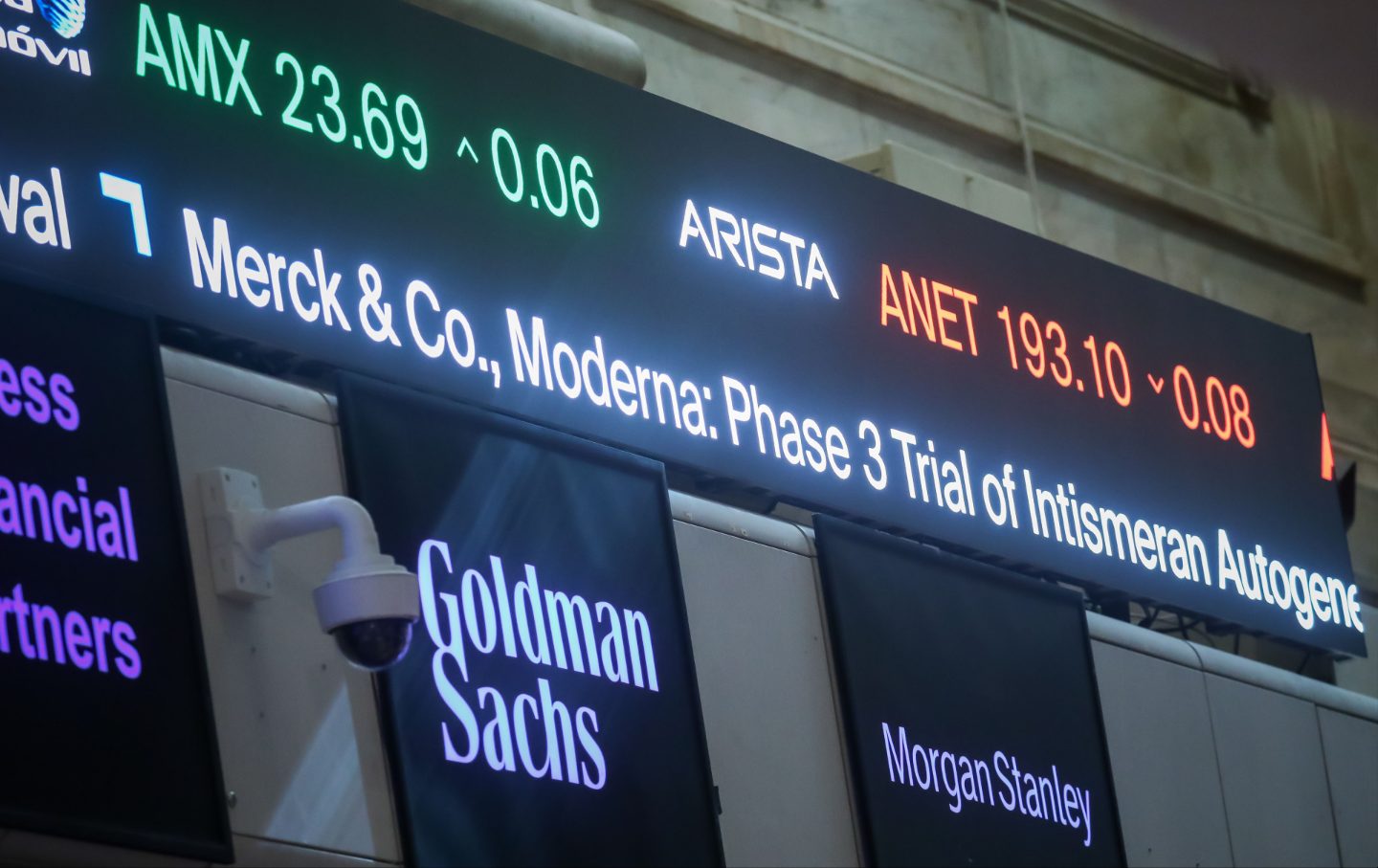
Moderna Inc. and Merck & Co. mRNA melanoma trial news on the floor of the New York Stock Exchange, on Wednesday, August 19, 2026.
(Michael Nagle / Bloomberg via Getty Images)The mRNA Covid vaccines saved millions of lives. Though the United States had higher excess deaths from SARS-CoV-2 than other peer nations in the G7, it could have been a whole lot worse without the development and rollout of these immunogens. The technology powering mRNA vaccines is truly remarkable, and the Nobel Prize that Katalin Karikó and Drew Weissman received for the foundational discoveries that made these vaccines possible was well deserved.
Since the arrival of these vaccines, there has been a flurry of activity to use mRNA technology to fight other diseases. A landmark “phase 3” study of an mRNA vaccine for melanoma, announced by Moderna and Merck in August, suggests that we may have found a winner.
In the study, patients were assigned to Merck’s Keytruda (or pembrolizumab, an immunotherapy drug) either with or without Moderna’s new vaccine (intisimeran, AKA mRNA-4157, an individualized neoantigen therapy). The combo extended the time patients lived without a recurrence of melanoma compared with Keytruda alone, while the treatment also reduced the risk of the cancer’s metastasizing across the body. Moderna’s mRNA vaccine for melanoma is also a personalized treatment—rather than targeting common tumor antigens, the vaccine is custom-made for each patient by identifying neoantigens (abnormal proteins associated with cancer cells) that are specific to their own tumor.
While phase 3 studies are the last port of call before regulatory approval by the FDA, the Moderna/Merck study is still underway. Immunotherapy for cancer is, as Science magazine’s Derek Lowe cautions us, “a hideously complex field with many twists and turns.” The companies have yet to show how much their drug could boost overall survival rates, which is the ultimate test of its effectiveness. Scientists, clinicians, and patients will have to wait to see the data when it is presented at upcoming conferences and examine the full set of results to derive any firmer conclusions. But the initial results are certainly promising.
Yet amid the excitement about this new development in melanoma treatment, the question arises: Who will get the benefit from these advances? You see, it is only a few years ago that Moderna dug in its heels and refused to share mRNA technology with lower- and middle-income countries, which led to a vast undersupply of these vaccines, a stark inequality in access to them, and millions of unnecessary deaths. Moderna was thinking ahead to this very moment: If they had shared mRNA technology with countries in Africa, Asia, and Latin America back then, allowing them to produce their own vaccines, then their future, exclusive profits from new uses of the mRNA platform would have been in jeopardy. This is after the company made billions in profits and benefited from investments by the US government in the fundamental research that made these vaccines possible. It is a story of greed and cruelty, which should never be forgotten.
Keytruda alone costs about $12,000 for a short-term dose, and on a yearly basis can cost upwards of $150,000–200,000 depending on one’s treatment regimen. Yes, insurance covers much of the costs for many, but once again, American taxpayers subsidized the fundamental research on PD1, the target of the drug, and are now paying again through higher deductibles, co-insurance, and rising premiums that pass on drug costs to the consumer. Now add Moderna’s new cancer vaccine into the mix.
Intisimeran is a bespoke treatment, made specifically for an individual’s tumor neoantigens. Think of it this way: Keytruda and similar drugs target a single common pathway; they are the box store, retail giant version of cancer immunotherapy. Intisimeran is haute couture, made just for you. The price for haute couture is never cheap. By the time pharmacy benefit managers, pharmacies, hospitals, and insurers take their cut, intisimeran is going to make high-fashion prices from the likes of Chanel and Christian Dior look like a bargain.
And don’t look to the federal government to rein all this in. Despite the fact that Merck was among the companies that signed a confidential deal with the White House to lower the prices of some prescription drugs, Keytruda’s price has risen 6 percent since last year to $210,000 for one year’s treatment under President Donald Trump.
Finally, despite the anticipated high price of Moderna’s melanoma vaccine, the future is not bright for the mRNA field in the United States, even with the profits that this technology may reap. Robert F. Kennedy Jr. and National Institutes of Health director Jay Bhattacharya both have come out strongly against mRNA development, citing the supposed dangers of their use and expressing lack of trust in the technology. Of course, both RFK Jr. and Bhattacharya have no evidence to support their claims and are actively spreading misinformation about the science. We indeed have to address the high price of drugs in the US, but cutting off public funding for mRNA development really puts us in the worst of both worlds. New innovations now will be forestalled; new applications of this technology will happen elsewhere, and patients will bear the ultimate price for the sheer idiocy and abject heartlessness of RFK Jr. and Jay Bhattacharya, as new cures and treatments based on mRNA will languish in what is becoming the most backward of nations.