The Timely Example of Dr. John Carlos
As the 1968 Olympian turns 80, his life provides a lesson for our times: Don’t sell out.
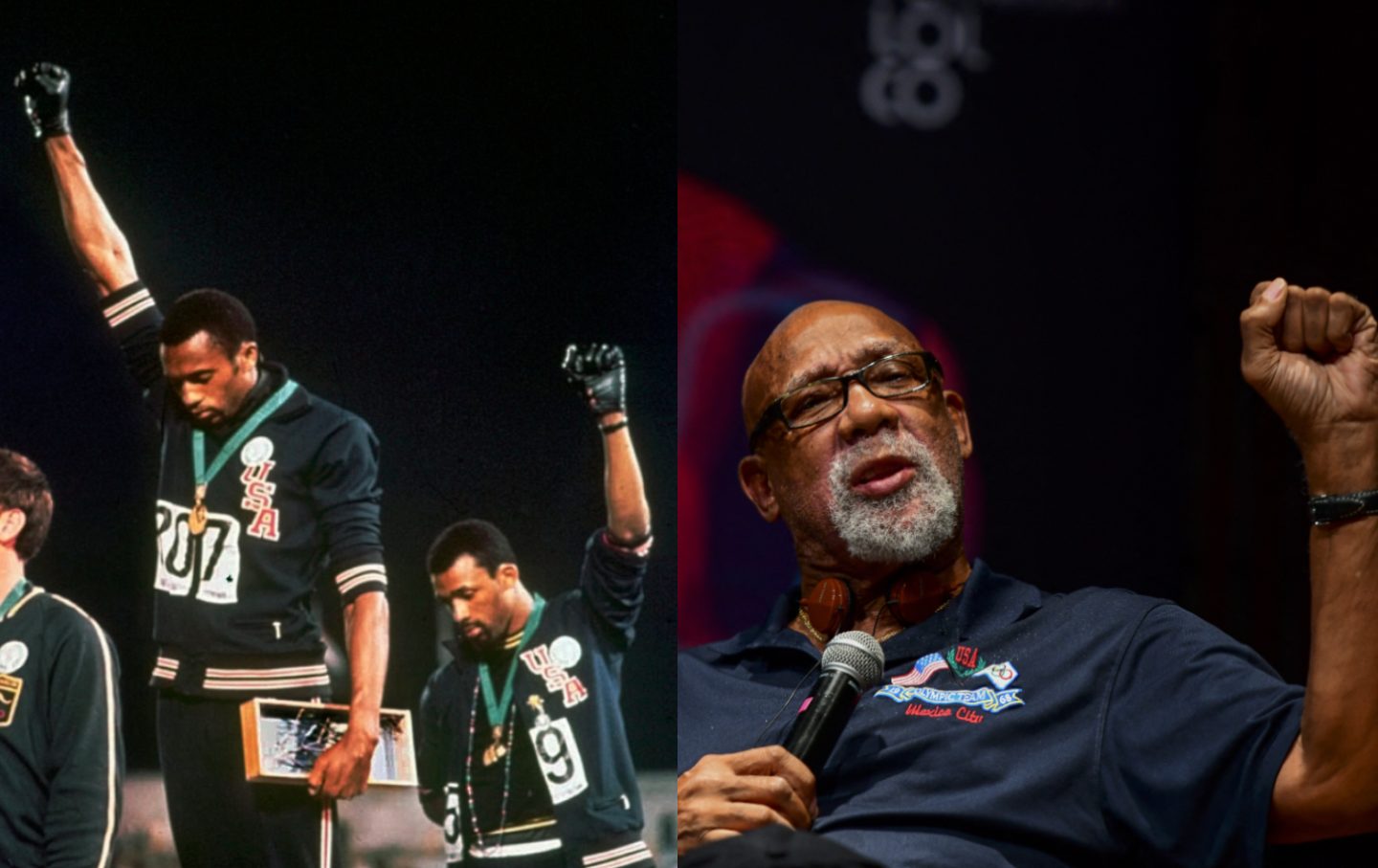
Born June 5, 1945, John Carlos became part of one of the most iconic photos in sports or protest history, when he raised his fist at the 1968 Summer Olympics. Sharing the 200-meter medal stand with Tommie Smith and Australian runner Peter Norman, the image of Carlos and Smith, their fists aloft, went global. This was the first Olympics broadcast around the world in technicolor and, truly, color was the way it had to be.
But Dr. John Carlos’s birthday or what he did on that cool October morning (the summer games—due to the weather or civil unrest, depending on the source—were postponed until October) is not why he deserves our attention today as we wrestle with effective resistance in troubled times. I had the honor of working with the track and field Hall of Famer on his memoir John Carlos: The Sports Moment That Changed the World and learned the unexpected. The great feat of this man’s life was not a raised fist for 90 seconds in 1968. It is the straight back he has held for the 57 years since. Both Smith and Carlos knew that there could be hell to pay for their protest on the Olympic medal stand, but the intensity of the backlash they could not have predicted.
But they also never expected there to be two statues of them, one at their alma mater San Jose State and one—at least until Vice President JD Vance rips it from the floor—at the National Museum of African American History in Culture. But this kind of acknowledgement and adulation has been a part of Carlos’s life only for the last 15 to 20 years.
Before that, there were decades of slander and disinformation about why they protested. Carlos and Smith did not expect their families and especially their children to suffer for their actions. They did not expect to be pariahs with no access to athletic employment opportunities—or even regular employment. They did not expect the FBI to be trailing their steps.
Over the next 57 years, Carlos, however, accomplished something rare: Carlos never made us ashamed to have that image taped to our walls or affixed to our homescreens. Given what he was put through, Carlos had every reason to succumb to demons. But he never had to come back from the depths, because his antagonists could never push him that low. There were bleak moments: The time Carlos had to chop up furniture in front of his family for firewood; the time his marriage to Kim Groce ended due to the pressures of being post-Olympic outcasts; and the time soon thereafter when Groce died by suicide. None of the pain stopped him from living with dignity. None of it stopped him from being there for his kids, and now they have their own children who adore their grandaddy.
Critical for the rest of us, none of these hardships caused him to repent. When actors or athletes are put on a blacklist, their status as public figures gives them an escape hatch that a blacklisted teacher, factory worker, or office employee cannot access. They can condemn themselves, denounce their former comrades, and then proceed to watch the doors reopen. You don’t even have to really believe it. The important part is for the world to see you bend the knee.
But Carlos, in the tradition of people like Paul Robeson, never expressed teary remorse for choosing to challenge oppression on the brightest possible stage. Instead, he wore his blacklist like a badge of honor. He worked with his hands and hustled when he could, before eventually becoming a counselor in the California Public School system for 20 years; an anonymous icon striding to his office among a throng of kids. Today, the word “sellout” has fallen out of use. In a time of modern-day blacklists, it needs to be reintroduced. Carlos never sold out, and that helped the rest of us stay the course.
We are in times when telling the truth, having political ethics, or holding up a mirror to this warped country are dangerous acts. They also seem to many to be increasingly irrelevant values. Why tell the truth when you can, like the president, make up your own? Why have principles if they stop you from accepting that gambling app sponsorship for your podcast? Why criticize this American nightmare if it comes with a steep price? One thing Carlos said to me upon meeting over 20 years ago was “I refuse to be exploited.” This refusal cost him money, but he along with his partner, Charlene, and their family, have had a better life for it, one where grandaddy is a hero. Carlos’s present and past are reminders, to paraphrase Dr. Martin Luther King Jr., that “a back can only be broken if it is already bent.” Happy 80th to Dr. John Carlos. Here’s to 80 more.