
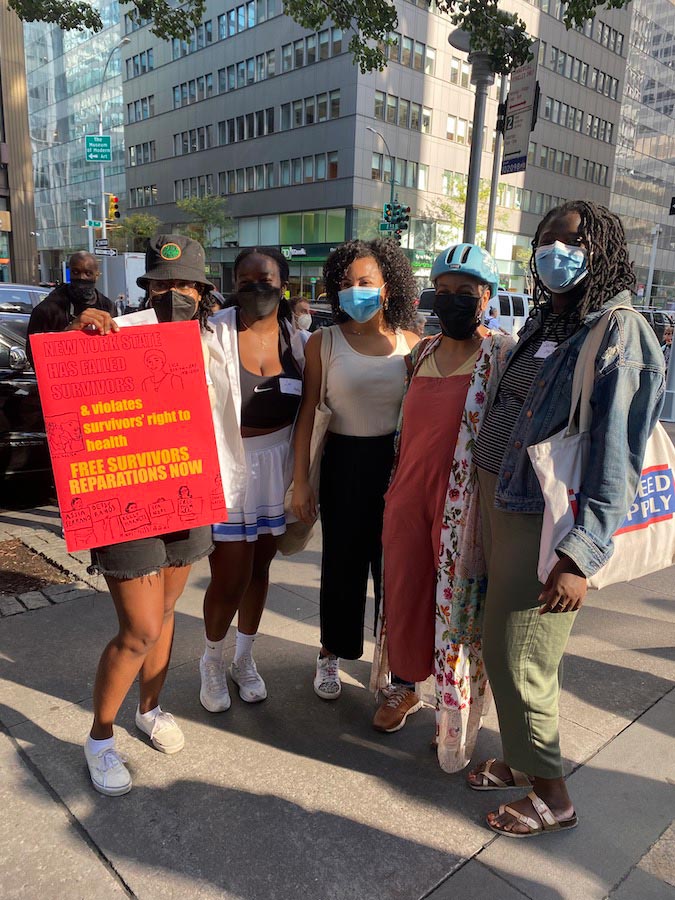
“Get them from behind the wall! Governor Hochul, free them all!” On Friday, more than five dozen people gathered in midtown Manhattan. They were repeating their demand that New York’s new governor do what her predecessor failed to do: release abuse survivors imprisoned throughout New York, particularly given the state’s widespread failure to provide protection and resources, such as housing, medical and mental health care, and other supports that would enable them to escape or survive violence.
“The state has already caused tremendous harm by leaving survivors—all survivors—highly vulnerable to patriarchal violence,” said Nathan Yaffe, an organizer with Survived and Punished New York, a grassroots group that works with abuse survivors incarcerated throughout New York. “But with survivors who are criminalized, the state then compounds that harm by punishing them for their survival actions—actions they took to survive conditions the state is responsible for. That’s why as a first step towards reparations, the governor must free criminalized survivors through mass clemency.”
Clemency can take two forms: a pardon, which expunges a person’s conviction, or a commutation, which shortens a person’s prison sentence. Advocates have long pressed the state’s executive to exercise the latter, and, in October 2015 their hopes were briefly raised when then-Governor Andrew Cuomo announced a clemency initiative. The former governor stated that he would issue commutations on a quarterly basis and encouraged incarcerated people to apply for them. Hundreds applied, but ultimately Cuomo commuted only 41 prison sentences during his entire tenure. There’s no timeline required for considering on clemencies, and many who heard nothing from Cuomo’s office are hoping that Governor Kathy Hochul will show more mercy.
Even before assuming the executive office following Cuomo’s resignation in August, Hochul has publicly condemned domestic violence. On October 1, the start of Domestic Violence Awareness Month, her office announced $6.5 million in funding for service providers to offer assistance and support to abuse survivors and their families.
Popular
"swipe left below to view more authors"Swipe →
Responding to whether she would grant clemencies to survivors, Hochul’s office said in a statement after publication, “Governor Hochul is committed to supporting and delivering justice to survivors of domestic violence, and we will work with advocates and impacted communities to address these concerns.”
While no national or statewide data is kept on the numbers of abuse survivors imprisoned for defending themselves or being coerced into criminal activity by their abuser, studies indicate that the intersections of abuse and incarceration are frequently intertwined. A widely cited 2012 report found that 77 percent of women in jails had previously experienced partner violence. Another widely cited study found that at Bedford Hills Correctional Facility, New York’s maximum-security prison for women, 75 percent of incarcerated people reported experiencing physical intimate partner violence and 90 percent had experienced physical or sexual abuse in their lifetimes.
“Putting survivors of gender-based violence in jail thrusts them into a system that mirrors the situation with their abusers,” said Natalia of STEPS to End Family Violence, a nonprofit that works with abuse survivors facing criminal charges. (Natalia did not want to disclose her last name.)
One of those hoping for gubernatorial compassion is 40-year-old Kelly Harnett, currently serving a 17-to-life sentence at Bedford Hills Correctional Facility. In July 2010, Harnett and her then-boyfriend Tommy Donovan were arrested in Astoria Park minutes after Donovan had strangled another man, Ruben Vargas, to death.
The couple had met Vargas that night and Donovan invited him to drink beer with them in the park. When they finished, Donovan borrowed Vargas’s bicycle to get more beer from the store. During that time, Harnett told The Nation, Vargas made a pass at her, making her increasingly uncomfortable. When Donovan returned, she told him repeatedly that she wanted to leave, finally telling him about Vargas’s action. She recalled Donovan responding, “I’m going to kill him” and rushing toward the other man.
“People say that all the time, but you don’t think they’re going to do it,” Harnett said. But Donovan did—strangling Vargas to death.
“I asked him to stop. I actually started crying,” Harnett recalled. “He looked at me and told me to shut the fuck up and said I will be next. I took that as a threat and did as he said—I was quiet.”
It was not the first time that Donovan had acted violently. Harnett recalled that in the months before that fateful night, Donovan had been increasingly abusive towards\ her. He had split her lip more than once. He had also choked her and threatened to kill her.
That night, after strangling Vargas, Donovan threatened her again. “He told me if I said anything, my family would go missing,” she recalled. Harnett believed him, worrying too that he might still kill her. When the police arrived 15 minutes later, she recalled breathing a sigh of relief.
Still, fearful of Donovan, Harnett told police she had been sleeping when the murder occurred, a lie that led reporters to label her as homeless and transient. (Harnett lived with her mother.)
Donovan pleaded guilty to manslaughter and received a 15-year prison sentence. He died of a drug overdose while incarcerated.
Harnett refused to plead guilty to a murder she did not commit. Shortly before her trial, Donovan wrote a letter to her defense attorney admitting that he alone had killed Vargas, that he had demanded—and then taken—her shoelace, and that she had not participated in the man’s death. The letter was never introduced into evidence, and her defense attorney failed to call Donovan to the stand. (Harnett’s attorney, David Epstein, died in 2017.)
At trial, Harnett was convicted of murder and sentenced to 17 years to life; she will not be eligible for her first parole hearing until October 2027.
“He said he was going to take my life, and the justice system allowed him to do it,” Harnett said, reflecting on the discrepancy between their sentences.
While incarcerated, Harnett studied the law—first while awaiting trial at Rikers Island, then at Bedford Hills Correctional Facility, the state’s maximum-security prison for women. She worked at the law library for several years, helping women with their post-conviction appeals and petitions for resentencing once the Domestic Violence Survivors Justice Act passed. While her efforts have helped free at least four women, her own legal appeals have been denied. Three years ago, she filed for clemency. She has received no response.
Now she’s hoping that Hochul will give her a second chance. “I’m very sorry for what happened to Mr. Vargas,” she reflected. She described her 2010 self as “a battered, mentally, and sexually abused victim of domestic violence who had no way of coping with my pain. I allowed my status as a victim [to] define me.”
Now, she says, “I have learned the impacts that negative relationships can have on my decision-making process. I have done a complete 180 from the person I was 11 years ago.”
There’s no timeline for the governor’s response. Hochul’s office has stated that they do not comment on pending clemency applications.

