Welcome to the “You Do You” Pandemic
The new Covid policy: Let them eat cake.
Several weeks ago, two op-eds appeared in The Boston Globe—one by President Biden’s former Covid czar, Ashish Jha, and the other by Jerome Adams, President Trump’s surgeon general. The occasion was the clear increase in Covid-19 cases this summer. Jha, who is back at his old gig as the dean of the Brown University School of Public Health, made a case for, in his words, “ignoring” Covid. This is an old refrain of his by now: We have the tools. If you’re vaccinated and have access to Paxlovid, why worry? Jha briefly acknowledged that some people may be more vulnerable, but apart from that, he played his biggest hit: Don’t worry, be happy. It’s what got him to the White House, and he’s not changing his tune now.
It fell to Adams to provide the kind of reality check that too many Democrats (along with virtually the entire Republican Party) appear to be avoiding. He pointed out that while we may have “the tools,” millions of people either lack access to those tools or have been abandoned by governments eager to pretend that Covid has disappeared. It was a stirring example of how one should lead with equity in the pandemic response, something the Biden administration said it would do but hasn’t.
Despite what Jha says, it is still prudent to protect yourself and those you love from infection, particularly since community-level protections are gone and widespread environmental upgrades that could have minimized the spread (such as indoor ventilation) were never implemented. Yes, things are far better than in 2020, but the virus is still here, and you don’t want to get it.
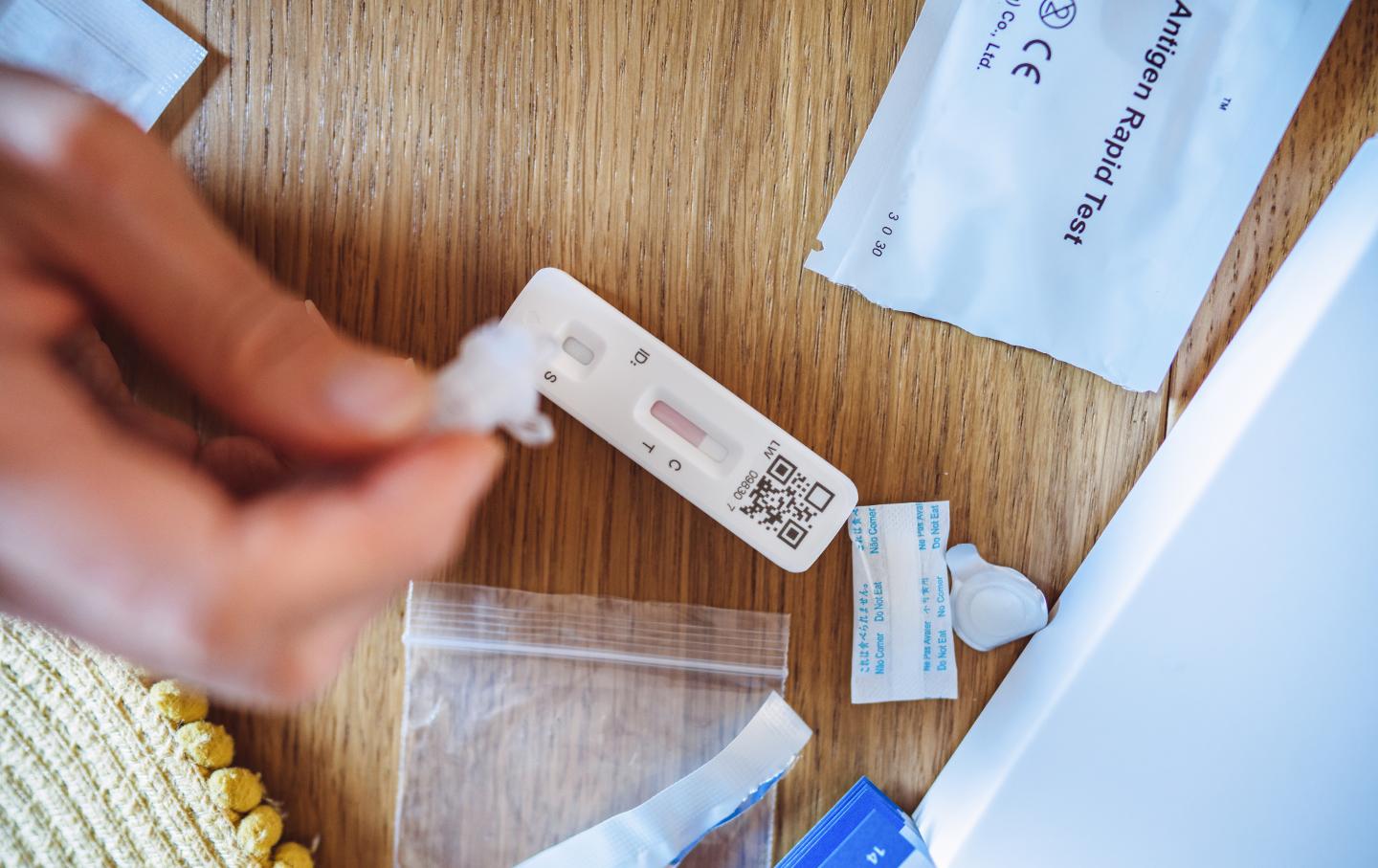
But Jha’s “nothing to see here” response is, in many ways, the logical outcome of Biden’s decision to essentially throw in the towel when it comes to Covid. Thanks to the official ending of the Covid public health emergency, millions—particularly low-income people—are now on their own in terms of access to the ubiquitous-in-Jha’s-mind-only tools of Democratic lore. So why bother telling anyone to worry when they might not be able to get the help they need? Instead, better to tell them that everything’s fine, that masks don’t need to be in the picture—or even that they “don’t need to know what virus they have and don’t need to be buying tests all the time,” as Shira Doron, the chief infection-control officer for the Tufts Medicine health care network in Massachusetts, told The Washington Post.
Jha and Doron and their ilk can speak so soothingly because they are part of the class that is much more insulated from the worst effects of Covid. People like them—the ones with money and access—can afford the expensive Covid tests. They can ensure that Paxlovid reaches their door quickly. They’ll be first in line for the new boosters. Some of them even have a concierge physician on speed dial for when things get hairy. Meanwhile, they offer the rest of the country the policy equivalent of “You do you” and “Let them eat cake.”
While too many people who should know better are downplaying the ongoing public health risk from Covid, others are trying to signal the peril of our current moment. The New York Times recently reported on new estimates from researchers that Covid might lead to at least 45,000 deaths between September and April—and that’s the best-case scenario. “Based on these projections, Covid is likely to remain in the leading causes of death in the United States for the foreseeable future,” Justin Lessler, an epidemiologist at the UNC Gillings School of Global Public Health, told the Times.
So Covid is still a leading cause of death, yet some of the most powerful medical figures in the country are telling us to ignore it. Shouldn’t that disconnect be a bigger deal?
Jha and Biden’s other defenders will call this realpolitik: What’s doable right now is to do little, and people like me are naïve dreamers. I think that’s a cop-out, particularly from people who took an oath to do no harm. I know about navigating political constraints—this is not my first time at the rodeo after more than 30 years of living with the AIDS epidemic—but I won’t make post hoc rationalizations for our failure to do more to prevent the continuing spread of another deadly virus.
In his 1992 book The Culture of Contentment, a series of essays that ring very true today, the late economist John Kenneth Galbraith wrote that “individuals and communities that are favored in their economic, social and political condition attribute social virtue and political durability to that which they themselves enjoy. That attribution, in turn, is made to apply even in the face of commanding evidence to the contrary.”
This is the exact problem we face now: a favored class that sees its own comfort as a sign that everything’s fine. As a result, the members of the Church of the Contented Establishment—from the White House to Jha and his Brown colleague Emily Oster, to David Leonhardt at The New York Times and Leana Wen at The Washington Post, to even infectious-disease doctors like Monica Gandhi at the University of California San Francisco—are pushing a narrative about Covid and our public health that, thanks to its influence within elite circles, is more subtly corrupting and poisonous than anything that outright Covid denialists like Ron DeSantis have come up with.