
The Wisconsin Supreme Court Race Has Become All About Elon Musk
The richest man in the world is the biggest spender on behalf of a right-wing effort to take control of a state Supreme Court.

A screenshot of a Democratic Party of Wisconsin ad about the state Supreme Court race.
(Democratic Party of Wisconsin)Wisconsin’s April 1 Supreme Court race is on track to become the most expensive judicial election contest in American history. The Wisconsin Democracy Campaign (WDC), a watchdog group that monitors electioneering in the state, says that the total spending on the contest could reach as high as $100 million. That’s thanks not only to the more traditional campaigns of the two contenders for the open seat on Wisconsin’s high court—progressive Dane County Judge Susan Crawford and right-wing Waukesha County Judge Brad Schimel—but also to jaw-dropping spending by billionaire-funded groups making so-called “independent expenditures.”
In particular, groups funded by Elon Musk.
Samantha De Forest-Davis, the research director for the WDC, reports that independent spending in this year’s court contest is 103 percent above where it was at this point in the high-stakes 2023 race that was won by liberal Justice Janet Protasiewicz. Protasiewicz’s victory gave the court a 4–3 liberal majority for the first time in decades. This year’s contest—to fill a seat being vacated by a retiring liberal justice—will decide whether the highest court in the nation’s ultimate swing state will remain liberal or flip back to the right.
The stakes are high. And the through-the-roof spending reflects that reality.
“These numbers just continue to increase daily,” De Forest-Davis told The Milwaukee Journal Sentinel, pointing out that, as of two weeks before the April 1 election, the democracy campaign has counted $29.24 million in independent expenditures. At the same point in the 2023 campaign, the independent expenditure figure was $14.41 million.
A substantial portion of the spending—a reported $13.2 million, as of Tuesday—comes from a new player in Wisconsin politics who happens to be the richest man in the world. Musk, who has emerged as the key player in the Republican administration of President Donald Trump, made his preference for Schimel public in January. It was then that he took to his social media platform, X, to promote Schimel’s candidacy with a declaration that it is “very important to vote Republican for the Wisconsin Supreme Court”—not knowing, apparently, that Wisconsin Supreme Court races are officially nonpartisan and do not feature Republican or Democratic ballot lines.
Musk’s meddling has picked up steam as the election approaches. Musk-backed groups are already spending in the double-digit millions, according to the democracy campaign. And the numbers will almost certainly rise as overall spending on the Schimel-Crawford race accelerates in the final weeks of a campaign that everyone recognizes as the first major electoral test of 2025.
Musk is not the only billionaire who has taken an interest in the Wisconsin race. Wealthy Democrats have given money to help Crawford, including, most recently, former New York mayor Michael Bloomberg, who supports the Everytown for Gun Safety Action Fund, which just allocated $600,000 in planned spending.
But the level of spending by Donald Trump’s “special government employee” has become a fundamental issue in the race—as was illustrated in the campaign’s sole debate last week.
Crawford went into the debate with a track record as a prosecutor, trial lawyer, and jurist—but not as a politician. She faced a rival who has spent much of his adult lifetime campaigning for one office or another. A former Republican district attorney and attorney general, who has always been closely aligned with defeated former Republican governor Scott Walker, Schimel has appeared on the ballot frequently over the past two decades and participated in statewide televised debates when he won the AG’s office in 2014, and when he lost it in 2018.
Yet it was Crawford who proved to be the more skilled debater. Indeed, she delivered what was easily the most amusing jab of the night, when she referred to her opponent as “Elon Schimel.”
In contrast, Schimel got bogged down in his own talking points. When he tried to upend Crawford with convoluted attacks that mimicked online trolling, she countered with short, sharp dismissals of the Republican’s remarks. Crawford did so most effectively during exchanges about Musk’s funding of Schimel’s campaign. Clearly aware that he was not having a particularly good night, Schimel tried to tie Crawford to liberal donors. But that line of attack blew up in his face as the discussion of how money is influencing the court race kept coming back to Musk’s over-the-top intervention in the race. “He’s spent over $10 million on my opponent’s race. He has basically taken over Brad Schimel’s campaign,” announced Crawford. “It is no coincidence that Elon Musk started spending that money within days of Tesla filing a lawsuit in Wisconsin.” The lawsuit by the Musk-owned automaker targets a Wisconsin regulatory decision that prohibits car manufacturers from also being able to own dealerships in the state, and could well end up on the state Supreme Court docket.
Popular
“swipe left below to view more authors”Swipe →But the biggest concern with Musk’s entry into Wisconsin politics has to do with the many issues related to the Trump administration—and Musk’s role in it. These conflicts are most likely to be litigated in federal courts, but it’s perfectly plausible that state courts will be roped in as well. “Musk wants to ensure he can prevent any check on himself and Trump from the states, and he’s starting right here in Wisconsin,” says Democratic Party of Wisconsin chair Ben Wikler.
Musk, the South African–born billionaire, poured more than $270 million into groups that helped Trump get elected last November. After the election, he was awarded with the title of “special government employee” and given free rein to fire federal workers, upend agencies, and access the sensitive data of hundreds of millions of Americans.
Musk’s power grab has seen critics referring to the billionaire as the country’s “copresident.” And it has not gone over well with the American people. According to Politico,
Over half of voters believe Elon Musk and his Department of Government Efficiency are hurting the country, a new Quinnipiac University poll finds. Fifty-four percent of voters believe DOGE, which the Trump administration has charged with slashing government spending, is harming the country. In comparison, 40 percent say Musk’s office is helping, according to the Quinnipiac poll. And 60 percent of voters disapprove of how Musk and DOGE deal with the federal workforce, while 36 percent approve.
Wisconsin Democrats are so sure that running against the richest oligarch in the world will help them defeat Musk’s candidate in the Supreme Court race that they’ve been organizing “People v. Musk” town hall events. When they did so in closely-contested Sauk County—which Democratic Party of Wisconsin chair Wikler describes as “the most bellwether county in the most bellwether state”—an overflow crowd packed the community room at the local library. They held signs that read, “Don’t Let Elon Musk Buy Wisconsin,” and cheered as Wikler declared, “We are in a fight for democracy itself.”
There’s something to that assertion.
Wisconsin Supreme Court races have in recent years been exceptionally expensive, and they have seen plenty of spending by out-of-state special interests. But, now, the ultimate “special interest” has arrived—an oligarch whose $320 billion fortune allows him to engage in epic levels of personal spending on behalf of his favored candidates.
Schimel says he can’t be bought. But the free-spending support he’s getting from groups aligned with Musk has a lot of Wisconsinites raising concerns about the court candidate’s independence. So, the Musk intervention matters, a lot. And Schimel’s bumbling debate performance has allowed Susan Crawford to make a dramatically bigger deal of Musk’s enthusiasm for “Elon Schimel.”
Support independent journalism that does not fall in line
Even before February 28, the reasons for Donald Trump’s imploding approval rating were abundantly clear: untrammeled corruption and personal enrichment to the tune of billions of dollars during an affordability crisis, a foreign policy guided only by his own derelict sense of morality, and the deployment of a murderous campaign of occupation, detention, and deportation on American streets.
Now an undeclared, unauthorized, unpopular, and unconstitutional war of aggression against Iran has spread like wildfire through the region and into Europe. A new “forever war”—with an ever-increasing likelihood of American troops on the ground—may very well be upon us.
As we’ve seen over and over, this administration uses lies, misdirection, and attempts to flood the zone to justify its abuses of power at home and abroad. Just as Trump, Marco Rubio, and Pete Hegseth offer erratic and contradictory rationales for the attacks on Iran, the administration is also spreading the lie that the upcoming midterm elections are under threat from noncitizens on voter rolls. When these lies go unchecked, they become the basis for further authoritarian encroachment and war.
In these dark times, independent journalism is uniquely able to uncover the falsehoods that threaten our republic—and civilians around the world—and shine a bright light on the truth.
The Nation’s experienced team of writers, editors, and fact-checkers understands the scale of what we’re up against and the urgency with which we have to act. That’s why we’re publishing critical reporting and analysis of the war on Iran, ICE violence at home, new forms of voter suppression emerging in the courts, and much more.
But this journalism is possible only with your support.
This March, The Nation needs to raise $50,000 to ensure that we have the resources for reporting and analysis that sets the record straight and empowers people of conscience to organize. Will you donate today?
More from The Nation
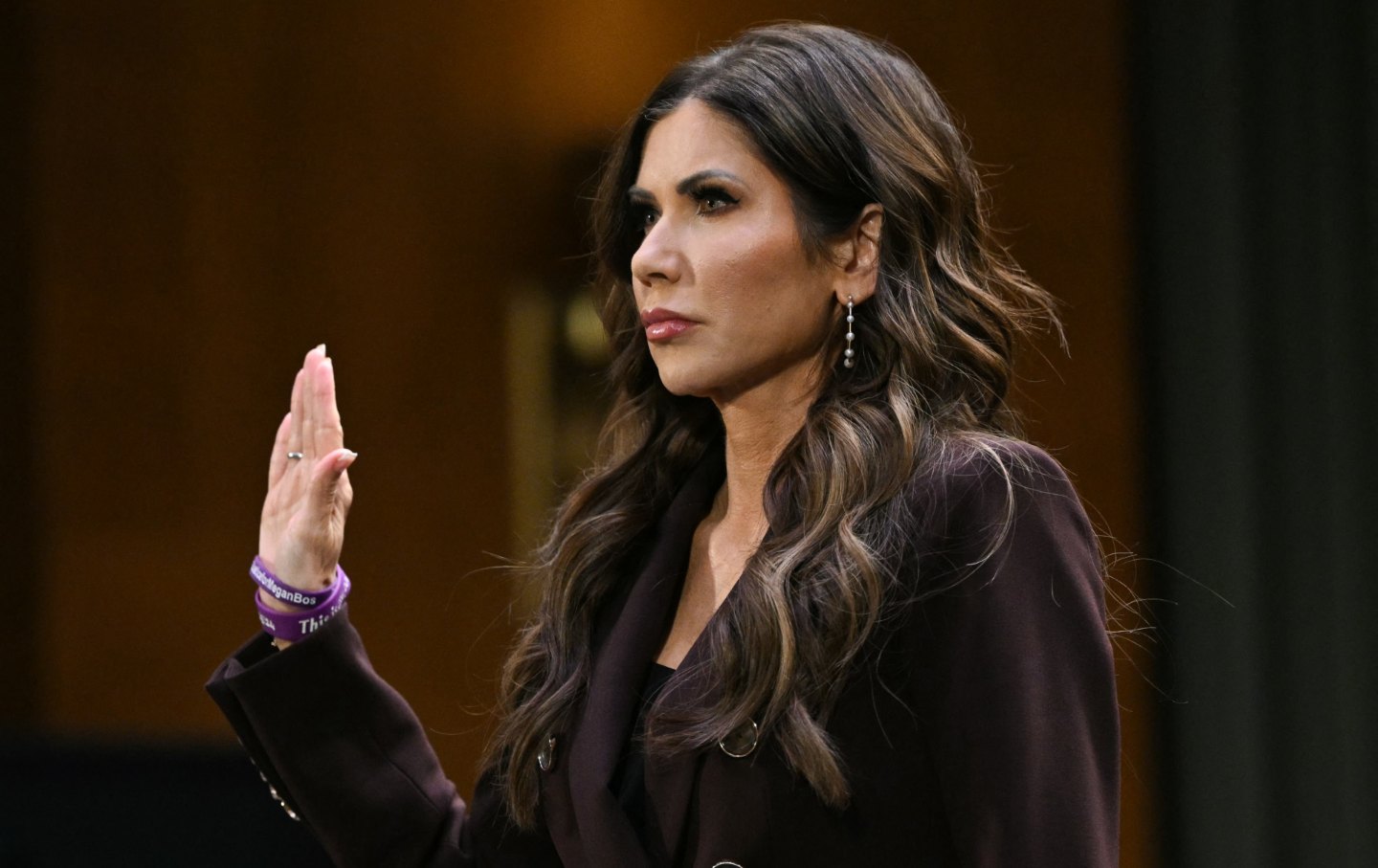
Celebrate Kristi Noem’s Firing. But Keep Protesting ICE. Celebrate Kristi Noem’s Firing. But Keep Protesting ICE.
Finally, someone in the administration is paying for their cruelty and incompetence.

We Don’t Need an Autopsy to Tell Us the Democrats Failed on Gaza We Don’t Need an Autopsy to Tell Us the Democrats Failed on Gaza
The DNC is allegedly hiding a report showing that Kamala Harris’s Gaza policy helped cost her the 2024 election. But that report won’t tell us anything we don’t already know.
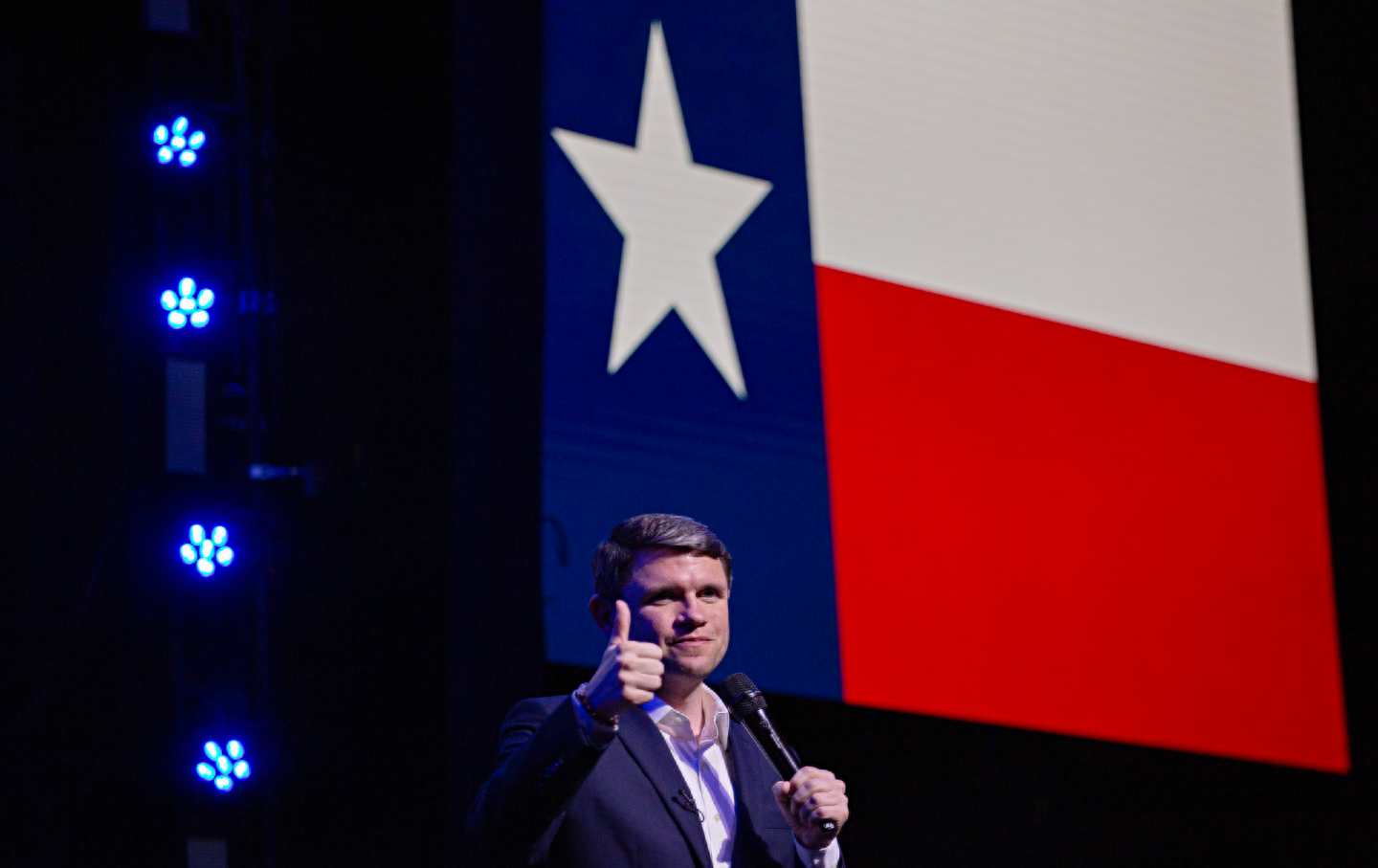
Texas’s Senate Primary Has Already Made History—and It’s Not Over Yet Texas’s Senate Primary Has Already Made History—and It’s Not Over Yet
Democratic nominee James Talarico is getting national media attention, but the real story is sky-high voter turnout, even amid GOP bids to suppress balloting
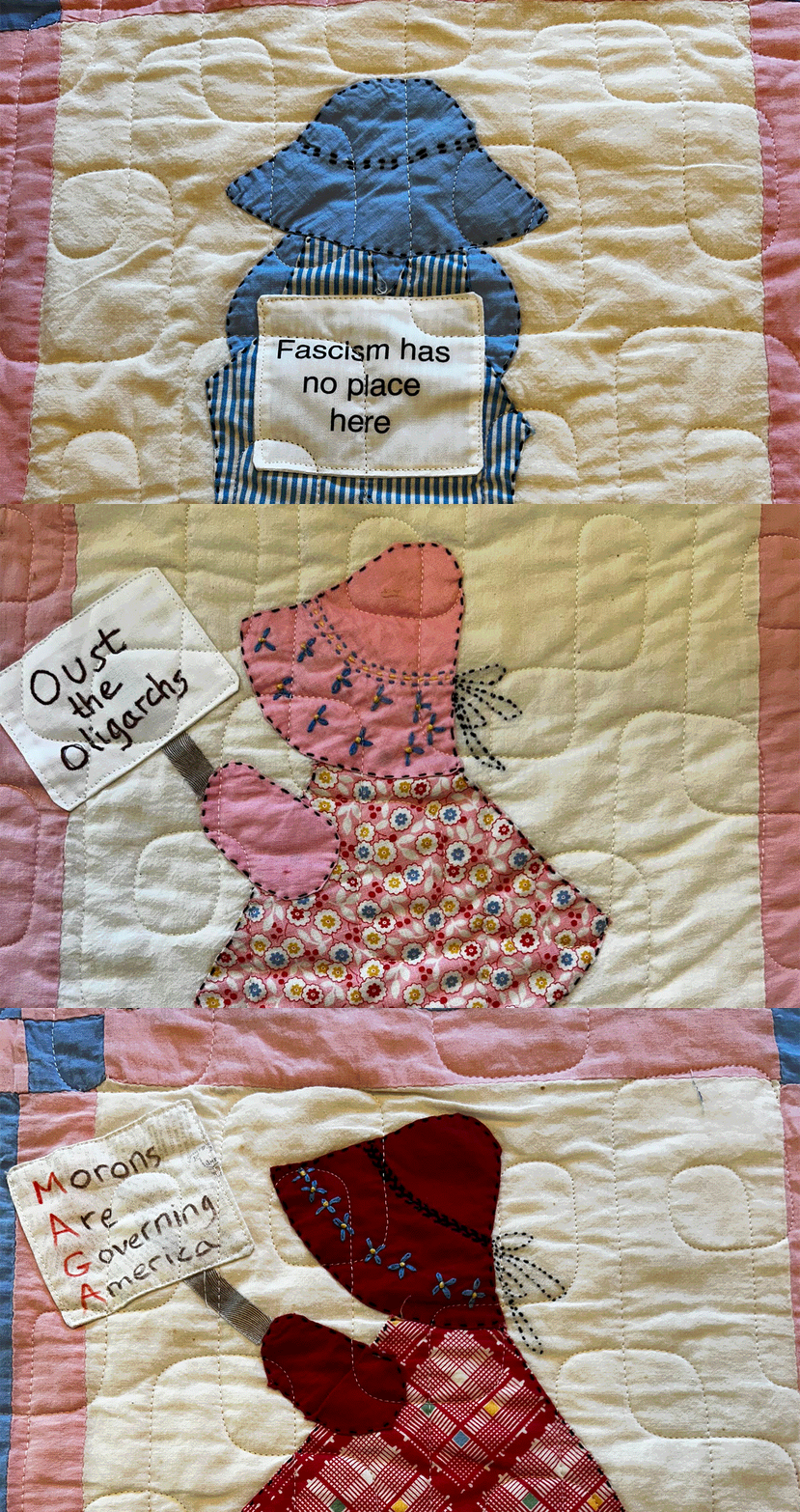
Quilted Messages Quilted Messages
Sunbonnets carrying not-so-sunny truths.
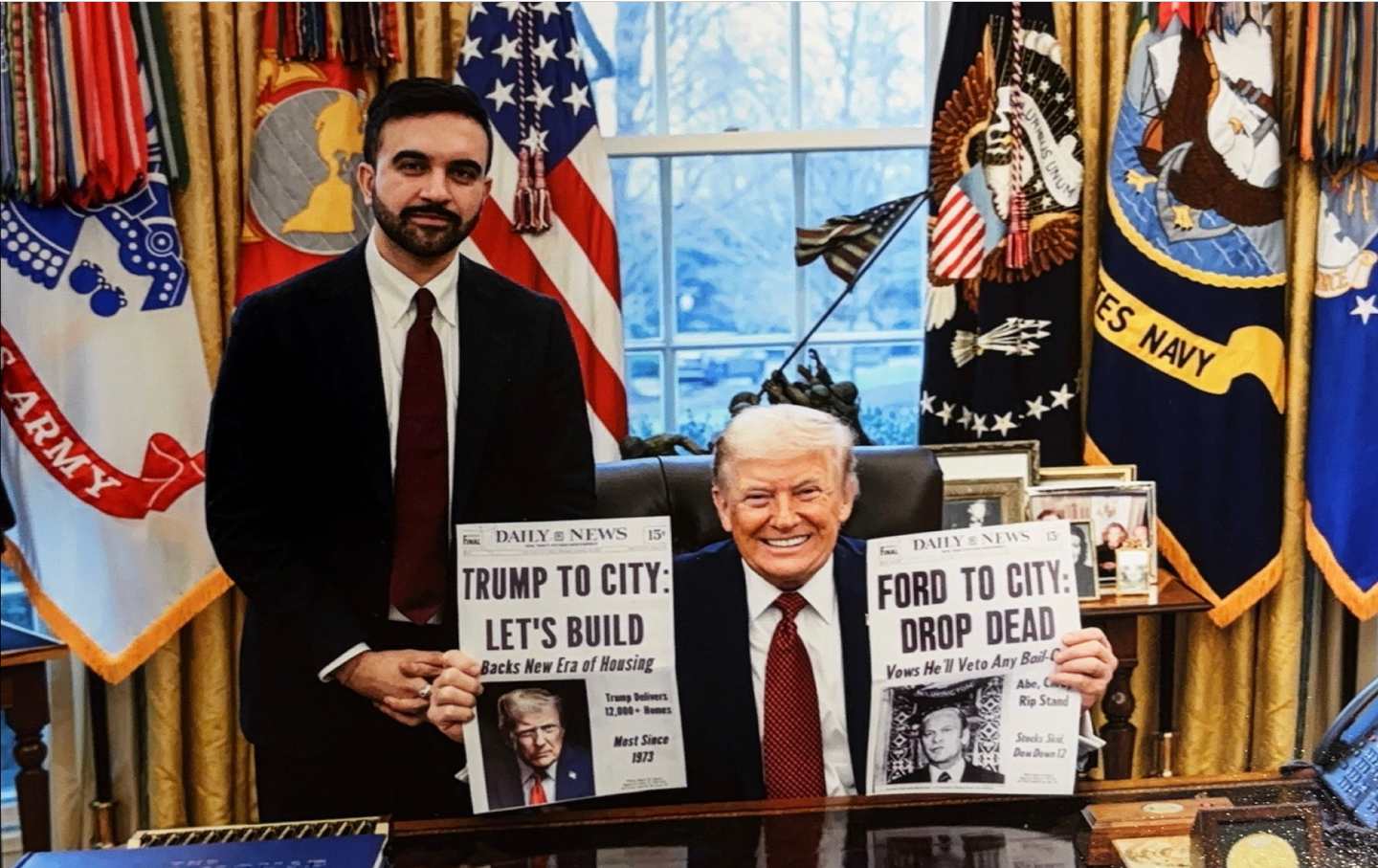
How the Theatrics of Mamdani’s Trump Meeting Backfired How the Theatrics of Mamdani’s Trump Meeting Backfired
By pandering to the president’s vanity, the New York mayor reinforced Trump’s image as a strongman commanding deference—an especially bad look on the eve of Trump’s war with Iran
Students in New York Are Going Hungry. How Can Mamdani Help? Students in New York Are Going Hungry. How Can Mamdani Help?
With plans for city-owned grocery stores and a focus on affordability, the new mayoral administration offers fresh hopes of successfully confronting the food crisis among students...

