Trump Wants to Make Art Into a Tool of the State
In ordering a review of the Smithsonian, the White House wants to use its power to remake our culture—or to reinvigorate a strain in the culture that has been dormant for a long time.
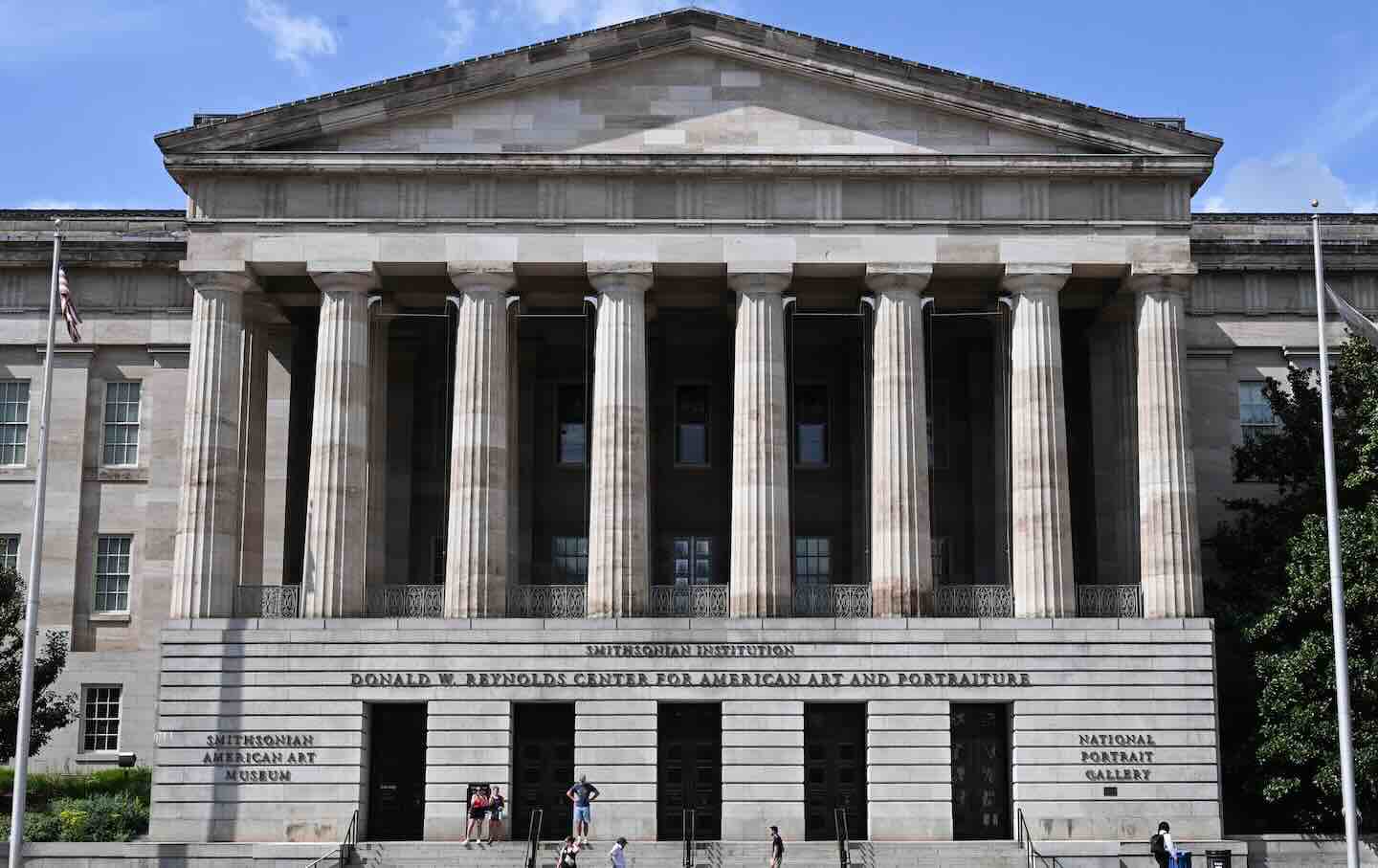
Visitors walk outside the Smithsonian American Art Museum and the National Portrait Gallery on August 14, 2025.
(Alex Wroblewski / AFP)
No one knows exactly what will result from Donald Trump’s order of an “internal review of…exhibitions and materials” at the Smithsonian museums. All we know is that the outcome will be ugly. His lament that the institution, “OUT OF CONTROL,” has focused too much on “how bad slavery was” makes it clear he wants it to whitewash history.
The August 12 letter to the Smithsonian demanded that its exhibits “reflect the unity, progress, and enduring values that define the American story.” That demand for “unity,” specifically, exposes the totalitarian nature of Trump’s request: Dissent, controversy, and the airing of heterodox views will not be countenanced.
The exercise of debate and criticism, which was so important to the founders of the country that they enshrined its value in the First Amendment to the Constitution, is anathema to the current regime in Washington. The founders recognized that we, the people, would always have grievances—the final word of the amendment—and therefore that our unity (with our government, with each other) could only ever be a goal, not a presumed fact or a metaphysical postulate of history.
The White House, however, wants to rewrite “the American story” to create a new identity for this country. It wants to remake our culture because it follows Andrew Breitbart’s dictum that culture is upstream of politics, but those in power have come to realize that the stream is circular, and that political action can be upstream of culture too. It wants to use its power to remake our culture—or rather, to reinvigorate a strain in the culture that has been dormant for a long time.
That’s a strain I learned about, in part, thanks to the Smithsonian—specifically, to the very first exhibition I can remember seeing at the Smithsonian American Art Museum, back in 1985. That show, called “Advancing American Art,” was a reconstruction of an exhibition of the same name that had taken place back in 1946. The 1946 exhibition surveyed American paintings organized by the State Department and was meant to travel through Europe and Latin America for two years. Included were some of the most renowned artists of the day: Milton Avery, Romare Bearden, Stuart Davis, Yasuo Kuniyoshi, Jacob Lawrence, Georgia O’Keeffe, and Ben Shahn. But the show was immediately enveloped in controversy. The conservative press hated the art, whose modernism now mostly seems rather cautious, and even President Harry S. Truman decided that he was competent as an art critic but mainly showed himself a racist by declaring, “If that’s art, I’m a Hottentot.”
But the objections to the 1946 exhibition were not purely aesthetic. Among the leaders opposing it was Republican congressman from Michigan George A. Dondero, who thundered, “Modern art is Communistic because it is distorted and ugly, because it does not glorify our beautiful country and smiling people and our material progress. Art that does not glorify our country, in plain, simple terms, breeds dissatisfaction. It is therefore opposed to our government and those who create it and promote it are enemies.”
Dondero won that battle. The State Department cut the exhibition tour short and sold off the artworks, which it had purchased. But he lost his war against United States government support of modern art. As the Cold War dragged on, it became evident that, far from being redolent of communism, modern art—which had been rejected by the Soviet Union and its allies as bourgeois twaddle—could be used to promote Americanism abroad. Precisely because of its critical stance toward cultural conventions, its formal insouciance, its determination to push against the limits and if possible explode them, modernism in the arts seemed to represent American values of freedom and self-invention in contrast to the gray silence of the world beyond the Iron Curtain. It helped that the State Department, including the CIA, made sure to promote modernist arts at every turn, using means both patent (support for the US pavilion at the Venice Biennale, sponsoring tours by jazz musicians like Louis Armstrong, Duke Ellington, and Dizzy Gillespie) and covert (funding magazines such as Encounter and The Paris Review). Truman’s Republican successor, Dwight D. Eisenhower, expressed what was by then the prevailing view: “As long as our artists are free to create with sincerity and conviction, there will be healthy controversy and progress in art.” He added, “How different it is in tyranny. When artists are made the slaves and tools of the state; when artists become the chief propagandists of a cause, progress is arrested and creation and genius are destroyed.”
You don’t have to be a fan of the CIA, or even of Eisenhower (whose warning about a “military-industrial complex” would soon find confirmation in Vietnam) or the State Department, to see that their welcoming attitude to “healthy controversy” in the arts—what Herbert Marcuse derided as “repressive tolerance”—reflects the optimism and self-confidence of a country that felt itself on the winning side of history. And it was, as the collapse of the Soviet Union in 1991 shows. But winning didn’t turn out to be worth much. A decade later, 9/11 inflicted a wound on the American psyche that has never healed. The 2008 mortgage crisis and the 2020 Covid-19 pandemic only amplified the sense that the world is out of joint; meanwhile, the neoliberal assault on workers went into overdrive, driving inequality to levels unseen for nearly a century. The word “progress” has little currency these days.
Once again, it’s George Dondero’s defensively fake dream of a beautiful country with smiling people that rules in Washington. Our “internally reviewed” institutions will no longer be places for serious artists—ones with the “sincerity and conviction” that Eisenhower lauded. Instead, they’ll be home to the kitsch purveyed by the likes of Sylvester Stallone and Kiss—upcoming honorees at the Kennedy Center—and, presumably, their artistic and literary equivalents. But today’s artists will not be disappeared. Even in the Soviet Union, the art of dissent could never be totally quashed. What will become of America’s long cultural legacy is a more worrisome question. I’m certainly not expecting to see any exhibitions as eye-opening as the 1985 “Advancing American Art” show anytime soon. The show was a reminder that art is inherently contentious, and that its inevitable entwinement with politics contains unresolvable tensions.
Reviewing the show back then for Artforum, John Yau (my companion on that visit to Washington 40 years ago) cautioned that the cancellation of the original 1946 show should not be considered a closed chapter but rather “a cautionary tale.” It’s a story that’s being recounted again in the present tense.
Support independent journalism that does not fall in line
Even before February 28, the reasons for Donald Trump’s imploding approval rating were abundantly clear: untrammeled corruption and personal enrichment to the tune of billions of dollars during an affordability crisis, a foreign policy guided only by his own derelict sense of morality, and the deployment of a murderous campaign of occupation, detention, and deportation on American streets.
Now an undeclared, unauthorized, unpopular, and unconstitutional war of aggression against Iran has spread like wildfire through the region and into Europe. A new “forever war”—with an ever-increasing likelihood of American troops on the ground—may very well be upon us.
As we’ve seen over and over, this administration uses lies, misdirection, and attempts to flood the zone to justify its abuses of power at home and abroad. Just as Trump, Marco Rubio, and Pete Hegseth offer erratic and contradictory rationales for the attacks on Iran, the administration is also spreading the lie that the upcoming midterm elections are under threat from noncitizens on voter rolls. When these lies go unchecked, they become the basis for further authoritarian encroachment and war.
In these dark times, independent journalism is uniquely able to uncover the falsehoods that threaten our republic—and civilians around the world—and shine a bright light on the truth.
The Nation’s experienced team of writers, editors, and fact-checkers understands the scale of what we’re up against and the urgency with which we have to act. That’s why we’re publishing critical reporting and analysis of the war on Iran, ICE violence at home, new forms of voter suppression emerging in the courts, and much more.
But this journalism is possible only with your support.
This March, The Nation needs to raise $50,000 to ensure that we have the resources for reporting and analysis that sets the record straight and empowers people of conscience to organize. Will you donate today?