If Trump Sounds Like He Wants a Police State, That’s Because He Does
And so do all of his cronies.
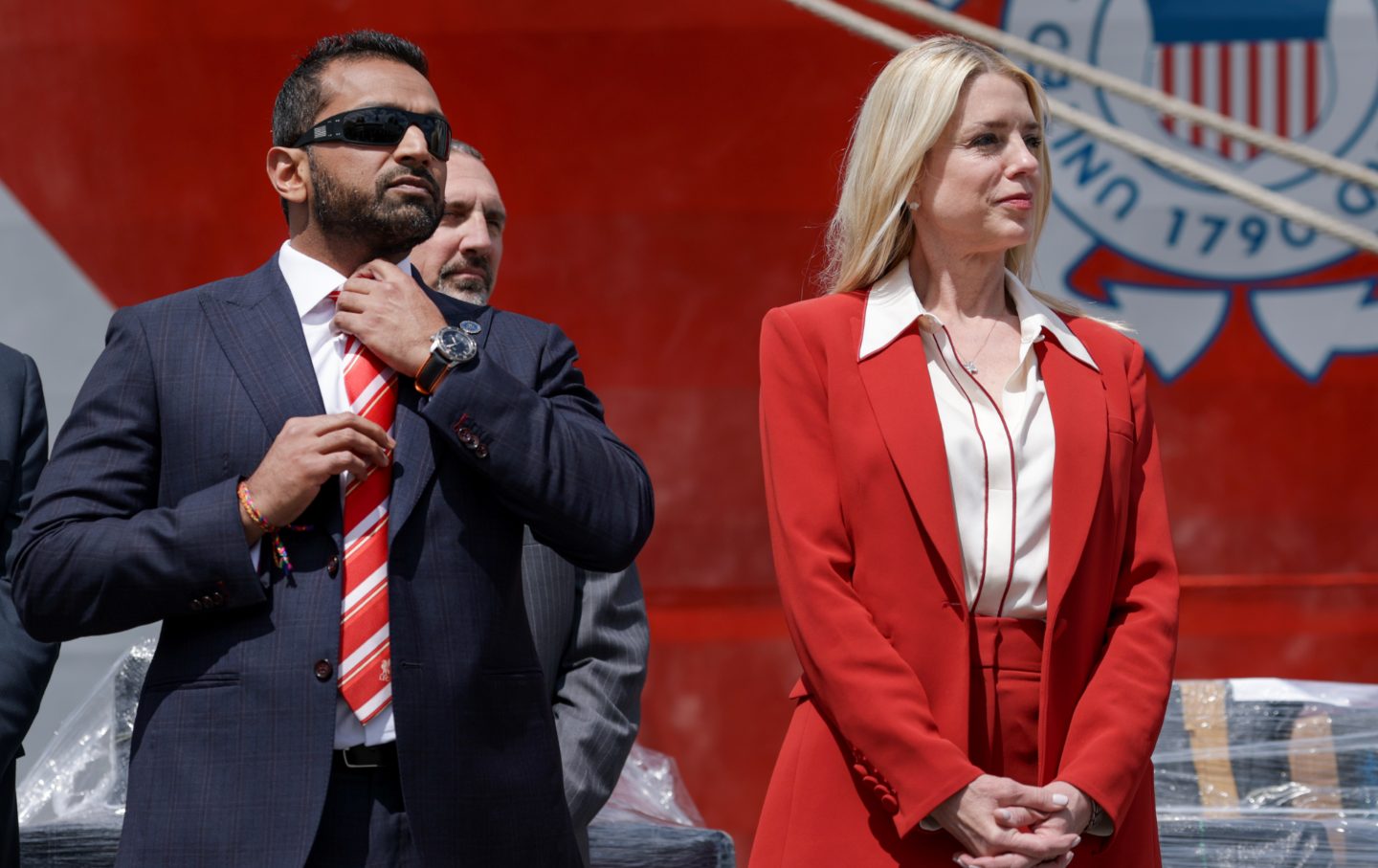
Pam Bondi, US attorney general, and Kash Patel, director of the Federal Bureau of Investigation, during a press conference at Port Everglades on April 9, 2025, in Fort Lauderdale, Florida.
(Joe Raedle / Getty Images)As President Donald Trump wound down Monday’s Oval Office meeting with El Salvadoran President Nayib Bukele, he trailed off into a reverie about having Bukele expand the capacity of the brutal COCET prison complex now housing immigrants swept up in Gestapo-style raids to include native-born criminal offenders. “Why do you think there’s [sic] special category of person?” the president said of the next demographic he’s sizing up for Gulag detention in a facility beyond the reach of basic American legal protections. “They’re as bad as anybody that comes in.”
The reporting and commentary that came in the wake of Trump’s comments treated them much like one of his bigoted campaign rally outbursts: a deluded foray into authoritarian speculation to rile up the MAGA base, but something that would never come to pass, since it’s so grotesquely illegal. Such procedural wishcasting is always ill advised in anything related to Trump—not only has he skirted convictions on two impeachments and a pair of federal prosecutions, but the selfsame press availability with Bukele underlined the administration’s refusal to abide by a unanimous Supreme Court ruling that Trump must facilitate the return of wrongfully detained immigrant Kilmar Armando Abrego Garcia. To point out an illegal scheme arising from a full-blown refusal to honor the unmistakable directive of the highest court in the country is much like complaining about the caliber of the orchestra’s performance as the Titanic sank into the North Atlantic.
What’s more, Trump’s earnest vigilantism marked his first major foray into public discourse, when he took out full-page ads in all of New York City’s major newspapers to demand that the state of New York bring back the death penalty to execute the innocent young men dubbed the Central Park Five. There’s no reason to think his ascension to maximum power has tempered his wide-ranging blood-and-punishment lust—indeed, quite the contrary.
Trump is poised, on April 20, to announce the Department of Justice’s findings on whether to invoke the Insurrection Act to address the alleged national emergency at the country’s southern border. (Border crossings now stand at their lowest rate in decades, but for an administration that came very close to crashing the world economy on phony and overhyped numbers purporting to document fentanyl and trade emergencies, that’s not much of a challenge.) Since US Attorney General Pam Bondi is a duly certified Trump sycophant, there’s not much drama attached to the finding itself: An emergency will almost certainly be declared, and the Trump administration will move into a whole new front of authoritarian impunity.
The Insurrection Act grants the federal government the authority to deploy military troops to quell civil disturbances; the last time it was invoked was in 1992, when President George HW Bush dispatched military forces to subdue rioters in Los Angeles protesting the Rodney King verdict. The act was first codified in 1807, but was initially signed into law in 1792. And like the Alien Enemies Act—the other relic of Early Republic authoritarianism embraced by the Trump administration in its executive order authorizing the illegal immigration raids that swept up Abrego Garcia—the Insurrection Act is all but tailor-made for maximum abuse from the executive branch. The act’s wording is exceedingly vague, and high-court jurisprudence has consistently exploited its diffuse wording to grant sweeping and largely uncontested powers to the American president to suspend the Posse Comitatus Act, which prevents federal troops from engaging in local law enforcement—and to pretty much direct the actions of such troops according to executive whim. Under the sorry legal history of the act, writes Brennan Center scholar Joseph Nunn, “the president has almost limitless discretion to deploy federal troops in cases of civil unrest. Such unbounded authority to use the military domestically has always been dangerous. In the 21st century, it is also unnecessary and untenable.”
For a leader like Donald Trump, that legacy is a boon roughly equivalent to a golf deal with a sultanate. In seeming anticipation of the act’s invocation, he’s already issued an executive order granting the military jurisdiction over federal lands along the southern border—meaning that any migrant on that land could be held by military forces until they’re presumably transferred into the Border Patrol’s jurisdiction. The order also charges the military to consult with the departments of the Interior, Agriculture, and Homeland Security—further eroding the basic protections of the Posse Comitatus and insinuating military authority over still broader reaches of American public life.
This early mobilization has prompted some to suggest that the Insurrection Act will supply a ready pretext for Trump to proclaim martial law, despite the fact that even the Insurrection Act doesn’t sanction that level of executive-branch impunity. Here, too, formal precedent doesn’t seem all that reassuring; after losing the 2020 election, Trump had broached the idea of declaring martial law to “rerun” the balloting. Even without the specter of martial law, it’s no great stretch to envision Trump using the border pretext to drastically step up surveillance powers, institute forced exile, and broaden economic coercion targeting the names on his extensive enemies list. That is, after all, largely the playbook he’s adopted in the first 100 days of his term, abusing the powers of his office in petty and vindictive crusades against private universities and law firms, federal agencies he associates with thought crimes—and even the Smithsonian Institution and the Kennedy Center.
In addition, Trump has already stocked the highest reaches of federal law enforcement with like-minded connoisseurs of federal prosecutions as glorified vendettas or backsheesh opportunities. Bondi leads that inglorious roster; while she served as Florida’s attorney general, she suspended a fraud inquiry into Trump University after Trump gave her a $25,000 campaign donation. In addition to endorsing Trump’s immigration raids, she’s also rescinded enforcement of bribery and foreign corrupt practices, a boon to many of the president’s business cronies. FBI Director Kash Patel and his deputy, Dan Bongino have likewise backed off investigation of right-wing extremism, while Patel has overseen a purge of senior agency leaders, including one on his own well-publicized enemies list. Tom Homan, Trump’s immigration czar, indicates he’s prepared to prosecute officials in jurisdictions offering sanctuary to undocumented immigrants.
Then there’s Trump’s nominee to lead the National Counterterrorism Center, failed MAGA congressional candidate Joe Kent. As Mother Jones reporter Noah Lanard writes, Kent–a former Green Beret who served 11 tours of duty in Iraq and Afghanistan—pulled up stakes from Portland during the 2020 Black Lives Matter and antifa protests there and moved his family to rural Washington State. In a 2021 interview with right-wing podcaster Tim Pool, Kent declared, “We need to treat antifa and BLM like terrorist organizations. We need to use the tools of the federal government, the FBI, the US Marshals—go after them like organized criminals and terrorists. So, when we start arresting these guys and charging them with federal terrorism charges, that’s going to take away a lot of the incentive to go out and riot.” Kent also hired on a Proud Boy as a consultant to his 2022 congressional campaign. Technically, the counterterrorism center’s jurisdiction doesn’t include handling “intelligence pertaining to domestic terrorism.” But given the Trump administration’s penchant for disregarding legal strictures, and for divining “emergency” enemy threats at every pass, it’s hard to see a Kent-led counterterrorism center lingering over such niceties—particularly under the anything-goes enforcement mandate of the Insurrection Act. Indeed, the administration’s “counterterrorism czar,” Sebastian Gorka, has now threatened to prosecute anyone advocating for due process on behalf of Abrego Garcia on charges of abetting a terrorist. You don’t really need to declare martial law, after all, when you’ve done your utmost to gut the rule of law in the first place.
Correction: An earlier version of this post mistakenly referenced the location where the Titanic sank.
Support independent journalism that does not fall in line
Even before February 28, the reasons for Donald Trump’s imploding approval rating were abundantly clear: untrammeled corruption and personal enrichment to the tune of billions of dollars during an affordability crisis, a foreign policy guided only by his own derelict sense of morality, and the deployment of a murderous campaign of occupation, detention, and deportation on American streets.
Now an undeclared, unauthorized, unpopular, and unconstitutional war of aggression against Iran has spread like wildfire through the region and into Europe. A new “forever war”—with an ever-increasing likelihood of American troops on the ground—may very well be upon us.
As we’ve seen over and over, this administration uses lies, misdirection, and attempts to flood the zone to justify its abuses of power at home and abroad. Just as Trump, Marco Rubio, and Pete Hegseth offer erratic and contradictory rationales for the attacks on Iran, the administration is also spreading the lie that the upcoming midterm elections are under threat from noncitizens on voter rolls. When these lies go unchecked, they become the basis for further authoritarian encroachment and war.
In these dark times, independent journalism is uniquely able to uncover the falsehoods that threaten our republic—and civilians around the world—and shine a bright light on the truth.
The Nation’s experienced team of writers, editors, and fact-checkers understands the scale of what we’re up against and the urgency with which we have to act. That’s why we’re publishing critical reporting and analysis of the war on Iran, ICE violence at home, new forms of voter suppression emerging in the courts, and much more.
But this journalism is possible only with your support.
This March, The Nation needs to raise $50,000 to ensure that we have the resources for reporting and analysis that sets the record straight and empowers people of conscience to organize. Will you donate today?