Trump Is Trying to Create His Own Personal Legal Strike Force
With his speech at the DOJ, Trump officially declared his intention to reshape the legal system according to his whims and will.
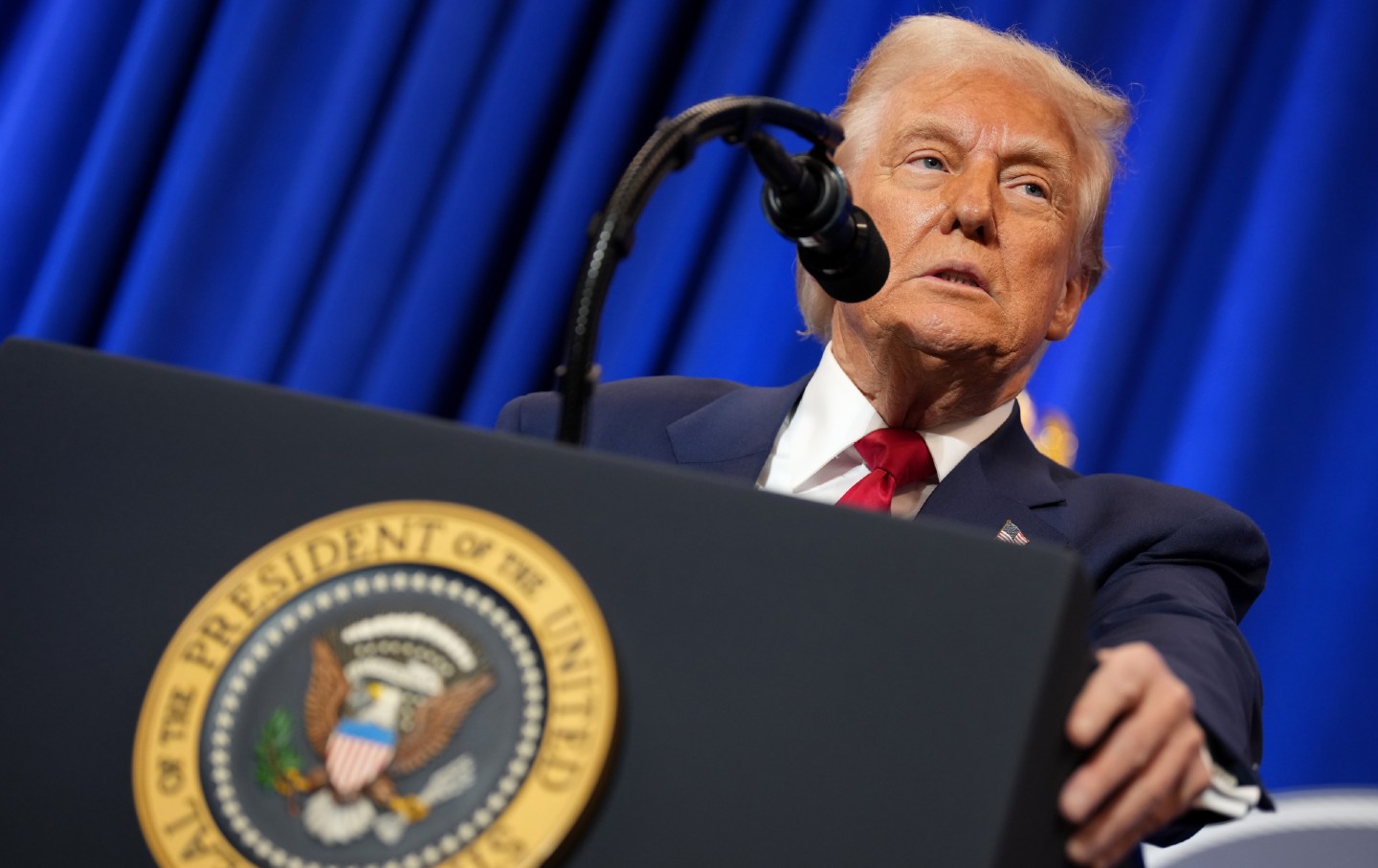
Donald Trump speaks at the Justice Department March 14, 2025, in Washington, DC.
(Andrew Harnik / Getty Images)
Late last week, Donald Trump went to the Department of Justice and, once again, threatened his political enemies with unlawful prosecutions. Referring to himself as “the chief law enforcement officer in our country,” he called for the agency to prosecute everybody from former special counsel Jack Smith to MSNBC and CNN to (apparently) anybody who writes or says mean things about him or his pet judge, Aileen Cannon. Even lawyer Norm Eisen, cofounder of The Contrarian (a freaking Substack), was singled out as a potential target.
This was, in many respects, standard operating procedure for Trump who, let’s not forget, called for his first political opponent, Senator Hillary Clinton, to be locked up. Calling for legal vengeance against his political enemies has been a central theme of all of Trump’s speeches since he came down his gilded escalator.
Trump has articulated his plans to go after his political opponents with legal actions time and again, but what’s significant about this version of his hour-long, rambling stump speech was where he gave it: inside the “Great Hall” at the Justice Department as the actual attorney general, Pam Bondi, and the FBI director, Kash Patel, looked on in rapt attendance. Only two other presidents have spoken in the hall this century: Bill Clinton, when he was trying to drum up support for his disastrous and racist 1994 crime bill, and George W. Bush, when he dedicated the building to Robert F. Kennedy (the one without the brain worms or the submission kink for measles). Presidents historically maintain a respectful distance between themselves and their attorneys general (unless they’re brothers) to avoid the perception that the DOJ’s actions are politically motivated.
Trump broke from this tradition to lay out a clear agenda to turn the DOJ into his personalized legal strike force. With the speech, he officially declared his intention to reshape the legal system according to his will, and whims.
Trump’s hysterics at the DOJ are part of a larger piece: to go after the lawyers who might oppose him. At the DOJ, he highlighted Smith and Eisen as his enemies, but Trump has also issued two executive proclamations decrying the “risk” from specific law firms: Perkins Coie and Paul Weiss. He revoked security clearances for lawyers who work for both those firms, and is trying to prevent the government from contracting with any of their lawyers. Neither of those firms have done anything other than represent clients with legitimate claims against Trump, or his MAGA cabal, but in Trump world that is apparently a violation of his new legal world order. Trump wants to silence the lawyers, and he wants to use the lawyers at the Department of Justice to do it.
One imagines the bad-faith actors now running the Justice Department will gladly comply. Trump has gone out of his way to populate the DOJ with people of low character who will serve his will and not the law.
As happens so often with Trump, his speech at the DOJ has left us in the dangerous limbo zone between what he says he can do, what he can actually do, and what he can’t do but will do anyway. Trump (or his sock puppet Bondi) cannot order the prosecution of his political enemies who have committed no crimes—at least he can’t under the traditional understanding of law and justice. But if he does, who will stop him? The federal government’s paramilitary police forces are now under the control of Trump, Bondi, and Patel. If they send their jackboots to round up Norm Eisen (or me, or you), who is going to tell them “no”? The courts? Ask Mahmoud Khalil how long it takes to be released from federal detention, even when your arrest is unlawful and you’ve committed no crime. Ask any one of the 137 Venezuelans, who were shaved and deported in a direct violation of a court order, whether the federal courts can “stop” Trump.
On Monday, Trump doubled-down on his DOJ speech by declaring that Joe Biden’s preemptive pardons for people who had investigated Trump are “VOID, VACANT, AND OF NO FURTHER FORCE OR EFFECT” (all-caps in the original German). Clearly, this move is meant to set the stage for Trump to prosecute these people, which was essentially what he ordered the DOJ to do last week. I could tell you that no president can revoke the pardons of a previous president, if that makes you feel better. But I can also tell you that the presidential pardon power is largely untested in courts—and preemptive pardons are certainly untested—and Trump controls the Supreme Court. Again, saying that Trump “can’t” do something doesn’t actually stop Trump from doing it.
As with every fascist regime throughout history, the point of Trump’s personal hijacking of the law enforcement apparatus is fear. Trump is trying to quell resistance to his junta by threatening prosecutions of anybody, especially the lawyers, who oppose him. He doesn’t actually have to prosecute everybody, or even most people. The threat alone will chill a lot of people, and he only needs to pull off one or two high-profile prosecutions to prove that he’s not bluffing. He and Bondi are not, for instance, going to charge everybody who defaces a Tesla dealership with domestic terrorism, but if he gets the DOJ to do it to just one person, then everybody will think twice before cursing out a Cybertruck owner in the parking lot of a CVS (which is not a crime, and there is absolutely no video evidence that I would do such an oddly specific thing).
Trump’s antics at the DOJ, and his larger agenda of “lawfare” against his political opponents, should alert those opponents to one crucial reality about living under a fascist regime: The law is not on our side. Too many liberals have lulled themselves into a false sense of security that “the law,” however defined, is on the side of justice. It’s not. It never is when dictators take control. In authoritarian regimes, the law always ends up on the side of the oppressor, not the oppressed. You cannot fight fascists through the legal system, because fascists always change the law to make fighting them a crime.
That is what Trump announced at the DOJ last week. The institutions now work for the bad guys. Adjust your expectations, and your resistance strategies, accordingly.
Support independent journalism that does not fall in line
Even before February 28, the reasons for Donald Trump’s imploding approval rating were abundantly clear: untrammeled corruption and personal enrichment to the tune of billions of dollars during an affordability crisis, a foreign policy guided only by his own derelict sense of morality, and the deployment of a murderous campaign of occupation, detention, and deportation on American streets.
Now an undeclared, unauthorized, unpopular, and unconstitutional war of aggression against Iran has spread like wildfire through the region and into Europe. A new “forever war”—with an ever-increasing likelihood of American troops on the ground—may very well be upon us.
As we’ve seen over and over, this administration uses lies, misdirection, and attempts to flood the zone to justify its abuses of power at home and abroad. Just as Trump, Marco Rubio, and Pete Hegseth offer erratic and contradictory rationales for the attacks on Iran, the administration is also spreading the lie that the upcoming midterm elections are under threat from noncitizens on voter rolls. When these lies go unchecked, they become the basis for further authoritarian encroachment and war.
In these dark times, independent journalism is uniquely able to uncover the falsehoods that threaten our republic—and civilians around the world—and shine a bright light on the truth.
The Nation’s experienced team of writers, editors, and fact-checkers understands the scale of what we’re up against and the urgency with which we have to act. That’s why we’re publishing critical reporting and analysis of the war on Iran, ICE violence at home, new forms of voter suppression emerging in the courts, and much more.
But this journalism is possible only with your support.
This March, The Nation needs to raise $50,000 to ensure that we have the resources for reporting and analysis that sets the record straight and empowers people of conscience to organize. Will you donate today?