
The Trump Plan to Cook the Census Books
From adding a citizenship question to not tracking race and ethnicity, the administration wants to minimize Black and brown political power.
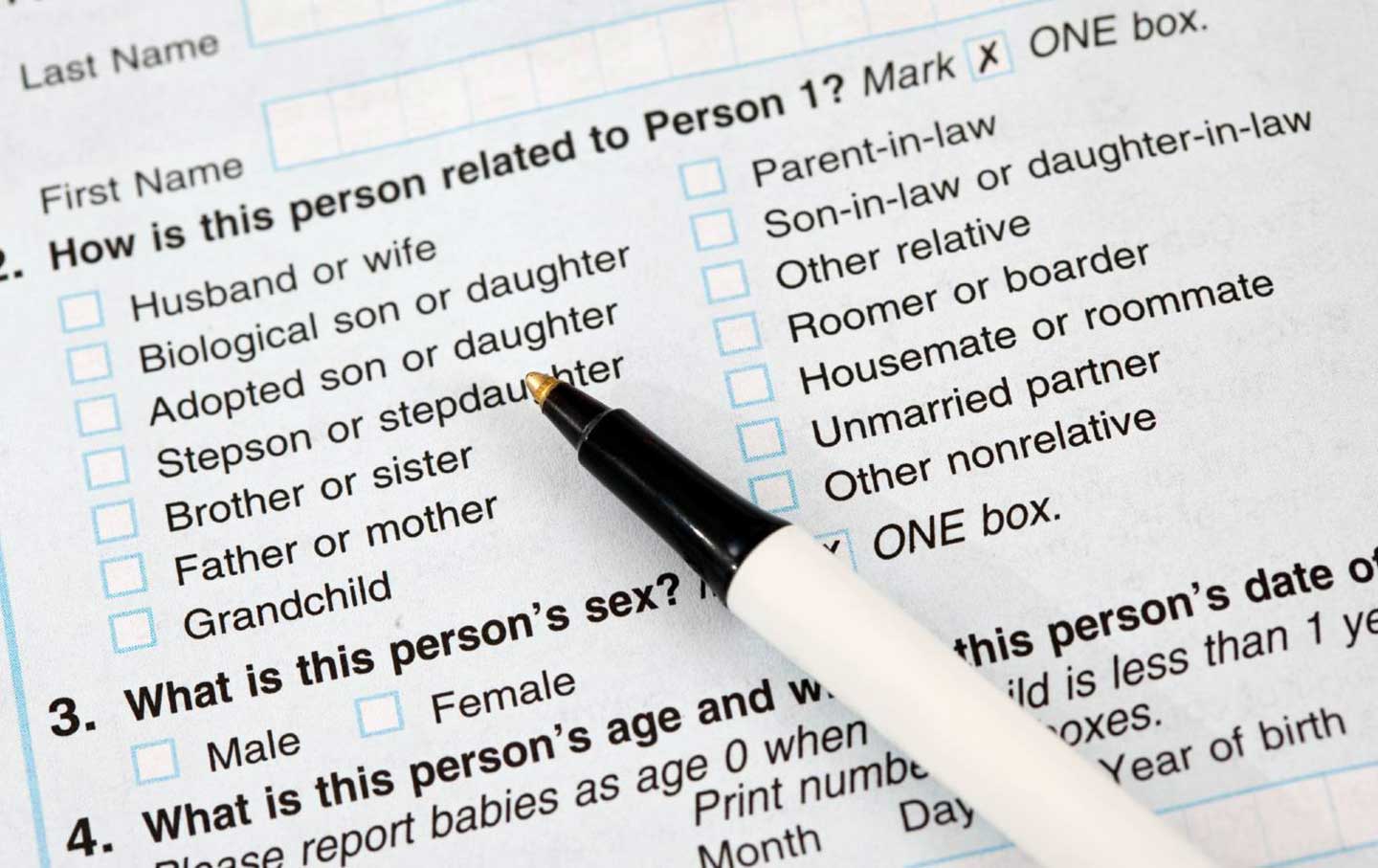
After the first Trump administration purposely broke the 2020 Census—the decennial population count that determines congressional representation, among other things—I implored the Biden administration to do away with Trump’s warped count and commission an accurate one. I said it should be unconscionable to spend 10 years relying on a census that purposely undercounted Black and brown voters, as it would make it even easier for Republicans to gerrymander away minority political representation.
The Biden administration, of course, did nothing to fix the problem, and Republicans have indeed done everything they can to erase minority representation through gerrymandering. Now Donald Trump is back, and his administration is taking another stab at ruining the Census. This time it’s not only trying to juice GOP representation in Congress but also trying to ensure massive changes in how federal resources are allocated.
Back during Trump’s first term, his administration did not get everything it wanted out of the 2020 Census. You might remember that, in 2019, Trump desperately tried to add a citizenship question to that Census but was blocked by the Supreme Court. Now that he has returned to power, his administration is trying to add a citizenship question to the 2030 Census—a question that will have two separate but related effects. The first is that it will deter some noncitizens from filling out the form, and the second is that the government will then exclude many of the noncitizens who do answer from the final count. The result: an artificially depressed population count in a number of states.
The fact that Trump is planning anything around the 2030 Census is mildly worrisome to me, given that Trump is supposed to be out of power by then. However, the decennial Census is a massive government undertaking, and mid-decade planning for the thing is not inherently abnormal.
Moreover, Trump’s attempt to radically change the Census just as the count was set to get started in 2019 is what scuttled his plan. Chief Justice John Roberts wrote the unanimous opinion blocking the addition of the citizenship question, arguing that the administration’s reason for adding the question was contrived, and thus the administration didn’t meet the criteria for amending the Census questionnaire. This time, Trump is starting early and doing what the court pretty much told him to do to get a second bite at the apple. This is the consistent call-and-response practice between the court and this president: Trump tries something outrageous; the Supreme Court says “no” but tells him exactly how to do it in the future; Trump does it the way the Supreme Court wants and then gets his way. Remember this when you’re “celebrating” any ruling that initially seems adverse to Trump’s plans.
In any event, blocking noncitizens from being counted by the Census would be a devastating change, not only to how we determine political representation but also to how the government functions. Trump and the Republicans justify the citizenship question by arguing that, since noncitizens can’t vote, they shouldn’t be included in our Census counts. That argument is flawed. Noncitizens still use, and are entitled to use, government resources, which means that having an accurate count of how many people live in a state or locality, regardless of citizenship or voting status, is still critical. It literally determines what cut of federal funding states and localities get across a host of issues.
Moreover, excluding noncitizens from the count is not the only major change Trump is planning for the 2030 Census. Talking Points Memo obtained a draft copy of the new rules circulating around the Department of Commerce (the executive agency charged with administering the Census) and discovered that the Trump administration is also trying to change how people record where they live; the administration wants to shift from using a person’s “usual residence” to the one available on their tax records.
This is a direct attack on young people, and especially college students. Often the “usual residence” of a student or recent graduate is, you know, where they actually live: in a college dorm, town, or urban enclave. But, for the purposes of taxes, they might still be listed as living with their parents. I, for instance, lived and voted in Massachusetts during college and law school, but my tax residence never changed from my parents’ house in New York. This change would essentially give young people less political power, while giving their parents more.
There’s a third proposed change that would potentially be more devastating than all the others: Trump wants the Census to stop counting the race and ethnicity of the people living in this country.
I am sure that Republicans will try to sell this change as some kind of wonderful, post-racial, “colorblind” moment of social advancement, but do not fall for the Kumbaya okey doke. Knowing the racial and ethnic makeup of the country is critical for a number of programs designed both to ameliorate the legacies of segregation and racism and to identify new expressions of bigotry. Even though the current administration thinks those programs should not exist, the hope is that Trump won’t be in charge through 2040. Yet if he is able to prevent the government from counting the number of Black and brown people in the country, he will be able to frustrate restarting those programs, even long after he is (hopefully) out of power.
And then there’s the more immediate problem of congressional redistricting. Remember, racially motivated gerrymanders are the only kind of gerrymanders that are still, technically speaking, unconstitutional according to this Supreme Court. But if Trump can prevent the government from counting where minorities live, it will be truly impossible to ever prove that a gerrymander was designed to take away their power. You won’t be able to argue that a district was designed to erase the Black vote if you are not allowed to know where Black people actually live.
There’s also the argument that the forced ignorance of our racial and ethnic makeup is textbook erasure of minority communities. Whatever we want to do with the information about race and ethnicity, we should at least have it as part of our official count of ourselves.
Popular
“swipe left below to view more authors”Swipe →Given the Trump administration’s well-documented racial animus, I have to assume that these proposals will go forward as part of the planning for the 2030 Census. I also have to assume that the Supreme Court will allow these changes to go through, as their concerns last time were entirely process-oriented, and Trump is giving himself enough time to do the process correctly.
That means that the only real chance to stop this will be for Democrats to take control of the White House in 2028 and put somebody in charge at the Commerce Department who will be laser-focused on fixing the Census. Democrats must recognize the problem, the existential danger it poses, and prioritize correcting it.
This is not a sexy issue. “I will unfuck the Census,” is not going to generate a lot of applause during a stump speech in New Hampshire. And yet, it must be a critical, “first hundred days” priority for an incoming Democratic administration—if we are allowed to have one.
More from The Nation

Little Voices, Big Messages Little Voices, Big Messages
Children and families turned creativity into a call for housing justice, educational equity, immigrant rights, and community solidarity at the Children’s Rally for Justice.
Who Decides What Matters? The Jensen Huangs of the World or the American People? Who Decides What Matters? The Jensen Huangs of the World or the American People?
Why we need greater democratic control over how society’s vast wealth is invested.

Democrats Finally Ran as Economic Populists—Thanks to Newcomers Democrats Finally Ran as Economic Populists—Thanks to Newcomers
We analyzed 16 years of Democratic campaigns. The 2026 surge in attacks on billionaires and corruption came from newcomers, not party leaders, and they’re about to remake the cauc...

Sean Duffy and the Perils of Trump’s Made-for-TV Cabinet Sean Duffy and the Perils of Trump’s Made-for-TV Cabinet
The secretary of transportation was a reality-TV “star” and a Fox Business cable host. But when the American aviation system was grounded, he lost it.