The United States Is Self-Destructing Amid Empire Collapse
Dangerously wrong priorities will accelerate America’s decline.
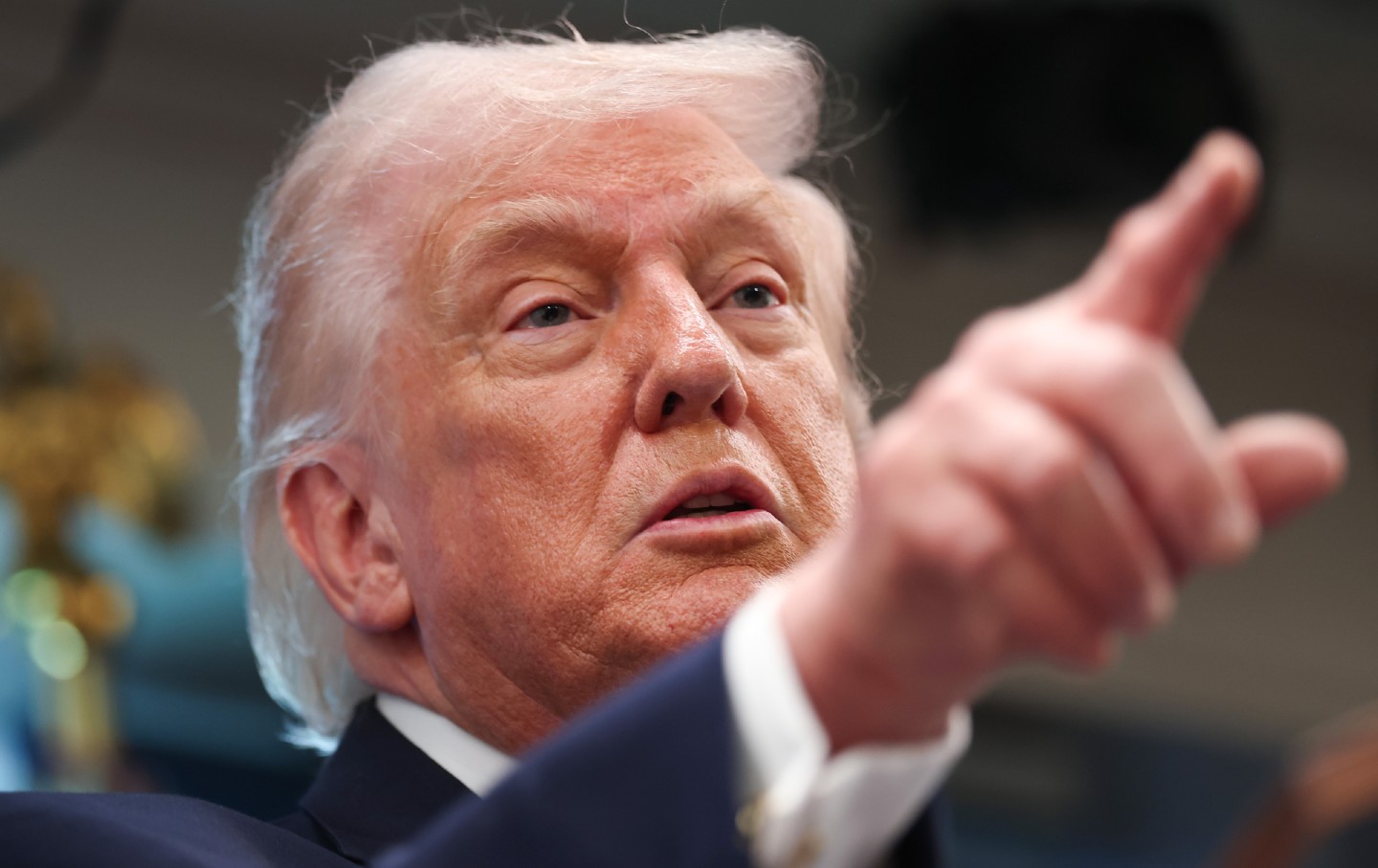
President Donald Trump speaks during a news conference in the White House on April 6, 2026.
(Anna Moneymaker / Getty Images)The Trump administration’s fiscal year 2027 budget request is a bat signal to Congress. The American empire is flailing, and the White House is working to ensure that the country declines with it. If there was ever a time for lawmakers to discipline the Pentagon, it is now.
On Friday, the White House released preliminary details about the fiscal year 2027 federal budget. The president requested $1.15 trillion for the Pentagon, as well as an additional $350 billion for the military outside of the regular budget process. If Congress manages to approve the latter in a separate spending bill, it will deliver President Trump a $1.5 trillion top line—a 44 percent increase from last year.
The administration’s budget request to Congress comes as the United States surpasses the first month of its illegal, dangerous war against Iran—which according to YouGov, about 60 percent of Americans oppose. It remains to be seen whether the Pentagon will pursue additional funding for the war, though the Pentagon suggested a separate $200 billion spending package just two weeks ago. Even with a ceasefire, the Pentagon may still pursue a supplemental to refill weapons stockpiles. Either way, lawmakers have a clear mandate: Cut the Pentagon budget and salvage their chance to deliver the domestic rejuvenation the American people demand.
The president is forcing austerity on the American people while prioritizing arms dealers and warmongers. The administration has proposed a 10 percent cut to nonmilitary spending, a $73 billion reduction. But superfluous military spending is an accelerant of American decline, coming at the cost of childcare, healthcare, and social welfare writ large—as the president made explicit in his address last Wednesday. According to the president, “it’s not possible” for the federal government to take care of childcare or healthcare: “We have to take care of one thing: military protection. We have to guard the country.”
The president’s idea of guarding the country is unmitigated weapons production. But this is really just an idea, and a flawed one at that. The United States does not have the industrial capacity nor the workforce to absorb an additional near $500 billion Pentagon budget plus-up in a single fiscal year. Production constraints aside, the president’s budget request kick-starts his vanity projects in earnest. The fiscal year 2027 budget establishes Trump’s Golden Fleet—including the Trump-class battleship. Americans may be losing critical services, but the administration made sure to carve out funding for the F-47 fighter jet and Golden Dome, the president’s fantasy missile defense system.
The administration’s budget request outlines an egregious misallocation of American resources, but President Biden and his predecessors paved the way to the trillion-dollar-plus Pentagon budget. For years, Republicans and Democrats alike have invoked the prospect of World War III to justify expanding Pentagon budgets and unfettered weapons production. If the United States was as vulnerable to a military attack as budget boosters claim it is, the federal government would exercise both executive powers and statutes like the Defense Production Act to seize industrial capacity and boost arms production in preparation for war—as the nation did in World War II.
The administration boasts that the current military buildup surpasses even that preceding the Second World War. The only reasonable response to such excess is to drastically cut military spending, starting with Trump’s pet projects: the Golden Dome missile-defense system, the Golden Fleet, and the F-47. Between last year’s “Big Beautiful Bill” and its proposed top line for fiscal year 2027, the administration is poised to commit at least $40 billion on Golden Dome—the land-and-space-based shield purportedly capable of protecting the United States from everything from ballistic to hypersonic and cruise missiles. But a poorly conceived, fantastically expensive missile-defense shield is far from the most effective way to mitigate the threats posed by nuclear weapons: diplomacy, arms control, and nuclear nonproliferation.
Rather than commit generations of Americans to unnecessary if not technically infeasible weapons programs, Congress must cut off America’s war machine at the source. Excessive Pentagon spending fuels the US’s war obsession, an affliction that drives American hubris in countries like Iran and beyond. Military restraint, however, may be a driver and a product of spending discipline. At the very least, deep cuts to the Pentagon budget would save taxpayers from financing the president’s weapons wish list, which is irrelevant to cohesive or realistic strategic thinking. Most importantly, Pentagon budget cuts would free up resources for programs that actually improve Americans’ quality of life, which is rapidly deteriorating amid both wage stagnation and rising prices.
Become a Sustaining Donor This September
Between the reemergence of right-wing red-baiting and Donald Trump’s use of the chilling National Security Presidential Memorandum–7 to criminalize left political organizing, we’re seeing McCarthyism reborn before our eyes.
This assault on democracy cannot be ignored or wished away. Resisting it requires bravery in the face of threats and repression, a steadfast commitment to the truth, and the unwavering belief that we can—and will—overcome this darkness.
We must have an independent media that sets the record straight, unearths corruption and abuses of power, and advances a politics of justice and dignity for all if we’re to win this fight.
That’s why I’m writing to you today. This September, The Nation needs to add 100 monthly donors to sustain our progressive journalism. Your contribution makes the next investigative report, the next truth-speaking column, and the next pathbreaking essay all possible.
I hope you’ll support our work with a recurring donation today. If you donate $10 or more a month, we’ll send you a brand new “Hands Off the Free Press!” sticker to recognise your commitment to our cause. Please, donate today.
Onward,
Katrina vanden Heuvel
Editor and Publisher, The Nation