Texas Republicans Are Doubling Down on Banning Capital Gains Taxes
If passed, the constitutional amendment would lock out a potential source of future state funding and disproportionately benefit wealthy households.
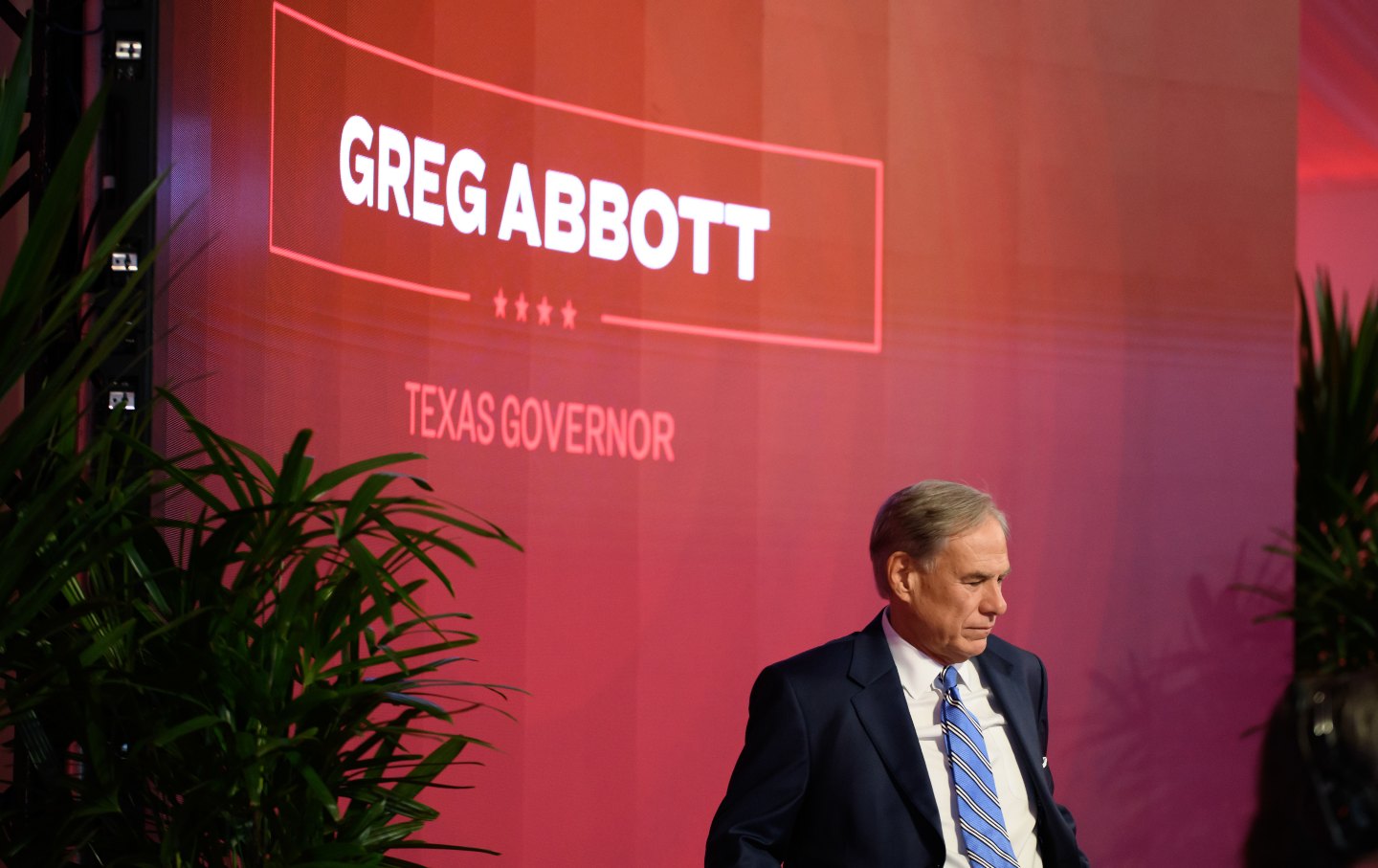
Greg Abbott, governor of Texas, during a news conference in September 2025.
(Mark Felix / Getty)
In Texas, 17 constitutional amendments will be up for a vote this November, on issues from bail reform to funding for dementia prevention. But the majority of the proposed measures concern tax rights, bans, and exemptions. Among them is Proposition 2, which calls to “Prohibit Capital Gains Tax on Individuals, Estates, and Trusts.”
If passed, the state of Texas would not be able to collect taxes on both “realized and unrealized capital gains,” meaning profits generated from selling or holding an investment—including stocks, bonds, real estate and personal vehicles. Though there has been no polling on the issue, voters in the state are likely to pass Prop 2. Since 1993, the state has proposed three tax bans, and all three have been approved by voters. Under the 2019 income tax ballot proposal, capital gains taxes were already effectively banned, and in 2023, voters in Texas approved a ban on a “wealth tax” with nearly 68 percent of the vote.
In a video from May, Texas Governor Greg Abbott was eager to sign a joint resolution that would allow voters to “ensure that we are not going to have a capital gains tax on Texans in the state of Texas.” He later shared that it is “an extension of our collective disdain in Texas for any type of tax.”
Most states only tax realized capital gains (and none of them tax unrealized gains). Though Texas does not currently impose any capital gains tax, the proposal, if passed, “erects a permanent barrier to a future legislature or electorate willing to adjust our tax code to changing needs,” wrote Dr. Cathy McAuliffe, a former candidate for the Rockport-Fulton Independent School District school board, in a letter to the editor to the Rockport Pilot. “Texans deserve the flexibility to address evolving challenges.”
The ban would disproportionately benefit wealthy households, many of whom have flocked to the state in recent years. In 2025, over 10 percent of the people on the Forbes 400 List of the richest people in the United States were Texas residents, and the state has one of the most regressive tax systems in the country, according to the Institute on Taxation and Economic Policy, with lower-income households in the state paying the greatest proportion of their income in taxes.
Several editorial boards across the state have expressed a negative opinion of Prop 2, including the Houston Chronicle and the San Antonio Express-News. In October, the editorial board of the Austin American-Statesman asked readers to vote no on the proposal, saying that, if passed, the constitutional amendment would remove a potential source of funding in the future. “Tax breaks on capital gains primarily benefit wealthy households and worsen racial wealth inequality,” wrote The Statesman. “Those at the top shouldn’t be permanently shielded if Texas ever needs new funding sources.”
Become a Sustaining Donor This September
Between the reemergence of right-wing red-baiting and Donald Trump’s use of the chilling National Security Presidential Memorandum–7 to criminalize left political organizing, we’re seeing McCarthyism reborn before our eyes.
This assault on democracy cannot be ignored or wished away. Resisting it requires bravery in the face of threats and repression, a steadfast commitment to the truth, and the unwavering belief that we can—and will—overcome this darkness.
We must have an independent media that sets the record straight, unearths corruption and abuses of power, and advances a politics of justice and dignity for all if we’re to win this fight.
That’s why I’m writing to you today. This September, The Nation needs to add 100 monthly donors to sustain our progressive journalism. Your contribution makes the next investigative report, the next truth-speaking column, and the next pathbreaking essay all possible.
I hope you’ll support our work with a recurring donation today. If you donate $10 or more a month, we’ll send you a brand new “Hands Off the Free Press!” sticker to recognise your commitment to our cause. Please, donate today.
Onward,
Katrina vanden Heuvel
Editor and Publisher, The Nation