
Stanford Students Sue Over Trump’s Crackdown on Political Speech
Amid the administration’s war on higher education, The Stanford Daily’s lawsuit targets federal statutes that allow deportation and visa revocation based on political speech.
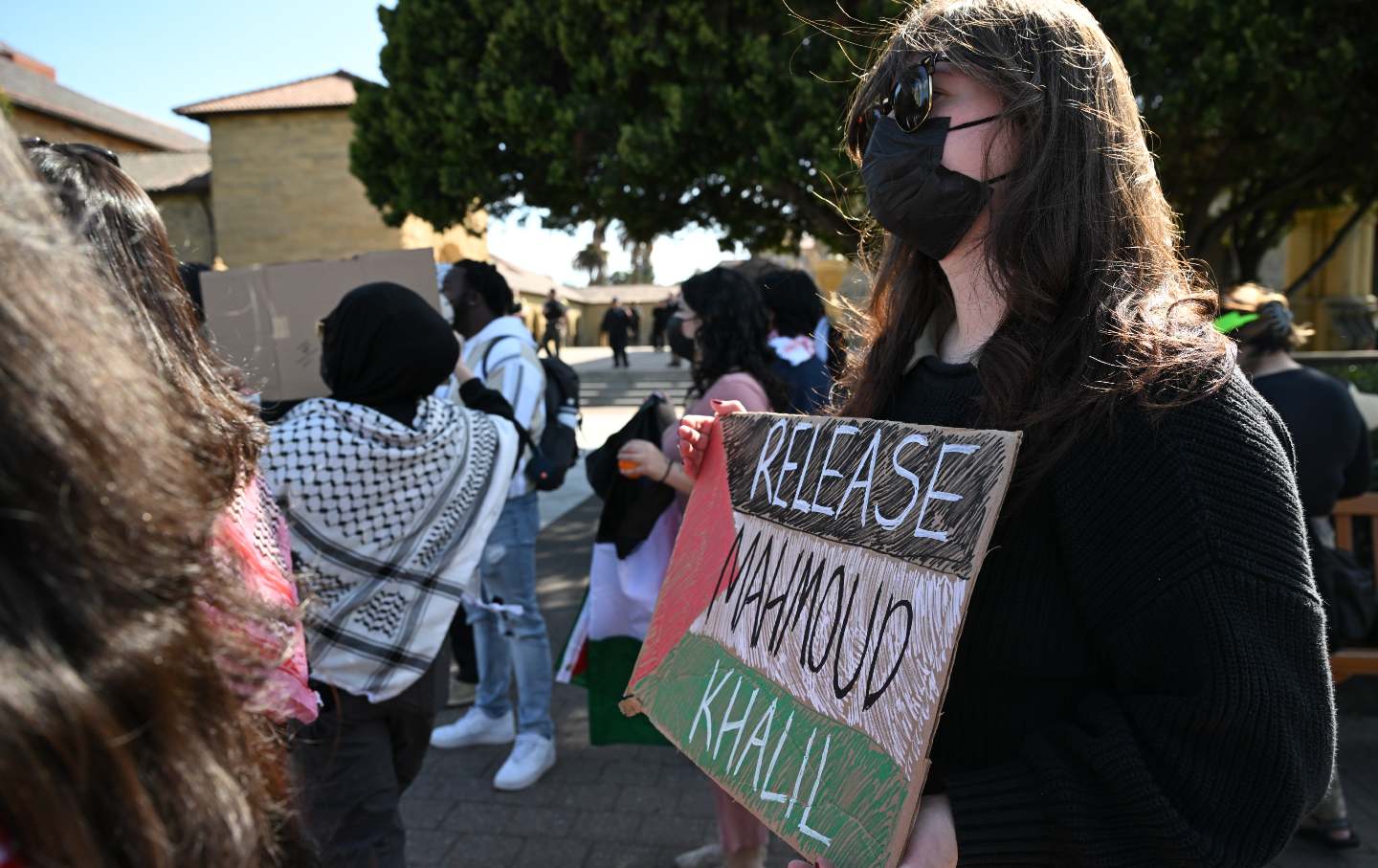
Stanford students and activists outside of the White Memorial Plaza in March 2025.
(Tayfun Coskun / Getty)In a San Jose courtroom on the morning of November 19, attorneys for The Stanford Daily and two anonymous international students argued that President Donald Trump’s administration has used federal law as a weapon against political dissent.
The lawsuit, filed against Secretary of State Marco Rubio and Homeland Security Secretary Kristi Noem, asserts that the plaintiffs’ First and Fifth Amendment rights have been fundamentally violated—but that it’s the statutes themselves, not just the administration enforcing them, to blame.
Unlike many First Amendment cases, which focus on harm to a handful of individuals, this suit challenges the underlying laws that allow the government to deport people for political speech. The suit argues that noncitizens lawfully present in the US enjoy the same free‑speech protections as citizens, even when their views are politically unpopular.
The Stanford Daily and coplaintiffs contended that the Trump administration’s use of two statutes to attack free speech and student protesters—particularly pro-Palestinian activists—has chilled the paper’s ability to not only gather news and print opinion but also to keep an archive of past work. The lawsuit was filed by The Stanford Daily, an independent student newspaper, not the university, and 55 college newspapers across the country—from The Tufts Daily to The Northern Light at the University of Alaska–Anchorage—joined an amicus brief in support.
For the plaintiffs, the stakes feel immediate and personal. “[The students] don’t want to be next,” said Conor Fitzpatrick, lead attorney representing The Daily and the student coplaintiffs. “They don’t want to be the next one thrown into the back of a van by masked agents, flown across the country to a holding cell in Louisiana, and be facing deportation.”
Three full cars of Stanford students attended the hearing, joined by reporters from a local community college paper, high school journalists from Palo Alto, and law students from Santa Clara. “We’re seeing immigrant advocates targeted across the board. People are losing immigration benefits for exercising their rights,” said one attendee, John Luke Farah, a Palestinian law student studying immigration law. “I believe in finding sanctuary—and protecting speech is a part of that.”
Amid more than 350 lawsuits filed against the Trump administration during his second term, this is the first major First Amendment case spearheaded by an independent student newspaper. The Foundation for Individual Rights and Expression (FIRE), a First Amendment nonprofit representing the plaintiffs, is pushing for a landmark ruling to invalidate federal laws that allow deportation or visa revocation based on political speech.
The initial hearing took less than 45 minutes—far shorter than students had expected. Judge Noël Wise of the US District Court for the Northern District of California asked questions around standing and procedural posture, asking both sides for additional briefings on how the statutes specifically affect the plaintiffs.
The issue of standing stems from arguments in the government’s brief, which asserts that the plaintiffs have not shown personal harm and therefore lack standing. Assistant US Attorney Kelsey Helland represented the government at the hearing. The court ultimately denied both motions for summary judgment without prejudice.
Judge Wise underscored the stakes, calling the issues at hand “powerful and important.” But she also cautioned that the plaintiffs are effectively asking the court to rule on the statute’s plain language, not merely its application in specific cases, which is “a tough road to hell.” At the hearing, she said it was “not impossible, but I urge you to think carefully about how you frame this case going forward.”
As an officer at the Daily, I’ve seen international students self-censor for months, hesitating to speak in discussions, engage with the press, or post online. But the tense atmosphere on campus has only intensified in recent weeks (as a student fellow for The Nation, I’m writing this as an independent reporter and not on the Daily’s behalf). “I’ve had reporters turn down assignments, request the removal of some of their articles and even quit the paper because they fear deportation for being associated with speaking on political topics, even in a journalistic capacity,” Greta Reich, editor in chief of the Daily, told FIRE.
E-mails from Stanford’s Bechtel International Center have cautioned noncitizen students to avoid political protests and social media activity. The campus debate has widened as pro-Palestinian student activists, including those at Stanford, face heightened legal scrutiny, and as publications across the ideological spectrum—such as The Stanford Review—weigh in on the boundaries of speech at the university.
These fears also led the two international students to join the case anonymously. “The reason they do that is because of a fear of retaliation,” said James Wheaton, the founder and senior counsel for the First Amendment Project and law lecturer at Stanford Graduate Program in Journalism. “But the court is going to insist on as much information as possible about the injury that the international students have suffered.”
Of course, Stanford’s campus is not alone, as similar anxieties have emerged nationwide. According to Fitzpatrick, the federal government’s use of immigration authority to target student activists for speech “is a new development from the Trump administration,” and the high-profile detentions of student activists in early 2025—including Mahmoud Khalil, Mohsen Mahdawi, and Rümeysa Öztürk—have intensified those fears. During this hearing, Marc Van Der Hout, representing Mahmoud Khalil, sat in as cocounsel on the case.
Trump has launched a war on higher education more broadly, freezing billions in grants and threatening to withhold federal research funds to pressure universities to fall within his political line. The Student Press Law Center emphasized that the number of student newspapers that joined the amicus brief illustrates a chilling effect extending beyond Stanford’s campus, one that has created an environment of fear across institutions of higher education and within student newsrooms.
“With every resignation and refusal to speak on the record, we actively miss out on covering an entire group of students’ voices—as well as the many events and stories on campus that benefit from an international student’s perspective,” reads a letter from the editors discussing the case, which was published in the Daily in August. “So, after multiple meetings with The Daily’s board of directors and members of our own staff, we decided to move forward with the lawsuit. It was a decision we did not make lightly.”
If the case is ultimately successful, the two statutory mechanisms that the administration relies on to target immigration status based on protected speech could no longer be used in that fashion, and the decision could prohibit the government from revoking a visa based on protected speech. “The reason that Marco Rubio is the main defendant is because under the Immigration Nationality Act, he is the only one with the statutory authority to revoke a visa at any time for any reason,” said Fitzpatrick. “He is the one with the authority to personally determine that someone’s protected speech compromises a compelling personal foreign policy interest.”
In court filings, the Trump administration defended the 1952 Deportation Provision as a “well-established and longstanding” tool, arguing that it applies only to noncitizens whose presence the secretary of state reasonably believes could cause “serious adverse foreign policy consequences.” At the hearing, Fitzpatrick emphasized that the plaintiffs are not seeking to invalidate the statute outright but rather challenge how the government is applying it in ways that allegedly punish constitutionally protected speech.
Popular
“swipe left below to view more authors”Swipe →The Stanford Daily et al. suit comes on the heels of a major First Amendment victory; The American Association of University Professors sued Rubio, and the court held that the Trump administration unconstitutionally targeted noncitizens for deportation based on pro-Palestinian speech.
The government now has until December 3 to file a “motion to dismiss,” which is a request to throw out the case entirely. The next hearing is scheduled for January 6, when the parties are expected to present their arguments. “The case is still very much alive and going forward,” said Fitzpatrick.
“This was not a political move—journalism exists to hold those in power accountable, regardless of who is in power,” read the letter from the Daily’s editors. “Our participation in this lawsuit has been to guard our First Amendment rights and ensure [that] The Daily’s writers and editors can fulfill our mandate as a student paper: covering campus to the best of our abilities.”
More from The Nation
This November, Vote Like Alito Is on the Ballot This November, Vote Like Alito Is on the Ballot
In this week’s Elie v. U.S., our justice correspondent gives Democrats another reason to vote in November. Plus: How Sarah Huckabee Sanders’s Medicaid unmasked the racists.
Does America First Really Mean Israel First? Does America First Really Mean Israel First?
Mike Huckabee’s aide shows how an extremist agenda dominates Trump’s Middle East policy.
Trump’s Die-Hards Are Taking Their Cultishness to New Lows Trump’s Die-Hards Are Taking Their Cultishness to New Lows
I’m finally starting to understand why Jim Jones’s lieutenants didn’t try to stop him.
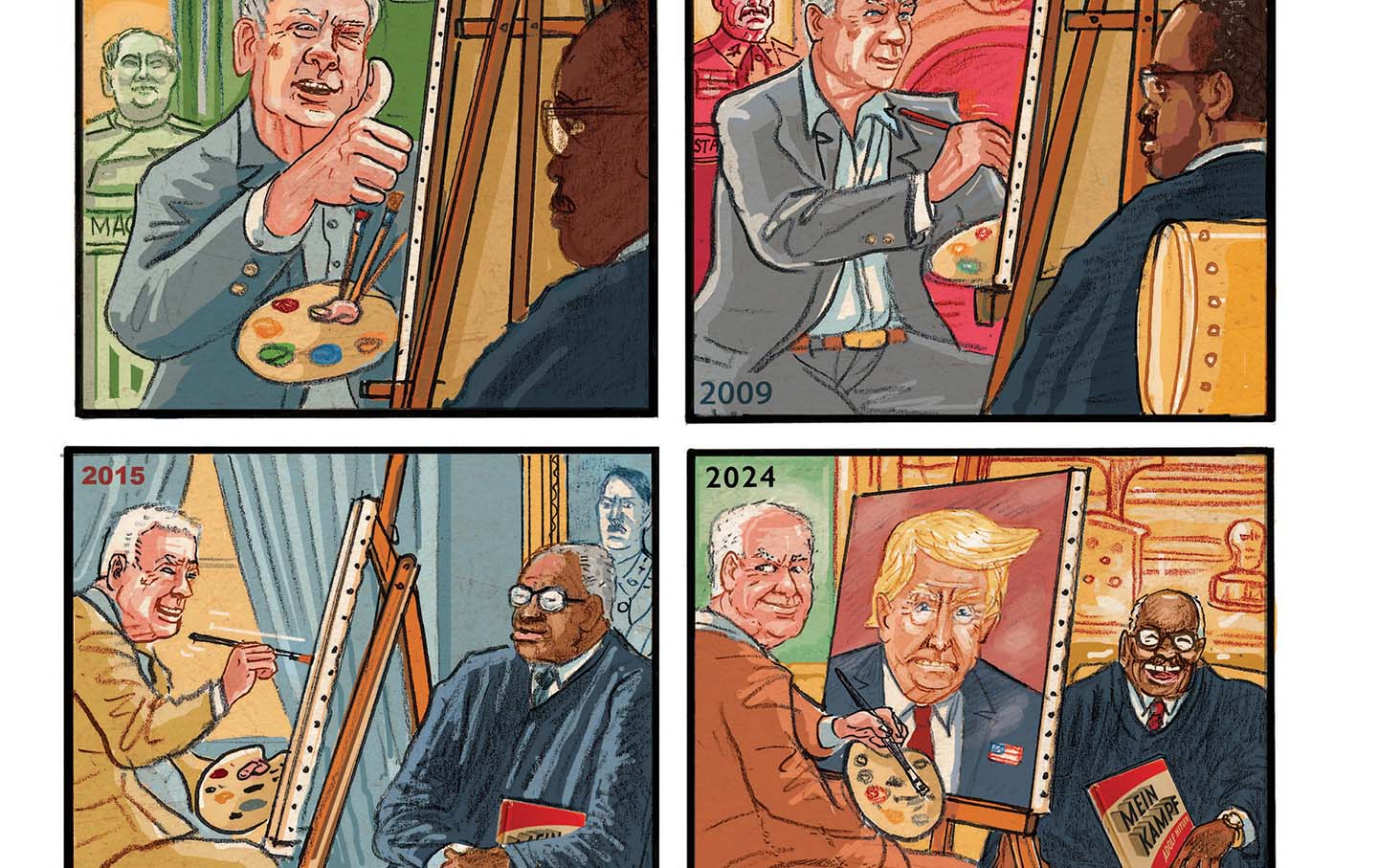
Harlan Crow’s Portrait of SCOTUS Under Trump Harlan Crow’s Portrait of SCOTUS Under Trump
Clarence Thomas, the picture of corruption.

