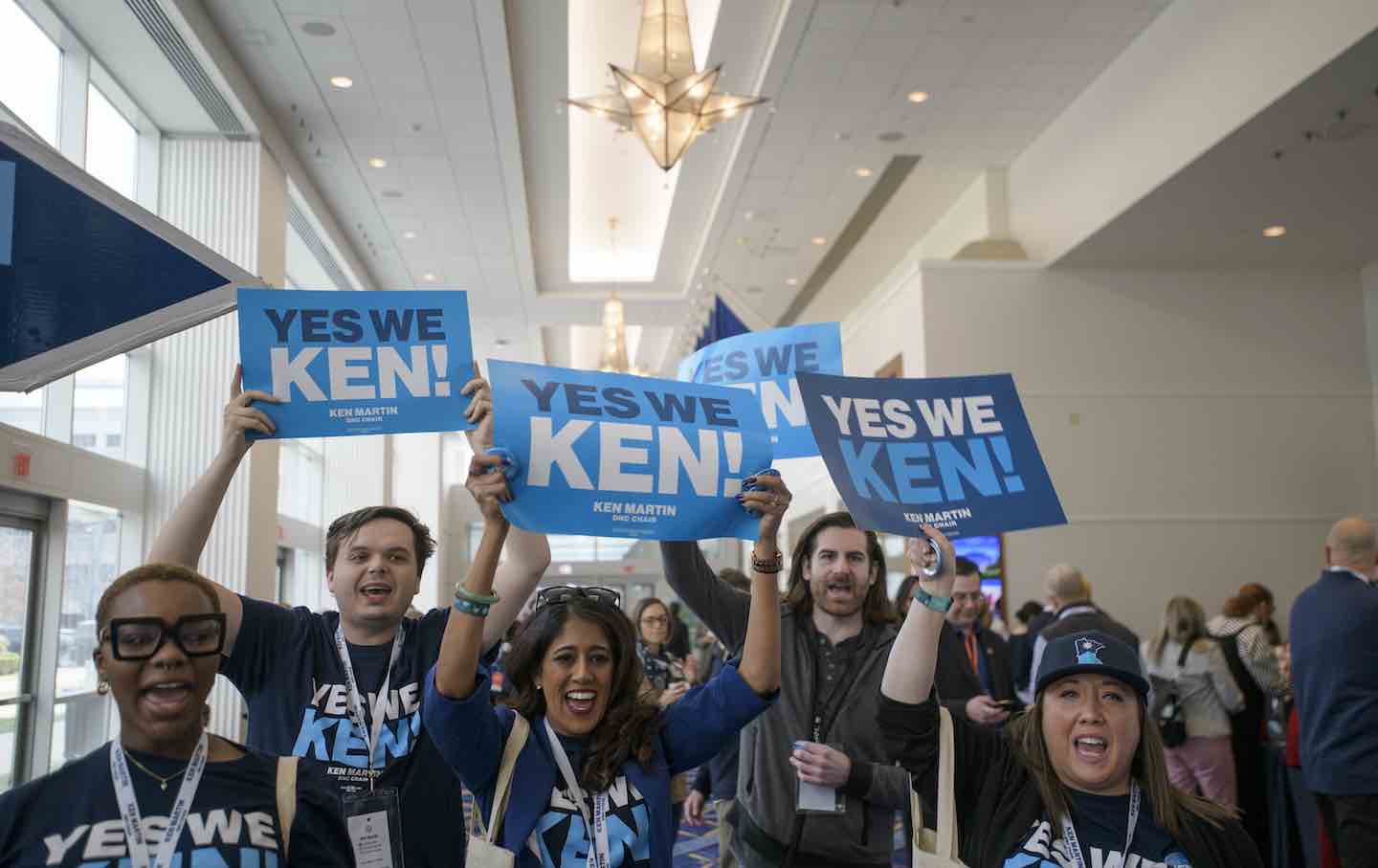
Supporters and volunteers of DNC chair candidate Ken Martin cheer outside of the ballroom in the hours prior to the votes for positions at the Democratic National Committee Winter Meeting at the Gaylord National Resort and Convention Center in National Harbor, Maryland, Saturday, February 1, 2025.
(Rod Lamkey Jr. / AP Photo)
In the Democratic Party’s first official response to the devastating setbacks it suffered in the 2024 presidential and congressional elections, members of the Democratic National Committee (DNC) elected Ken Martin as their chair on February 1. Martin, the well-regarded chair of the Minnesota Democratic-Farmer-Labor Party (DFL), won after speaking frankly to committee members about the party’s difficult circumstances. “We got punched in the mouth in November,” he said. “A lot of people in this country right now are going to need us to walk and chew gum at the same time—meaning we’re going to have to fight the extremes of Donald Trump while we make a case in both red and blue states about why they should trust us with their votes. When the Trump agenda fails Americans—which it certainly will, and already has—we have to be there with the legitimate alternative to this chaos.”
That was an implicit acknowledgment of the mistake Democrats made in 2024, when they spent so much time talking about the threats posed by Trump that there was little space left to communicate about what the party offered anxious working families. At a time when 74 percent of Americans were saying they weren’t happy with the country’s direction, Trump and the Republicans—as cruel and extreme as they are—did a better job of channeling that frustration than the Democrats. This allowed Trump to secure more support from working-class, young, and Latino voters, among others, than should ever have been the case. But the bigger story, as The New York Times noted, was that “many Democrats sat this election out, presumably turned off by both candidates.”
Martin was not the only DNC candidate to recognize that the Democrats need a bolder pro-worker agenda. His main rival, Wisconsin Democratic Party chair Ben Wikler, said, “Losing working-class voters in 2024 has to be a wake-up call for us as a party.” Wikler was backed by key union leaders, Senate minority leader Chuck Schumer, House minority leader Hakeem Jeffries, former House speaker Nancy Pelosi, and Democratic governors such as Michigan’s Gretchen Whitmer. But that big-name support garnered only 134½ DNC votes for the Wisconsinite, versus 246½ votes for Martin.
The Minnesotan benefited from the fact that he’s been in the trenches for years as head of the Association of State Democratic Chairs. But as the vote approached, he also leaned into an urgently populist message that resonated with grassroots Democrats, who are exasperated with out-of-touch DC-based strategists and are passionate about moving resources into state parties; taking bolder stands on party priorities such as expanded access to healthcare and childcare, climate, and labor rights; forging multi-racial, multiethnic, multigenerational urban and rural coalitions; and distinguishing the Democrats from the Republicans on economic issues.
Highlighting Martin’s record in Minnesota, where the DFL has won 25 statewide elections in a row, Representative Ilhan Omar (D-MN) said that Martin is “an organizer at heart and has been on the front lines of battles on behalf of working people, which is exactly what the Democratic Party needs right now.” At a point “when so many voters feel disconnected from politics,” Omar said, “Ken has proven that when we engage with people year-round, invest in grassroots infrastructure, and build real relationships, we win.”
Replicating the Minnesota model—which is rooted in the politics of the new chair’s mentor, Minnesota progressive Paul Wellstone—could be difficult. The DNC has been so focused on fundraising in recent years that it’s faced sharp criticism from veteran committee members like James Zogby (who lost a bid for vice chair); they say the party organization is too deferential to the demands of billionaire donors and highly paid consultants. Martin and Wikler both shied away from embracing the most sweeping demands of reformers, including calls for banning dark money from Democratic primaries and any rebuff of big-money politics as explicit as that of Vermont Senator Bernie Sanders. But Martin told The Nation that he’s determined to put a stronger focus on raising money from small donors, and he’s won the confidence of activists such as Alan Minsky, the executive director of the Progressive Democrats of America, who says the new chair is “ready to build a bigger, bolder party that reaches out to people who have been frustrated with both parties—to build a party that is no longer dominated by elites but is truly our party.”
Martin said as much in his winning appeal to the committee, which featured a reflection on the historic union song “Which Side Are You On?” “Are we on the side of the robber baron, the ultra-wealthy billionaire, the oil-and-gas polluter, the union buster?” he asked. “Or are we on the side of the working family, the small business owner, the farmer, the immigrants, the students? Let me tell you: I know which side I’m on.”
If Martin can give the Democratic Party that level of clarity, it will be ready to take on Trump and Trumpism.
Become a Sustaining Donor This September
Between the reemergence of right-wing red-baiting and Donald Trump’s use of the chilling National Security Presidential Memorandum–7 to criminalize left political organizing, we’re seeing McCarthyism reborn before our eyes.
This assault on democracy cannot be ignored or wished away. Resisting it requires bravery in the face of threats and repression, a steadfast commitment to the truth, and the unwavering belief that we can—and will—overcome this darkness.
We must have an independent media that sets the record straight, unearths corruption and abuses of power, and advances a politics of justice and dignity for all if we’re to win this fight.
That’s why I’m writing to you today. This September, The Nation needs to add 100 monthly donors to sustain our progressive journalism. Your contribution makes the next investigative report, the next truth-speaking column, and the next pathbreaking essay all possible.
I hope you’ll support our work with a recurring donation today. If you donate $10 or more a month, we’ll send you a brand new “Hands Off the Free Press!” sticker to recognise your commitment to our cause. Please, donate today.
Onward,
Katrina vanden Heuvel
Editor and Publisher, The Nation