
Other Countries Know Housing Is a Human Right. Why Doesn’t America?
Many European countries have systems to help unhoused people that put our society to shame. When will we change?
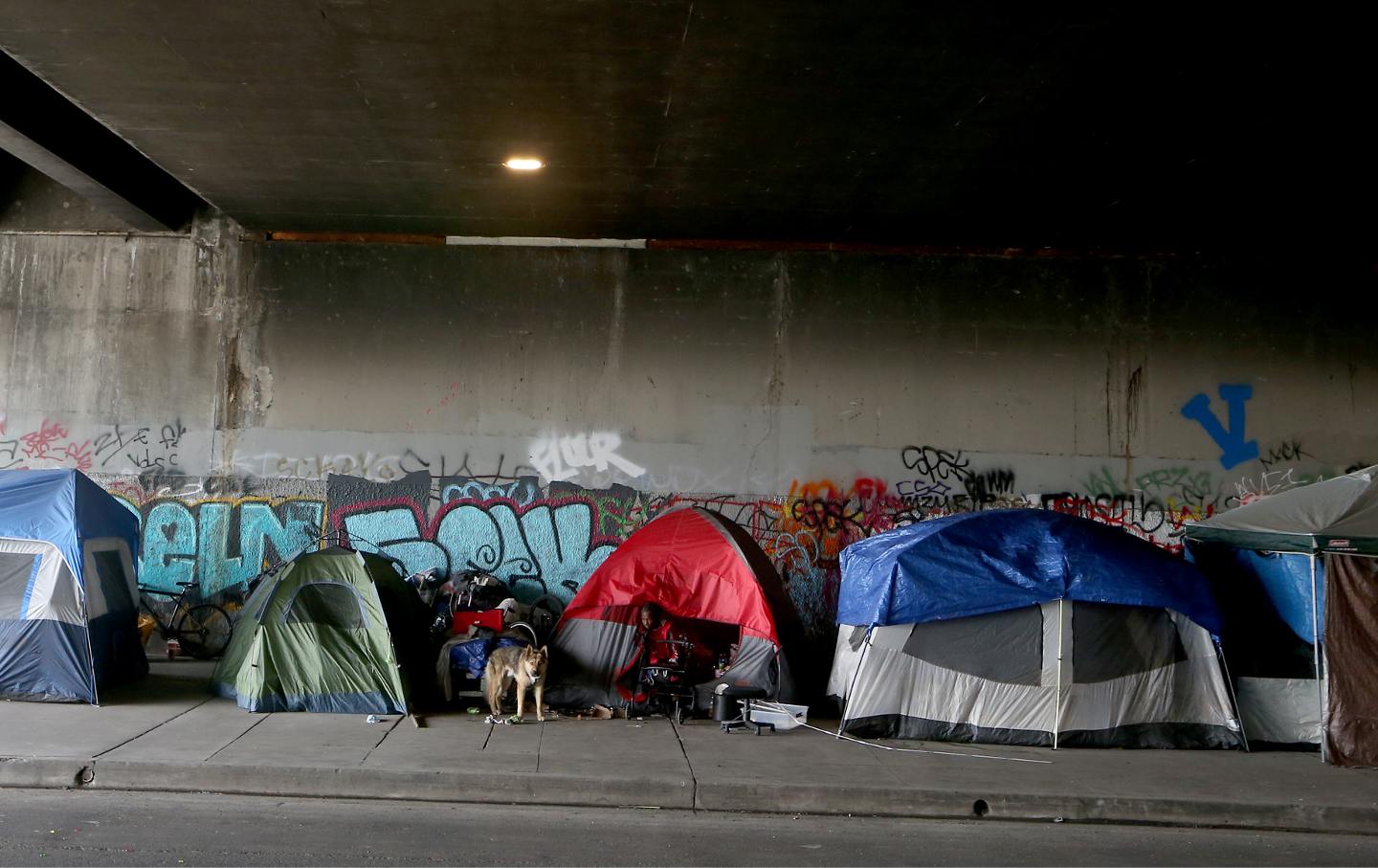
A tent city in Culver City, Calif.
(Luis Sinco / Los Angeles Times via Getty Images)For the past several weeks, I have been traveling around Europe, visiting three countries—Denmark, the United Kingdom, and Greece—with different levels of wealth and inequality, and different political ideologies animating their governments. As someone coming from California, where homelessness and endemic on-the-street drug usage and mental illness are the backdrop to everyday life in the state’s large cities, it’s always an eye-opener to see how the rest of the world fares on this.
In the entire country of Denmark, with a population of roughly 6 million, there are, experts believe, 10,000–15,000 homeless people. Most of them, however, do not live on the streets, since, more than a decade ago, the government embraced a goal of eliminating on-the-streets homelessness by providing a range of temporary accommodations, and, at the same time, began enforcing laws against the presence of homeless encampments. Denmark’s total number of homeless is about the same as the total number in Sacramento, where I live. In Sacramento, a city of less than 600,000, the majority of these men and women do live on the streets, with precious few alternatives offered to most of them, and a lack of political will to do much more than move the encampments from one city block to the next.
In the UK, which has many of the same social inequalities and wealth disparities as the US, the advocacy group Shelter estimates that there are more than a quarter of a million homeless, which is a larger number than in California. In the UK, though, the vast majority of these individuals have access to at least temporary housing. In fact, according to Shelter’s report, while London has nearly 150,000 homeless people, the total number of on-the-streets homeless in the capital city is counted in the hundreds rather than the thousands.
Meanwhile, in the Greek capital, Athens, for the past two years the homeless population has been protected by a homeless bill of rights, which defines housing access as a fundamental human right. Thus, despite the fact that Greece is a far poorer country than the United States—and certainly far poorer than is California—one doesn’t see homeless encampments lining city streets, or huge numbers of desperately ill people wandering, untreated, through urban neighborhoods.
Don’t get me wrong. There are many things the US, including California, does very well. There are areas of life in which the world can learn from America. But when it comes to housing—and the delivery of social and medical services that might help prevent people from spiraling into homelessness in the first place—California needs to take every lesson it can from regions of the world that do a far better job at tackling systemic homelessness.
In the UK, the Conservative government, an unsavory bunch of right-wing ideologues who no one can seriously claim is some sort of radical-left cabal, has embraced the idea of expanding the supply of affordable housing—albeit in a haphazard, somewhat half-hearted way. And it has done so with grassroots support: More than half of the party’s voters support increased investments in “social housing,” or what in the US would be termed either public housing or affordable housing.
In the US, by contrast, while majorities of the public support more investments in housing, including the idea of building more shelters, that support fissures when people are whether they would support the building of shelters in their own communities. NIMBYist movements are particularly powerful in US politics. Moreover, there’s huge suspicion of defining housing as a right—even California Governor Gavin Newsom has pushed back against such proposals by liberal state legislators.
All of this helps shape a particularly cautious—and dysfunctional—approach to on-the-streets homelessness. Newsom’s administration continues to pour money into the housing crisis, with a paucity of results. No wonder California’s public is deeply pessimistic on the housing front, with 70 percent reporting that the unaffordability of housing has increased in their areas in recent years and one in three saying that the cost of putting a roof over their head could ultimately drive them out of the state.
When I talk with my friends in Europe, they always express amazement at the continued existence of shantytowns around California. America’s West Coast is, after all, something of a shining beacon—a place that, in the world imagination, people go to so as to reinvent themselves, and a place that, during the darkest days of the Trump era, stood up and proudly articulated an alternative vision of what America could be.
To be honest, by the end of these conversations I’m just as bemused as are my friends. How is it that I can walk around a city in Greece at all hours of the day and night and see just a handful of homeless individuals, whereas when I walk around any city in California, within a few minutes I have seen dozens of desperately poor men and women living in tents and cardboard shacks a stone’s throw from some of the most valuable real estate on the planet? How is it that London, this metropolis of 8 million people, has far fewer on-the-streets homeless than Sacramento, a capital city with one-16th the population? How is it that Denmark can provide so many options to those who lack permanent residences, but California stumbles from one slapdash, expensive, and generally ineffective response to the next?
It’s too easy to just throw up one’s hands and say, “Oh, but America’s problems—its inequality, its drug addiction crisis, its mental health catastrophe, its problem with released prisoners, its racial inequities—are just in a different league from that of other countries.” Yes, all of that is true, but the question still remains, how do we as a society deal with these grim realities? How do we marshal the energy—political, economic, and creative—to craft solutions to match these needs? After all, we cannot choose the reality we inherit, but we can choose how we interact with that reality.
If Athens can embrace the idea of housing as a fundamental human right, why on Earth can’t Los Angeles or San Francisco, Sacramento or San Diego? Or, for that matter, Seattle or Portland up north? It’s hardly as if Athens has more money or political clout than the major cities of the West Coast.
How wonderful it would be if, one day, I no longer had to have these conversations on my travels—if, instead of looking askance at America’s West Coast and its housing catastrophe, one day people from far afield could look westward and instead say, “What marvelous, creative, effective solutions you have crafted to end the scourge of homelessness. How brave of you to meet the moment so boldly.”
Support independent journalism that does not fall in line
Even before February 28, the reasons for Donald Trump’s imploding approval rating were abundantly clear: untrammeled corruption and personal enrichment to the tune of billions of dollars during an affordability crisis, a foreign policy guided only by his own derelict sense of morality, and the deployment of a murderous campaign of occupation, detention, and deportation on American streets.
Now an undeclared, unauthorized, unpopular, and unconstitutional war of aggression against Iran has spread like wildfire through the region and into Europe. A new “forever war”—with an ever-increasing likelihood of American troops on the ground—may very well be upon us.
As we’ve seen over and over, this administration uses lies, misdirection, and attempts to flood the zone to justify its abuses of power at home and abroad. Just as Trump, Marco Rubio, and Pete Hegseth offer erratic and contradictory rationales for the attacks on Iran, the administration is also spreading the lie that the upcoming midterm elections are under threat from noncitizens on voter rolls. When these lies go unchecked, they become the basis for further authoritarian encroachment and war.
In these dark times, independent journalism is uniquely able to uncover the falsehoods that threaten our republic—and civilians around the world—and shine a bright light on the truth.
The Nation’s experienced team of writers, editors, and fact-checkers understands the scale of what we’re up against and the urgency with which we have to act. That’s why we’re publishing critical reporting and analysis of the war on Iran, ICE violence at home, new forms of voter suppression emerging in the courts, and much more.
But this journalism is possible only with your support.
This March, The Nation needs to raise $50,000 to ensure that we have the resources for reporting and analysis that sets the record straight and empowers people of conscience to organize. Will you donate today?
More from The Nation

We Don’t Need an Autopsy to Tell Us the Democrats Failed on Gaza We Don’t Need an Autopsy to Tell Us the Democrats Failed on Gaza
The DNC is allegedly hiding a report showing that Kamala Harris’s Gaza policy helped cost her the 2024 election. But that report won’t tell us anything we don’t already know.

Texas’s Senate Primary Has Already Made History—and It’s Not Over Yet Texas’s Senate Primary Has Already Made History—and It’s Not Over Yet
Democratic nominee James Talarico is getting national media attention, but the real story is sky-high voter turnout, even amid GOP bids to suppress balloting
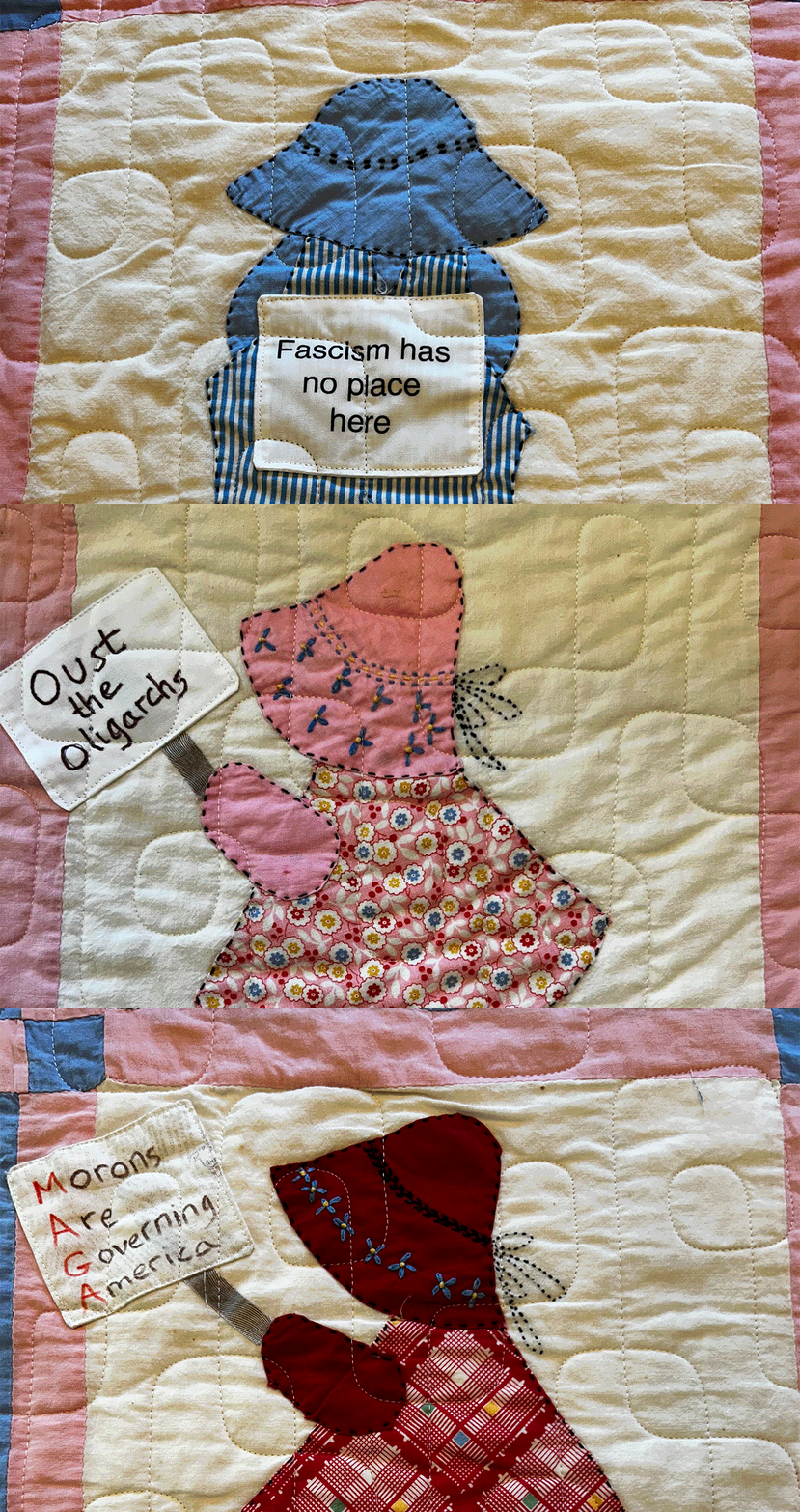
Quilted Messages Quilted Messages
Sunbonnets carrying not-so-sunny truths.

How the Theatrics of Mamdani’s Trump Meeting Backfired How the Theatrics of Mamdani’s Trump Meeting Backfired
By pandering to the president’s vanity, the New York mayor reinforced Trump’s image as a strongman commanding deference—an especially bad look on the eve of Trump’s war with Iran

Students in New York Are Going Hungry. How Can Mamdani Help? Students in New York Are Going Hungry. How Can Mamdani Help?
With plans for city-owned grocery stores and a focus on affordability, the new mayoral administration offers fresh hopes of successfully confronting the food crisis among students...

We Are the Fire That Melts the ICE We Are the Fire That Melts the ICE
Oaxaca, Mexico, street art.

