Last Night, a DJ Saved My Campaign Rally
At a town hall event in Oaks, Pennsylvania, Donald Trump appeared to give up on politics and spent 39 minutes nodding along to his favorite songs.
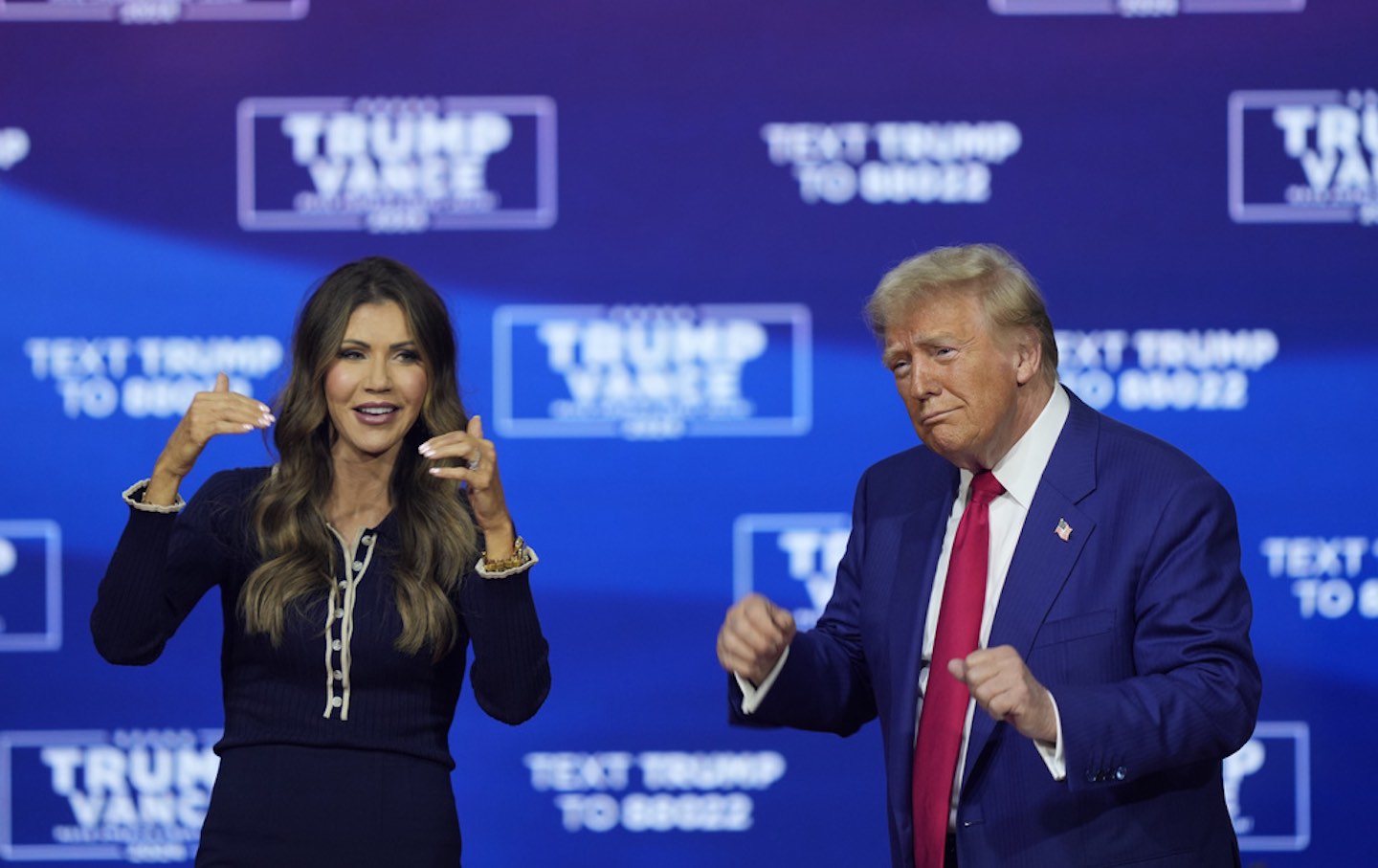
In one dystopian scenario, future historians will record that the American republic died not with a bang or whimper but with a playlist. At a surreal town hall event in Oaks, Pennsylvania, Donald Trump rushed to wrap up his pitch to voters in the critical swing state so that his DJ could segue into his favorite set of rally tunes.
“If my guys can do it, let’s make it a musical festival.… If my guys can hear me, put up my chart, my all-time favorite chart,” Trump said in one among countless disjointed asides at the event. He then looked across the stage at the same misleading chart of immigrant encounters at the US border that he was gesturing toward when an assassin took a shot at him at the July rally he held across the state in Butler. “That’s my favorite piece of paper in the world, I kiss it and take it to bed with me,” Trump continued, adding that he’d still feel that way “even if it had lousy numbers.” Then it was back to the playlist: “Put on Pavorotti singing ‘Ave Maria.’ Turn it up nice and loud. We want lots of action.”
As Trump’s DJ obliged, the candidate wandered to the end of the stage, pointing at attendees and calling out to at one point to a Gold Star family who had asked him a question earlier in the evening, “That’s for their boy—stand up. That’s for their boy.” And then back to center stage: “Let’s not do any more questions, let’s just do music—who the hell wants to hear more questions, right?” Trump’s team didn’t get the music teed up right away, though, which then gave Trump the opportunity to cycle through some more randomized talking points as they occurred to him: on Pennsylvania’s must-win status, the candidacy of Bernie Moreno in Ohio, the Biden-to-Harris campaign switch. The evening’s hapless yet sycophantic moderator, South Dakota GOP Governor Kristi Noem, tried to intercede with a gentle return to patented MAGA sloganeering: “We’re not going to complain about things, are we? We’re going to fix them. We’re going to make America great again.” That yielded this reply from the candidate: “Those doors are open. That feels good. I don’t know who’s out there trying to get in, but you know.… Doesn’t that feel nice? And it’s nothing like outdoors, you don’t even have the cost of an air conditioner, if they have them in this beautiful factory.”
This was all prelude to the most notorious segment of the proceedings: Trump silently bobbing along and gesturing at crowd members as his favorite setlist played on. The proceedings seemed to reach their greatest pitch of unhinged Juche when Sinead O’Connor’s cover of “Nothing Compares 2 U” blared before the befuddled crowd as a graphic behind Trump and Noem displayed the prompt “Trump was right about everything”—an already dubious claim that appeared to be eroding by the second. Still, for all the high-profile derangement overtaking what was intended to be a carefully vetted show of fawning admiration from Trump’s swing-state devotees, the most jarring moment came when Noem, disoriented by her sudden transformation from dog-shooting MAGA tribune into the campaign equivalent of a home healthcare aide, had to steer Trump through this exchange:
NOEM: Well, sir, did you want to play your song and greet a few people?
TRUMP: What song?
NOEM: Well, you had said you had wanted to close with a specific song.
TRUMP [to the offstage DJ]: OK, Justin, how about some real beauties, and we’ll sit down and relax?
To be fair to Trump and Noem, the town hall had been interrupted twice prior to its train-wreck phase, as medical personnel tended to rally attendees who had fainted from the heat in the congested and stuffy factory hosting the event. That was the reason Trump was marveling at the breeze blowing into the facility once security personnel opened the doors. But the spectacle of Trump standing and bobbing in place for the final 39 minutes of the event was not exactly a profile in clear and competent leadership. Toward the end, he seemed to recall that this was a campaign gathering, and reminded his playlist listeners that “this is the most important election in the history of our country.” But then the somnolent bobbing resumed. The crowd on hand was left wondering just what it was supposed to do, before its members gradually fanned out and left—a far cry from the mood of motivated voter engagement the town hall was supposed to generate.
The Oaks town hall drove home a central issue in this election that the national political press has only episodically addressed: For all the Sturm and Drang that commentators and reporters unleashed on incumbent President Joe Biden after his checked-out debate performance in June, Donald Trump is unmistakably losing the plot. At last week’s meandering and non sequitur–filled address before the Detroit Economic Club, Trump stood stock still on the stage for five minutes prior to beginning his remarks. His notorious rally speeches are now so pocked with impenetrable references and surreal asides that even the stoutly normalizing New York Times was forced to note that they “reignite the question of age”—without of course taking stock of the Times’ epic role in dampening that very question over the course of the campaign.
In any event, the Times had evidently decided that its own initial venture into the taboo subject of Trump’s mental acuity was too much, so when the paper covered Trump’s meltdown in Oaks, it promptly reverted to its imperviously normalizing house style, terming the moment an “odd detour” in its headline. After the medical emergencies, reporter Michael Gold wrote, “Mr. Trump, a political candidate known for improvisational departures, made a detour. Rather than try to restart the political program, he seemed to decide in the moment that it would be more enjoyable for all concerned—and, it appeared, for himself—to just listen to music instead.” At least Trump’s distressing state in Oaks prompted The Washington Post to publish a rare foray into refreshingly direct Trump reportage, under the headline “Trump Sways and Bops to Music for 39 Minutes in Bizarre Town Hall Episode.”
Still, the belatedness of these acknowledgments of Trump’s waning grasp of the real speaks volumes about the failures of the elite press to confront the character of the candidate over the past nine years. After all, Trump’s nomination speech at the Republican National Convention in Milwaukee featured many of the same aporias and fundamental breakdowns of reasoning, prompting many in that most ardent of MAGA crowds to break out into conversation and scroll through their smartphones. When I left the hall a few minutes prior to the ritual balloon drop to file my dispatch, a puzzled event worker who was smoking outside asked me, “Is he still talking?” Yet the elite press papered over that dismal performance with a clutch of canned headlines saying that the candidate, spooked by his Butler assassination attempt, was mounting a statesmanlike call to national unity.
This false elevation of Trump is now commonly termed “sanewashing”—an apt characterization, but one that, via its fixation on the person of Trump, sells short the media’s own blind investment in the simulacra of political sanity amid conditions of drastic institutional derangement. The fact is, the same establishment press turning a blind eye to Trump’s plain dementia is perpetrating other rank fantasias as business-as-usual truths: the farcical notion that the Supreme Court is an impartial, depoliticized body of higher consensus, the lethal fiction that Israel is a misunderstood agent of democracy in the Middle East, and the fable that Trump doesn’t actually mean what he says when he promotes fascism, racial hate, and campaigns of political vengeance. For the life of me, I can’t puzzle out what playlist they think they’re listening to.
Support independent journalism that does not fall in line
Even before February 28, the reasons for Donald Trump’s imploding approval rating were abundantly clear: untrammeled corruption and personal enrichment to the tune of billions of dollars during an affordability crisis, a foreign policy guided only by his own derelict sense of morality, and the deployment of a murderous campaign of occupation, detention, and deportation on American streets.
Now an undeclared, unauthorized, unpopular, and unconstitutional war of aggression against Iran has spread like wildfire through the region and into Europe. A new “forever war”—with an ever-increasing likelihood of American troops on the ground—may very well be upon us.
As we’ve seen over and over, this administration uses lies, misdirection, and attempts to flood the zone to justify its abuses of power at home and abroad. Just as Trump, Marco Rubio, and Pete Hegseth offer erratic and contradictory rationales for the attacks on Iran, the administration is also spreading the lie that the upcoming midterm elections are under threat from noncitizens on voter rolls. When these lies go unchecked, they become the basis for further authoritarian encroachment and war.
In these dark times, independent journalism is uniquely able to uncover the falsehoods that threaten our republic—and civilians around the world—and shine a bright light on the truth.
The Nation’s experienced team of writers, editors, and fact-checkers understands the scale of what we’re up against and the urgency with which we have to act. That’s why we’re publishing critical reporting and analysis of the war on Iran, ICE violence at home, new forms of voter suppression emerging in the courts, and much more.
But this journalism is possible only with your support.
This March, The Nation needs to raise $50,000 to ensure that we have the resources for reporting and analysis that sets the record straight and empowers people of conscience to organize. Will you donate today?