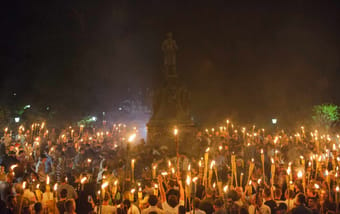
Will the US Move Toward “Demonstration Elections”?
If fascism—or even just an authoritarian regime—does happen here in November, it may look surprisingly familiar.
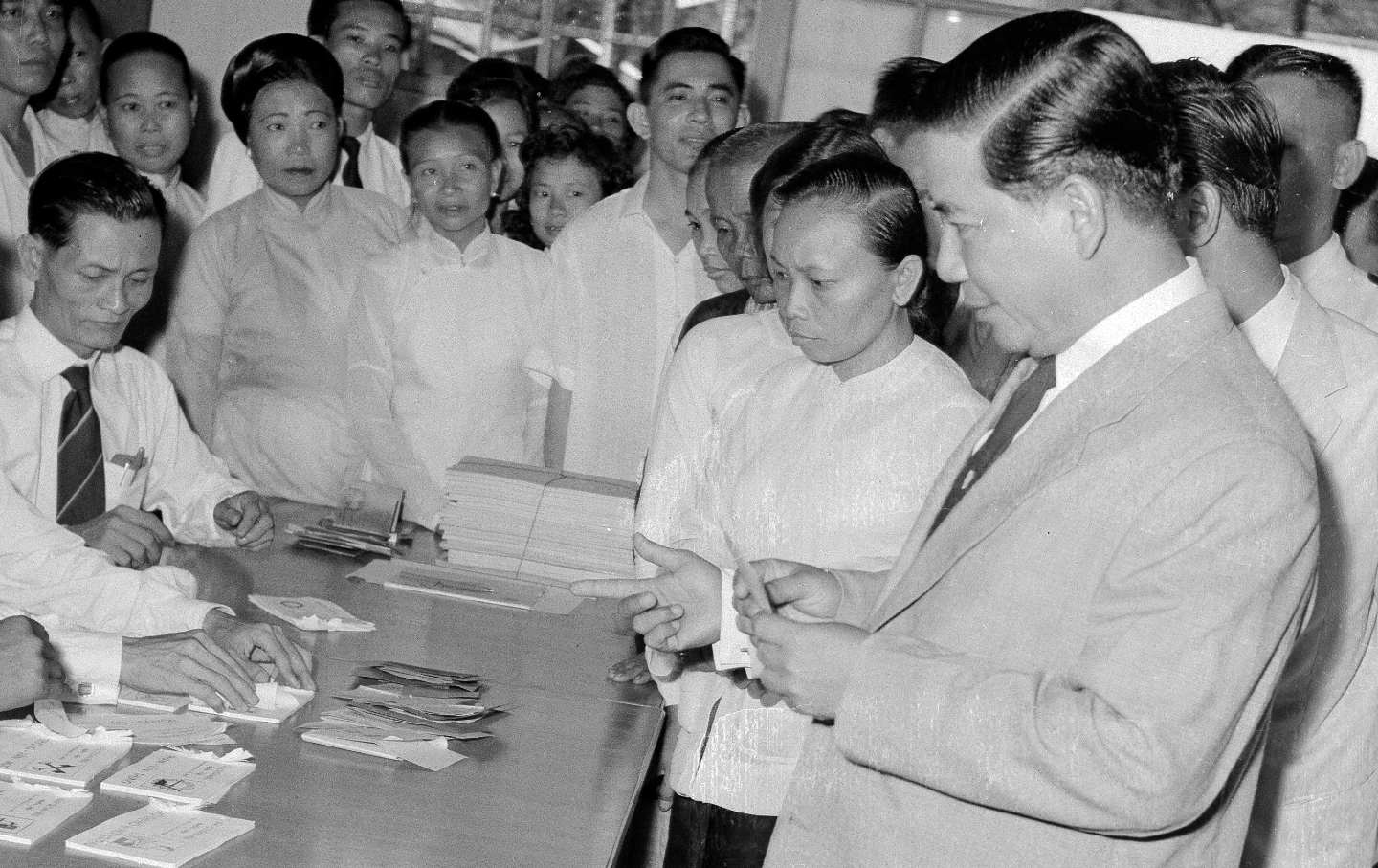
Forty years ago, in 1984, Edward S. Herman and Frank Brodhead published Demonstration Elections: U.S.-Staged Elections in the Dominican Republic, Vietnam and El Salvador. This influential book documented how American diplomats and CIA experts organized so-called “free elections” to legitimize Cold War counterinsurgency projects. As the authors noted, the primary audience for these spectacles were not the Vietnamese, Dominicans, or Salvadorans themselves, who of course knew perfectly well what was happening their countries, but US television audiences, journalists, and members of Congress back home.
Some of the time it worked. Joaquín Balaguer claimed victory in the Dominican Republic’s 1966 elections and stayed in power until 1978, while his death squads roamed at will. In 1967 General Nguyễn Văn Thiệu went from heading South Vietnam’s latest military junta to being “President Thieu” on nightly newscasts in the United States. The 1984 election of Christian Democrat José Napoleón Duarte in the midst of El Salvador’s civil war quieted congressional dissent over US military aid, although as president Duarte was incapable of curbing mass murders by the US-backed Salvadoran military.
A different kind of “demonstration election” has recently come to the fore, staged not by foreign powers but by domestic authoritarians in India, Turkey, Russia, Hungary, and elsewhere. This may be the future we face if Trump loses the popular vote on November 5 (as he undoubtedly will) but pulls out slim victories in enough states to take the Electoral College—or if the Republicans engage in outright violence and intimidation that allows them to “carry” states they actually lost to Biden. In many respects, the latter is already happening.
In a demonstration election, what matters are the visibility of certain tropes:
- They must be “multiparty,” in that opposition parties actually appear on the ballot—the more the merrier if one seeks to foster the illusion of genuine competition.
- They must appear to be “free,” producing many photos and videos of people lining up to vote without visible intimidation.
- The results must be sufficiently “contested” so that the opposition’s objections after their inevitable defeat makes them look like sore losers rather than players on a sharply tilted field—no Soviet-style 99 percent majorities, in other words.
This rigged, corrupted form of “democracy” is steadily expanding around us. Although their gerrymandering was just overturned by court order, since 2012 the Republicans controlling Wisconsin rigged their legislature to make it impossible for Democrats to win a majority. The Brennan Center for Justice’s latest report, “Growing Racial Disparities in Voter Turnout, 2008–2022” documents the ways “voter ID” laws, restrictions on when and where you can vote, and purges of voter rolls have significantly reduced turnout among voters of color, presumptive Democrats. And now, Trump has made an architect of the “fake electors” scheme in 2020, Christina Bobb, the chief counsel of the Republican National Committee.
If Trump wins, do not expect an old-style military coup. He will not immediately shut down the electoral process. The above criteria will be met (two-party competition, voting without overt violence, less-than-absolute majorities for Republicans) for some time to come. Democrats will continue to run, but the space in which they can win will get tighter and tighter. Certainly, The New York Times and The Washington Post will continue to publish, but their dissents and exposés will be increasingly irrelevant—shouting into a void. Protests will continue on the shrinking terrain of blue America; elsewhere, they will be severely restricted, and everywhere (including Democratic cities and states) police will “take the gloves off” with Trump’s enthusiastic support. Even if Democrats control Congress, a supine Supreme Court will ignore their complaints when Trump fires, jails, deports, indicts, and intimidates, using the panoply of federal power—the IRS, FBI, DOJ, Homeland Security, just to start—to go after his enemies. Even if the House impeaches him for a third time, why should he care, as a two-thirds vote of the Senate will remain an impossibility?
The current Supreme Court is likely to go along with whatever bald-faced violation of constitutional norms Trump orders his next vice president to perform when electoral votes are counted in January 2029. And maintaining “demonstration elections” is merely one component of the broader scheme for authoritarian rule.
The Heritage Foundation’s Project 2025 has produced a detailed 920-page plan, “Mandate for Leadership: The Conservative Promise,” to put the entire federal apparatus under direct White House control while gutting the regulatory state established in the late 19th and early 20th centuries.
The good news is that we are not there yet. SCOTUS and Trump-appointed federal judges still enforce the rule of law on occasion. Democrats win or run close races in red states. But it is high time to recognize that the United States is at a tipping point—roughly where Russia was 20 years ago, when Trump’s idol Vladimir Putin still had to overcome serious opposition, receiving 53 percent in his first election to Russia’s presidency in 2000. The slow slide into a system where one party dominates, allowing just enough dissent and (in a federal structure like ours) state and local autonomy, is advancing fast. In light of the obsequious toadying after Putin by the likes of Tucker Carlson and the reverential welcome given Viktor Orbán at the Conservative Political Action Conference (Hungary’s competitive authoritarianism is especially exemplary), there should be no doubt about what the MAGA right wants. Fundamentally more concerning is that “McConnell Republicans,” representing the corporate elite, are also quite willing to see a future where their perks and preferences are unassailable. In the long run of history, this power-play—to ensure “conservative” dominance regardless of majority sentiments at the ballot box—is likely to be seen as originating long before Donald Trump’s obsessive pursuit of power and revenge.
The United States met only the most basic definition of an electoral democracy (that all citizens can vote) in the presidential election of 1968, when implementation of the 1965 Voting Rights Act finally ended the deliberate legal disfranchisement of Black people from Virginia to Texas. Will it turn out that something like full democracy lasted just a half-century before the US turned back to oligarchic rule validated by demonstration elections? Will liberals, progressives, and leftists wake up and see the future before them? Time will tell. But if we don’t, history will not absolve us.
More from The Nation
Donald Trump Is Bad at Politics Donald Trump Is Bad at Politics
The president’s flailing midterms campaign underscores a truth we should be acknowledging more often: He kind of sucks at this.

Obama Delivers a Scorching Rebuke to Trump—and Centrist Dems Obama Delivers a Scorching Rebuke to Trump—and Centrist Dems
Unlike other establishment figures, the former president isn’t scared to associate with the party’s left flank.
Elon Musk’s Mortal Threat to Democracy Elon Musk’s Mortal Threat to Democracy
The world’s richest man—saying he’s “wised up” to the fiction of self-government—is leveraging his wealth to sway elections, threaten Congress, and alter the global balance of pow...

Michigan Students Are All In for Abdul El-Sayed Michigan Students Are All In for Abdul El-Sayed
The progressive Senate candidate has won over students with his politics—and, in at least one case, his protein intake.

What Are Democrats Prepared to Do if Trump Rigs the Election? What Are Democrats Prepared to Do if Trump Rigs the Election?
In this week’s Elie v. U.S, our justice correspondent challenges Democrats' lack of a plan if Trump steals the midterms. Plus: the most racist, and honest, AI add ever.