
In his first term, Donald Trump presided over perhaps the most brazenly plutocratic government the United States has ever seen, with the president proclaiming in 2016, regarding his cabinet picks: “I want people that made a fortune!” Forbes later noted that Trump’s cabinet included “17 millionaires, 2 centimillionaires and 1 billionaire. They’re worth $3.2 billion in all.” Just three of them were worth $3 billion combined: Education Secretary Betsy DeVos ($2 billion), Commerce Secretary Wilbur Ross ($600 million), and Treasury Secretary Steven Mnuchin ($400 million).
Trump’s return to the White House will be a reprise of this government of the rich and for the rich. Axios reports that “Trump will fill his top ranks with billionaires, former CEOs, tech leaders, and loyalists.” Trump’s top surrogate, Elon Musk, often listed as the richest man in the world, is being tapped to oversee the shrinking of the federal government. Tax cuts and deregulation are again the order of the day.
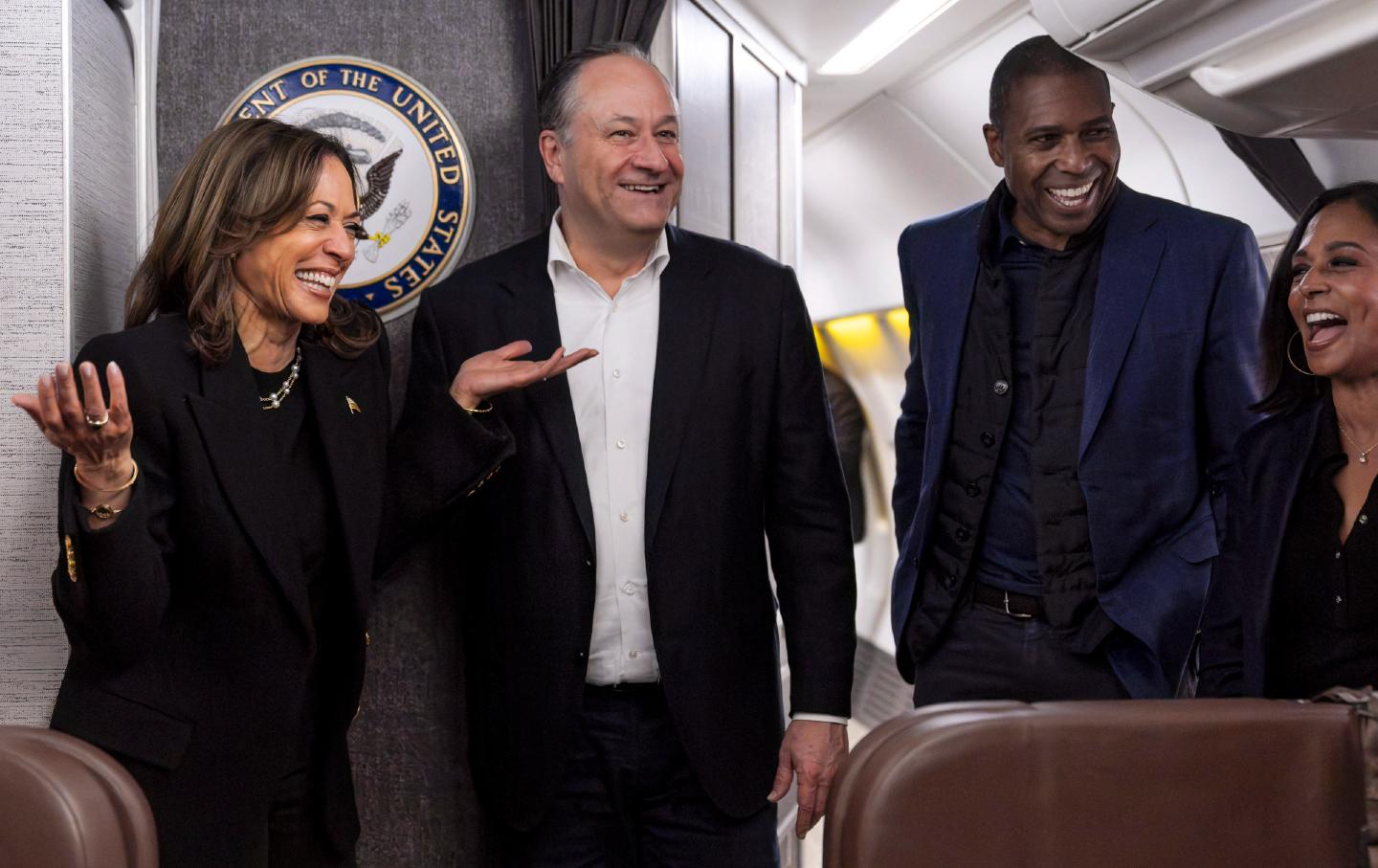
It’s both easy and accurate to describe Trump as a shameless plutocrat. But this tells only half the story. Trump wouldn’t have won the 2024 election if it weren’t for the fact that the Democrats have their own plutocrats—wealthy donors who sabotaged Kamala Harris’s presidential bid.
Big money has always spoken with a loud voice in American politics, but the problem has gotten much worse in the neoliberal era that began in the 1970s. Abetted by the decline of labor unions and court decisions weakening restrictions on campaign spending, both political parties have become increasingly beholden to wealthy donors. The result has been particularly disastrous for the Democrats as they became a pale imitation of the Republicans—and suffered a steady erosion of support from working-class voters.
The Democrats did have a real chance to break from the neoliberal era after the unexpectedly robust support Bernie Sanders received in 2016 and 2020—both of his campaigns were financed almost entirely by small donors. Sanders lost the nominations, but his model of politics remade the Democratic Party. President Joe Biden, who governed in close consultation with Sanders on domestic matters, inaugurated the most ambitious program of government expansion since the 1960s.
But once Biden withdrew from the race on July 21 and Harris became the presumptive Democratic nominee, big donors saw a chance to launch a counterrevolution. Campaign contributions had dried up in the weeks before Biden’s withdrawal—and the Democrats had to catch up fast. This made the Harris campaign vulnerable to the whisperings of the party’s moneybags.
As Franklin Foer reported in The Atlantic, Harris initially continued running as an economic populist—a theme Biden had emphasized in a bid to rescue his failing political fortunes—but this shifted once the campaign started listening to wealthy donors, who had an inside lane via Tony West, Uber’s chief legal officer (and also Harris’s brother-in-law). “Then, quite suddenly, this strain of populism disappeared,” Foer wrote. “To win the support of CEOs, Harris jettisoned a strong argument that deflected attention from one of her weakest issues. Instead, the campaign elevated Mark Cuban as one of its chief surrogates, the very sort of rich guy she had recently attacked.”
This account parallels a New York Times report from October documenting how Cuban had repeatedly blunted and sabotaged economic populism in the Harris campaign. Cuban bragged that he had sent her campaign “a never-ending stream of texts and calls and emails,” and “in all those areas I’ve seen something pop into her speech at some level.”
In August, Harris said she would crack down on “price gouging” for groceries. According to the Times, “Some of Ms. Harris’s donors warned campaign advisers against such a ban, arguing that it would amount to counterproductive price controls…. [Her] team clarified that the plan would apply only during emergencies and would mirror laws already in place in many states—a narrower concept that would not immediately address rising grocery prices…. The price-gouging touched on a broader anxiety among Ms. Harris’s corporate allies, who were worried that her economic policies might cater to the progressive wing of the Democratic Party.”
Cuban himself boasted: “People are trying to say, ‘Here are the progressive and liberal principles that have always been the principles of the Democratic Party.’ Those are gone. It’s Kamala Harris’s party now.” In September, Cuban went on the CNBC show Squawk Box and flatly dismissed a proposed tax on the rich that both Biden and Harris supported, stating, “Every conversation I’ve had is that it’s not going to happen.”
Harris did feature an economic populist message in ads that ran in swing states. But with Cuban as a key surrogate, there was little reason for voters to take her claims to populism seriously.
The elevation of a retrograde figure like Cuban was of a piece with the Harris campaign’s desperate courting of Republican voters, and with the way Harris repeatedly praised Liz Cheney and her father, former vice president Dick Cheney. As a strategy, this solicitude toward anti-Trump Republicans was a total flop. Not only did it fail to gain any significant Republican support, but it also arguably contributed to a demobilization of the Democrats’ base, doing nothing to stem the party’s long-term bleeding of working-class voters.
Harris might have won if she had run a vigorous campaign against Trump’s plutocracy. Instead, she undermined her credibility by relying so heavily on donations and advice from her own plutocrats.
More from
Jeet Heer 
Trump and Netanyahu Want to Turn Iran Into a Failed State Trump and Netanyahu Want to Turn Iran Into a Failed State
This war looks designed to cause maximum chaos and instability. The world will pay a high price.
The State of the Union Will Be Even Worse Than Trump’s Polling Numbers The State of the Union Will Be Even Worse Than Trump’s Polling Numbers
What’s a flopping demagogue to do? Lash out at his enemies, pretend he’s doing great, and bore us all into submission.
Trump’s Iran War Could Be an Even Bigger Catastrophe Than Iraq Trump’s Iran War Could Be an Even Bigger Catastrophe Than Iraq
Remarkably, Trump seems on the verge of outdoing George W. Bush in reckless, stupid militarism.
Why Trump Is Trying to Steal Jesse Jackson’s Glory Why Trump Is Trying to Steal Jesse Jackson’s Glory
The president wants you to know he had a Black friend, sort of.
From Epstein to Bezos, the Ruling Class Is Rotten to the Core From Epstein to Bezos, the Ruling Class Is Rotten to the Core
Let this week be yet another reminder that plutocrats are a threat to democracy, not its saviors.
How Trump Became the Biggest Crook in the History of Democracy How Trump Became the Biggest Crook in the History of Democracy
The penny-ante bribes of his first term have given way to billions in graft.

