
What Happened to the Democratic Party?
The squalid state of our present political institutions points to a failure of not just individuals but the system as a whole.
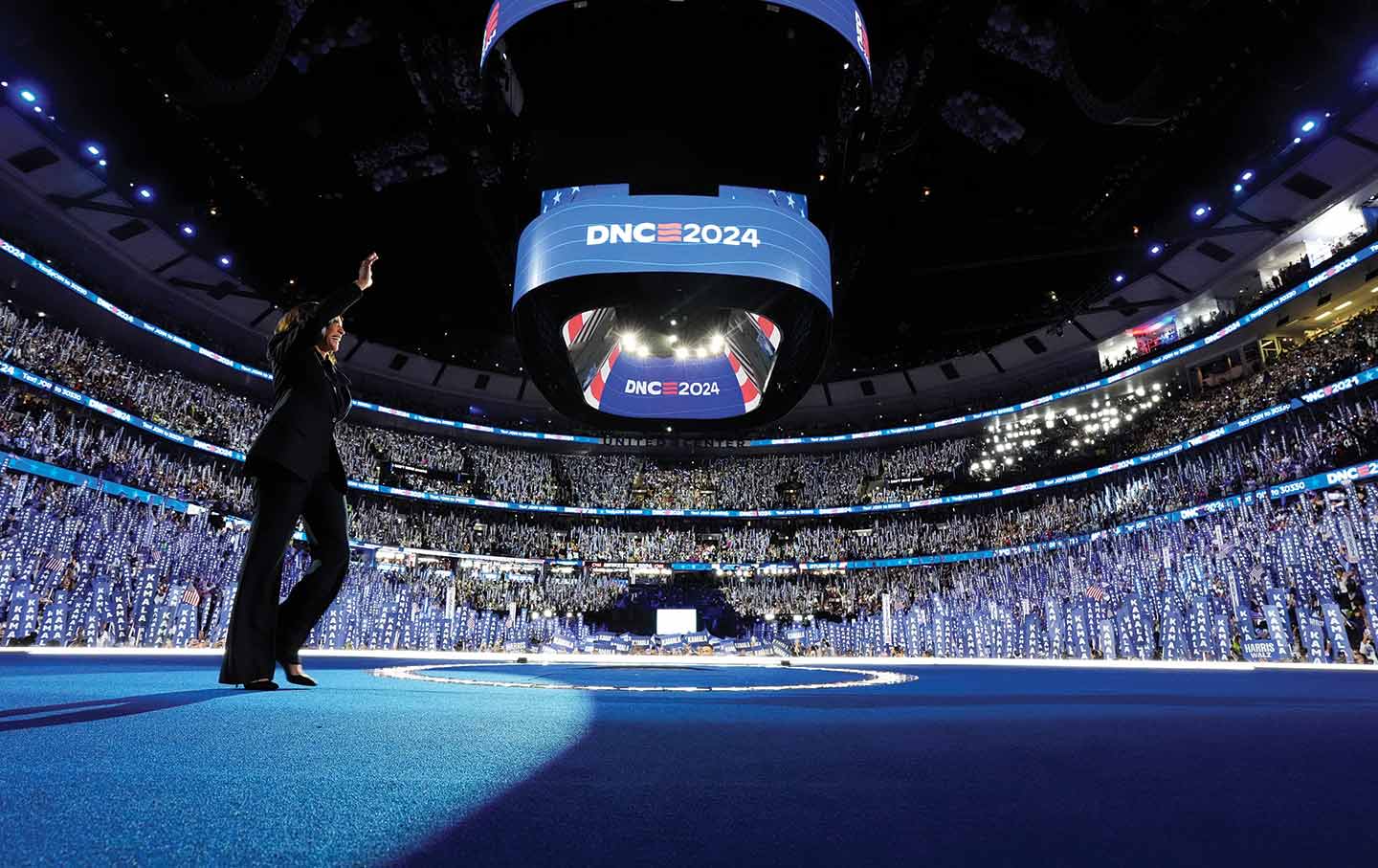
Kamala Harris at the 2024 Democratic National Convention.
(Kent Nishimura / Getty images)
With all eyes on the outcome of the 2024 presidential election, it’s been easy to overlook or downplay the many signs of acute decline in American politics. Donald Trump’s victory is still sending shockwaves through the established political system, so it’s tempting to dismiss his deranged decade-long reign on the right as an aberration, born of incoherent moral panics, misplaced economic anxiety, and declining media literacy. But in reality, the Trump distemper never existed in isolation. It was a fundamental expression of a host of unresolved pathologies—many within the Democratic Party, too—and not an inexplicable detour from a serenely ordered status quo.
The final count shows that Trump again came up short of a majority of the popular vote. Still, it never should have been this close. Throughout his campaign, Donald Trump and the Republicans told us exactly who they are. They pledged to wreak vengeance on their political enemies, to create a new counter-federalist brigade of brownshirts to initiate mass deportations, to bomb Iran to smithereens, and to establish an interstate menstrual surveillance regime. Trump barked out random non sequiturs about windmills and Hannibal Lecter and bobbed silently to schlock-heavy playlists. He dogmatically asserted his faith in tariffs and their ability to magically eliminate inequality and create mass prosperity, even if they would do the opposite. And yet Kamala Harris and the Democrats struggled to mount a successful opposition. Harris refused to separate herself from Joe Biden’s unconscionable support for genocide in Gaza, and she put forward an economic platform that often devolved into a standard litany of milquetoast measures to uphold a starkly unequal status quo—from her squishiness on antitrust enforcement to her pandering to the crypto industry.
Books in review
-
Left Adrift: What Happened to Liberal Politics
Buy this book -
The Hollow Parties: The Many Pasts and Disordered Present of America’s Political Parties
Buy this book
Where did the national political machine (and its operators and strategists) that was once called the Democratic Party go? How did it become so fangless in the face of a presidential candidate so clearly ill-equipped for the presidency? For that matter, where was the Republican Party that might have prevented Trump’s third run for the White House? Even as some of its name-brand leaders have broken from Trump, the party remained wedded to a MAGA path to power.
Any party system that can so easily be throttled—and for so long—by an unscrupulous and self-interested demagogue is far from the picture of health. If anything, the squalid state of our present political institutions points to a failure of not just individuals but the system as a whole.
Two new books make this crisis of institutional atrophy and ideological entropy their central theme. In Left Adrift, the historian Timothy Shenk chronicles the Democratic Party’s path to a working-class dealignment—perhaps the single greatest demographic shift that sparked the rise of Trumpism as a bogus brand of right-wing “populism.” Meanwhile, in The Hollow Parties, the political scientists Daniel Schlozman and Sam Rosenfeld examine the broader drift of both major parties from their traditional mandates of building mass coalitions, promulgating policy agendas to serve their grassroots bases, and recruiting and cultivating leaders with material connections to those bases.
Both books ask how our political parties, which once represented somewhat coherent and wide-ranging coalitions and political ideas, morphed into zombie-like institutions that fundraise and battle over shrinking segments of the electorate while stage-managing random culture-war contretemps in each new election cycle. Both books also wonder if the return to an era of majoritarian party politics has become an unrealizable dream in the blighted 21st century.
To chronicle this saga, Left Adrift examines the careers of two data-driven political consultants in the Democratic establishment: poll savants Stanley Greenberg and Douglas Schoen. This choice of subjects furnishes one of the most direct answers to the book’s subtitle: “What Happened to Liberal Politics.” In past eras of modern liberalism’s history, the central protagonists would have been party leaders, such as Franklin Roosevelt or Lyndon Johnson, or pivotal movement figures, such as Sidney Hillman or Martin Luther King Jr. But in our own age of retreating governing ambitions and malleable party messaging, it makes a grim kind of sense to foreground the thinking of hired-gun political strategists like Greenberg and Schoen, who have played an outsize role in the steady miniaturization of our public life.
For Shenk, these two men—bitter rivals for clout and clients in the retooling Democratic Party of the Clinton era—understood better than many traditional New Dealers in the party’s leadership caste that a massive, if slow-moving, political realignment was under way: the party’s abandonment of its traditional working-class base and its embrace of a professional, highly educated elite. This turn to a new breed of voters—“Atari Democrats,” as the journalist Chris Matthews called them—marked an ideological transformation in the party as well as a social one: Democrats began to preach a gospel of cultural tolerance and demographic diversity, even as they broke from basic issues of economic fairness. The party’s activist base, now broadly maligned as a backward-looking congeries of “special interests,” were replaced by a cadre of Ivy Leaguers weaned on the fables of a new information economy and avowing a politics of free trade, cheap labor, and a financialized model of national prosperity.
Greenberg, who came of political age during Eugene McCarthy’s incendiary anti-war presidential campaign in 1968, accepted this political shift as it gained traction in the Reagan era. But he did so from a defensive posture, seeking to persuade candidates and clients to echo vintage Democratic populist appeals in a last-ditch bid to arrest the dealignment of working-class voters from the party. Meanwhile, Schoen, a scion of Manhattan privilege, cheerfully welcomed the shift as the new consensus delimiting future Democratic agendas, policy goals, and political campaigns.
Using data gleaned from polls, Greenberg laid out his case for a more social-democratic path to winning back the working-class and suburban “Reagan Democrats” who had helped deliver Ronald Reagan’s landslide victory in 1980. In a series of focus-group studies in the suburban Detroit communities of Macomb County, he found many of these voters still receptive to universalist appeals to economic fairness and social-democratic equality—but wary of the racialized remedies and social-engineering planks of the Great Society. Writing in The American Prospect in the early 1990s, Greenberg divined the lineaments of a new “mass party, encompassing the needs of the have-nots and working Americans,” even as Democratic leaders pursued the interests of a new base of professionals and suburbanites. What was needed, Greenberg argued, was a party that “can speak expansively of broad, cross-class issues, such as full employment, tax relief, and health care.” But for that message to come through loud and clear to its target voters, Democrats had to purge “the demons of the 1960s.” As Shenk sums up Greenberg’s prescription for a renewed majoritarian platform in the pinched realities of the Reagan era:
Disillusioned white voters would not listen to what Democrats had to say about economics until the party showed respect for their values. A shift to the center on polarizing social issues was the price of admission for resurrecting the New Deal coalition. [Greenberg] had seen time and again in his work that class wasn’t just a matter of economics. It was an identity, and a fragile one at that. Getting voters to hear its call required turning down the volume in the culture wars.
Greenberg’s analysis was steeped in the anxious postmortems that the party launched after Reagan’s powerful new coalition made strong inroads among Democrats in the 1980s. But the presuppositions behind his counsel reflected a constrained and fast-obsolescing view of working-class politics and interests—and even of who was and who was not in the working class. While plenty of white workers fit into the Macomb model, the country’s working class was also composed of many groups who benefited from the Great Society’s programs. Likewise, the work of the working class was shifting as the service economy grew; the financialization of key sectors caused wage and wealth inequality to spike; and rural Americans were laid low by the farm crisis—a calamity compounded by the deregulation of the savings-and-loan industry. These other constituencies—far more complex and diverse than the ones found in a place like Macomb County—loomed large in the Rev. Jesse Jackson’s insurgent presidential campaigns in 1984 and 1988. They also served as a reminder that Greenberg’s version of a retrenched New Deal politics risked overlooking the actual makeup of working-class America.
Schoen, for his part, had no misgivings about the party giving up on the working class, white or not. An early and enthusiastic adopter of Margaret Thatcher’s famous pronouncement on the neoliberal dispensation—“There is no alternative”—Schoen and his consulting partner, Mark Penn (who would later serve as chairman of Hillary Clinton’s disastrous 2008 presidential campaign), built up an influential and wildly profitable Beltway franchise for political and corporate clients that also advanced their own political preferences. As Shenk writes:
They began from the premise that Democrats were living in Reagan country. Polarization around hot-button social issues had killed off the FDR coalition, and no viable successor had emerged to replace it. In a 1986 op-ed for the New York Times, they announced that “an anti-New Deal consensus” had become the dominant force in American politics. Populist broadsides against Wall Street no longer moved the electorate. The only hope for Democrats was to “demonstrat[e] that they shared the Republicans’ basic positions on fiscal issues” and then pivot to “local issues and personality differences.”
Whether they embraced Greenberg’s more notionally populist stratagems or Schoen’s elite-minded appropriations of Reaganism, the Democrats began to rely more and more on their poll-driven counsel to craft their appeals to the electorate. The party also turned its back on many of the recipients of the Great Society programs who had made up much of its base: African Americans, urban Catholics, and working-class voters of all ethnic persuasions. In a long, painful series of right-leaning policy moves, from the embrace of NAFTA and free trade to the recursive racial posturing introduced in Bill Clinton’s dismal attack on the rapper Sistah Souljah, the party’s leading strategists told each other that the constituencies they alienated weren’t going to go anywhere. The operative slogan among Democratic campaign professionals was “What are they going to do, vote Republican?” It was a plausible-sounding alibi, until that was just what happened.
Meanwhile, class dealignment continued at a prodigious pace during Clinton’s two terms in the White House. Greenberg charted this baleful process closely, but he was largely left exhorting Democratic campaign gurus from the sidelines as Schoen and Penn’s argument won the day and Clintonite neoliberalism became the party’s savvy insider consensus. As the 2016 Trump campaign drew greater and greater support from disenchanted white working-class voters, Greenberg told John Podesta, the head of Hillary Clinton’s campaign that year, “You sound clueless in blue-collar America,” and later announced in The American Prospect that “the Obama years were the critical juncture when Democratic leaders stopped seeing the working class.” As Shenk observes, “Bill Clinton had managed to hold off the shift in the 1990s, but a gap had opened after his presidency that turned into a chasm in 2016.”
Even as the Democrats continued to lose more and more of the working class, Shenk tracks how the Greenberg-Schoen battle went abroad. The consultants’ own practices became global as they took on electoral clients in Israel (Labor and Kadima leader Shimon Peres and his embattled successor, Ehud Barak), Britain (New Labour’s lead apostle Tony Blair), and South Africa—where Greenberg worked with African National Congress leader Nelson Mandela and his successor, Thabo Mbeki, before defecting in the face of mounting ANC corruption and ruling-class complacency to represent the first Black candidate fielded by the country’s traditional white rival party, Democratic Alliance.
This narrative makes up the latter half of Left Adrift, but it’s not entirely clear how the erratic fortunes of American consultants abroad played a role in the otherwise organic and variegated global rise of neoliberalism, or how this right-leaning retrenchment shaped today’s burgeoning post-liberal and pseudo-populist reactionary politics. And it is at this point in Left Adrift that Shenk’s otherwise deft and nuanced narrative shows the limits of adopting a consultants-first account of political change. For both Greenberg and Schoen are, by professional definition, trailing indicators of larger political currents. Even when they avow divergent positions of principle, they are still just managing their candidates’ messages in a political environment outside of their control. It’s true that their quarrels over Democratic strategy in many ways distilled and focused a key pivot point in the party’s neoliberal makeover, but the stakes of the fight were necessarily inhibited by the passing perceptions designed to drive short-term electoral results in far-flung settings—so much so that it’s difficult to affix a clear takeaway from a class-versus-culture donnybrook in which, as Shenk writes early on, “both sides lost.”
Indeed, the terms of engagement in this war come off as more an exercise in impression management than the mobilization of history-shaping new majoritarian coalitions: “Where Greenberg’s clients traded in a soft populism, Schoen’s talked about finding unity,” Shenk notes. Under that soft-focus set of overlapping mandates, it’s no wonder that both consultancies took in a vast retinue of political clients in global political markets together with a numbing litany of corporate customers. It’s also no wonder that both camps produced similarly inert book-length broadsides—ranging from Mark Penn’s stunningly banal anatomy of a brand-infested American electorate in his coauthored 2007 manifesto Microtrends to Greenberg’s 2004 Two Americas, a red-and-blue Mad Libs account of voter behavior hinging on a wholly bastardized version of culturalized “populism” that’s all but indistinguishable from Penn’s maunderings.
This is not to say that Shenk’s close dissection of the Greenberg-Schoen wars does not shed important light on how basic precepts of class politics and cultural messaging took shape at a critical moment in Democratic politics. It is, however, to suggest that consultancy takes one only so far in puzzling out the abiding ills of contemporary liberalism—in the United States and elsewhere.
For a broader analysis of our political distemper, Daniel Schlozman and Sam Rosenfeld chart the decline of robust and principled ideological sorting across American history in The Hollow Parties. Their chronology of the breakdown of party-driven politics identifies six interwoven “strands” of party operation that have shaped mass political thinking and behavior in often overlapping and unpredictable ways. The first is the “accommodationist” strand, which focused on political victories and displayed only an erratic interest in ideological discipline. The second is the “anti-party” strand, which functioned largely to trim back the excesses of the accommodationists and produced a series of good-government Progressive-era reforms such as the ballot initiative, voter recalls, and the popular election of US senators. The third is the “pro-capital” strand, which, unsurprisingly, advanced the interests of bosses and owners at the expense of workers. The fourth is the “policy-reform” tradition, which provided, the authors argue, a working synthesis with accommodationism and was usually marshaled by insiders agitating for reform. The fifth is the “radical” strand, which seeks to exert wider and deeper social change from an Archimedean point outside of party protocols and mores. Finally, the sixth is the “populist” strand, which needs little introduction to followers of today’s politics: It is, Schlozman and Rosenfeld write, less “a cohesive approach to party politics than a set of recurring tendencies and resonances” that pit a clueless yet dangerous set of out-of-touch elites against a virtuous, misunderstood, and voiceless group of aggrieved and insurgent citizens often represented by a Great Leader figure.
This array of categories can strike historically minded readers as overly schematic; Schlozman and Rosenfeld’s model of populism, in particular, suffers from the same caricature-prone reductionism that is seemingly endemic among political scientists. Yet in the main, this schema helps to sort out the episodic and errant character of party formation and deformation, and the bulk of The Hollow Parties is taken up with an engaging and perceptive historical account of how parties have navigated the obstacles thrown up by these competing strands.
Beginning with the second party system of antebellum America, Schlozman and Rosenfeld examine the ways in which the Whig and Democratic parties functioned not merely as electoral machines, but as forces of robust civic engagement. In the torchlight parades and debate forums of this first age of mass politics in America, political leaders began to harness the means of mobilizing and reimagining the American nation, from new personality-centered mass campaigns to the rise of ethnic party machines in major cities. These efforts were bound by racial and gender exclusions and widespread religious animus, particularly against Catholic immigrants.
Nonetheless, they created a new understanding of the public sphere and its character and reach. The ballot itself was perhaps the most potent symbol of this transformation—a party-brokered means of political identification that overtook the older tradition of voice voting in the early Republic:
Popular
“swipe left below to view more authors”Swipe →Campaign hoopla and press broadsides were but tools in service of the ultimate goal: corralling men to the polls on Election Day to vote the party ticket. As the printed ballot supplanted the old practices of voice voting during those years, it transformed the entire electoral system. Parties, not any arm of the state, printed and distributed the ballots, which listed party candidates for every level of office, often accompanied by patriotic motifs. At the frequently raucous polling place, voters took tickets from watchful party agents, and then deposited them into the ballot box. This system required vast outlays of labor and resources to ensure that every voter got his ticket. And as a matter of strategy, it pushed parties toward all-out mobilization of loyalists more than candidate- or policy-specific campaigns of persuasion.
The second party system came asunder due to the conjoined issues of slavery and the sectional crisis, but its underlying structure continued amid the crisis of the Civil War, and it indeed proved pivotal in producing the Reconstruction amendments that belatedly sought to expand the basic terms of citizenship and political participation to nonwhite Americans. However, the retreat from Radical Republicanism yielded a debilitating moment of impasse in the rise of the third party system—one that anticipates the hollowing-out of today’s party politics:
As Republicans marshaled the resources of state and society behind their project, they cast aside long-held rules of the game and cast aspersions on their opponents’ regime loyalties. In turn, their Unionist opponents in the North—both Democrats and, much more softly, moderate Republicans—deployed language about the limits of politics that would be familiar to those warning today’s insurgents against flying too close to the sun. Likewise, conservative Unionists then, like centrist institutionalists now, touted small-party politics as an antidote to extremism.
Perhaps ominously for today’s scattered forces of small-d democratic reform, Redemption politics provided the new fulcrum for the parties’ balancing act—one that continued to serve the parties well through most of the 20th century, as the “anti-party” (yet paradoxically bipartisan) ethos of Progressive reform succumbed to the GOP’s “pro-capital” reign in the 1920s on through to the New Deal and the Great Society, which deftly incorporated elements of all the party strands during their nearly half-century run.
But during the 1970s, the collaboration between different party strands started to unravel rapidly under the pressures of stagflation, internal party dissension, and the broader breakdown of Keynesian consensus in the political economy.
This fragmentation within society more generally triggered vastly divergent reactions within the Republican and Democratic parties. For conservatives, it spurred the rise of what Schlozman and Rosenfeld call “the long New Right”—a fierce repudiation of the business-establishment proceduralism favored by GOP leaders that produced the cascading revolutions of Reaganism, Gingrichism, and Trumpism over the past 40 years. Partisans of the waning liberal consensus, meanwhile, retreated into acute uncertainty and second-guessing; the authors label the Democrats of this era practitioners of a “politics of listlessness.” The Democratic Party retained the hierarchy of local and state chieftains it had built during its accommodationist heyday, but it was operating in both an ideological and an economic vacuum.
What took place in this period of institutional breakdown was a hollowing-out of the party system. The toxic compound of ideological drift and errant attention to basic accommodationist party functions steered more and more power into the hands of party elites, who scorned and sidestepped the demands of the party’s traditional working-class base. “Old commitments to what a young Tip O’Neill encapsulated as ‘wages and work’ receded,” Schlozman and Rosenfeld write; in their place emerged the sort of policy agenda and numbing finance jargon preferred by investors and donors: “Democrats resisted big-ticket programs in favor of public-private partnerships, incentives delivered through the tax code, and fiscal rectitude to slay the beast of the budget deficit.”
In addition to offering a broader account of party decline, Schlozman and Rosenfeld help flesh out the background of the internecine consultant wars that propel Shenk’s narrative; indeed, in one telling anecdote from the Obama years, The Hollow Parties demonstrates just how far the New Deal party that had produced Tip O’Neill had gone through the looking glass:
More than cultivating constituencies, the Obama operation attended to the president’s image, measured by public opinion. When Obama was debating a rescue for the auto industry—a latter-day version of the Chrysler bailout that had so bothered the [Atari Democrats]—his chief strategist, David Axelrod, did not list the players on each side or remind his boss of the contributions of the UAW to Democratic victories. Instead, he pointed to polling: even in Michigan, voters told pollsters they hated bailouts. A decision that reaped political benefits across the Midwest in 2012 came about because Obama overruled his chief strategist.
It’s sobering, to put it mildly, that the central policy decision that likely shored up the crucial “blue wall” in the upper Midwest for Obama’s reelection happened only when the incumbent president took it upon himself to disregard the counsel of a party blob that had grown indifferent, if not hostile, to maintaining a functional party base—that is to say, the fundamental work of politics. And it’s beyond sobering to be reminded how gleefully cavalier Hillary Clinton’s own retinue of super-wonk advisers were in following the broad thrust of Axelrod’s advice in the next cycle, with the disastrous consequence of Trump’s election.
While Democratic leaders fled from their base constituencies in a listless herd, Republicans embarked on a politics of militant base appeasement. This also entailed a hollowing-out process, but one of a far different order than what the Democrats experienced. Where the Democrats increasingly relied on centrist-minded consultants, pollsters, and donors while preserving a rigidly impervious gerontocracy atop the party, the Republicans handed the levers of power over to radicalizing forces within the Tea Party and the Fox News messaging empire.
In this no-holds-barred environment that Schlozman and Rosenfeld call “politics without guardrails,” traditional party leaders—most notably GOP House speakers—came under fire from the party’s grievance-driven base for ideologically deviationist tendencies and accommodationist RINOism, which got them ritually purged. Meanwhile, the party’s base embraced an overt counter-majoritarian, election-denying lurch into authoritarian rule, driven by the dogmatic certainty that “the excesses of liberalism demand maximum response given the existential peril.” Even after this ethos precipitated the coup attempt of January 6—something that, in any healthy democracy, would have resulted in the permanent political exile of Trump and his enablers—the MAGA-fied GOP was still a potent mass political movement, largely because it had positioned itself to feed on the chief organizing weaknesses of the listless Democratic opposition. As Schlozman and Rosenfeld observe:
The same Republican Party, supposedly coming apart at the seams and described by normally even-keeled elites as an outright threat to democracy, remained a viable electoral force…. Amid the eroding pillars of class, ethnic, and partisan loyalty that had long undergirded Democratic support, Republicans took advantage of new opportunities. Their repertory of appeals, often cheekily deploying in-group idioms, expanded beyond the arid, up-from-the-bootstraps narrative of success that had dominated the party’s approach for decades.
Schlozman and Rosenfeld try, in the book’s closing chapter, to sketch a path forward for the renewal of the Democratic Party. They note how the Nevada Democrats have once more become a vital source of organizing and a training ground for reform-minded leaders, largely on the strength of their ties to the state’s burgeoning union movement. Yet the broader forces of listlessness remain very much in play for national Democratic leaders, who continue to bypass urgent in-house structural overhauls in favor of “a fetish for process reforms that prize deliberation and information—often laced with the self-righteous implication that all will be well if only the ‘correct’ facts could flow to the unenlightened.”
This tendency suffuses many big-ticket Democratic appeals to the electorate, from the involuted goo-goo crusades against “misinformation” to what the authors call “a kind of politics as performative consumption” within the vast, self-congratulatory liberal mediasphere. The prospects for renewal are bleaker still for a GOP that has followed its trademark resentments beyond the reach of formal democracy; here the authors’ prescriptions come across as pure wish-fulfillment fantasy. “The congressional party would have the capacity to meet the challenge of governing”—here, I wrote an all-caps “HAH!” in the margin of my review copy. “And its party program would emphasize strengthening the frayed bonds of family and civil society and encourage a patriotism that steers clear of racial and ethnic nationalism,” they continue, prompting me to scrawl “On what planet, exactly?” in the cluttered book margin.
Still, Schlozman and Rosenfeld are right that any hope of reclaiming a viable small-d democratic politics from our era of authoritarian reaction and gladiatorial culture warfare does entail a ground-up reinvention of the hollow and unresponsive party system that we have come to wearily endure. With the outcome of yet another grinding, exasperating, and soul-deadening election cycle that has accelerated our descent into authoritarian squalor, the real work of politics has to begin in earnest. Let us pray, and be anything but listless. Oh, and don’t mourn—organize.
Support independent journalism that does not fall in line
Even before February 28, the reasons for Donald Trump’s imploding approval rating were abundantly clear: untrammeled corruption and personal enrichment to the tune of billions of dollars during an affordability crisis, a foreign policy guided only by his own derelict sense of morality, and the deployment of a murderous campaign of occupation, detention, and deportation on American streets.
Now an undeclared, unauthorized, unpopular, and unconstitutional war of aggression against Iran has spread like wildfire through the region and into Europe. A new “forever war”—with an ever-increasing likelihood of American troops on the ground—may very well be upon us.
As we’ve seen over and over, this administration uses lies, misdirection, and attempts to flood the zone to justify its abuses of power at home and abroad. Just as Trump, Marco Rubio, and Pete Hegseth offer erratic and contradictory rationales for the attacks on Iran, the administration is also spreading the lie that the upcoming midterm elections are under threat from noncitizens on voter rolls. When these lies go unchecked, they become the basis for further authoritarian encroachment and war.
In these dark times, independent journalism is uniquely able to uncover the falsehoods that threaten our republic—and civilians around the world—and shine a bright light on the truth.
The Nation’s experienced team of writers, editors, and fact-checkers understands the scale of what we’re up against and the urgency with which we have to act. That’s why we’re publishing critical reporting and analysis of the war on Iran, ICE violence at home, new forms of voter suppression emerging in the courts, and much more.
But this journalism is possible only with your support.
This March, The Nation needs to raise $50,000 to ensure that we have the resources for reporting and analysis that sets the record straight and empowers people of conscience to organize. Will you donate today?
More from The Nation
Celebrate Kristi Noem’s Firing. But Keep Protesting ICE. Celebrate Kristi Noem’s Firing. But Keep Protesting ICE.
Finally, someone in the administration is paying for their cruelty and incompetence.
We Don’t Need an Autopsy to Tell Us the Democrats Failed on Gaza We Don’t Need an Autopsy to Tell Us the Democrats Failed on Gaza
The DNC is allegedly hiding a report showing that Kamala Harris’s Gaza policy helped cost her the 2024 election. But that report won’t tell us anything we don’t already know.
Texas’s Senate Primary Has Already Made History—and It’s Not Over Yet Texas’s Senate Primary Has Already Made History—and It’s Not Over Yet
Democratic nominee James Talarico is getting national media attention, but the real story is sky-high voter turnout, even amid GOP bids to suppress balloting
Quilted Messages Quilted Messages
Sunbonnets carrying not-so-sunny truths.
How the Theatrics of Mamdani’s Trump Meeting Backfired How the Theatrics of Mamdani’s Trump Meeting Backfired
By pandering to the president’s vanity, the New York mayor reinforced Trump’s image as a strongman commanding deference—an especially bad look on the eve of Trump’s war with Iran

Students in New York Are Going Hungry. How Can Mamdani Help? Students in New York Are Going Hungry. How Can Mamdani Help?
With plans for city-owned grocery stores and a focus on affordability, the new mayoral administration offers fresh hopes of successfully confronting the food crisis among students...

