The Unfathomable Toll of the Syrian Civil War
How to make sense of the 13-year conflict?
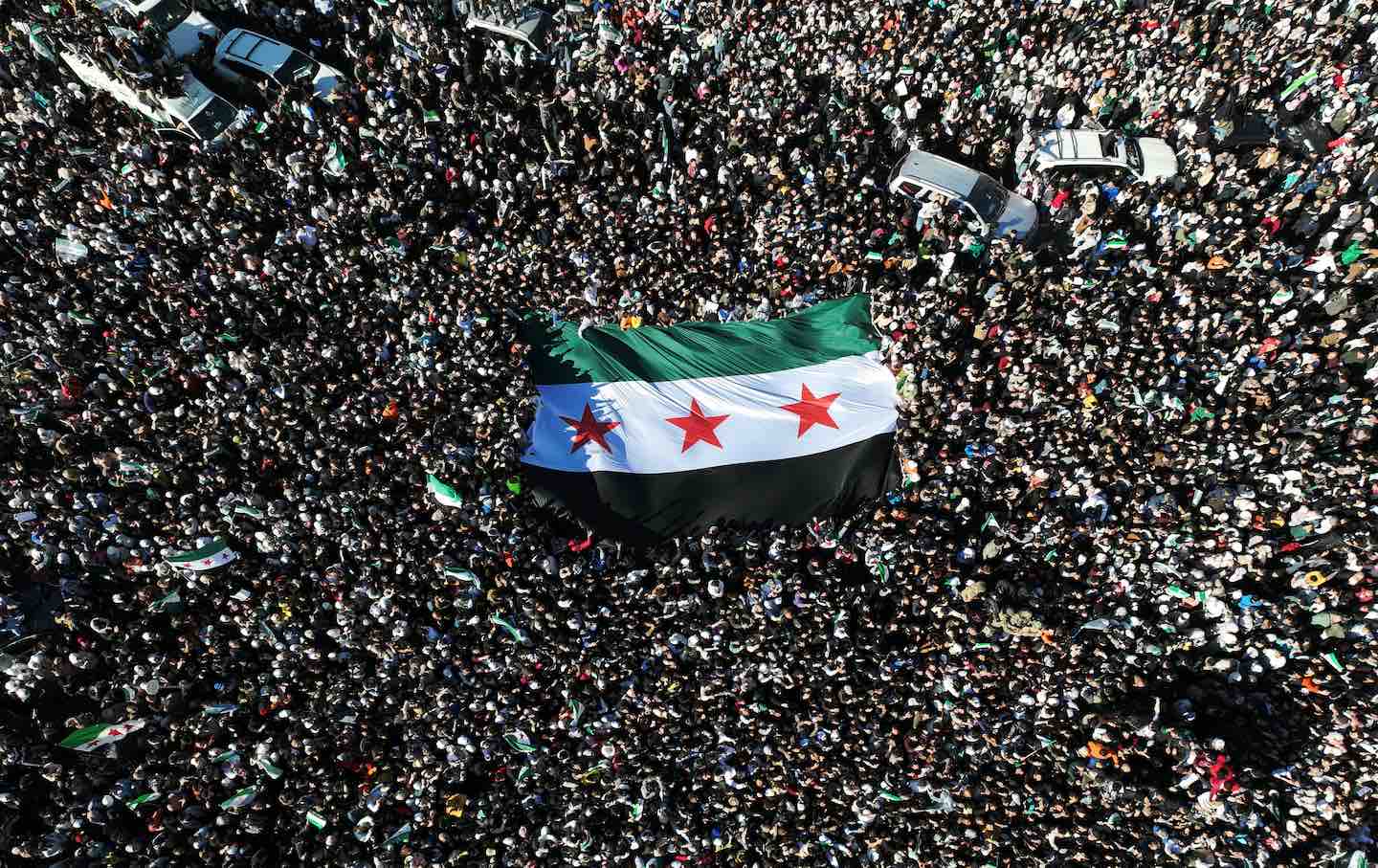
An aerial photo shows crowds of Syrians raising a giant independence-era flag, used by the opposition since the uprising began in 2011, as they celebrate the fall of Bashar al-Assad’s rule earlier this week at the central Umayyad Square in Damascus on 2024.
(Omar Haj Kadour / AFP via Getty Images)This essay is adapted from Days of Love and Rage: A Story of Ordinary People Forging a Revolution (Simon & Schuster).
No one knows how many people were killed in Syria during the civil war. Local human rights organizations estimate that, by mid-2013, more than one hundred thousand people died, a figure that is almost certainly a gross undercount. Most of the dead were likely civilians, the vast majority killed by the Assad regime and its allies. The killing was targeted and systematic, a government policy designed to quell the rebellion.
This slaughter came in three forms. There was the house-to-house variety, the hulking men in bandoliers burning people alive, raping women—of which there exist many recorded instances, like Monk Farm in 2013, spanning multiple provinces. Such massacres require boots on the ground, though, which proved a challenge for the regime when swathes of the country fell under rebel control. So the second variety of killing came from bombers and helicopters; in some corners of Syria, bombing raids became so common-place that locals, upon overcoming the shock that their own government was dropping explosives on them, cobbled together an early-warning system for approaching aircraft by stationing spotters near air bases.
The third mode of death occurred in the dozens of detention centers strung across the country, some no larger than a few cells, others housed in sprawling military compounds. We know something of the inner workings of such repression due to regime defectors, who smuggled tens of thousands of government documents out of Syria. These files, which include communiqués between branches of the security services, detail a govern-ment policy, drawn up in 2011, to crush the protests by targeting categories of people, such as demonstration organizers and those who “tarnish the image of Syria in the foreign media.”
It’s unclear how many people passed through this gulag archipelago, though some estimates suggest over one hundred thousand. In the early days, most detainees were released after confessing under torture, but as the rebellion spread, the torture grew more sadistic, and growing numbers of prisoners never returned home.
The regime catalogued these deaths, photographing the corpses, presumably so jailers could report their progress to superiors. In August 2013, an employee at Military Hospital 601 in Damascus, code-named Caesar, stuffed into his socks flash drives containing nearly fifty thousand images of bodies and fled the country. Caesar’s photos provide the clearest evidence of the charnel house that was the Syrian prison system: naked corpses, faces battered beyond recognition, eyes gouged. The victims showed signs of severe malnutrition, their skin furrowed at the rib cage, limbs like twigs. They lay with an alien grimace, in the ghastly repose of the dead of a concentration camp.
For many Syrians, the scale of the horror unfolding in their country, orchestrated by such cold bureaucratic machinery, conjured one word: genocide. Yet according to the Genocide Convention of 1948, that word refers to the “intent to destroy, in whole or part, a national, ethnical, racial or religious group.” Under these terms, the slaughter in Syria cannot be classed as a genocide; while many of the dead were Sunni Muslims, the government was clearly targeting anyone who opposed it, regardless of religion. To muddy things further, you could find Sunni Muslims in the regime’s army and among Assad’s supporters. But if the Syrian government’s campaign of mass slaughter was not, legally speaking, a genocide, that may tell us more about our Western moral categories than it does about the devastation in Syria.
The concept of genocide arose following the horrors of World War II—it provides a moral compass of sorts, a standard against which we judge right and wrong. We see genocide as the “crime of crimes,” the greatest possible injustice humans can inflict upon each other. Genocide is, for the secular West, the hallmark of “evil.” What makes genocide evil? Industrial-scale slaughter is not enough; recent history is filled with grisly examples—such as General Suharto’s mass killing of leftists in Indonesia—that do not rise to the conventional designation of genocide. Rather, what gives genocide its distinctive moral cast is that people are targeted merely for the ethnic or religious group to which they happen to belong. That is, people are targeted for something they did not choose, something they have no control over.
International law, then, does not consider the slaughter in Syria a genocide, because people were primarily targeted primarily for their political activity—something we normally understand as resulting from free choice. After all, no one forced protesters to organize against the dictatorship, eventually resulting in revolution. But putting it this way seems to miss something important about the human condition. What if engaging in political activity is an essential exercise of our humanity, and to obtain the things we need to live a good life, we have no choice but to be political?
We tend to associate politics with the undertakings of political parties, which has made politics something of a dirty word: think of the hollow pageantry, the dissimulation, the greased palms, the horse-trading, the crass maneuvers of special interests. Politics, in this conception, happens behind closed doors; it involves scheming over the heads of ordinary people. It’s no wonder that, given such a cynical kabuki, most of us want little to do with politics. The ancient Greeks, though, viewed the matter quite differently. Because we live in community with others, we can only obtain the things we desire through others. If we are powerful or wealthy, we can simply command others to do our bidding. But if we aren’t, then we must coordinate, cooperate, cajole, and com-promise with others. So politics, for the ancient Greeks, is the art of forming alliances to obtain the goods of collective life. It’s what happens when neighbors organize a community garden, when parents band together to contest a school board election, when workers strike for better wages. Aristotle wrote, “The man who is isolated—who is unable to share in the benefits of political association, or has no need to share because he is already self-sufficient…must be either a beast or a god.” From this, he concluded that the human “is by nature a political animal.” He means that we cannot achieve our aims alone, that we must act collectively—and when we are inhibited from doing so, we have lost an essential part of our humanity.
There are many ways to stifle our political nature: dictatorial repression; legal and institutional barriers to political participation; poverty and precarity. And that—Syrians’ political nature—is precisely what the Assad regime sought to eradicate. It was a campaign of extermination as total, as apocalyptic, as any genocide. Yassin al-Haj Saleh, an activist who was imprisoned by the regime for many years, calls such slaughter “politicide.” Whatever the term, the glaring truth is that the Syrian regime was indeed orchestrating the “crime of crimes.”
Under dictatorship—what the Greeks called tyranny—laws and institutions make it impossible for ordinary people to form alliances to obtain collective goods. Manbij, a city in Northern Syria, suffered forty years of dictatorship, during which time free associational activity was banned; there was no political party or professional association or labor union or religious institute or media organization or football team or chess club that was not controlled by the regime. Yet when the people of Manbij overthrew the government in 2012 for eighteen months, independent councils and assemblies and newspapers and charities and unions appeared overnight. They did so because people felt compelled to secure the goods crucial to life, like free information and clean streets and fresh bread, and could only do so by allying with each other. In other words, the people of Manbij started doing politics. They felt they had no choice but to do politics, because that’s what the situation demanded. No one taught them to be political. There were no international NGOs conducting trainings, no instruction manuals, no political theorists offering guidance. They engaged in politics simply because that is what people, given the opportunity, will do. What the revolution shows, in a striking confirmation of Aristotle’s thesis, is that people are political animals—that when the fetters are removed, their political natures will flourish.
That an activity is natural, though, does not mean it comes easily. We naturally walk and talk, but it takes years to master these skills. Likewise, the people of Syria were learning, in the most adverse of circumstances, how to be political: how to debate, how to listen, when to protest, when to abstain. Eventually, after years of tribulations, Syrians finally succeeded in overthrowing Assad for good. The country’s new leaders, a hardline rebel group, have their own authoritarian tendencies. There will be new woes, unforeseen inequities, fresh abuses–but people will still organize and resist, not because they are radicals or ideologues, but simply because it is who they are.
Support independent journalism that does not fall in line
Even before February 28, the reasons for Donald Trump’s imploding approval rating were abundantly clear: untrammeled corruption and personal enrichment to the tune of billions of dollars during an affordability crisis, a foreign policy guided only by his own derelict sense of morality, and the deployment of a murderous campaign of occupation, detention, and deportation on American streets.
Now an undeclared, unauthorized, unpopular, and unconstitutional war of aggression against Iran has spread like wildfire through the region and into Europe. A new “forever war”—with an ever-increasing likelihood of American troops on the ground—may very well be upon us.
As we’ve seen over and over, this administration uses lies, misdirection, and attempts to flood the zone to justify its abuses of power at home and abroad. Just as Trump, Marco Rubio, and Pete Hegseth offer erratic and contradictory rationales for the attacks on Iran, the administration is also spreading the lie that the upcoming midterm elections are under threat from noncitizens on voter rolls. When these lies go unchecked, they become the basis for further authoritarian encroachment and war.
In these dark times, independent journalism is uniquely able to uncover the falsehoods that threaten our republic—and civilians around the world—and shine a bright light on the truth.
The Nation’s experienced team of writers, editors, and fact-checkers understands the scale of what we’re up against and the urgency with which we have to act. That’s why we’re publishing critical reporting and analysis of the war on Iran, ICE violence at home, new forms of voter suppression emerging in the courts, and much more.
But this journalism is possible only with your support.
This March, The Nation needs to raise $50,000 to ensure that we have the resources for reporting and analysis that sets the record straight and empowers people of conscience to organize. Will you donate today?