
Why the 14th Amendment Is the Constitutional Remedy for Trump’s Assault on Democracy
Lawyers, scholars, and historians have long argued that the 14th Amendment disqualifies Trump. Now, the Colorado high court has agreed.
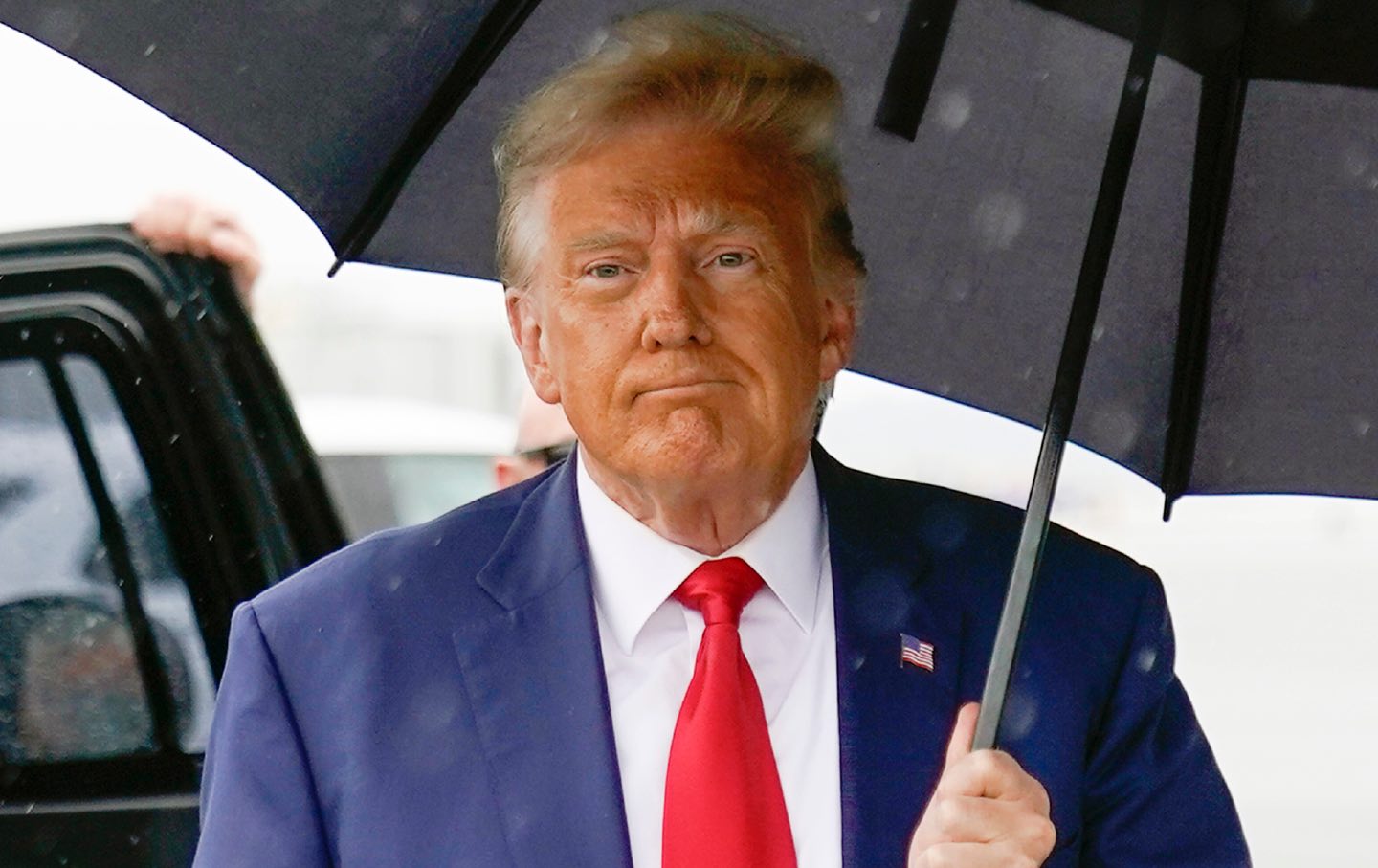
Former president Donald Trump walks to speak with reporters before boarding his plane on August 3, 2023.
(Alex Brandon / AP Photo)In January of 2021, when congressional Democrats and a number of Republicans were discussing how to hold Donald Trump to account for inciting an insurrection that sought to overturn the results of the 2020 presidential election, there was talk about impeachment and about using the 25th Amendment, which permits the vice president and a majority of cabinet members to declare a president unfit to continue in office. But in The Nation, Pulitzer Prize–winning historian Eric Foner pointed to another section of the Constitution: Section 3 of the 14th Amendment, which was written after the Civil War to prevent former US officials who had supported the Confederacy from holding elected office.
Foner suggested that members of Congress give a close read to amendment language, which states: “No person shall be a Senator or Representative in Congress, or elector of President and Vice President, or hold any office, civil or military, under the United States, or under any state, who, having previously taken an oath, as a member of Congress, or as an officer of the United States, or as a member of any state legislature, or as an executive or judicial officer of any state, to support the Constitution of the United States, shall have engaged in insurrection or rebellion against the same, or given aid or comfort to the enemies thereof.”
Foner, a historian of the post–Civil War era, explained that Congress could, with majority votes in the House and Senate, simply declare Trump to be disqualified. “This can be invoked against anyone who has ever taken an oath to support the Constitution, including the president. It’s much simpler than impeachment. It is not a judicial proceeding,” he wrote. “It’s a political proceeding. It doesn’t involve lawyers or trials. It is simply about qualification for office. You could have one afternoon of debate and a vote.”
Foner’s proposal was practical, but it never gained traction in Washington. Vice President Mike Pence, despite being targeted by Trump supporters who stormed the Capitol on January 6, chose not to invoke the 25th Amendment. The House did vote to impeach Trump, and, after a Senate trial, members of the upper chamber voted 57-43 to hold the former president to account. That was a majority, but it was not enough to reach the two-thirds threshold required for a conviction. So that constitutional remedy also came off the table.
Meanwhile, a dedicated group of lawyers and constitutional scholars pursued the final remedy—a 14th Amendment strategy—in the courts.
Accountability groups such as Free Speech for People and Citizens for Responsibility and Ethics in Washington promised to pursue the issue in the states. “If [Trump] runs in 2024, we will go into court and argue that he has disqualified himself,” announced constitutional lawyer John Bonifaz, FSFP’s president. CREW argued that because “Trump caused a violent insurrection that nearly overthrew an election and shattered our democracy,” he “disqualified himself under Section 3 of the Fourteenth Amendment from holding any federal or state office, including the presidency.” US Representative Jamie Raskin (D-Md.), a former constitutional law professor who led the effort to convict Trump following the former president’s 2021 impeachment, said with regard to the 14th Amendment’s standard for disqualification that Trump “really does fulfill exactly the constitutional prohibition there.” And J. Michael Luttig, a conservative former federal judge on the US Court of Appeals for the Fourth Circuit, and Laurence Tribe, the noted legal scholar and Carl M. Loeb University Professor of Constitutional Law Emeritus at Harvard University, wrote, “As students of the United States Constitution for many decades—one of us as a US Court of Appeals judge, the other as a professor of constitutional law, and both as constitutional advocates, scholars, and practitioners—we long ago came to the conclusion that the Fourteenth Amendment, the amendment ratified in 1868 that represents our nation’s second founding and a new birth of freedom, contains within it a protection against the dissolution of the republic by a treasonous president.”
But would a court actually be so bold as to disqualify Trump, the front-runner for the 2024 Republican presidential nomination? Skepticism abounded. There were even those who desperately suggested that the 14th did not apply to Trump because the amendment did not specifically mention the president as “an officer of the United States” who could be barred from seeking office.
On Tuesday, however, the Colorado Supreme Court weighed in on behalf of a clear and unequivocal reading of the Constitution. In the court’s 4-3 decision, it declared, “A majority of the court holds that Trump is disqualified from holding the office of president under Section 3 of the 14th Amendment.”
It was the first time in American history that the 14th Amendment was used to disqualify a presidential candidate. And the Colorado court’s majority was cognizant of the legal minefield they were entering into, writing, “We do not reach these conclusions lightly. We are mindful of the magnitude and weight of the questions now before us. We are likewise mindful of our solemn duty to apply the law, without fear or favor, and without being swayed by public reaction to the decisions that the law mandates we reach.”
The jurists stayed implementation of their decision until January 4, 2024, recognizing that Trump’s lawyers intend to appeal the case to the US Supreme Court. But this question is now on a fast track, as the deadline for Colorado officials to print Republican presidential primary ballots—on which Trump’s campaign intends to have his name appear—is January 5.
The US Supreme Court has a conservative majority appointed by Republican presidents, unlike the Colorado high court where the justices were appointed by Democratic governors. That bodes ill for judicial accountability.
But CREW President Noah Bookbinder chose to focus on the breakthrough that the Colorado represents for those who have long argued for applying the 14th Amendment.
“The court’s decision today affirms what our clients alleged in this lawsuit: that Donald Trump is an insurrectionist who disqualified himself from office under Section 3 of the 14th Amendment based on his role in the January 6 attack on the Capitol, and that [Colorado Secretary of State Jena Griswold] must keep him off of Colorado’s primary ballot. It is not only historic and justified, but is necessary to protect the future of democracy in our country,” Bookbinder said. “Our Constitution clearly states that those who violate their oath by attacking our democracy are barred from serving in government.”
The Colorado court made a detailed argument for this view, explaining in its majority opinion that the chief objections from Trump’s lawyers made little sense. “President Trump asks us to hold that Section 3 disqualifies every oath-breaking insurrectionist except the most powerful one and that it bars oath-breakers from virtually every office, both state and federal, except the highest one in the land,” wrote the majority. “Both results are inconsistent with the plain language and history of Section 3.”
Popular
“swipe left below to view more authors”Swipe →The legal wrangling is far from done. There is the Colorado case, which was brought by CREW on behalf of six Republican and unaffiliated Colorado voters, but there are also more than two dozen other cases pending elsewhere, including in several of the battleground states that are likely to decide the winner of the 2024 presidential race.
“This ruling demonstrates that Section 3 of the 14th Amendment applies to the January 6 insurrection and anyone who took an oath of office and then engaged in that insurrection is disqualified from holding public office, including current insurrectionists seated in the House and Senate,” explained FSFP’s Bonifaz, who has focused his work on electoral accountability issues for decades.
Whatever the final outcome, Norma Anderson, a former Republican majority leader of the Colorado House and Senate, and a plaintiff in the case, said she felt vindicated.
“My fellow plaintiffs and I brought this case to continue to protect the right to free and fair elections enshrined in our Constitution and to ensure Colorado Republican primary voters are only voting for eligible candidates. Today’s win does just that,” Anderson said on Tuesday. “Long before this lawsuit was filed, I had already read Section 3 of the 14th Amendment and concluded that it applied to Donald Trump, given his actions leading up to and on January 6. I am proud to be a petitioner, and gratified that the Colorado Supreme Court arrived at the same conclusion we all did.”
Support independent journalism that does not fall in line
Even before February 28, the reasons for Donald Trump’s imploding approval rating were abundantly clear: untrammeled corruption and personal enrichment to the tune of billions of dollars during an affordability crisis, a foreign policy guided only by his own derelict sense of morality, and the deployment of a murderous campaign of occupation, detention, and deportation on American streets.
Now an undeclared, unauthorized, unpopular, and unconstitutional war of aggression against Iran has spread like wildfire through the region and into Europe. A new “forever war”—with an ever-increasing likelihood of American troops on the ground—may very well be upon us.
As we’ve seen over and over, this administration uses lies, misdirection, and attempts to flood the zone to justify its abuses of power at home and abroad. Just as Trump, Marco Rubio, and Pete Hegseth offer erratic and contradictory rationales for the attacks on Iran, the administration is also spreading the lie that the upcoming midterm elections are under threat from noncitizens on voter rolls. When these lies go unchecked, they become the basis for further authoritarian encroachment and war.
In these dark times, independent journalism is uniquely able to uncover the falsehoods that threaten our republic—and civilians around the world—and shine a bright light on the truth.
The Nation’s experienced team of writers, editors, and fact-checkers understands the scale of what we’re up against and the urgency with which we have to act. That’s why we’re publishing critical reporting and analysis of the war on Iran, ICE violence at home, new forms of voter suppression emerging in the courts, and much more.
But this journalism is possible only with your support.
This March, The Nation needs to raise $50,000 to ensure that we have the resources for reporting and analysis that sets the record straight and empowers people of conscience to organize. Will you donate today?
More from The Nation
Celebrate Kristi Noem’s Firing. But Keep Protesting ICE. Celebrate Kristi Noem’s Firing. But Keep Protesting ICE.
Finally, someone in the administration is paying for their cruelty and incompetence.
We Don’t Need an Autopsy to Tell Us the Democrats Failed on Gaza We Don’t Need an Autopsy to Tell Us the Democrats Failed on Gaza
The DNC is allegedly hiding a report showing that Kamala Harris’s Gaza policy helped cost her the 2024 election. But that report won’t tell us anything we don’t already know.
Texas’s Senate Primary Has Already Made History—and It’s Not Over Yet Texas’s Senate Primary Has Already Made History—and It’s Not Over Yet
Democratic nominee James Talarico is getting national media attention, but the real story is sky-high voter turnout, even amid GOP bids to suppress balloting
Quilted Messages Quilted Messages
Sunbonnets carrying not-so-sunny truths.
How the Theatrics of Mamdani’s Trump Meeting Backfired How the Theatrics of Mamdani’s Trump Meeting Backfired
By pandering to the president’s vanity, the New York mayor reinforced Trump’s image as a strongman commanding deference—an especially bad look on the eve of Trump’s war with Iran

Students in New York Are Going Hungry. How Can Mamdani Help? Students in New York Are Going Hungry. How Can Mamdani Help?
With plans for city-owned grocery stores and a focus on affordability, the new mayoral administration offers fresh hopes of successfully confronting the food crisis among students...

