Adam Schiff’s “Brazenly Cynical” Campaign Strategy Boosts a Republican
The California Senate candidate’s latest TV ad could help a Republican elbow aside fellow Democrat Katie Porter and Barbara Lee in an open primary on March 5.
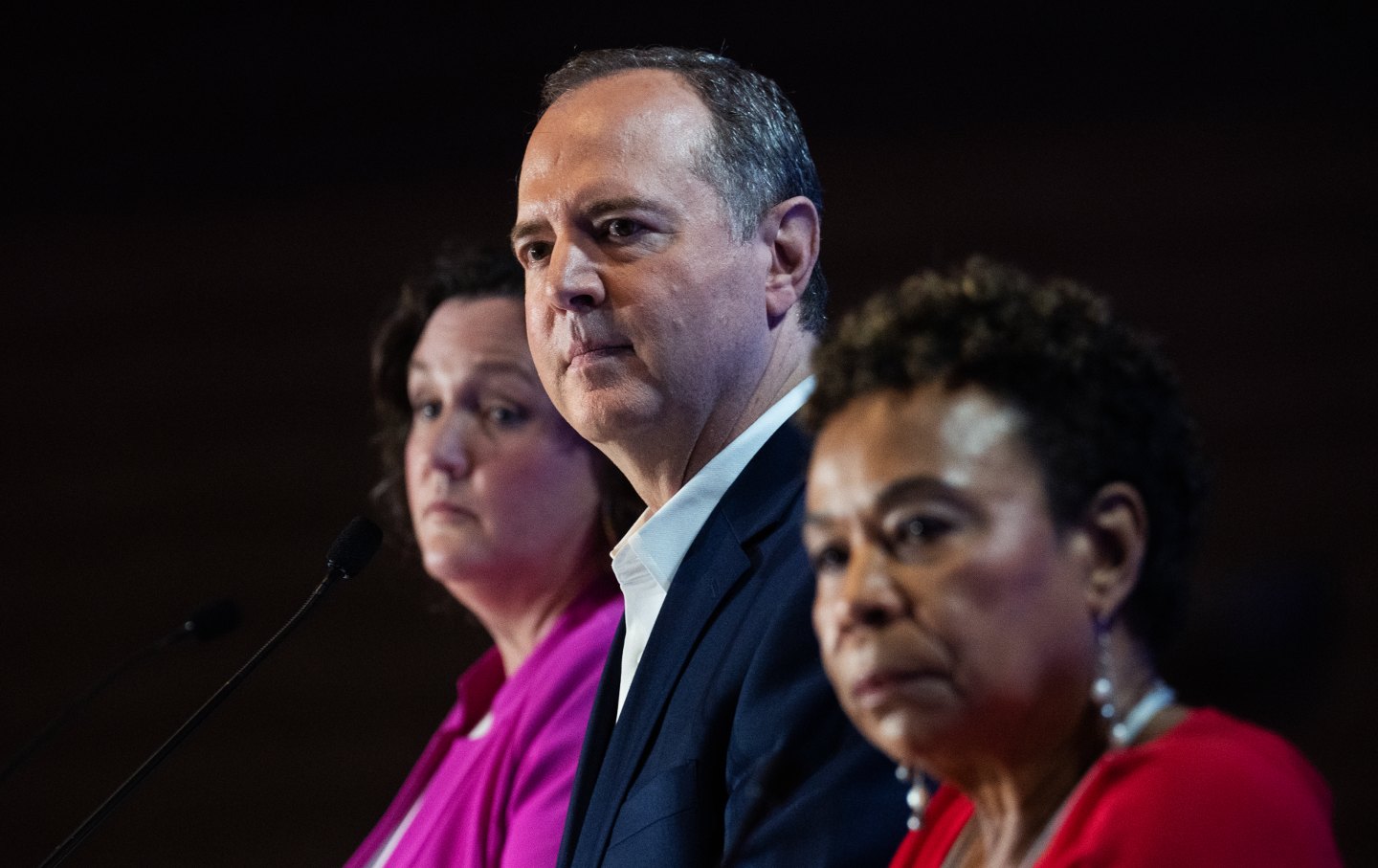
California Representatives Katie Porter, Adam Schiff, and Barbara Lee, Democratic candidates for the US Senate, participate in the National Union of Healthcare Workers Senate Candidate Forum in downtown Los Angeles, Calif., on Sunday, October 8, 2023.
(Tom Williams / CQ-Roll Call, Inc via Getty Images)Adam Schiff is the front-runner in the California US Senate primary that will be held March 5. A headline-grabbing Democratic member of the US House, Schiff is a regular on cable television shows, has raised lots more money than his rivals, and has attracted endorsements from the likes of former House speaker Nancy Pelosi, who remains a highly influential figure in California politics. Polls suggest that he’s all but certain to make the general election ballot this fall.
But Schiff isn’t satisfied. He’s now spending heavily to ensure that he gets the opponent he wants in November.
California has a different primary system than most other states. Candidates from every party appear on the same primary ballot, and whichever two people get the most votes then run against one another in November. Republicans are often so weak in the state that they come in third overall, and two Democrats wind up running against each other in the general election; both Kamala Harris and the late Dianne Feinstein, for instance, ran against fellow Democrats in the state’s 2016 and 2018 Senate races.
Schiff, who is generally seen as the most centrist of the prominent Democratic candidates in this year’s field, wants to avoid that scenario. In such a deep-blue state, a November race against either of his more progressive Democratic competitors—US Representative Katie Porter or US Representative Barbara Lee—would be considerably tougher than one against a Republican. So, with the primary barely a month away, Schiff’s campaign has started running ads that highlight his record versus that of the leading Republican contender, former Los Angeles Dodgers baseball star Steve Garvey.
Garvey’s Senate campaign has been a bumbling affair, in which he has struggled to raise funds and turned in cringe-worthy debate performances—so much so that the Los Angeles Times opined after a January debate that “Steve Garvey was less a heavy hitter on Monday night’s Senate debate stage and more often a punchline.” He’s tried to capitalize on his baseball background, but polling shows that voters aren’t impressed. Indeed, an analysis of fresh data collected by the University of Southern California’s California Elections and Policy Poll found that “Garvey is not winning Dodgers fans’ votes, suggesting his strategy of emphasizing his baseball biography is not working.”
So that explains why Schiff is flooding the airwaves with advertising that ominously identifies Garvey as “the leading Republican” and a conservative who “voted for Trump twice” and has “supported Republicans for years.” Sure, the ad helps Schiff, by positioning him as “the leading Democrat” and a foe of “Trump and the insurrectionists.” But it also heightens awareness of Garvey’s candidacy and helps to rally Republican support in a state where roughly a third of voters still line up on the right. If that happens, Garvey could displace Porter or Lee and make it much easier for Schiff to win in November.
The jockeying to determine whether California will have a Senate race involving two Democrats or a Democrat and a Republican is consequential for Democrats, and particularly for progressive Democrats. A race between two Democrats obviously benefits the party. That way, no matter who wins, a Democrat will take the seat that was long held by Feinstein In Feinstein’s last race, in 2018, the centrist incumbent faced another Democrat, Kevin de León, the former president pro tempore of the California State Senate, who challenged her from the left. That race, which focused on both issues and concerns about Feinstein’s age, turned out to be an unexpectedly competitive contest. But it didn’t cause any worries for Democratic strategists, as both candidates were certain to join the Senate Democratic Caucus and generally vote the party line.
In the 2024 race, where Schiff has consistently led in the polls, both Porter and Lee have been hoping for a second-place finish that would set up a centrist Democrat-versus-progressive Democrat competition in the fall. But Schiff’s new ad campaign removes any doubt that he is angling for a two-party race. Veteran California political reporter Doug Sovern explains that Schiff’s ad “raises Garvey’s profile among Republican voters” because “Schiff would prefer a November cakewalk versus Garvey, [rather] than a Democrat versus Democrat race battle.”
Schiff’s strategy is savvy but cynical. And it’s worked before. In 2012, when Missouri Democratic Senator Claire McCaskill was facing a tough reelection race, she started running ads before the GOP Senate primary that played up controversial US Representative Todd Akin. With an assist from McCaskill, Akin won the primary. Her scheme paid off when he infamously suggested that women who were victims of “legitimate rape” rarely get pregnant, and she easily dispatched him in November. Since then, the strategy has been employed with some frequency by Democrats seeking to ensure that they face extremists who are perceived to be the least electable Republicans in fall races. The approach has drawn significant criticism, however, from some Democrats who say it’s dangerous to boost MAGA Republicans who are aligned with former president Donald Trump, and who also argue that this sort of crossover meddling undermines confidence in the political process.
In California’s open primary, the latest polling suggests that Schiff is at 25 percent, Porter and Garvey are both at 15 percent, and Lee is at 7 percent. The undecided voters in the race are disproportionately Republicans and independents. As Schiff’s advertising campaign increases Garvey’s political profile, that could attract more Republicans and Republican-leaning independents to his candidacy and push him over the top in the primary.
For her part, Porter is calling Schiff out, arguing, “Adam Schiff knows he will lose to me in November. That’s what this brazenly cynical ad is about—furthering his own political career, boxing out qualified Democratic women candidates, and boosting a Republican candidate to do it. We need honest leadership, not political games.”
Support independent journalism that does not fall in line
Even before February 28, the reasons for Donald Trump’s imploding approval rating were abundantly clear: untrammeled corruption and personal enrichment to the tune of billions of dollars during an affordability crisis, a foreign policy guided only by his own derelict sense of morality, and the deployment of a murderous campaign of occupation, detention, and deportation on American streets.
Now an undeclared, unauthorized, unpopular, and unconstitutional war of aggression against Iran has spread like wildfire through the region and into Europe. A new “forever war”—with an ever-increasing likelihood of American troops on the ground—may very well be upon us.
As we’ve seen over and over, this administration uses lies, misdirection, and attempts to flood the zone to justify its abuses of power at home and abroad. Just as Trump, Marco Rubio, and Pete Hegseth offer erratic and contradictory rationales for the attacks on Iran, the administration is also spreading the lie that the upcoming midterm elections are under threat from noncitizens on voter rolls. When these lies go unchecked, they become the basis for further authoritarian encroachment and war.
In these dark times, independent journalism is uniquely able to uncover the falsehoods that threaten our republic—and civilians around the world—and shine a bright light on the truth.
The Nation’s experienced team of writers, editors, and fact-checkers understands the scale of what we’re up against and the urgency with which we have to act. That’s why we’re publishing critical reporting and analysis of the war on Iran, ICE violence at home, new forms of voter suppression emerging in the courts, and much more.
But this journalism is possible only with your support.
This March, The Nation needs to raise $50,000 to ensure that we have the resources for reporting and analysis that sets the record straight and empowers people of conscience to organize. Will you donate today?