A Silent Climate Majority
Most of the world’s people want stronger climate action—but don’t realize they’re the majority.
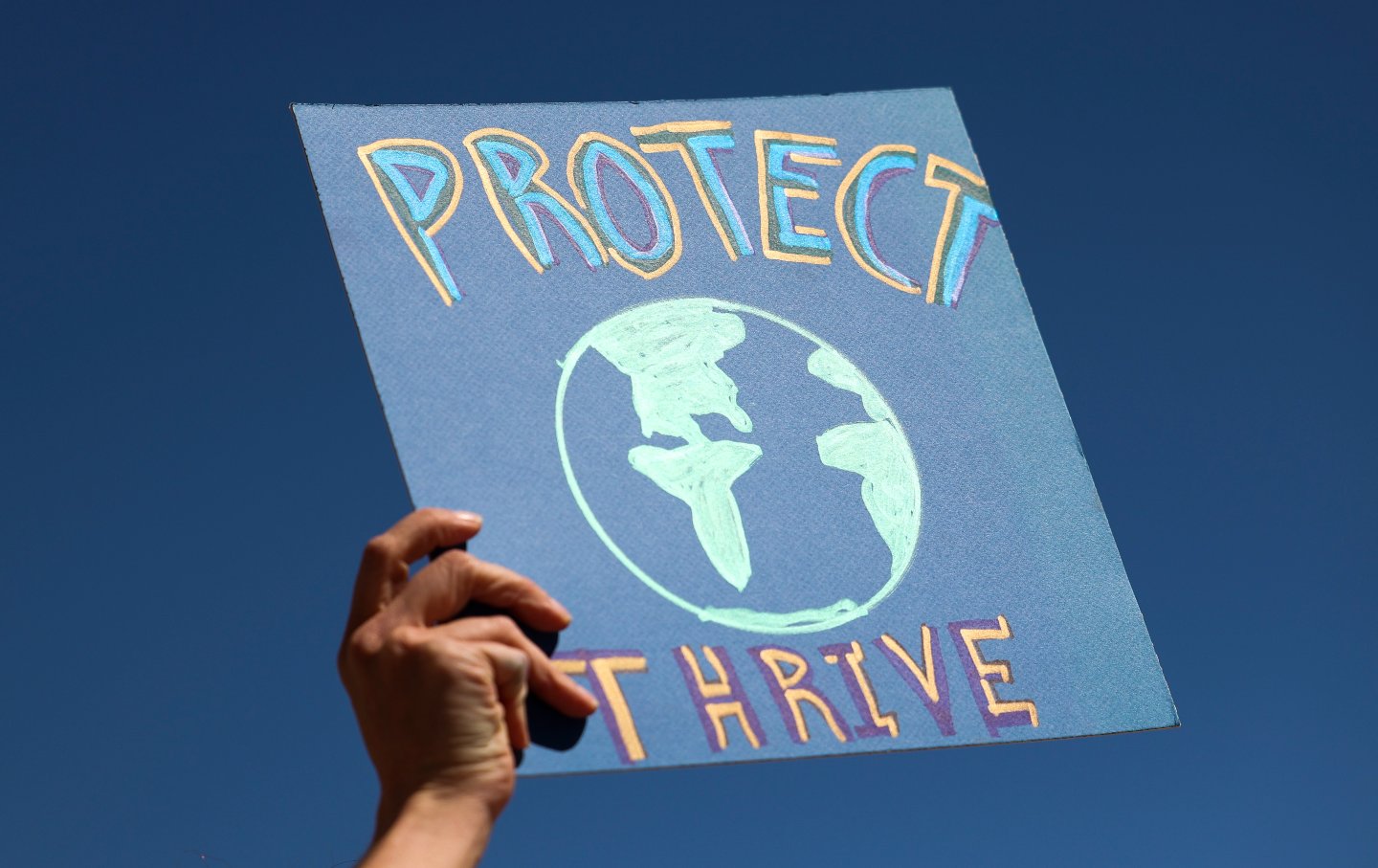
Harmony Cummings holds a sign outside the office of Senator John Hickenlooper (D-CO) during a Time to Thrive rally organized by the Colorado Green New Deal coalition to demand support for the THRIVE act on March 31, 2021, in Denver.
(Michael Ciaglo / Getty Images for New Green Deal Network)A superpower in the fight against global warming is hiding in plain sight. It turns out that the overwhelming majority of people in the world—between 80 and 89 percent, according to a growing number of peer-reviewed scientific studies—want their governments to take stronger climate action.
As cofounders of a nonprofit that studies news coverage of climate change, those findings surprised even us. And they are a sharp rebuttal to the Trump administration’s efforts to attack anyone who does care about climate change.
For years—and especially at this fraught political moment—most press coverage of the climate crisis has been defensive. People who support climate action are implicitly told—by their elected officials, by the fossil fuel industry, by news stories and social media discourse—that theirs is a minority, even a fringe, view.
That is not what the new research finds.
The most recent study, “People’s Climate Vote 2024,” was conducted by Oxford University as part of a program the United Nations launched after the 2015 Paris Agreement. Among poorer countries, where roughly four in five of the world’s inhabitants live, 89 percent of the public wanted stronger climate action. In richer, industrialized countries, roughly two in three people wanted stronger action. Combining rich and poor populations, “80% [of people globally] want more climate action from their governments.”
The Yale Program on Climate Change Communication—which, along with its partner, the George Mason University Center for Climate Change Communication, is arguably the global gold standard in climate opinion research—has published numerous studies documenting the same point: Most people, in most countries, want stronger action on climate change.
A fascinating additional 89 percent angle was documented in a study published by Nature Climate Change, which noted that the overwhelming global majority does not know it is the majority: “Individuals around the globe systematically underestimate the willingness of their fellow citizens to act,” the report states.
In other words, an overwhelming majority of people want stronger action against climate change. But at least for now, this global climate majority is a silent majority.
Taken together, the new research turns the conventional wisdom about climate opinion on its ear. At a time when many governments and companies are stalling or retreating from rapidly phasing out the fossil fuels that are driving deadly heat, fires, and floods, the fact that more than eight in 10 human beings on the planet want their political representatives to preserve a livable future offers a much-needed ray of hope.
The question is whether and how that mass sentiment might be translated into effective action.
What would it mean if this silent climate majority woke up—if its members came to understand just how many people, both in distant lands and in their own communities, think and feel like they do? How might this majority’s actions—as citizens, as consumers, as voters—change? If the current narrative in news and social media shifted from one of retreat and despair to one of self-confidence and common purpose, would people shift from being passive observers to active shapers of their shared future? If so, what kinds of climate action would they demand from their leaders?
These are the animating questions behind the 89 Percent Project, a yearlong media initiative that launched this week. The journalistic nonprofit we run, Covering Climate Now, has invited newsrooms from around the world to report, independently or together, on the climate majorities found in their communities.
Popular
“swipe left below to view more authors”Swipe →Who are the people who comprise the 89 percent? Given that support for climate action varies by country—the figure is 74 percent in the United States, 80 percent in India, 90 percent in Burkina Faso—does support also vary by age, gender, political affiliation, and economic status? What do members of the climate majority want from their political and community leaders? And what has been standing in the way?
This week of coverage will be followed by months of further reporting that explores additional aspects of public opinion about climate change. If most of the climate majority have no idea they are the majority, do they also not realize that defusing the climate crisis is by no means impossible? Scientists have long said that humanity possesses the tools and know-how necessary to limit temperature rise to the Paris Agreement’s aspirational target of the 1.5º C above preindustrial levels. What’s been lacking is the political will to implement those tools and leave fossil fuels behind. The 89 Percent Project will culminate in a second joint week of coverage prior to the COP30 United Nations climate meeting in Brazil in November.
While it’s impossible to know how many newsrooms will participate in this week’s 89 percent coverage, early signs are heartening. The Guardian and the Agence France-Presse news agency have joined as lead partners of the project. Other newsrooms offering coverage include The Nation, Rolling Stone, Scientific American, Time, Drilled, Crooked Media, and Indian Country Today in the United States; the National Observer in Canada; the global broadcaster Deutsche Welle in Germany; the Corriere della Sera in Italy; the Asahi Shimbun in Japan; and the multinational collaborative Arab Reporters for Investigative Journalism, based in Jordan.
We believe the current mismatch between public will and government action amounts to a deficit in democracy. Can that deficit be addressed if the climate majority awakens to its existence? Would people elect different leaders? Buy (or not buy) different products? Would they talk differently to family, friends, and coworkers about what can be done to build a cleaner, safer future? The first step to answering such questions is to give the silent climate majority a voice. That will happen, finally, this week in news coverage around the world.