Environment / March 6, 2025

Trump’s Deadly Assault on Weather Reporting

I’m a meteorologist, and breaking NOAA would undermine journalists’ ability to cover the story our audiences care about most.
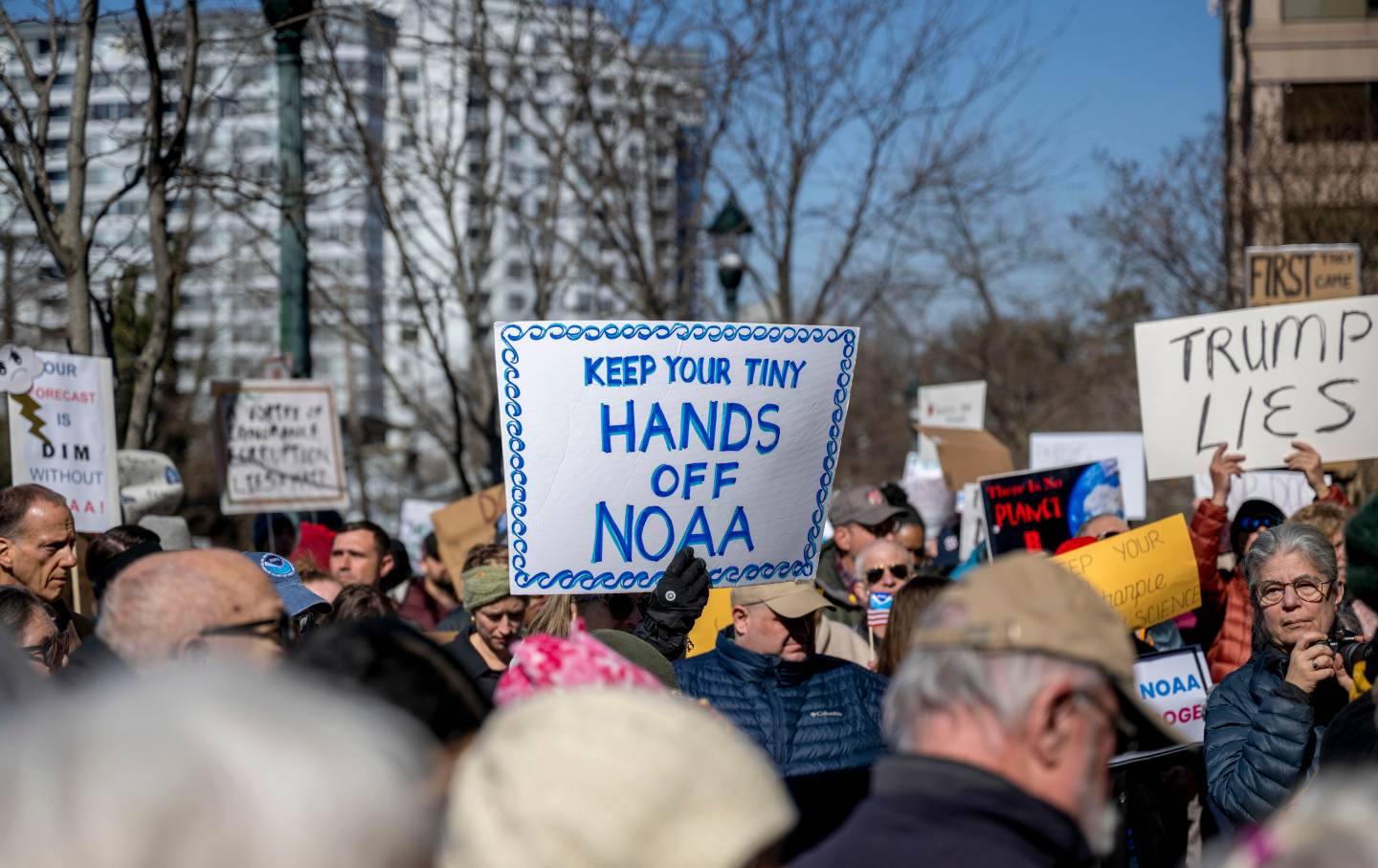
David Dickson

Protesters rally outside the National Oceanic and Atmospheric Administration headquarters in Silver Spring, Maryland, on Monday, March 3, 2025.


(Daniel Heuer / Bloomberg via Getty Images)

“There will be people who die.” That stark warning came last week from Daniel Swain, a climate scientist at the University of California, Los Angeles, after President Donald Trump sought to fire more than 800 employees of the National Oceanic and Atmospheric Administration (NOAA). As a former TV weathercaster myself, I know the same worry is shared throughout the professional meteorological community.

NOAA houses the National Weather Service, which provides the data and analysis that informs virtually all the weather forecasts Americans receive, whether via TV or radio broadcasts or their phone apps. Emergency alerts to coastal residents as a hurricane approaches? Warnings to farmers about an impending flood or heat wave? A winter weather advisory for mountain-bound ski vacationers? These and countless other lifesaving services are at risk if Trump succeeds with his order, which legal experts say violates US law, according to reporting by Inside Climate News.

“Going into the severe weather and hurricane season, this cannot be good,” Al Roker, the chief meteorologist for NBC News, wrote in a social media post responding to the NOAA layoffs.

The public deserves to know what’s at stake. To aid coverage of this developing story, it’s worth noting that NOAA is one of the best investments of taxpayer dollars on record. The National Weather Service’s annual budget of roughly $1.4 billion delivers an economic return in excess of $100 billion, according to one recent study. That’s not surprising, considering how directly the weather affects so much of the economy, including agriculture, air transportation, fishing, tourism, utilities, and commerce. To highlight this angle, reporters can explore the potential losses that companies, universities, and nonprofits may experience with further disruptions to the NOAA workforce. Think of airlines unable to steer their planes safely away from storms and farmers left unaware of an upcoming frost that threatens their entire season’s harvest.

Reporting can also point out that providing critical weather and climate information is just one part of NOAA’s work. Eat seafood? NOAA ensures that fish and shellfish from across the world are safe to consume. Enjoy a beach day? NOAA protects you from a number of marine impacts, including tsunamis (recent cuts included one scientist from this team). NOAA’s reach even extends beyond our planet, monitoring solar activity and “space weather” that disrupts global communications.

As climate change drives increasingly volatile and destructive extreme weather across the US and around the world, a reliable understanding of the climate-weather connection is critical to saving lives and ensuring that society can continue to function. Plainspoken journalism can make clear the consequences if this attempt to sabotage NOAA succeeds: People will die.
Time is running out to have your gift matched 

In this time of unrelenting, often unprecedented cruelty and lawlessness, I’m grateful for Nation readers like you. 

So many of you have taken to the streets, organized in your neighborhood and with your union, and showed up at the ballot box to vote for progressive candidates. You’re proving that it is possible—to paraphrase the legendary Patti Smith—to redeem the work of the fools running our government.

And as we head into 2026, I promise that The Nation will fight like never before for justice, humanity, and dignity in these United States. 

At a time when most news organizations are either cutting budgets or cozying up to Trump by bringing in right-wing propagandists, The Nation’s writers, editors, copy editors, fact-checkers, and illustrators confront head-on the administration’s deadly abuses of power, blatant corruption, and deconstruction of both government and civil society. 

We couldn’t do this crucial work without you.

Through the end of the year, a generous donor is matching all donations to The Nation’s independent journalism up to $75,000. But the end of the year is now only days away. 

Time is running out to have your gift doubled. Don’t wait—donate now to ensure that our newsroom has the full $150,000 to start the new year. 

Another world really is possible. Together, we can and will win it!

Love and Solidarity,

John Nichols 

Executive Editor, The Nation

David Dickson

David Dickson is an award-winning meteorologist and the TV engagement director at the global media collaboration Covering Climate Now.

More from The Nation

People participate in a demonstration in front of the main entrance of COP30 in Belém, Brazil, on November 10, 2025.

Backsliding in Belém Backsliding in Belém

Petrostates at COP30 quash fossil fuel and deforestation phaseouts.

Mark Hertsgaard

Indigenous Activists to COP30: “We Will Fight to the Death”

Indigenous Activists to COP30: “We Will Fight to the Death” Indigenous Activists to COP30: “We Will Fight to the Death”

Indigenous people lead COP30 protests against agribusinesses that “want to take everything.”

Mark Hertsgaard

World leaders attend a session on the energy transition on the second day of COP30 on November 7, 2025, in Belém, Brazil.

Global Leaders Are Glad the US Isn’t Attending COP30 Global Leaders Are Glad the US Isn’t Attending COP30

Momentum behind decarbonizing the global economy has built to the point where it is inevitable—with or without the United States.

Mark Hertsgaard

Luiz Inacio Lula da Silva, Brazil's president, speaks during the COP30 Leaders Summit in Belem, Para state, Brazil, on November. 6, 2025.

At COP30, Will Lula Be a Rain Forest Champion? At COP30, Will Lula Be a Rain Forest Champion?

During this term, Brazil’s president has reduced deforestation but he is government is pushing projects that would open up the Amazon to extractivism.

Jonathan Watts

Bill Gates

How Much Suffering Can COP30 Prevent? How Much Suffering Can COP30 Prevent?

Bill Gates gets climate change wrong. It’s not a binary—humanity survives or goes extinct—it’s a questions of scale: How many people will die or be left destitute?

Andrew McCormick

A TV reporter braces against the wind as Hurricane Irma approaches in Miami, Florida, on September 10, 2017.

The Media Is Complicit in the Climate Confusion The Media Is Complicit in the Climate Confusion

The vast majority of people want their governments to take climate action—but most wrongly think they’re in the minority. The media is partly to blame.

Amy Westervelt