Why Climate Activists Are Protesting Their Favorite Sports Teams
Climate change is rendering the future of many sports more dangerous or impossible. But many teams are still taking fossil fuel dollars.
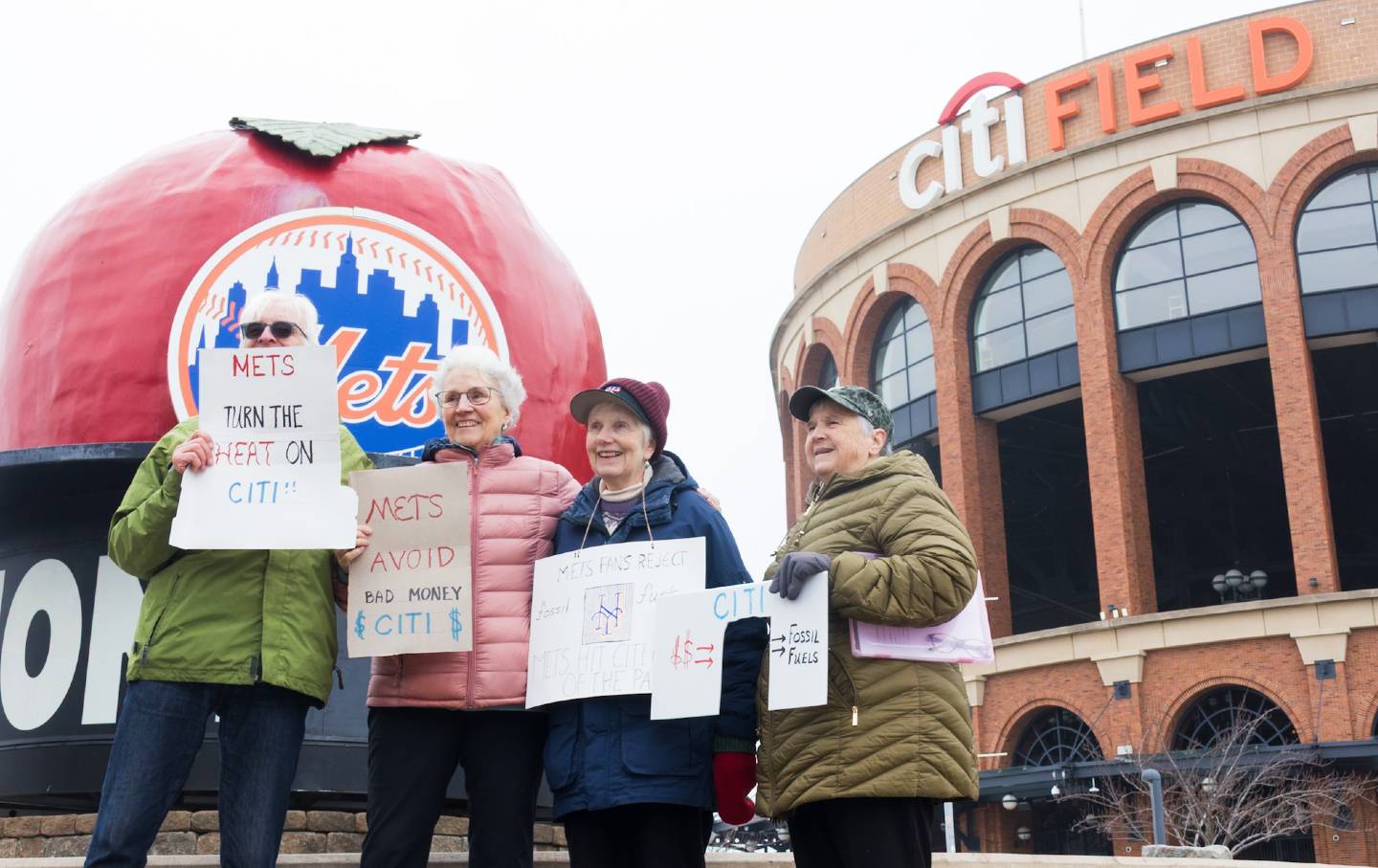
Protesters gather outside of Citi Field in New York City to object to the Mets’ partnership with Citibank.
(Alexandra Tey)In January 2025, wildfire swept through the Los Angeles suburb of Pacific Palisades, burning thousands of houses. Dennis Higgins showed me photos of what was left of his home: a chimney, an archway, ashes.
“It was devastating,” Higgins said. “We all got out healthy—my family’s fine, the two dogs made it—but the entire community is just gone.”
After 35 years in California, Higgins moved back to New York City. And on February 17, he joined a small group of activists outside Citi Field, the New York Mets’ stadium in Queens, to protest the team’s naming deal with Citigroup, the biggest lender to fossil fuel companies since the 2015 Paris Agreement.
These firms can see the catastrophic effects of climate change just as clearly as we can. That’s why Citigroup gestures at efforts toward “the energy transition” alongside “energy security.” Sowing complacency is crucial to keeping fossil fuel extraction going as long as it can. And hitching themselves to sports teams is a strategy as obvious as it is effective. According to a 2021 Nielsen study, consumers trust brands that sponsor sporting events almost as much as they trust brands recommended by family and friends.
“It works for them very well to put their name on a baseball stadium where people come and have fun,” Higgins told me. “There’s a lot of fossil fuel financing that’s wrecking our world.”
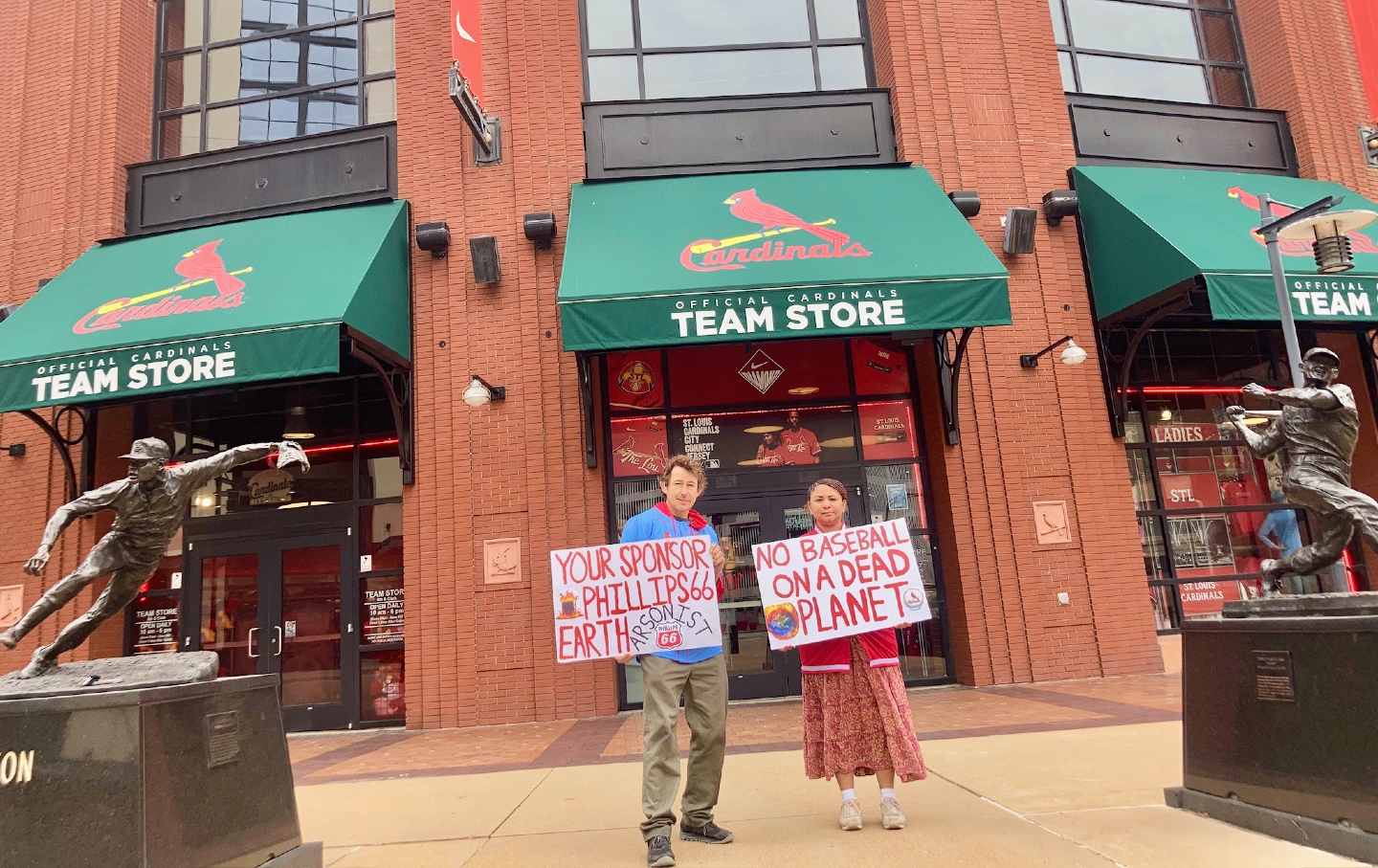
The Citi Field protesters are part of a nascent movement drawing connections between climate disasters like the Palisades fire, fossil fuel companies, the banks that enable them, and the sports teams who lend their reputations in support. That morning, simultaneous demonstrations at 10 professional sports stadiums across the country protested teams’ deals with the likes of Gulf Oil (the Boston Celtics), NRG Energy (the Philadelphia Eagles), and Phillips 66 (the Los Angeles Dodgers).
Activists and scholars say these sponsorships amount to “sportswashing,” in which corporate or state actors use athletics to launder their own reputations. “They do an excellent job of ingratiating themselves to the public, and one of the ways that they do that is associating themselves with sports teams,” said Laura Iwanaga, who protested the Portland Timbers’ jersey deal with fossil fuel financier Bank of America. “Everybody loves their sports team.”
The New York contingent’s focus on Citigroup echoed demands made by New York City Public Advocate Jumaane Williams in 2023, when he called on the Mets to drop Citibank if it “refuses to end its toxic relationship with the fossil fuel industry.”
Claire Regan, one of the three Roman Catholic religious sisters protesting the Mets, said her mother taught her the proverb about being known by the company you keep. She told me, “As a Mets fan, as a New Yorker, I don’t like that they’re in bad company right now with Citibank.”
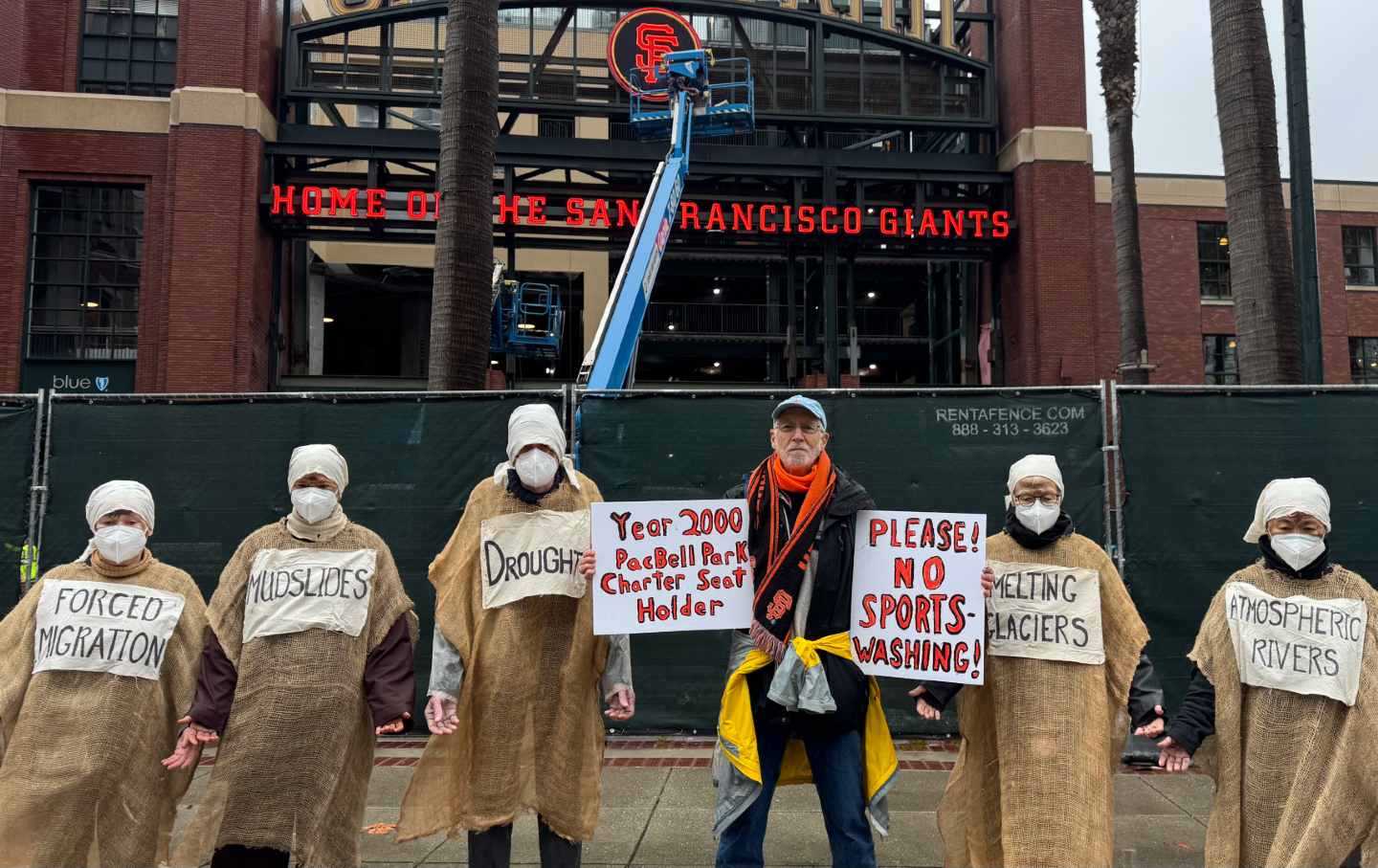
The movement, now led by the Los Angeles Sierra Club chapter, started with a petition calling on the Dodgers to end a long-running partnership with Phillips 66 through its 76 gasoline brand.
Evan George, the communications director of UCLA’s Emmett Institute on environmental law, described to me what he saw from his seat at Dodger Stadium one evening with his colleagues in June 2024: “The sun is setting, you’re between Echo Park and downtown LA, and it’s a gorgeous outdoor view of Los Angeles looking off into the distance—and the tallest thing in the stadium is the orange balls on the scoreboard for 76 gas.”
George said the institute’s director Cara Horowitz pointed out the 76 logos and got them all thinking: “Why, in this day and age, when the state of California is suing Big Oil for climate deception, and LA, in a lot of ways, has some progressive environmental policies—why do we have to look at this?”
Horowitz’s subsequent post on the Emmett Institute’s Legal Planet blog caught the eye of journalist Sammy Roth. His Los Angeles Times columns led Zan Dubin and two activist friends to start the Dodgers Fans Against Fossil Fuels petition drive that August, which has since gathered more than 28,000 signatures. In March 2025, Dubin gathered about a dozen activists outside Dodger Stadium. About 40 participated in February’s 10-stadium protest.
For winter sports, climate change presents an existential threat. Rising winter temperatures will make every future Winter Olympics more logistically challenging than the last. Italian oil giant Eni was a major sponsor of the Milan Cortina Games despite athletes’ urging the International Olympic Committee to cut ties. The Pyeongchang, Beijing, and Milan Cortina organizers relied on artificial snow to carry on with business as usual, but as temperatures rise, no amount of machines, energy, or money can stop it from melting once it’s on the ground.
Hotter summers threaten the safety of the athletes themselves. A French-led research team reported last month that it is “only a matter of time” until extreme heat strains existing safety protocols at European summer sporting events.
In 2021, the US track and field Olympic trials were hit by a record-setting Pacific Northwest heat wave. Discus thrower Sam Mattis recalled feeling “in a daze” the day he made the Olympic team. The ground was so hot, he said, his feet burned through his shoes. And it’s no wonder: The track reached 150 degrees on a 113-degree day that weekend.
“The longer you enable the oil and gas industry, the more difficult sport becomes,” Mattis said. “I’d love for fans to be more conscious of the advertisers, and then demand that their teams and venues are going to put some distance between themselves and oil and gas sponsorships.”
At sub-professional levels with fewer support staff, temperatures are already deadly. In high school and college football, exertional heat stroke killed an average of two players per year from 1998 through 2018. As the world heats up—since then, the United States has seen half its 10 hottest years so far—sports become more dangerous. Last summer, at least five high school football players died during extreme heat.
Mattis worries what will happen to professional sports when it’s unsafe for young athletes to train. He said he hopes to see high-profile pros joining advocacy initiatives like EcoAthletes (of which he is a part), High Impact Athletes, Protect Our Winters, and Ski Fossil Free. A Big Four star would be taking more of a risk than a “random Olympic athlete who doesn’t have any real sponsors,” Mattis said, but pointed to NBA point guard Russell Westbrook’s backing of the Los Angeles Cleantech Incubator as an example of the direction athletes should be taking.
George, of UCLA, suggested that athletes could refuse to appear in team social-media videos with fossil fuel company logos visible. Regardless of how, it will likely come down to players and fans pressuring teams to change voluntarily. Advertising bans are rare in the United States under any administration, George said, and we certainly can’t count on any corporate moral awakenings.
“We want to make it a bad business decision,” said Naomi Oreskes, a historian of science at Harvard University who backed the protests. “We want enough people to say, ‘No, we don’t want our beloved Dodgers taking money from oil and gas. We don’t want sports heroes to be compromised by their association with these companies that are hurting people.’”
So far, though, teams have refused to engage with the activists, even to brush them off. The Dodgers have ignored outreach, even as Roth hammered them in the Los Angeles Times and California state Senator Lena Gonzalez joined the calls for the team to drop Phillips 66. In November 2025, Roth reported on his Substack that the team’s president had privately told Gonzalez that they had “no plans” to change. A Dodgers representative refused my request for comment.
When faced with human intransigence amid crisis, Regan and her fellow Sisters of Charity told me they find hope in God. At the Citi Field protest, she read aloud Pope Francis’s prayer for the earth: “Touch the hearts of those who look only for gain at the expense of the poor and the earth.”
Speaking for herself, though, she said she struggled to find sympathy for the uncaring industrialists most responsible for the planet’s ruin.
“In some ways, you can forgive ignorance,” Regan said. “Callousness, greed, that’s hard to forgive—because that’s deep in their heart.”
Support independent journalism that does not fall in line
Even before February 28, the reasons for Donald Trump’s imploding approval rating were abundantly clear: untrammeled corruption and personal enrichment to the tune of billions of dollars during an affordability crisis, a foreign policy guided only by his own derelict sense of morality, and the deployment of a murderous campaign of occupation, detention, and deportation on American streets.
Now an undeclared, unauthorized, unpopular, and unconstitutional war of aggression against Iran has spread like wildfire through the region and into Europe. A new “forever war”—with an ever-increasing likelihood of American troops on the ground—may very well be upon us.
As we’ve seen over and over, this administration uses lies, misdirection, and attempts to flood the zone to justify its abuses of power at home and abroad. Just as Trump, Marco Rubio, and Pete Hegseth offer erratic and contradictory rationales for the attacks on Iran, the administration is also spreading the lie that the upcoming midterm elections are under threat from noncitizens on voter rolls. When these lies go unchecked, they become the basis for further authoritarian encroachment and war.
In these dark times, independent journalism is uniquely able to uncover the falsehoods that threaten our republic—and civilians around the world—and shine a bright light on the truth.
The Nation’s experienced team of writers, editors, and fact-checkers understands the scale of what we’re up against and the urgency with which we have to act. That’s why we’re publishing critical reporting and analysis of the war on Iran, ICE violence at home, new forms of voter suppression emerging in the courts, and much more.
But this journalism is possible only with your support.
This March, The Nation needs to raise $50,000 to ensure that we have the resources for reporting and analysis that sets the record straight and empowers people of conscience to organize. Will you donate today?