
Why We Need a “Doug Jones” More Than a Dow Jones
On the Magnificent Seven and market myths.
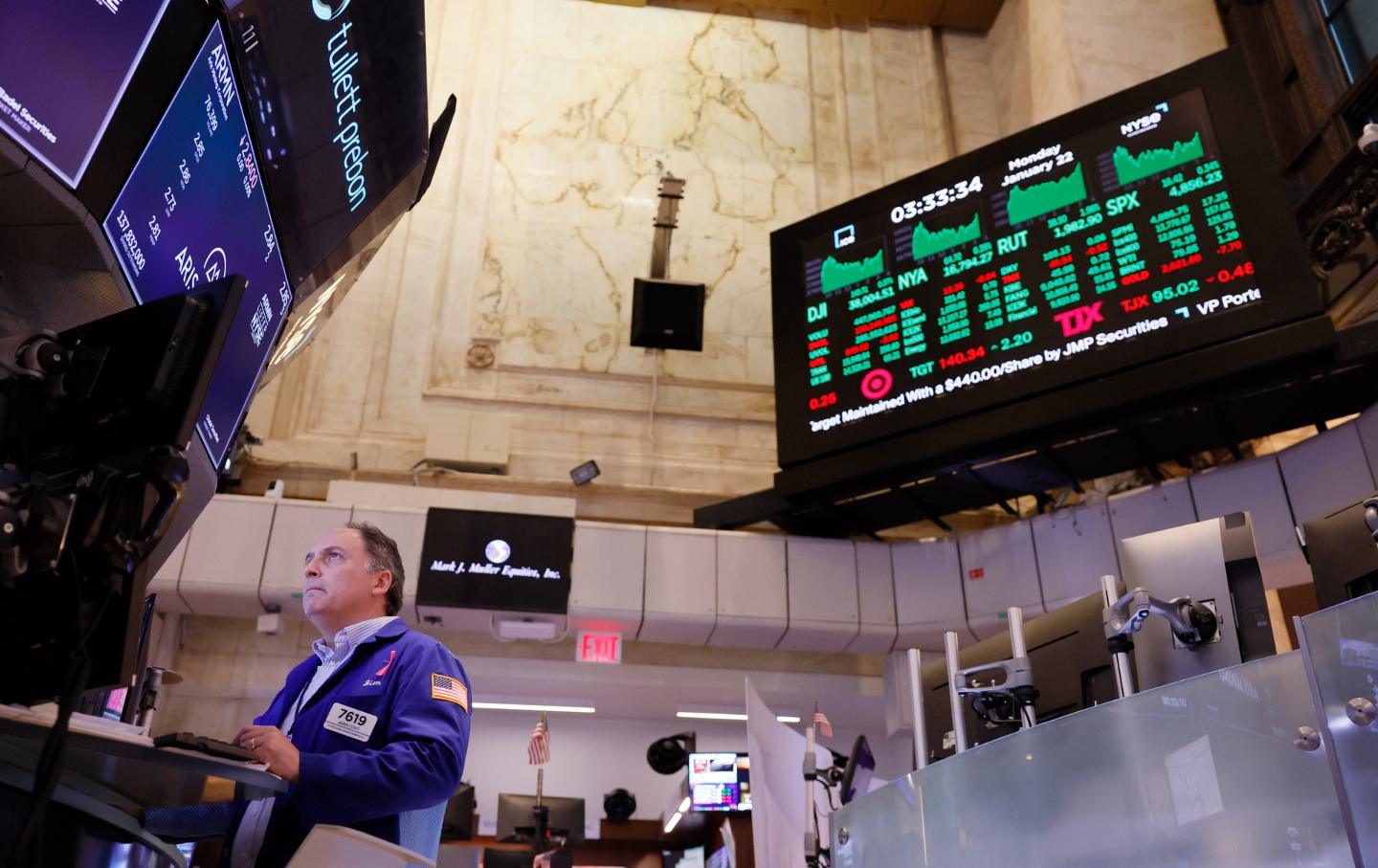
The S&P 500 rose to new heights last week on the strength of the Magnificent Seven. No, that’s not the title of a new remake of a remake of a Spaghetti Western film. It’s the name coined by Bank of America analyst Michael Hartnett to label the seven tech companies—Apple, Amazon, Alphabet, Meta, Microsoft, Nvidia, and Tesla—that make up over a quarter of the stock market’s total value, and that added a collective $5.1 trillion to the market last year.
In other words: The companies that were already making a lot of money are now making even more. For the average working American, the market’s ups and downs have little or no correlation to their lives—but they think it does, thanks in no small part to close and continuous media coverage.
Nearly 40 percent of Americans have no financial stake in the stock market. Among those households who do, most have only indirect investments through index funds and 401(k)s, which amount to a tiny slice of the total pie. And even for those with direct stockholdings, the average value of their investments is around $15,000—for comparison, the average American owes about $60,000 in debt.
The inequity doesn’t stop there. Americans with postgraduate degrees are twice as likely to hold stocks as high school grads. White Americans own a staggering 89 percent of stocks. And to echo a senator from Vermont, the wealthiest 1 percent now own more than half of all US stocks—a fact that both illustrates and perpetuates the gross wealth disparity in this country. A “bull” market, indeed.
Adding insult to injury, the value of the stock market sometimes reflects the exact inverse of the worker’s experience. Wins for labor, like unionization and wage growth, often sink stock values. The same goes for antitrust measures that keep prices competitive and hold companies accountable to consumers. After a judge blocked Spirit Airlines’ merger with JetBlue, the carrier’s shares dropped 20 percent. On the flip side, when the pandemic shuttered businesses and sent unemployment skyrocketing, the S&P 500 saw its best month of trading in 33 years.
And yet, thanks to the tenor of today’s stock market coverage, consumers still tend to conflate the market with the economy overall. The media—its members perhaps over-indexing on their own status in the stockholding elite—has perpetuated this fallacy. Share prices scroll endlessly on the nightly news, while analysts devote entire shows to evaluating stocks as though they were NBA draft prospects. But the truth is, Jim Cramer’s antics on Mad Money are at best irrelevant and at worst insulting to the millions of Americans who don’t have the money to spend on theatrical stock picks, and don’t have the time to watch a show that airs on their way home from work.
It’s past time to refocus our national attention from the fortunes of the 500 to the concerns of countless families living paycheck to paycheck.
Over 30 years ago, the firebrand progressive thinker and beloved Nation contributor Jim Hightower proposed replacing the Dow Jones Industrial Average with a better economic bellwether: the Doug Jones. (No relation to the former Alabama senator, though he certainly deserves economic prosperity.)
Jim’s tongue-in-cheek ticker tape recorded the fortunes of Doug Jones, the archetypical American worker: his job prospects threatened by factory closures, his grocery bill squeezed by inflation, his bank account burdened by high interest rates. It was, as Jim put it, “a real-life measure of ‘how ya doin’?”
Decades later, it’s more important than ever. Breathless coverage of the Magnificent Seven’s record-breaking growth stands in stark contrast to the ongoing economic pessimism of many Americans. The result is a sense of whiplash.
With voters thinking of their pocketbooks as they head to the polls this year, President Biden must sell his administration’s economic wins in terms that square with people’s experiences—by addressing the state of the Doug Jones. To his credit, he has already made real economic indicators a core part of his reelection message, touting low unemployment and slowing inflation. But Biden can do more both to take credit for his successes, including recent consumer protection victories, and to take ownership of issues like wage stagnation.
The media, too, has an important role to play in telling the story of everyday Americans’ economic reality. The tactics used to tout minute-by-minute stock performance would be better spent broadcasting the line items that show up in people’s budgets and bank accounts.
How about showing a live ticker tracking real wages? Or announcing a drop in egg prices with the same fanfare as a spike in Microsoft shares? Robert Reich could take over for Jim Cramer, smashing a celebratory buzzer every time another Starbucks unionizes.
And most importantly, for every report on how much growth we’re seeing, let’s examine who profits from that growth. An economy where everyone benefits—there’s nothing more magnificent than that.
Support independent journalism that does not fall in line
Even before February 28, the reasons for Donald Trump’s imploding approval rating were abundantly clear: untrammeled corruption and personal enrichment to the tune of billions of dollars during an affordability crisis, a foreign policy guided only by his own derelict sense of morality, and the deployment of a murderous campaign of occupation, detention, and deportation on American streets.
Now an undeclared, unauthorized, unpopular, and unconstitutional war of aggression against Iran has spread like wildfire through the region and into Europe. A new “forever war”—with an ever-increasing likelihood of American troops on the ground—may very well be upon us.
As we’ve seen over and over, this administration uses lies, misdirection, and attempts to flood the zone to justify its abuses of power at home and abroad. Just as Trump, Marco Rubio, and Pete Hegseth offer erratic and contradictory rationales for the attacks on Iran, the administration is also spreading the lie that the upcoming midterm elections are under threat from noncitizens on voter rolls. When these lies go unchecked, they become the basis for further authoritarian encroachment and war.
In these dark times, independent journalism is uniquely able to uncover the falsehoods that threaten our republic—and civilians around the world—and shine a bright light on the truth.
The Nation’s experienced team of writers, editors, and fact-checkers understands the scale of what we’re up against and the urgency with which we have to act. That’s why we’re publishing critical reporting and analysis of the war on Iran, ICE violence at home, new forms of voter suppression emerging in the courts, and much more.
But this journalism is possible only with your support.
This March, The Nation needs to raise $50,000 to ensure that we have the resources for reporting and analysis that sets the record straight and empowers people of conscience to organize. Will you donate today?
More from The Nation
How Trump’s Economy Is Crushing Everyday Americans How Trump’s Economy Is Crushing Everyday Americans
As costs surge and safety nets shrink, millions of Americans are struggling to afford the basics.
How Larry Ellison’s Acquisition Binge Began in Hawaii How Larry Ellison’s Acquisition Binge Began in Hawaii
In 2012, the Oracle CEO bought most of the island of Lānaʻi. What happened next doesn’t bode well for his new empire of media properties.

Larry Summers, We Knew Ye Too Well Larry Summers, We Knew Ye Too Well
The former Harvard president and Treasury secretary has resigned over humiliating disclosures in the Epstein files. But will that be enough to keep an ardent neoliberal down?

Binance’s MAGA-Branding Strategy Binance’s MAGA-Branding Strategy
The world’s largest crypto exchange often operates beyond the reach of the law. Now it’s helping to enrich the Trump family.

How Brothel Workers in Nevada Just Made Labor History How Brothel Workers in Nevada Just Made Labor History
The courtesans at Sheri’s Ranch were staring down a horrifying new contract. So they did what workers everywhere do: They got organized.
Don’t Let Trump Fool You. The Economy Is Bad, and He Is to Blame. Don’t Let Trump Fool You. The Economy Is Bad, and He Is to Blame.
The Trump administration’s efforts to distract from the bad economy just divert attention from one dumpster fire to another.

