
Walmart Worship
Journalists adore the CEO of the world’s largest retailer.
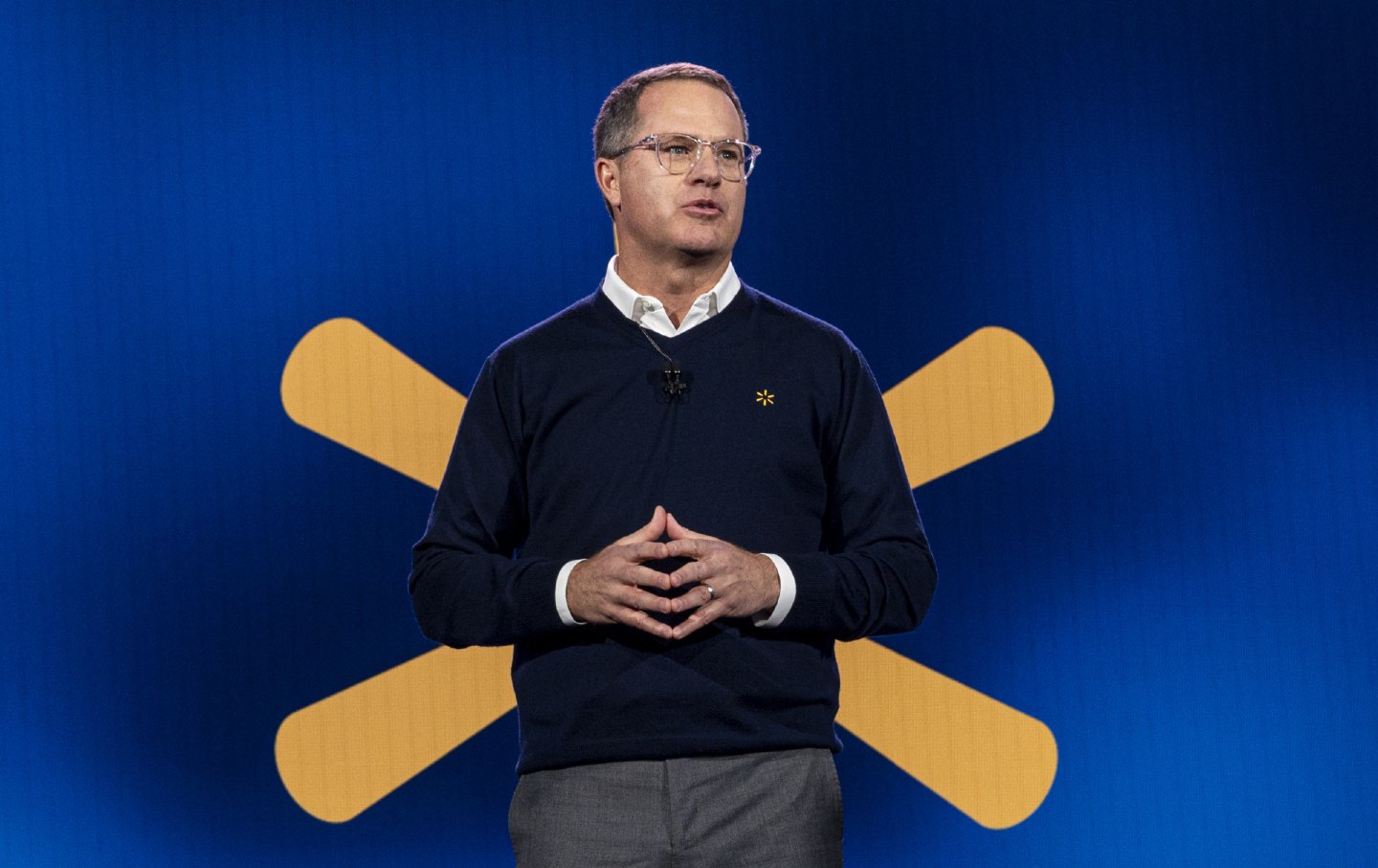
All hail Doug McMillon.
Since his announcement in mid-November that he plans to retire early next year as the chief executive of Walmart, McMillon has been basking in tributes. During his 12-year reign atop the world’s largest retailer, Walmart’s annual revenue has increased by nearly $200 billion, to $681 billion. Its stock price has risen more than 300 percent, handily outperforming the S&P 500. And its market capitalization has surpassed $900 million.
What those numbers conceal, however, is Walmart’s contribution to the nation’s stark economic divide. And the press has blithely ignored it.
“Walmart’s chief executive, Doug McMillon, will step down on Jan. 31,” The New York Times bullishly observed, “completing a 12-year run that moved the company from a staid brick-and-mortar retailer to a formidable challenger to Amazon, making the big-box store the envy of many in the retail industry.” McMillon “leaves Walmart in a strong position after years of work repositioning it as a formidable digital player and more competitive employer.” “I can’t overstate how difficult it is to take a company with such a strong legacy and make it competitive in today’s environment, given the pace of change,” Joanna Starek, an adviser to chief executives, told the Times.
In an effort to improve its relationship with its 2.1 million workers worldwide, the paper went on, Walmart under McMillon “has boosted wages as it sought to compete for talented employees, raising both its base salary for US store managers and starting hourly wages for its store workers.” The company “has also started to win over a new type of customer who may go to its website for delivery of not just low-priced clothing, home goods and groceries but also items like the $4,000 Louis Vuitton bags it now sells.”
Some pertinent details were missing from the Times account. While wages at Walmart have increased under McMillon—from an average of $12 an hour in 2015—they are still very low. The average hourly rate of a “field associate” (as Walmart calls its cashiers, stockers, and other hands-on workers) is just over $18, which works out to about $36,000 a year—far below a living wage in most of the country. In 2023, Walmart adopted a new wage structure under which most new employees would receive the lowest possible wage for the store hiring them—as little as $14 in some regions.
Walmart did expand other benefits, including parental leave, job training, and free college and technical education. It did so not out of any burst of benevolence but rather a need to reduce turnover, which was proving costly. Even with the wage increase, Walmart pays less than other retailers, including Costco (where starting clerks earn $20 to $21 an hour and top-tier ones $32) and Target. In surveys of worker satisfaction, Walmart significantly lags both those retailers.
McMillon’s compensation for the year ending February 1, meanwhile, totaled around $27.4 million ($1.5 million in base salary plus stock awards and bonuses). Walmart’s top six executives received a combined compensation of about $100 million. In addition, McMillon owns more than 4 million shares of Walmart stock, worth about $500 million.
In the view of The Wall Street Journal, McMillon was worth every penny. “Why CEOs Get Paid So Much,” ran the headline over an editorial extolling his tenure. It cited McMillon’s expansion of Walmart’s e-commerce business, his integration of AI into store management, and his adept managing of Trump’s tariffs. In addition to the spurt in the company’s stock, the Journal observed, Walmart “has increased wages and benefits” for its workers. Noting that big business today is a political target on the left and the right, it urged readers to “compare the wealth created over the last decade by Walmart and the performance of the federal government, and weep for the feds.” While Walmart’s success wasn’t the result of McMillon alone, “its profits have allowed hundreds of thousands of Americans to buy homes, pay tuition, and save for a comfortable retirement. The Gen Z socialists now rising in politics won’t admit it, but they are living off the prosperity created by wealth creators like Walmart’s CEO.”
That last comment seems as clueless as it is snide. However, much today’s young progressives might have benefited from a rising stock market, they know how unevenly those benefits have been distributed. About 40 percent of Americans own no stock, and among those who do, the holdings are sharply skewed. The top 10 percent of the population owns more than 90 percent of all stock, while the bottom 50 percent owns but one percent. Not many of them can afford the $4,000 Louis Vuitton bags Walmart is now selling.
The Waltons can. The descendants of Sam Walton, Walmart’s founder, the Walmart family is the richest in not just the United States but the world. Walton’s children and grandchildren control about 45 percent of the company’s stock and together are worth $450 billion. Sam’s three children—Jim, Rob, and Alice—are each worth more than $100 billion and rank among the top 20 on Forbes’s list of the 400 richest Americans. Alice is the world’s richest woman.
This is shareholder-driven capitalism at its most grotesque. And here’s the fundamental fact: The wealth of the Waltons is directly related to the struggles of Walmart workers. By keeping labor costs down, the company can keep its earnings per share up, and that boosts its stock price. Over the last half-century, executives and shareholders have siphoned off an ever-larger share of national income from retail clerks, forklift operators, and delivery drivers. Whatever raises manual workers at Walmart and other companies have received, their earnings still do not support a middle-class life, fueling frustration with capitalism, fascination with socialism, and a fragmenting of society.
On December 9, Doug McMillon was in New York to ring Nasdaq’s opening bell. He was celebrating Walmart’s move to that exchange after more than 40 years on the New York Stock Exchange. Joining the tech-heavy Nasdaq was part of its rebranding as a company committed “to innovation and growth as a people-led, tech-powered omnichannel retailer,” as he clunkily put it.
That same morning, McMillon appeared on Squawk Box, the morning financial talk show on CNBC, and—even by the welcoming standards of that show—he was treated with reverence. “We’ve known each other for a long time,” said cohost Andrew Ross Sorkin. “How long have you been thinking of leaving?”
“Are you going to write a book?” asked fellow host Joe Kernen. Kernen noted that the company was raising wages. “Our associates are doing well,” McMillon said.
“And managers do well,” put in the third host, Becky Quick. “Does the Walmart employee think the system is working?”
Popular
“swipe left below to view more authors”Swipe →“People can become managers,” McMillon said. (Walmart in the United States has 4,600 managers—one for each store—which means that about a million and a half employees do not become one.)
Mentioning Sam Walton, Kernen said that “it’s a marvel what he did for the American dream.”
“We have to keep it going,” said McMillon.
“You’ve been a phenomenal leader,” said Quick, “not just at the company but for American values.”
“You guys have helped us, educating us,” McMillon said.
Not so much the American people.
In the coverage of McMillon’s retirement, the perspective of labor was almost completely absent. Journalistic accounts should come with a warning label: No workers were interviewed for this story.
Your support makes stories like this possible
From Minneapolis to Venezuela, from Gaza to Washington, DC, this is a time of staggering chaos, cruelty, and violence.
Unlike other publications that parrot the views of authoritarians, billionaires, and corporations, The Nation publishes stories that hold the powerful to account and center the communities too often denied a voice in the national media—stories like the one you’ve just read.
Each day, our journalism cuts through lies and distortions, contextualizes the developments reshaping politics around the globe, and advances progressive ideas that oxygenate our movements and instigate change in the halls of power.
This independent journalism is only possible with the support of our readers. If you want to see more urgent coverage like this, please donate to The Nation today.
More from The Nation
Why Elon Musk’s Latest Mega Merger Is Little More than Vaporware Why Elon Musk’s Latest Mega Merger Is Little More than Vaporware
The tech mogul and would-be space pioneer is mashing up his properties once more in a deal that's unlikely to achieve escape velocity .

The Farmland Revolt The Farmland Revolt
America’s farmers are fuming over Trump’s tariffs. Democrats need to channel their anger.
We Need Radical Abundance We Need Radical Abundance
If we want abundance we have to ask, an abundance of what exactly, and produced under what economic logic?

Zohran Mamdani Takes on the Gig Economy’s Wage Thieves Zohran Mamdani Takes on the Gig Economy’s Wage Thieves
New York City is suing a delivery app for stealing workers’ pay—signaling that under Mamdani, gig companies can no longer break the law with impunity.

How Trump’s Immigration Crackdown Chills Organizing and Erodes Conditions for All Workers How Trump’s Immigration Crackdown Chills Organizing and Erodes Conditions for All Workers
When one group of workers is terrorized or disappeared, it threatens all workers’ ability to fight for their labor rights.

Ro Khanna Has a New Tech Social Contract for California’s Oligarchs Ro Khanna Has a New Tech Social Contract for California’s Oligarchs
As Peter Thiel and other fat cats threaten to flee California over a billionaire tax, Khanna is calling their bluff.

