After 100 Days of Trump, a Growing Economy Started Shrinking
And according to the president, it’s all Joe Biden’s fault.
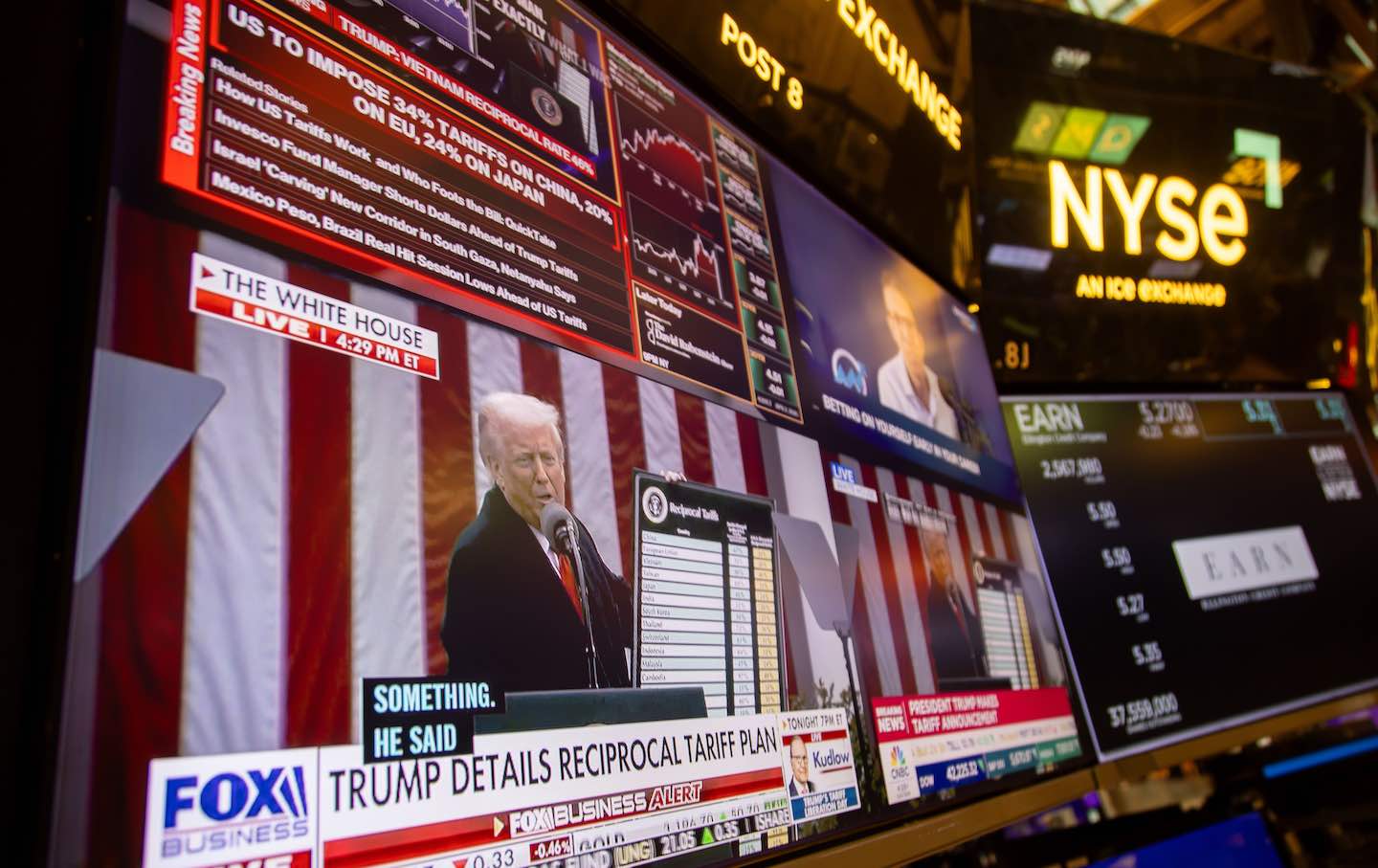
A television station on the floor of the New York Stock Exchange broadcasts Donald Trump announcing tariffs.
(Michael Nagle / Bloomberg)The 100-day marker in a presidential administration always triggers a slew of sober press assessments, gauging the White House’s roster of early achievements against those of past administrations and the campaign promises made in the heat of the prior election season. In the case of Donald Trump’s second term in office, though, this formulaic ritual makes little sense; the administration operates so far afield from traditional models of political consensus and public oversight that the breakthroughs and policy wins it now claims for itself come at the cost of any viable model of constitutional governance. The victories of an antidemocratic, lawless, and white nationalist administration can only produce permanent harm to whatever remains of the American democratic system. Passing the 100-days threshold feels less like a moment for a policy grading session than the onset of a grim civic deathwatch.
It’s perhaps for the best, then, that all the ceremonial 100-day punditizing has been instantly obsolesced on the 101st day of the new Trump term by the state of the economy. The first quarter of 2025 witnessed a 0.3 percent shrinkage, per a GDP report from the US Commerce Department—the first contraction in growth since 2022, when the country was still contending with the fallout of the Covid pandemic. Most economists had forecast significantly reduced growth, in the range of 0.4 percent—already a drastic comedown from the growth rates of 3.1 and 2.4 percent in the prior two quarters. But the lurch into negative territory signals a potential recession in the offing—one that could court the dread specter of prolonged stagflation, thanks largely to Trump’s absurdly conceived and erratically administered tariffs program.
Inflation is baked into the White House’s sweeping tariffs, with major retailers poised to pass on increased import taxes directly to consumers—and the rattled investment picture created by Trump’s roulette-wheel model of protectionism clearly presages a pending economic slowdown, ratcheting employment downward and stifling demand. As the impact of tariffs spreads across the globe, West Coast container ports are starting to resemble ghost towns, and consumers are postponing or canceling major purchases such as homes and cars. (A drastic spike in car purchases last month was, like other increases in consumer spending, the result of a stampede of buyers rightly freaked out by the contractions coming under the new tariff regime.) Overall consumer confidence has nosedived this month, while expectations of rampant unemployment surged—both reliable indicators of a pending recession.
Sensing disaster ahead, the prime author of this chaos raced to blame it on his predecessor. “This is Biden’s Stock Market, not Trump’s,” the latter barked on his Truth Social account.
Tariffs will soon start kicking in, and companies are starting to move into the USA in record numbers. Our Country will boom, but we have to get rid of the Biden ‘Overhang.’ This will take a while, has NOTHING TO DO WITH TARIFFS, only that he left us with bad numbers, but when the boom begins, it will be like no other. BE PATIENT!!!
Nothing steadies the nerves, after all, like an upper-case imperative punctuated by multiple exclamation points.
Trump’s panicked stab at morale boosting was especially half-assed, even by his standards, since a year ago he claimed that his reelection bid was solely responsible for the market’s then-hale condition, again seeking to mask the ludicrous character of his claim in all-caps formatting: “THIS IS THE TRUMP STOCK MARKET BECAUSE MY POLLS AGAINST BIDEN ARE SO GOOD THAT INVESTORS ARE PROJECTING THAT I WILL WIN, AND THAT WILL DRIVE THE MARKET UP.” Nor was that all: At a DC rally just prior to his inauguration, Trump announced that “everyone is calling it the—I don’t want to say this. It’s too braggadocious, but we’ll say it anyway—the Trump effect…. Since the election, the stock market has surged, and small-business optimism has soared, a record 41 points to a 39-year high.” (We all know how short-lived that bullish Wall Street mood has proved to be—and the same goes for the brief flood of small-business exuberance.)
Trump’s on-again, off-again Wall Street romance follows the same arc as his bipolar lurch into punitive across-the-boards tariff hikes, which after a series of plunges on Wall Street segued into a similarly tetchy “pause” lowering most tariffs to a 10-percent baseline (excluding the harsh imposts on China, as well as some Mexico and Canada tariffs). Indeed, the only constant in all this self-imposed economic pain is Trump’s own random mood swings and social media tantrums—and the record already shows that neither is likely to calm the mood of either the paper economy or the actual goods-and-services one.
That leaves a reckoning ahead that could well make this quarter’s swoon into the negative growth column look like a boom by comparison. The prospects ahead for the US-China trade war—which by dint of the sheer volume of commerce involved is bound to have massive follow-on effects throughout the US economy—are dismal. The Economist has a sobering breakdown of the trendline, courtesy of shipping data:
Bookings for new journeys between China and America plummeted by 45% year-on-year in the week beginning April 14th, according to Vizion, a data firm. The number of blank sailings, when a vessel skips a port or a carrier runs fewer ships on a route to even out the service, has risen to 40% of all scheduled trips. Pricing data suggests trade flows are being reshuffled. The cost of sailing between Shanghai and Los Angeles has fallen by about $1,000 in the past month, according to Freightos, a logistics company, as companies have gone from “front-running” the tariffs—by importing more than usual to beat the implementation deadline—to avoiding them. The price for ferrying goods from Vietnam to America has risen by a similar amount, suggesting importers have been looking for alternative suppliers.
Trump also dismisses the specter of a prolonged slump induced by the China tariffs, claiming baselessly to have initiated a series of agreements to halt the trade war. China’s own economic troubles have it on the brink of recession, the president claims, making them all the more likely to bend to US leverage—a classic demonstration of Trump’s always-phony deal-making prowess.
So let’s roll the tape: In its first-quarter report, China’s economy grew by 5.4 percent, eclipsing the projection of 5.1 percent held by most economists. That rate matched the country’s fourth-quarter growth figures from last year—though forecasters do anticipate a slowdown ahead thanks to the US trade war. Yet China, unlike the United States, is making plans to stimulate domestic demand in the face of the contractions ahead, to set about creating an alternate free-trade zone in Asia with Japan and South Korea, and to tighten its trade connections with the European Union.
Still, fear not: We can count on the leader of the American economic order to lift us all out of this downward spiral. All it will take is another exclamation-heavy Truth Social post blaming it all on Joe Biden.
Support independent journalism that does not fall in line
Even before February 28, the reasons for Donald Trump’s imploding approval rating were abundantly clear: untrammeled corruption and personal enrichment to the tune of billions of dollars during an affordability crisis, a foreign policy guided only by his own derelict sense of morality, and the deployment of a murderous campaign of occupation, detention, and deportation on American streets.
Now an undeclared, unauthorized, unpopular, and unconstitutional war of aggression against Iran has spread like wildfire through the region and into Europe. A new “forever war”—with an ever-increasing likelihood of American troops on the ground—may very well be upon us.
As we’ve seen over and over, this administration uses lies, misdirection, and attempts to flood the zone to justify its abuses of power at home and abroad. Just as Trump, Marco Rubio, and Pete Hegseth offer erratic and contradictory rationales for the attacks on Iran, the administration is also spreading the lie that the upcoming midterm elections are under threat from noncitizens on voter rolls. When these lies go unchecked, they become the basis for further authoritarian encroachment and war.
In these dark times, independent journalism is uniquely able to uncover the falsehoods that threaten our republic—and civilians around the world—and shine a bright light on the truth.
The Nation’s experienced team of writers, editors, and fact-checkers understands the scale of what we’re up against and the urgency with which we have to act. That’s why we’re publishing critical reporting and analysis of the war on Iran, ICE violence at home, new forms of voter suppression emerging in the courts, and much more.
But this journalism is possible only with your support.
This March, The Nation needs to raise $50,000 to ensure that we have the resources for reporting and analysis that sets the record straight and empowers people of conscience to organize. Will you donate today?